

Crown Vintage
Breitling Navitimer Cosmonaute 809 42mm 1960s
Breitling Navitimer Cosmonaute 809 42mm 1960s
Couldn't load pickup availability
Breitling Navitimer Cosmonaute 809 42mm 1960s
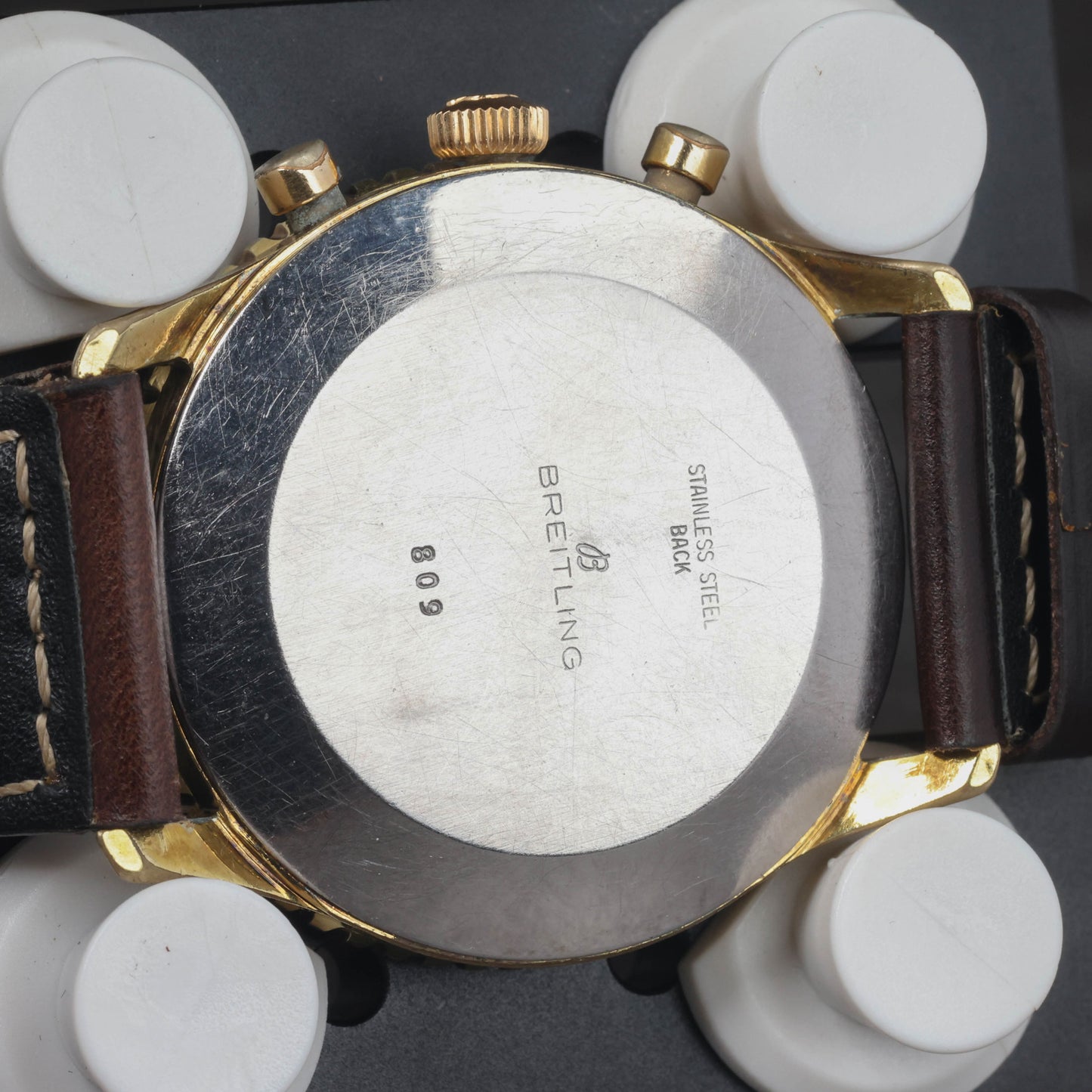
This Breitling Navitimer Cosmonaute 809 is presented in good vintage condition. The case shows light hairline marks, consistent with age and careful use, and retains an honest period appearance with no major dents or structural issues observed. The watch has received a full service and is fitted with a new crystal, ensuring clear visibility of the dial and improved overall usability while remaining sympathetic to the watch’s vintage character.
The dial is in good vintage condition, with lume plots intact and evenly aged. Light oxidation is present on both the dial and hands, consistent with original materials and decades of natural ageing. Printing remains legible, and the overall presentation is cohesive and period correct.
As with all watches of this age, this Cosmonaute should be treated as a vintage timepiece and is not recommended for swimming or water exposure, regardless of original specifications.
Share
Why we love this watch
Why we love this watch
Breitling Navitimer Cosmonaute 809
Introduction
Produced in the early 1960s, the Breitling Navitimer Cosmonaute 809 occupies a singular position in twentieth century watch history. It is one of the very few wrist chronographs designed around a true 24 hour dial, created to solve a specific operational problem encountered beyond conventional aviation. While the standard Navitimer was already established as a professional pilot’s instrument, the Cosmonaute extended that concept into spaceflight. The reference 809, including examples produced in gold plated cases, illustrates how Breitling adapted an existing technical platform for a new frontier while preserving the functional logic that defined the Navitimer from the outset.
The Navitimer Before Spaceflight
The Navitimer was introduced in the early 1950s in collaboration with the Aircraft Owners and Pilots Association. It combined a chronograph with a circular slide rule bezel that allowed pilots to perform essential calculations such as fuel consumption, ground speed, rate of climb, and distance. This made it a wrist worn flight computer rather than a simple timing device.
By the end of the 1950s, the Navitimer had become widely recognised among civilian and military aviators. Its dense dial, rotating bezel, and emphasis on information hierarchy prioritised usability over decoration. This mature and proven platform provided the foundation for the Cosmonaute.
The Need for a 24 Hour Dial
Spaceflight introduced a challenge that aviation had never fully faced. In low Earth orbit, sunrise and sunset occur roughly every ninety minutes. A conventional twelve hour dial becomes ambiguous under these conditions, as external cues for day and night are unreliable.
This problem was identified by astronaut Scott Carpenter during preparations for NASA’s Mercury Atlas 7 mission. Carpenter requested a watch that could display time across a full twenty four hour cycle, allowing immediate orientation regardless of lighting conditions. Breitling responded by reengineering the Navitimer so that the hour hand completed one full rotation per day. The result was the Navitimer Cosmonaute.
Development of the Cosmonaute 809
The Cosmonaute was derived directly from the Navitimer 806 architecture but fundamentally altered in its time display. The reference 809 retained the slide rule bezel, chronograph layout, and case profile of the standard Navitimer, while integrating the twenty four hour system.
This was not a commemorative exercise. The Cosmonaute was developed to meet a specific operational request and was delivered in time for real use. When Carpenter wore his Cosmonaute during the Mercury Atlas 7 mission in 1962, it became one of the earliest Swiss wristwatches worn in space. Its significance lies in purposeful adaptation rather than later marketing narratives.
Case Construction and Gold Plated Execution
The reference 809 was produced in multiple case finishes, including stainless steel and gold plated variants. The gold plated examples are particularly interesting when viewed in their historical context. In the early 1960s, gold plating was often used to offer a more refined appearance while retaining the structural strength of a steel case.
The case measures approximately forty one to forty two millimetres, which was large by the standards of the time but necessary to accommodate the slide rule bezel and information dense dial. Straight lugs and a broad bezel give the watch a stable presence on the wrist. In gold plated form, the Cosmonaute retains its instrument character while adding warmth and visual depth that reflects period tastes rather than later ideas of what a tool watch should look like.
Dial Architecture and Twenty Four Hour Layout
The defining feature of the Cosmonaute is its twenty four hour dial. Numerals run from one to twenty four, with midnight positioned at the top of the dial. This layout eliminates ambiguity in environments where traditional day night cycles do not apply.
The tri register chronograph layout remains intact, with sub dials for running seconds, thirty minute counter, and twelve hour chronograph totaliser. The slide rule scales continue to provide navigational calculation capability. Despite the density of information, legibility is preserved through careful spacing, clear typography, and a disciplined hierarchy that reflects Breitling’s experience in instrument design.
Movement and Technical Foundation
The Cosmonaute 809 is powered by the Venus 178, a manually wound column wheel chronograph movement widely respected for its robustness and smooth operation. The movement was adapted to drive the twenty four hour display, requiring modified gearing while retaining chronograph integrity.
Manual winding was a deliberate choice. At the time, automatic chronograph movements were still evolving, and simplicity was valued in extreme environments. Manual winding offered predictability and control, particularly in conditions where automatic winding efficiency could be uncertain.
Spaceflight Context and Historical Importance
Scott Carpenter’s Mercury Atlas 7 mission marked the first time a Breitling wristwatch was worn in space. Unlike later officially certified equipment, the Cosmonaute was the result of a direct request and a rapid technical response. This distinction is important. The watch was not selected through institutional testing but through practical need.
The Cosmonaute’s role in spaceflight demonstrates adaptability rather than standardisation. It represents a moment when a manufacturer responded directly to the realities faced by an individual user operating at the edge of human capability.
Gold Plated Cosmonaute and Professional Use
Gold plated Cosmonaute examples challenge modern assumptions about professional watches. In the early 1960s, functional watches could still incorporate precious finishes without undermining their purpose. Breitling offered different executions to suit different users, all sharing the same technical foundation.
The gold plating does not alter the watch’s functionality. The slide rule bezel, chronograph operation, and twenty four hour display remain identical. What changes is the visual tone, which reflects the era in which professional and personal identities were less rigidly separated.
Rosemary Arnold and the Cosmonaute Connection
The gold plated Cosmonaute also resonates beyond spaceflight when viewed through the broader lens of aviation history. Rosemary Arnold, recognised as Australia’s first female helicopter pilot, represents a generation of aviators who operated at the intersection of technical skill and public visibility.
Arnold flew extensively during a period when aviation instruments were transitioning from purely military or industrial tools to personal professional equipment. For aviators like Arnold, a watch such as the Cosmonaute would have represented both capability and confidence. The gold plated execution aligns with the reality that pioneering pilots often operated in public facing roles, demonstrations, and instruction, where presentation mattered alongside function.
This context reinforces that the Cosmonaute was not only a space watch but part of a broader culture of aviation professionalism, where precision instruments accompanied individuals breaking new ground.
Wearing Experience
On the wrist, the Cosmonaute wears much like a standard Navitimer, with added visual complexity from the twenty four hour scale. The case sits securely, and the slide rule bezel remains tactile and usable. Once accustomed to the dial layout, reading absolute time becomes intuitive.
The watch continues to make sense outside of its original context. Long haul aviation, polar travel, and extended operations without clear light cycles all benefit from a twenty four hour display. This enduring relevance speaks to the clarity of the original design brief.
Design Legacy
The Navitimer Cosmonaute established a clear precedent for watches designed around alternative time displays. It demonstrated that modifying the fundamental structure of a dial could solve real problems without abandoning established design language.
Later twenty four hour watches would follow similar principles, but few carry the same clarity of purpose. The Cosmonaute’s legacy lies in its restraint and precision rather than visual novelty.
Final Thoughts
The Breitling Navitimer Cosmonaute 809 stands as one of the most purposeful adaptations of a professional wristwatch in the twentieth century. Developed to address the realities of spaceflight, it transformed an already sophisticated aviation instrument into a tool capable of operating beyond Earth’s conventional time cues. The gold plated execution adds historical texture, reflecting how professional watches were conceived and worn in the early 1960s.
Rather than relying on mythology, the Cosmonaute’s importance is grounded in real use and clear intent. It bridges aviation and space, function and presentation, and individual need and technical response in a way that few watches ever have.
Case & Bracelet
Case & Bracelet
- Case in good vintage condition. Light hairlines.
- Watch has received a full service and has a new crystal.
Dial & Hands
Dial & Hands
Dial in good vintage condition. Lume plots intact. Light oxidation on hands and dial.
Warranty & Condition
Warranty & Condition
Crown Vintage Watches provides a minimum 6-month mechanical warranty on pre-owned watches, from the date of purchase.
The warranty covers mechanical defects only.
The warranty does not cover damages such as scratches, finish, crystals, glass, straps (leather, fabric or rubber damage due to wear and tear), damage resulting from wear under conditions exceeding the watch manufacturer’s water resistance limitations, and damage due to physical and or accidental abuse.
Please note, water resistance is neither tested nor guaranteed.
Shipping and insurance costs for warranty returns to us must be covered by the customer. Returns must be shipped via traceable courier. Return shipment must be pre-paid and fully insured. Collect shipping will be refused. In case of loss or damages, the customer is liable.
Our Pledge
At Crown Vintage Watches, we stand by the authenticity of every product we sell. For added peace of mind, customers are welcome to have items independently authenticated at their own expense.
Condition
Due to the nature of vintage timepieces, all watches are sold as is. We will accurately describe the current condition and working order of all watches we sell to the best of our ability.
Shipping & Refund
Shipping & Refund