

Crown Vintage
Cartier Tank Must 'Lapis' Manual Wind 23x30MM Circa 1980s
Cartier Tank Must 'Lapis' Manual Wind 23x30MM Circa 1980s
Couldn't load pickup availability
Cartier Tank Must 'Lapis' Manual Wind 23x30MM Circa 1980s
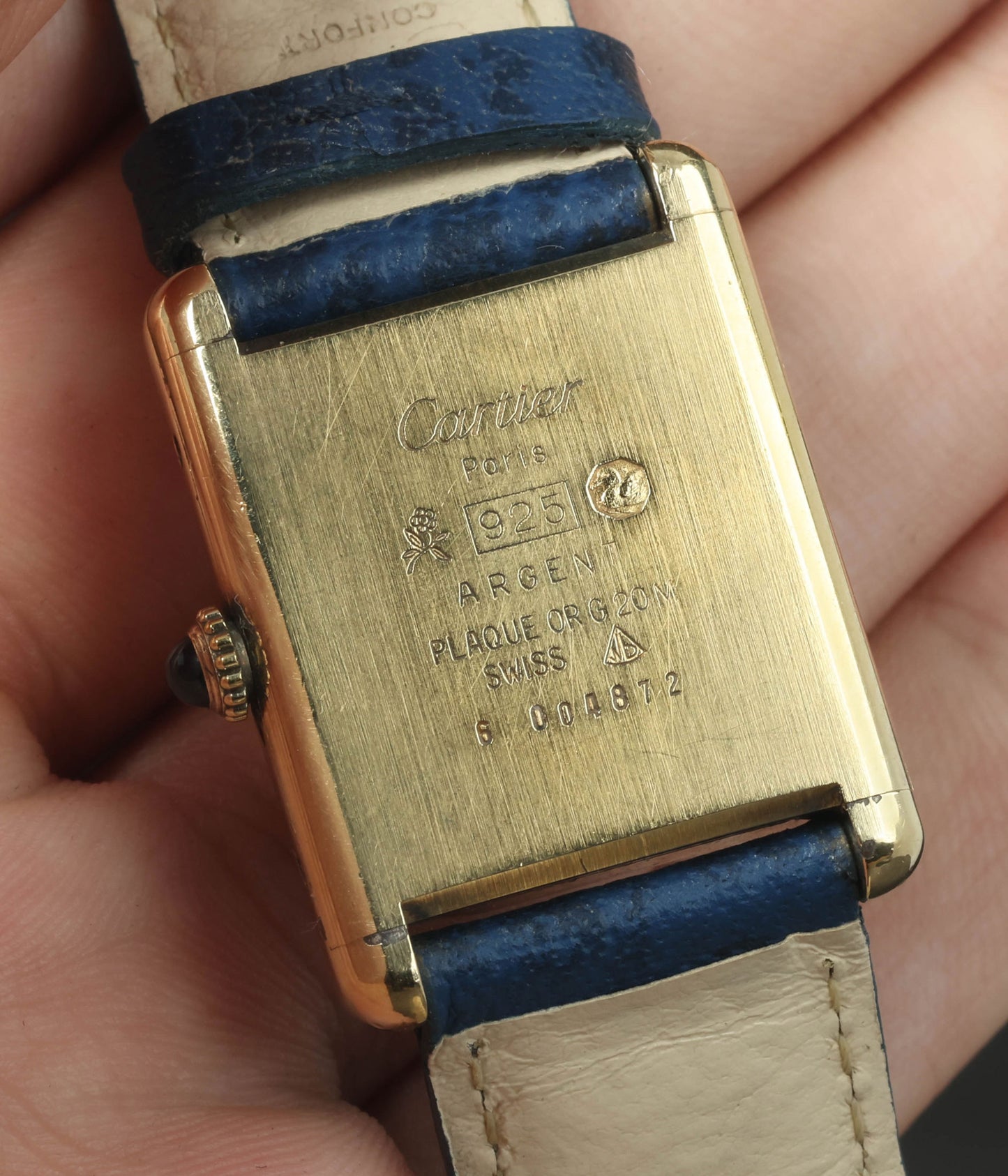
Cartier Tank Must “Lapis” Manual Wind 23x30MM from the 1980s in good vintage condition, retaining the clean lines and elegant presence expected of this classic design. The case shows light hairlines visible on close inspection, consistent with careful wear over time, with little to no visible oxidation of the plating, presenting very well on the wrist. The leather strap is in good condition, with expected signs of gentle use but no major flaws that detract from overall appearance. The lapis style dial is in great condition, with strong colour and no obvious marks interrupting its minimalist layout. Hands show light oxidation that aligns well with the age of the watch and adds a subtle vintage character without impairing legibility. As this piece is over thirty years old, it should be treated as a vintage timepiece and not be worn whilst swimming or exposed to moisture, irrespective of its original specifications.
Share
Why we love this watch
Why we love this watch
Cartier Tank Must Lapis Manual Wind 23x30MM Circa 1980s
Introduction
Produced between the early 1980s and the early 1990s, the Cartier Tank Must Lapis represents one of the most distinctive expressions of the Tank line. This period marked a renewed push by Cartier to make the Tank accessible to a wider audience while still keeping the essence of Louis Cartier’s original 1917 design. The Lapis variant became a standout within the Must collection due to its deep blue dial, refined proportions and clean geometry. It delivers the unmistakable Cartier aesthetic while offering a unique presence that sets it apart from the classic Roman numeral layout.
The Evolution of the Tank Must
A New Era for the Tank
By the 1980s, Cartier sought to expand the reach of the Tank while maintaining the spirit that had made the design iconic. The Tank Must line was created to achieve this balance. These watches retained the familiar rectangular case, parallel brancards and cabochon crown, but experimented with new dial colours and materials. Instead of traditional layout elements, the Must series embraced minimalist design, allowing colour and proportion to become the central visual interest. The Lapis dial variation sits at the centre of this creative moment.
Why the Lapis Dial Matters
The deep blue dial draws inspiration from lapis lazuli, a stone long associated with luxury, art and decorative design across centuries. While the dial itself is a lacquered creation rather than natural stone, Cartier achieved an appearance that mimics the rich depth of lapis through careful layering and colour saturation. The absence of numerals or indices gives the dial uninterrupted visual impact. Against the minimalist background, the gold coloured hands and case create a strong contrast that feels elegant yet contemporary.
The Design Language of the 1980s Tank Must
Proportions that Define the Model
Measuring 23 by 30 millimetres, the Tank Must Lapis delivers a profile that is both refined and wearable. Cartier maintained the linear symmetry that has defined the Tank for over a century. The case sides run straight and parallel, lending a disciplined architectural quality to the watch. This geometry has always been central to the Tank identity, but on the Lapis model the combination of blue and gold heightens the effect. The watch appears balanced and calm, with no visual clutter to compete for attention.
A Dial that Feels Timeless
The lapis inspired dial remains the defining feature. When light moves across the surface, the lacquer layers subtly shift in depth. Some examples appear vivid blue, while others take on a darker tone depending on age and exposure. This natural variation adds character and individuality to each piece. Cartier’s decision to omit markers was deliberate. It places the entire visual focus on tone and shape, allowing the hands to float cleanly across the surface. The result is a dial that is as much a design object as it is a functional component.
Historical Significance of the Tank Must Line
Cartier in the Late Twentieth Century
The late twentieth century was a transformative time for Cartier. The brand was expanding globally, defining itself not only as a jewellery house but as a leader in refined watchmaking. The Tank Must line played a key role in this strategy. It offered a gateway into the Cartier world without compromising the aesthetic identity that had been consistent for decades. Watches like the Lapis model embodied this approach by combining accessible luxury with enduring design codes.
The Tank Legacy
The Tank itself has a unique place in watch history. Designed in the 1910s and refined through every decade that followed, it has remained one of the clearest expressions of geometric elegance in watchmaking. Worn by artists, actors, political figures and individuals drawn to understated design, the Tank has always transcended trends. The Lapis variant continues this lineage, demonstrating how the Tank can evolve stylistically while remaining instantly recognisable.
The Experience of Wearing the Lapis Tank
Lightness and Comfort
The manual wind Tank Must wears with exceptional comfort. The slim case slides easily under a cuff. The dimensions feel appropriate for a wide range of wrists, retaining the discreet presence that is central to the Tank style. Many modern rectangular watches have grown larger, but the 1980s proportions remain closest to the original intention of the design. This sense of restraint is a major part of the watch’s appeal.
Manual Wind Charm
The manual wind movement adds a layer of interaction that aligns perfectly with the character of the watch. Winding the crown each morning becomes a small daily ritual. Cartier’s cabochon crown design makes this interaction tactile and visually pleasing. Although hidden behind the simplicity of the dial and case, the beating heart within the Tank Must Lapis contributes to its personality and charm.
The Lapis Blue Appeal
A Colour that Feels Luxurious Without Excess
Blue has long been associated with refinement, but the specific tone used in the Lapis series feels particularly rich. It has the depth of fine enamel, the artistic quality of lapis lazuli and the calm elegance that suits the Tank silhouette. The gold coloured hands and case amplify the vibrancy of the dial, creating a look that feels dressy yet modern.
Versatility Across Styles
Despite its striking presence, the Lapis Tank remains versatile. On a leather strap, it carries a formal and refined appearance. On a lighter coloured strap, the blue stands out even more, giving the watch a crisp contemporary feel. The size, simplicity and colour all contribute to its ability to be worn in many contexts while still feeling special.
Cultural Resonance
A Watch that Reflects Cartier’s Identity
Cartier has always been known for its ability to combine jewellery level refinement with technical watchmaking. The Lapis Tank channels this identity clearly. It is elegant without unnecessary decoration, colourful without being loud, and recognisable without relying on complexity. These traits sit at the heart of Cartier’s design culture and help explain why the Tank Must has held its appeal through changing tastes.
The Enduring Appeal of Minimalism
The simplicity of the Lapis dial aligns with broader artistic movements of the late twentieth century. Minimalist design was flourishing in art, architecture and furniture. Cartier’s approach to the Tank Must dial reflects these influences. Removing ornamentation shifts attention to geometry, proportion and colour. When a watch embraces minimalism this effectively, it becomes timeless.
Final Thoughts
The Cartier Tank Must Lapis from the 1980s remains a standout within the broader Tank family. Its lapis inspired dial, refined proportions and faithful adherence to the original Tank design language make it a piece with lasting significance. The watch balances elegance, restraint and colour in a way that feels unmistakably Cartier. It reflects a defining period in the brand’s history, celebrates the enduring architectural clarity of the Tank and offers a distinctive alternative to more traditional dial layouts. For those drawn to the combination of simplicity and bold colour, the Lapis Tank continues to represent one of the most compelling expressions of Cartier design from the era.
Case & Bracelet
Case & Bracelet
- Case in good vintage condition, light hairlines visible, little to no oxidation of plating.
- Leather strap in good condition.
Dial & Hands
Dial & Hands
- Dial in great condition.
- Hands lightly oxidised.
Warranty & Condition
Warranty & Condition
Crown Vintage Watches provides a minimum 6-month mechanical warranty on pre-owned watches, from the date of purchase.
The warranty covers mechanical defects only.
The warranty does not cover damages such as scratches, finish, crystals, glass, straps (leather, fabric or rubber damage due to wear and tear), damage resulting from wear under conditions exceeding the watch manufacturer’s water resistance limitations, and damage due to physical and or accidental abuse.
Please note, water resistance is neither tested nor guaranteed.
Shipping and insurance costs for warranty returns to us must be covered by the customer. Returns must be shipped via traceable courier. Return shipment must be pre-paid and fully insured. Collect shipping will be refused. In case of loss or damages, the customer is liable.
Our Pledge
At Crown Vintage Watches, we stand by the authenticity of every product we sell. For added peace of mind, customers are welcome to have items independently authenticated at their own expense.
Condition
Due to the nature of vintage timepieces, all watches are sold as is. We will accurately describe the current condition and working order of all watches we sell to the best of our ability.
Shipping & Refund
Shipping & Refund