

Crown Vintage
Heuer Autavia 73463 42mm 1970s
Heuer Autavia 73463 42mm 1970s
Couldn't load pickup availability
Heuer Autavia 73463 42mm 1970s
This Heuer Autavia 73463 presents in great vintage condition overall. The stainless steel case shows light hairlines in normal light, with original geometry and chamfering clearly visible and no dents or deep marks observed. The bezel presents cleanly with only minor handling visible on close inspection, and the crystal is clear and free of distracting scratches. Crown and pushers operate positively; the chronograph starts, stops and resets correctly during careful handling. The metallic brushed silver dial is clean, with crisp printing and applied markers intact; the black sub-dials display a pleasing tropical patina that is developing evenly. Hands are in excellent condition, correctly aligned with intact finish and luminous material presenting neatly. The strap is in excellent condition and fitted with a Heuer-signed buckle, securing firmly on the wrist.
Evaluated on the Witschi WAIO across four positions, the Valjoux 7734 manual-wind movement recorded a mean rate of 0.0 seconds per day, an essentially perfect result for a movement now over fifty years old. The Valjoux 7734 does not carry COSC chronometer certification, and no published rate standard from Heuer or Valjoux applies to this calibre; the result nonetheless represents a level of accuracy that requires no qualification. Positional deviation of 4.7 seconds per day is tight and reflects consistent rate performance across all measured positions, confirming the movement is well regulated. Beat error averaged 0.3 ms across four positions, with the 6H position recording a marginally elevated 0.5 ms; for a manually wound calibre of this period and age, this is within acceptable range, though the slightly higher vertical reading is worth monitoring following future regulation. Mean amplitude of 226.7 degrees is adequate for the 7734 at 18,000 bph, with the horizontal positions returning stronger readings of 261.8 and 224.1 degrees and the vertical positions recording 206.8 and 214.2 degrees. The spread across positions of 55.0 degrees in amplitude is typical of a lightly wound or partially depleted mainspring at the time of testing rather than a sign of mechanical deficiency, and is a normal characteristic of manual-wind movements tested in real-world conditions. Taken together, the results describe a well-regulated movement in sound mechanical order for its age.
Share
Why we love this watch
Why we love this watch
Heuer Autavia 73463
Introduction
Produced between 1974 and 1977, the Heuer Autavia 73463 is a manual wind chronograph that showcases the visual language Heuer developed during the 1970s. It is defined by its metallic brushed silver dial, black registers and bold orange accents. This configuration gives the watch a distinct identity within the Autavia family. The 73463 combines the classic Heuer tonneau case with the proven Valjoux 7734 movement at a time when Heuer was balancing modern automatic chronographs with traditional hand wound calibres. It reflects the brand’s approach during a transitional period in its history.
Origins of Heuer
Heuer was founded in 1860 by Edouard Heuer in Saint Imier. From the beginning, the company focused on manufacturing timing instruments for sport and industry. Heuer secured early patents for keyless winding systems and innovative crown mechanisms, but it was the brand’s work in chronographs and stopwatches that established its reputation. By the early twentieth century, Heuer was supplying timing equipment to scientific laboratories, automotive manufacturers and sporting bodies. The company’s timers were used in the Olympics and by aviation pioneers.
In 1916, Heuer introduced the Mikrograph, the first stopwatch capable of measuring one hundredth of a second. This marked a significant advance in mechanical precision. The company continued to innovate throughout the early twentieth century, producing cockpit clocks for aircraft and dashboard timers for cars. These developments anchored Heuer’s identity in motorsport and aviation, shaping the direction the company would take in the decades ahead.
By the 1960s, Heuer had become synonymous with motorsport timing. The brand’s stopwatches and dashboard timers were seen in rally cars, endurance events and Formula One paddocks. Heuer’s leadership under Jack Heuer expanded the company’s involvement in racing, forming partnerships with teams and drivers. The focus on precision, legibility and reliability translated naturally into wristwatch design, particularly in the Autavia, Carrera and Monaco lines.
Development of the Autavia Name
The Autavia name first appeared in 1933 on a dashboard timer intended for automotive and aviation use. Its name combined the first letters of both fields and reflected the instrument’s versatility. These dashboard Autavias were known for robust construction and clear markings. They were used in racing, flying and military operations, performing reliably in harsh conditions.
In 1962, Jack Heuer revived the Autavia name for a new wrist chronograph. This marked the beginning of the Autavia as a wristwatch line and represented a shift in Heuer’s strategy. Rather than producing specialised dashboard instruments, the company sought to place motorsport timing directly on the wrist of drivers. The first wrist Autavias featured rotating bezels, large sub dials and strong contrast for readability.
Throughout the 1960s and 1970s, the Autavia line evolved significantly. The early models used round cases and Valjoux movements, but the introduction of the automatic Calibre 11 in 1969 brought major changes. These new Autavias featured left side crowns, distinctive case shapes and a modern look that aligned with contemporary design trends. Heuer continued to refine the Autavia through different dial layouts, bezels and movements. The Autavia became a central pillar of the brand’s motorsport identity and remained one of Heuer’s most recognisable lines.
The Autavia in the 1970s
The 1970s were a decade of innovation and challenge for Heuer. The company was heavily involved in Formula One, sponsoring teams and using drivers as brand ambassadors. Heuer timing equipment was a fixture in the racing world, and wristwatches often appeared on the wrists of drivers and team managers. The Autavia was the model most closely associated with this environment. It featured bold styling, practical timing functions and rotating bezels that catered to motorsport and aviation.
Heuer expanded the Autavia range during the decade. Some models used automatic chronograph movements, while others retained hand wound calibres. The brand used a variety of case shapes, including the wide tonneau design that became a hallmark of 1970s Heuer aesthetics. The Autavia line also diversified with specialist versions for divers, pilots and rally drivers.
In this landscape, the 73463 emerged as a hand wound chronograph that combined the familiar Autavia case with a visually distinctive dial and a proven mechanical movement. Its brushed silver dial contrasted with the darker, more aggressive colour schemes of earlier automatic Autavias and provided a cleaner, more technical look.
Design and Case Construction
The Heuer Autavia 73463 uses the second generation tonneau case that appeared across the Autavia line in the early to mid 1970s. This case measures approximately 42 mm and features straight, integrated lugs that flow from the cushion style central body. The top surface is vertically brushed, while the case sides are polished. This contrast enhances the geometry of the case and contributes to its strong presence.
Unlike the Calibre 11 and 12 Autavias, which place the crown on the left side, the 73463 uses a conventional right side crown. Two pump pushers sit above and below it, providing a symmetrical layout that recalls earlier Heuer chronograph designs. The rotating bezel is an essential element of the Autavia identity, and the 73463 was offered with multiple bezel types depending on the intended use. Tachymeter bezels catered to motorsport timing, while minute and hour scales suited diving or elapsed time measurement.
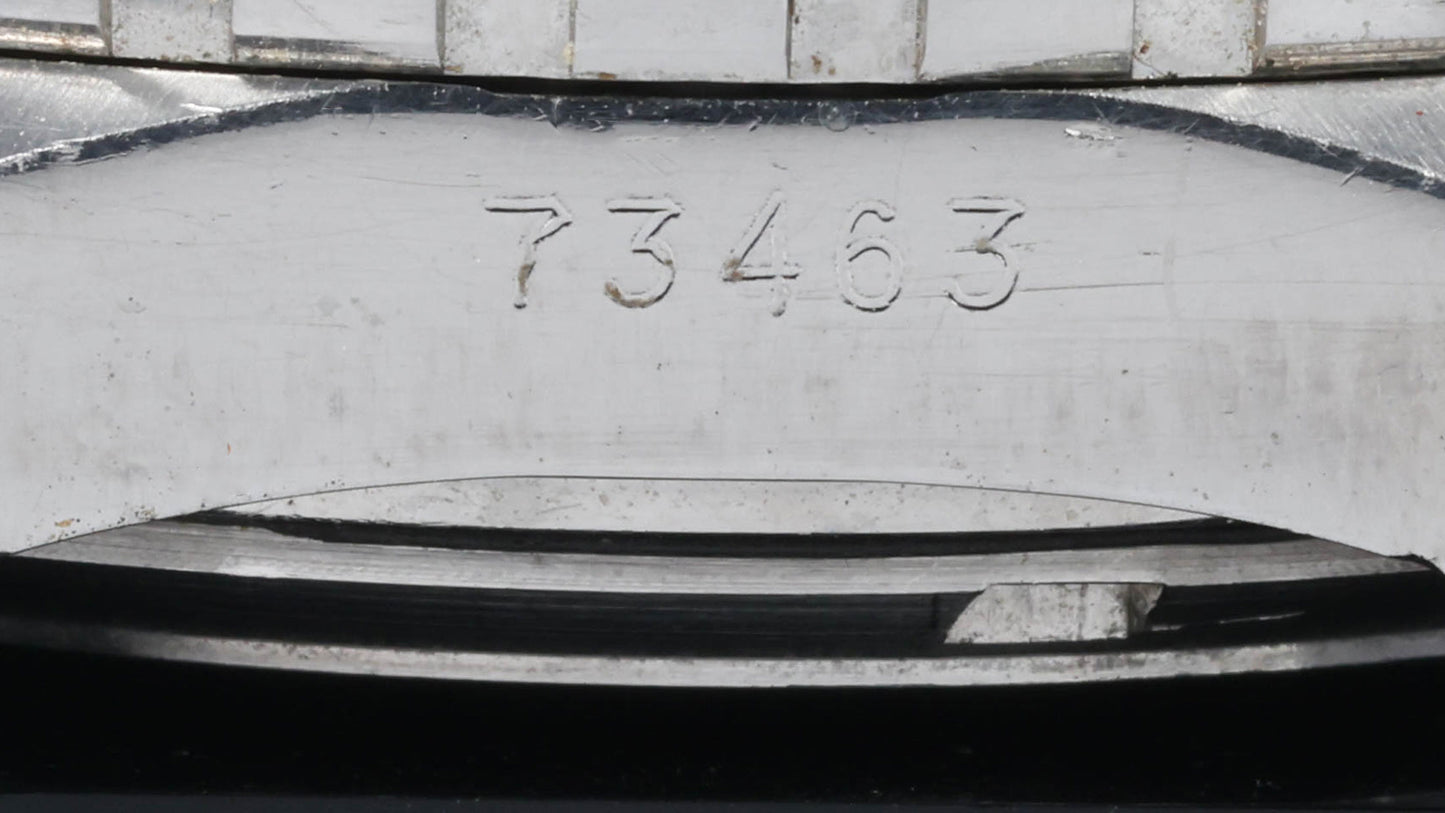
The caseback is solid stainless steel and typically engraved with the reference number. Its construction is simple and robust, reflecting Heuer’s emphasis on durability. The interior houses the Valjoux 7734 movement secured by a movement ring. The overall form of the case gives the 73463 a purposeful appearance, suitable for sporting and professional environments.
The Metallic Brushed Silver Dial
The defining feature of the Autavia 73463 is its metallic brushed silver dial. The surface finish has a vertical brushing that reflects light in a subtle, controlled way, giving the dial texture and depth. This finish distinguishes the watch from the matte dials used on earlier Autavias.
The dial layout uses two black sub registers positioned at three and nine o’clock. The left register displays continuous seconds, while the right register serves as the 30 minute chronograph counter. The contrast between the metallic silver background and the deep black registers creates strong legibility.
Applied hour markers are polished steel with black inserts. These inserts reinforce the overall silver and black theme and provide visual alignment with the sub dials. The printed minute track runs along the outer edge of the dial, showing clear subdivisions for precise reading.
The chronograph seconds hand and the sub dial hands for the minutes often feature orange paint. This colour was used by Heuer extensively during the 1970s and reflects the influence of motorsport instrumentation, where orange was a common highlight colour for visibility. The orange accents on the 73463 stand out against the silver and black fields, giving the dial a practical and vibrant character.
The date window sits at six o’clock and uses a simple frame that integrates cleanly with the lower portion of the dial. The typography for the Autavia name and Heuer shield follows the design standards of the era, with the model designation placed near the top centre.
Movement: Valjoux 7734
The Valjoux 7734 is a hand wound, cam switched chronograph movement that saw widespread use in the 1970s. It offers a 30 minute chronograph counter, continuous seconds and a date complication. Operating at 21,600 vibrations per hour, it provides a stable rate and straightforward maintenance.
The movement belongs to the larger Valjoux 7730 family, which was designed to offer reliable chronograph functionality without the complexity and cost of a column wheel. The cam switching system provides dependable engagement of the chronograph mechanism, and the horizontal clutch design aligns with traditional Swiss chronograph architecture.
For Heuer, the Valjoux 7734 provided a practical solution that complemented the company’s range of automatic chronographs. It allowed the brand to offer manual wind alternatives at a different price point and appeal to buyers who preferred a traditional mechanical experience. The 73463 used the movement effectively, balancing performance with durability.
The Autavia 73463 in the Heuer Lineup
The 73463 was produced at a time when Heuer was adjusting to changing market conditions. Quartz watches were becoming more prevalent and global competition was increasing. Despite these external challenges, Heuer continued to develop mechanical chronographs, maintaining the connection to motorsport and precision timing.
Within the Autavia line, the 73463 occupied a distinct place. It shared the tonneau case and rotating bezel with the automatic models but retained the tactile feel of a hand wound movement. Its dial design set it apart, offering a lighter and more technical aesthetic compared with the darker tones of many automatic Autavias.
The 73463 appealed to customers who appreciated the classic operation of a manual wind chronograph. It also suited markets where price sensitivity required an alternative to the automatic Autavias. For Heuer, this allowed the company to maintain a broader presence in different regions and continue producing mechanical watches during a complex period for the Swiss industry.
A Detailed Look at the Dial Construction
The dial of the 73463 deserves closer examination due to its unique visual impact. The silver brushing is achieved through a controlled process that gives the dial a vertical grain. This grain interacts with natural light, producing subtle variations in tone. The brushing also contrasts with the matte texture of the black sub registers, enhancing their definition.
The applied hour markers have a geometric profile that maintains consistency across the dial. The black inserts are precisely placed to align with the minute track, reinforcing the clarity of the layout. The hands are polished steel with luminous material in the centre, creating a balanced look that fits the overall theme.
The orange chronograph seconds hand is one of the most distinctive elements. Its high visibility ensures the chronograph function can be read at a glance, an important feature for timing applications. The orange minute counter hand provides similar legibility within the right sub dial.
Heuer’s design choices for the 73463 dial express the company’s focus on legibility, functionality and visual coherence. The silver, black and orange palette aligns with the broader aesthetic trends of the 1970s and reflects the technical roots of the Autavia name.
Historical Context and Motorsport Influence
During the mid 1970s, Heuer’s involvement in motorsport was extensive. The brand worked closely with Formula One teams, including Ferrari, BRM and McLaren. Heuer stopwatches and timing systems were used in professional racing, and Heuer chronographs were worn by drivers, team principals and mechanics.
The Autavia line, including the 73463, was shaped by this environment. The rotating bezels allowed drivers and team members to measure elapsed time, pit windows and fuel consumption. The legibility of the dials addressed the needs of fast paced settings. The inclusion of orange accents reflected the influence of racing instrumentation.
The 73463 does not have a direct association with a specific driver or team like some automatic Autavia models. However, it remains part of the wider Autavia heritage connected to motorsport timing. Its presence in Heuer catalogues during the racing focused era contributes to its historical relevance.
Role of the 73463 During the Quartz Period
The emergence of quartz technology affected all Swiss manufacturers. Heuer introduced quartz chronographs and timing devices during this period, but continued to produce mechanical watches including the 73463. The decision to offer both mechanical and quartz options illustrates the brand’s attempt to navigate changing consumer preferences.
The 73463 reflects Heuer’s commitment to mechanical chronographs, even as electronic timing became more common. The use of the Valjoux 7734 ensured the watch could be serviced and maintained over time, preserving the mechanical tradition of the Autavia line.
By the late 1970s, the Swiss watch industry was undergoing consolidation. Heuer faced financial pressures and eventually joined TAG in 1985. The 73463 represents one of the last manual wind Autavias produced before this transition.
Legacy of the Heuer Autavia 73463
The Autavia 73463 remains a significant reference within the history of Heuer. Its design captures the visual language of the 1970s, with a case and dial that align with the brand’s motorsport identity. The metallic silver dial sets it apart from other Autavias and demonstrates Heuer’s willingness to explore different aesthetic directions.
The watch represents a period when Heuer balanced tradition and innovation. It maintained the mechanical approach that had defined the company for over a century while adapting to new case designs and market conditions. The Valjoux 7734 movement underscores the link between Heuer’s mid century chronographs and the evolving sport watch designs of the 1970s.
The 73463 provides insight into Heuer’s strategy during a complex era and stands as a clear example of the brand’s ability to produce technically sound, visually coherent sports chronographs.
Final Thoughts
The Heuer Autavia 73463 illustrates the distinctive design and mechanical craftsmanship Heuer developed during the 1970s. Its metallic brushed silver dial, black registers and orange accents create an appearance that is both practical and visually engaging. The manual wind movement connects it to earlier Heuer chronographs, while the tonneau case situates it firmly within the era’s design philosophy.
The 73463 formed part of Heuer’s broader Autavia lineup during a time of innovation, challenge and transition. It reflects the ongoing relevance of mechanical chronographs in the face of electronic competition and represents Heuer’s continued involvement in motorsport and precision timing. The reference endures as a well defined example of the Autavia identity and a clear expression of Heuer’s approach to design and engineering during the period.
Case & Bracelet
Case & Bracelet
- Case in great vintage condition, light hairlines visible around the case.
- Original case geometry & chamfering still visible.
- Strap in excellent condition with Heuer buckle.
Dial & Hands
Dial & Hands
- Dial has tropical patina forming on subdials.
- Hands in Excellent condition.
Warranty & Condition
Warranty & Condition
Crown Vintage Watches provides a minimum 6-month mechanical warranty on pre-owned watches, from the date of purchase.
The warranty covers mechanical defects only.
The warranty does not cover damages such as scratches, finish, crystals, glass, straps (leather, fabric or rubber damage due to wear and tear), damage resulting from wear under conditions exceeding the watch manufacturer’s water resistance limitations, and damage due to physical and or accidental abuse.
Please note, water resistance is neither tested nor guaranteed.
Shipping and insurance costs for warranty returns to us must be covered by the customer. Returns must be shipped via traceable courier. Return shipment must be pre-paid and fully insured. Collect shipping will be refused. In case of loss or damages, the customer is liable.
Our Pledge
At Crown Vintage Watches, we stand by the authenticity of every product we sell. For added peace of mind, customers are welcome to have items independently authenticated at their own expense.
Condition
Due to the nature of vintage timepieces, all watches are sold as is. We will accurately describe the current condition and working order of all watches we sell to the best of our ability.
Shipping & Refund
Shipping & Refund