

Crown Vintage
Heuer Monza 150.501 39mm Circa 1976
Heuer Monza 150.501 39mm Circa 1976
Couldn't load pickup availability
Heuer Monza 150.501 39mm Circa 1976
Case and External Condition
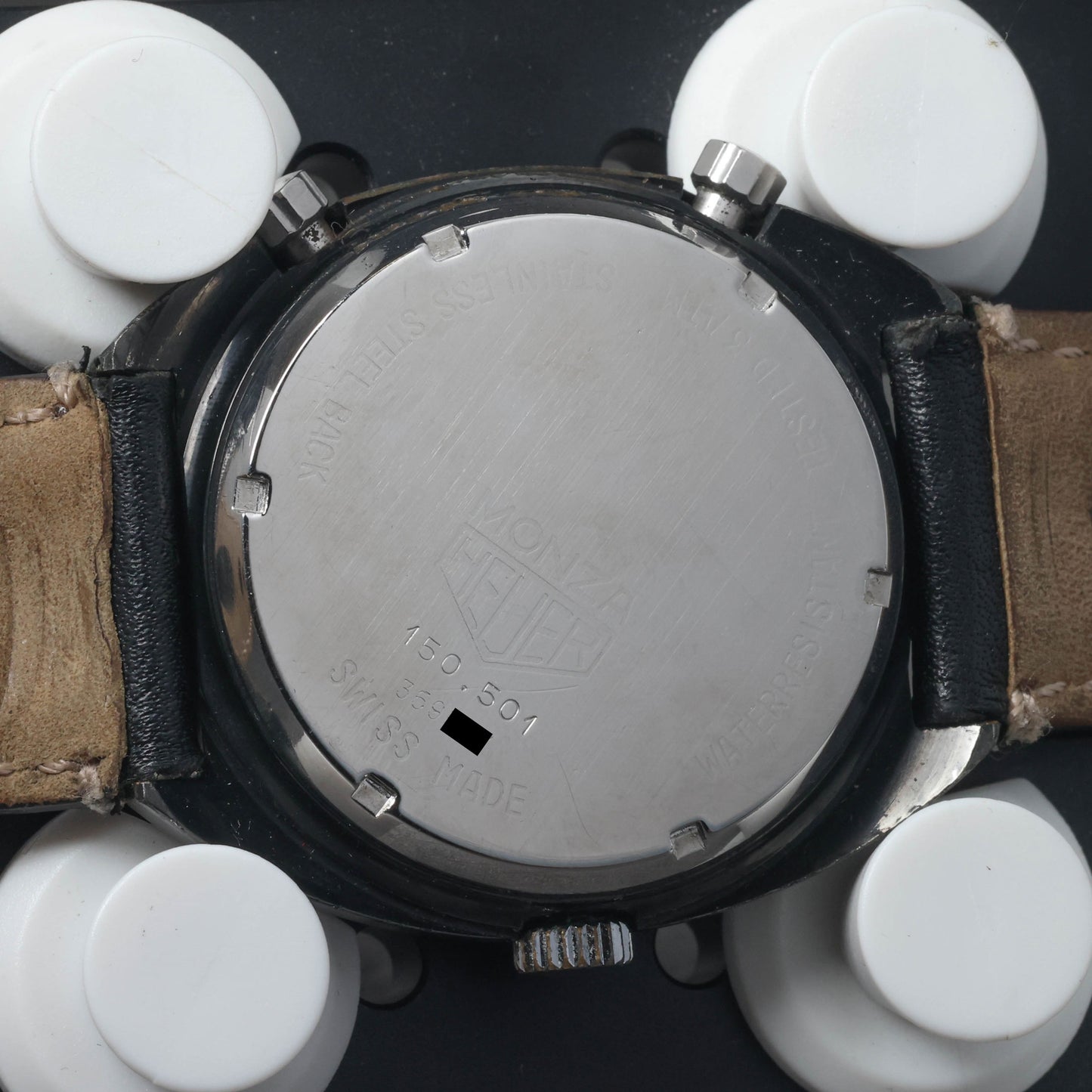
The case is presented in good vintage condition, with light hairline scratches visible throughout, consistent with careful use over time. There are no major dents or structural damage, and the overall case shape remains intact. The black coated finish shows honest wear appropriate for age, with no signs of heavy abrasion. Crown and chronograph pushers operate as intended and sit correctly within the case profile. The strap is in good condition, showing light wear from use but remaining secure and serviceable.
Dial, Hands, and Crystal
The dial is in good condition, with clean printing and no visible damage or moisture intrusion. The asymmetric layout remains clear and legible. Hands are also in good condition, with matching ageing and no significant corrosion noted. Luminous material appears consistent across dial and hands. The crystal shows light surface marks consistent with age, with no cracks.
Vintage Use Note
Given this watch is a vintage timepiece, it should be treated as such and we recommend avoiding swimming or water exposure, even if it has passed water resistance testing at the time of assessment.
Share
Why we love this watch
Why we love this watch
Heuer Monza 150.501
Introduction
Produced in the late 1970s, the Heuer Monza reference 150.501 was developed as an automatic chronograph built around the Buren Calibre 15 movement. It was conceived as a self contained model rather than an evolution of the Carrera or Autavia, with its own case architecture, dial layout, and functional priorities. The Monza was designed during a period when mechanical chronographs were being simplified and rationalised, both in response to market pressures and to changing expectations around durability, legibility, and everyday usability. Its specification reflects those conditions directly, with no attempt to replicate earlier Heuer chronograph formats.
Heuer Context and Model Positioning
During this period, Heuer was adapting its chronograph range to a changing market. The development of automatic chronographs earlier in the decade had resulted in the Calibre 11 family, created in partnership with Buren, Dubois Dépraz, and Breitling. As production costs and competitive pressure increased, Heuer introduced simplified variants of these movements, including the Calibre 15. The Monza was one of the models designed specifically to accommodate this movement architecture, rather than retrofitting it into an existing case or dial format. As a result, the Monza sits apart from Heuer’s established chronograph lines, occupying a clearly defined position within the late 1970s catalogue.
Case Construction and External Design
The Monza 150.501 is housed in a cushion shaped stainless steel case measuring approximately 42mm in diameter. At the time, this size placed it at the upper end of the spectrum for automatic chronographs, but the proportions were managed carefully through the use of short integrated lugs and broad, flat surfaces. The case was finished with a black PVD coating, applied over stainless steel. Physical Vapour Deposition was still relatively uncommon in serial Swiss watch production, and its use here was driven by functional considerations rather than decorative intent. The matte black finish reduces glare and reflections, particularly in bright outdoor environments, and aligns visually with contemporary motorsport equipment, which increasingly favoured non reflective surfaces. The crown and chronograph pushers are proportioned for practical use and partially recessed into the case flanks. Their placement reflects the requirements of the Calibre 15 movement and prioritises ease of operation over water resistance, with no screw down pushers employed.
Dial Architecture and Asymmetry
The dial layout of the Monza 150.501 is dictated entirely by the architecture of the Calibre 15. The most immediately recognisable feature is the offset running seconds subdial positioned at 10 o’clock. This asymmetrical arrangement is a defining characteristic of Calibre 15 powered chronographs and results from a deliberate engineering decision to simplify the movement. By relocating the running seconds display away from the central axis, additional gearing could be eliminated, reducing complexity and cost. The central chronograph seconds hand remains the primary timing indicator, supported by a 30 minute counter. The dial itself is matte black, chosen to minimise reflection, with all numerals, markers, and scales printed in white for maximum contrast. There are no applied indices or polished elements. The typography is functional and consistent, with a clear separation between timekeeping information and chronograph indications. Day and date apertures are included as part of the Calibre 15 base specification and are integrated into the dial without overwhelming the asymmetric layout. Luminous material is applied to the hands and primary hour markers in a restrained manner, ensuring legibility in low light conditions without introducing unnecessary visual complexity.
Movement and Technical Specification
Powering the Monza 150.501 is the Buren Calibre 15, produced by Buren as part of the Calibre 11 family. The Calibre 15 was conceived as a simplified automatic chronograph movement, retaining automatic winding while reducing the number of components relative to earlier Calibre 11 and Calibre 12 variants. It operates at 19,800 vibrations per hour and uses a cam actuated chronograph mechanism with a modular construction. The relocation of the running seconds subdial to 10 o’clock was a direct result of this simplification, allowing the movement to function efficiently without additional gearing. The movement includes day and date complications and was engineered with durability and ease of assembly in mind, reflecting the commercial and technical realities of the period. The Monza case was designed specifically to accommodate the dimensions and layout of the Calibre 15. Its cushion profile distributes the movement’s height evenly across the wrist, resulting in a stable and balanced wearing experience despite the thickness inherent to modular automatic chronographs.
Use, Wearability, and Intended Function
The Monza was designed as a practical chronograph for regular use rather than a specialised or decorative object. Its large case provides clear dial visibility, while the black PVD finish reduces visual bulk and glare. The asymmetric dial layout, though unconventional, ensures that chronograph indications remain prominent and easily distinguishable from standard timekeeping information. The inclusion of day and date reflects its positioning as an everyday instrument rather than a single purpose timer. Ergonomically, the short lug length and integrated case shape allow the watch to sit securely on the wrist, even during active use. These characteristics align with the Monza’s motorsport association, where clarity, robustness, and ease of operation were prioritised over traditional aesthetic balance.
Historical and Industry Context
The Heuer Monza 150.501 provides a clear snapshot of mechanical chronograph design during the late 1970s. This was a period defined by rapid technological change, with quartz movements placing significant pressure on traditional mechanical watchmaking. In response, brands such as Heuer focused on simplifying mechanical constructions, reducing production costs, and emphasising functional advantages that quartz could not replicate in the same way. The Monza reflects this approach directly. Its movement architecture, case construction, and dial design all point to a pragmatic response to market conditions rather than an attempt to preserve earlier design conventions. The later reuse of the Monza name by Heuer and its successors confirms the lasting recognition of this original model as the foundation of the Monza line.
Final Thoughts
The Heuer Monza 150.501 was developed as a functional automatic chronograph built around the specific requirements of the Buren Calibre 15. Its black PVD cushion case, asymmetric dial with running seconds at 10 o’clock, and simplified movement architecture are all direct outcomes of the technical and commercial environment in which it was produced. Viewed within its historical context, the Monza stands as a factual record of how Heuer approached chronograph design during a period of significant industry change, prioritising usability, durability, and modern manufacturing considerations.
Case & Bracelet
Case & Bracelet
- Case in good vintage condition, hairlines visible.
- No major dents.
- Strap in good condition
Dial & Hands
Dial & Hands
- Dial & hands good condition
Warranty & Condition
Warranty & Condition
Crown Vintage Watches provides a minimum 6-month mechanical warranty on pre-owned watches, from the date of purchase.
The warranty covers mechanical defects only.
The warranty does not cover damages such as scratches, finish, crystals, glass, straps (leather, fabric or rubber damage due to wear and tear), damage resulting from wear under conditions exceeding the watch manufacturer’s water resistance limitations, and damage due to physical and or accidental abuse.
Please note, water resistance is neither tested nor guaranteed.
Shipping and insurance costs for warranty returns to us must be covered by the customer. Returns must be shipped via traceable courier. Return shipment must be pre-paid and fully insured. Collect shipping will be refused. In case of loss or damages, the customer is liable.
Our Pledge
At Crown Vintage Watches, we stand by the authenticity of every product we sell. For added peace of mind, customers are welcome to have items independently authenticated at their own expense.
Condition
Due to the nature of vintage timepieces, all watches are sold as is. We will accurately describe the current condition and working order of all watches we sell to the best of our ability.
Shipping & Refund
Shipping & Refund