
Crown Vintage
Heuer Silverstone 110.313B 42mm 1970s
Heuer Silverstone 110.313B 42mm 1970s
Couldn't load pickup availability
Heuer Silverstone 110.313B 42mm 1970s
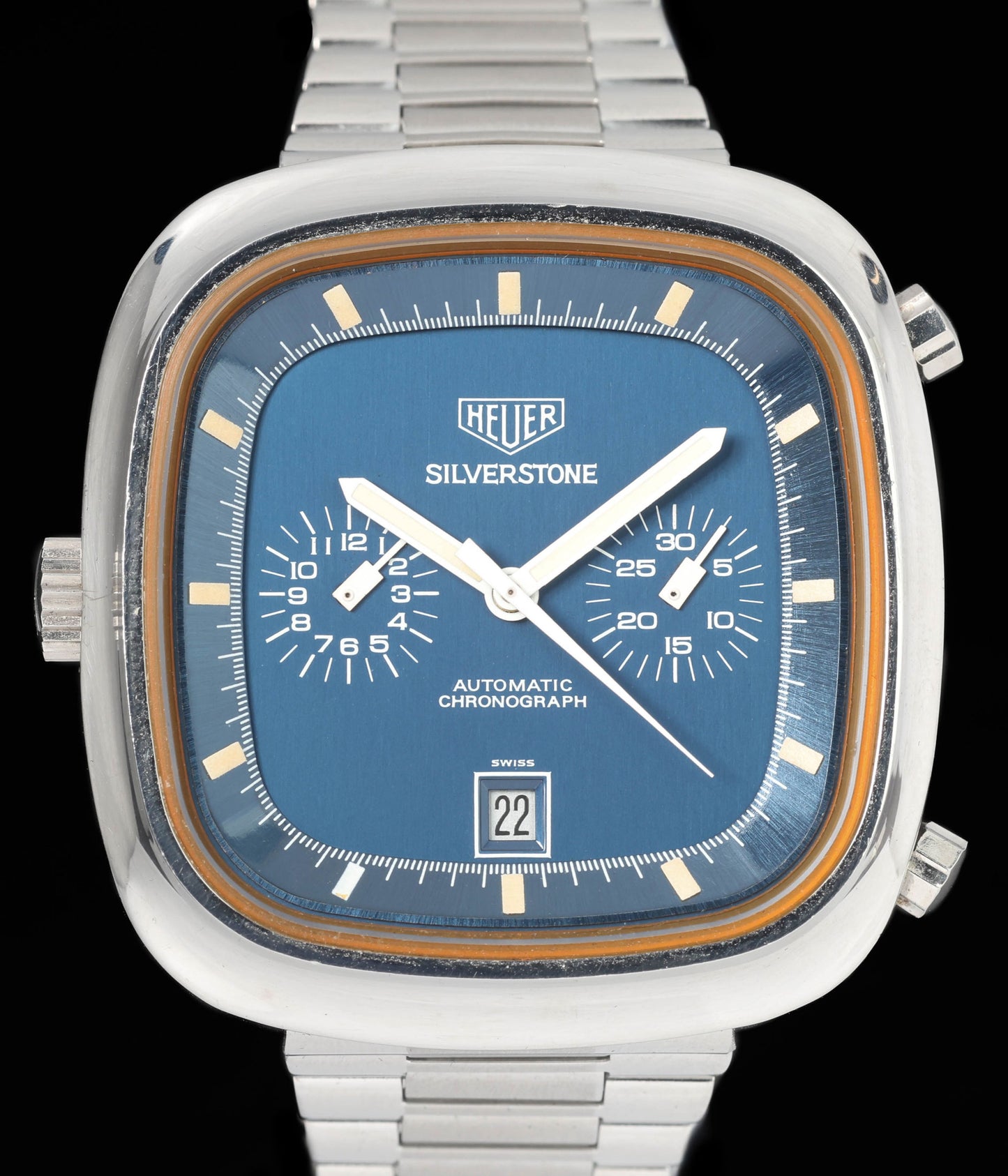
The dial and hands are in excellent condition, with strong colour, clean surfaces, and crisp printing throughout. There is no visible degradation, spotting, or damage, and legibility remains clear across all indications. The case is in very good vintage condition, showing light hairline scratches consistent with careful wear over time. The original case form and geometry remain intact, with no signs of heavy polishing. The watch is fitted with its original stainless steel bracelet, which is in excellent vintage condition with minimal stretch and light hairlines commensurate with age.
As this watch is now over 30 years old, it should be treated as a vintage timepiece. Despite its original sporting purpose, it is not recommended to wear this watch whilst swimming or expose it to moisture.
Performance and Testing Results
The movement has been tested on a Witschi WAIO professional timing system. Testing was carried out across multiple positions, with the following results observed: rate readings ranging from approximately -6 seconds per day to +16 seconds per day depending on position, beat error measuring between 0.1 ms and 0.5 ms, and amplitude readings generally in the low to mid 200-degree range, with higher amplitude recorded in dial-down position. These results indicate stable and consistent performance for a vintage automatic chronograph of this era. The test was completed successfully, and the movement is operating within an acceptable range at the time of assessment.
Vintage Use Note
Given this watch is a vintage timepiece, it should be treated as such and we recommend avoiding swimming or water exposure, even if it has passed water resistance testing at the time of assessment.
Share
Why we love this watch
Why we love this watch
Heuer Silverstone 110.313B
Introduction
Produced in the early 1970s, the Heuer Silverstone 110.313B was introduced at a time when Swiss watchmaking was undergoing a fundamental shift in both technology and design language. This reference was conceived not as a continuation of Heuer’s established chronographs, but as a deliberate response to the arrival of the automatic chronograph and the changing visual tastes of the decade. The Silverstone line allowed Heuer to step away from the restrained forms of the 1960s and explore bolder case shapes, stronger colours, and a more contemporary presence. The 110.313B, distinguished by its blue dial and cushion shaped case, clearly illustrates why this model was produced and how it fit into Heuer’s broader strategy during this transitional period.
Heuer at the Start of the 1970s
By the beginning of the decade, Heuer was already firmly established as a leading manufacturer of professional chronographs. Under the leadership of Jack Heuer, the brand had developed deep ties with motorsport, supplying timing equipment to racing teams, circuits, and organisers worldwide. Models such as the Carrera and Autavia had defined Heuer’s reputation for clarity, functional design, and reliability. However, the late 1960s brought rapid change. Case sizes were increasing, design trends were becoming more expressive, and the development of the automatic chronograph was reshaping expectations. Heuer’s involvement in Project 99 ensured the brand would play a central role in this technical milestone rather than reacting to it after the fact.
The Automatic Chronograph as a Turning Point
The arrival of the automatic chronograph marked a decisive moment for the Swiss watch industry. For Heuer, it required a reconsideration of both movement architecture and external design. The new automatic chronograph movements, including the Calibre 11 and its successor Calibre 12, necessitated an offset crown position and different case proportions. Rather than disguising these changes, Heuer chose to highlight them. The Silverstone was designed from the outset to embrace the automatic chronograph visually, using the left side crown placement as part of its identity. The 110.313B is therefore inseparable from this technical shift, existing specifically because automatic chronograph technology made new forms possible.
Why the Silverstone Was Produced
The Silverstone was created to reflect changing tastes and expectations. By the early 1970s, design across industries was moving towards larger, more integrated forms and stronger use of colour. Automotive styling, architecture, and consumer products were all influenced by a desire for modernity and visual confidence. Heuer recognised that relying solely on traditional round case chronographs would limit its relevance. The Silverstone was conceived as a modern alternative within the catalogue, offering a chronograph that felt contemporary while remaining grounded in Heuer’s timing heritage. Naming the watch after the Silverstone Circuit reinforced the motorsport connection while giving the brand freedom to experiment with form and colour.
The Role of the 110.313B Within the Silverstone Line
The Silverstone range was relatively compact, and within it the 110.313B occupies a distinct position as the blue dial variant. The suffix B identifies this execution, which pairs a deep blue sunburst dial with contrasting white chronograph registers. This colour combination was emblematic of early 1970s design, offering strong visual impact while maintaining legibility. The 110.313B was not intended as a subtle or conservative option. Instead, it demonstrated Heuer’s willingness to align its watches with contemporary colour trends and to produce a chronograph that immediately communicated modernity.
Case Design and Overall Architecture
The cushion shaped case of the Heuer Silverstone 110.313B is one of its most defining characteristics. Measuring approximately 42mm across, it was large by the standards of its era and deliberately so. The fully polished case emphasises the smooth, flowing shape, giving the watch a sculptural presence. Unlike sharply faceted tonneau cases, the Silverstone relies on rounded edges and continuous curves, creating a softer but still substantial appearance. The crown is positioned to the left of centre to accommodate the automatic chronograph movement, while the pushers remain on the right for intuitive operation. This layout clearly signals the watch’s technical makeup and reinforces its modern identity.
Blue Dial Design and Visual Identity
The blue dial of the 110.313B is central to the character of the watch. The sunburst finish creates depth and movement, shifting tone depending on lighting conditions. White sub dials provide clear contrast, ensuring chronograph functions are easy to read at a glance. Applied hour markers add dimensionality, with polished surfaces that catch the light and enhance clarity. The use of bright accent colours, including the central chronograph seconds hand, reflects Heuer’s long standing focus on readability, particularly in motorsport timing instruments. Despite its bold colour, the dial remains balanced and purposeful, staying true to Heuer’s functional design principles.
The Calibre 12 Automatic Chronograph
Powering the Heuer Silverstone 110.313B is the Calibre 12 automatic chronograph movement. Developed as a refinement of the original Calibre 11, Calibre 12 offered improved performance while retaining the modular construction and micro rotor automatic winding system. This architecture allowed Heuer to deliver a self winding chronograph without excessive thickness and enabled the distinctive crown placement that became a hallmark of early automatic chronographs. The inclusion of Calibre 12 is fundamental to the Silverstone’s existence. Without the introduction of this movement, there would have been little reason to pursue such a radical departure from earlier chronograph designs.
Motorsport Influence and the Silverstone Name
Heuer’s association with motorsport is integral to understanding the Silverstone. Naming the watch after the Silverstone Circuit linked the model directly to one of the most important venues in international racing. During this period, motorsport was gaining increased visibility through television and global sponsorship, and Heuer’s timing equipment was already widely used within the sport. The Silverstone was designed to evoke the speed, precision, and modernity associated with racing rather than to replicate any specific instrument. The name served as both a reference point and a statement of intent.
The Silverstone in Heuer’s Experimental Period
The early 1970s were among the most experimental years in Heuer’s history. Alongside the Silverstone, the brand introduced models such as the Monaco and Camaro, each exploring different approaches to modern chronograph design. The Silverstone occupies a distinctive position within this group. It is less radical than the square Monaco but more expressive than the traditional Carrera. The 110.313B, with its flowing case and bold blue dial, demonstrates how Heuer was testing new ideas while maintaining a clear link to functional chronograph design.
Production Context and Limited Lifespan
The Silverstone line was produced for a relatively short period, reflecting the rapidly changing conditions of the watch industry at the time. The early 1970s were marked by uncertainty, with electronic timekeeping beginning to challenge mechanical watches. Heuer was required to adapt quickly, balancing innovation with commercial realities. The limited production run of the Silverstone highlights its role as an exploratory design rather than a long term cornerstone of the catalogue. Its significance lies in what it represents rather than how long it was produced.
Cultural and Design Influences of the Era
The Heuer Silverstone 110.313B is best understood within the broader cultural and design context of its time. The early 1970s favoured bold experimentation across multiple industries. Automotive design embraced wider forms and stronger colours, while consumer products increasingly reflected futuristic ideals. The Silverstone mirrors these influences through its case shape, dial colour, and overall presence. It is unmistakably a product of its era, yet its design remains cohesive and purposeful rather than arbitrary.
Relationship to Other Heuer Chronographs
Although visually distinct, the Silverstone shares technical foundations with other Heuer chronographs of the period. The use of Calibre 12 places it alongside certain Autavia and Monaco references, yet the Silverstone differentiates itself through its softer case geometry and vivid dial colour. This suggests that Heuer intended the Silverstone to broaden its design language rather than replace existing models. The 110.313B offered an alternative expression of Heuer’s approach to modern chronograph design.
Enduring Historical Significance
The Heuer Silverstone 110.313B stands as a clear representation of a pivotal moment in Heuer’s history. It captures the convergence of new technology, evolving design trends, and shifting cultural expectations. The watch exists because Heuer recognised that innovation required more than incremental updates. It required a willingness to rethink form, colour, and identity. The Silverstone embodies that mindset, preserved in a reference that remains closely tied to the period that produced it.
Final Thoughts
The Heuer Silverstone 110.313B was produced because Heuer understood that the future of the chronograph lay in embracing change rather than resisting it. By adopting the automatic Calibre 12 movement, introducing a bold cushion shaped case, and using a striking blue dial, Heuer created a watch that reflected both its technical capability and its awareness of contemporary design. The Silverstone is not an anomaly within the Heuer catalogue but a deliberate statement from a brand navigating one of the most transformative periods in Swiss watchmaking history.
Case & Bracelet
Case & Bracelet
Case in very good condition, very light indications of wear.
Dial & Hands
Dial & Hands
Dial & hands excellent.
Warranty & Condition
Warranty & Condition
Crown Vintage Watches provides a minimum 6-month mechanical warranty on pre-owned watches, from the date of purchase.
The warranty covers mechanical defects only.
The warranty does not cover damages such as scratches, finish, crystals, glass, straps (leather, fabric or rubber damage due to wear and tear), damage resulting from wear under conditions exceeding the watch manufacturer’s water resistance limitations, and damage due to physical and or accidental abuse.
Please note, water resistance is neither tested nor guaranteed.
Shipping and insurance costs for warranty returns to us must be covered by the customer. Returns must be shipped via traceable courier. Return shipment must be pre-paid and fully insured. Collect shipping will be refused. In case of loss or damages, the customer is liable.
Our Pledge
At Crown Vintage Watches, we stand by the authenticity of every product we sell. For added peace of mind, customers are welcome to have items independently authenticated at their own expense.
Condition
Due to the nature of vintage timepieces, all watches are sold as is. We will accurately describe the current condition and working order of all watches we sell to the best of our ability.
Shipping & Refund
Shipping & Refund