

Crown Vintage
Jaeger‑LeCoultre Master Réserve de Marche 140.8.93.S 37mm 2000s
Jaeger‑LeCoultre Master Réserve de Marche 140.8.93.S 37mm 2000s
Couldn't load pickup availability
Jaeger‑LeCoultre Master Réserve de Marche 140.8.93.S 37mm 2000s
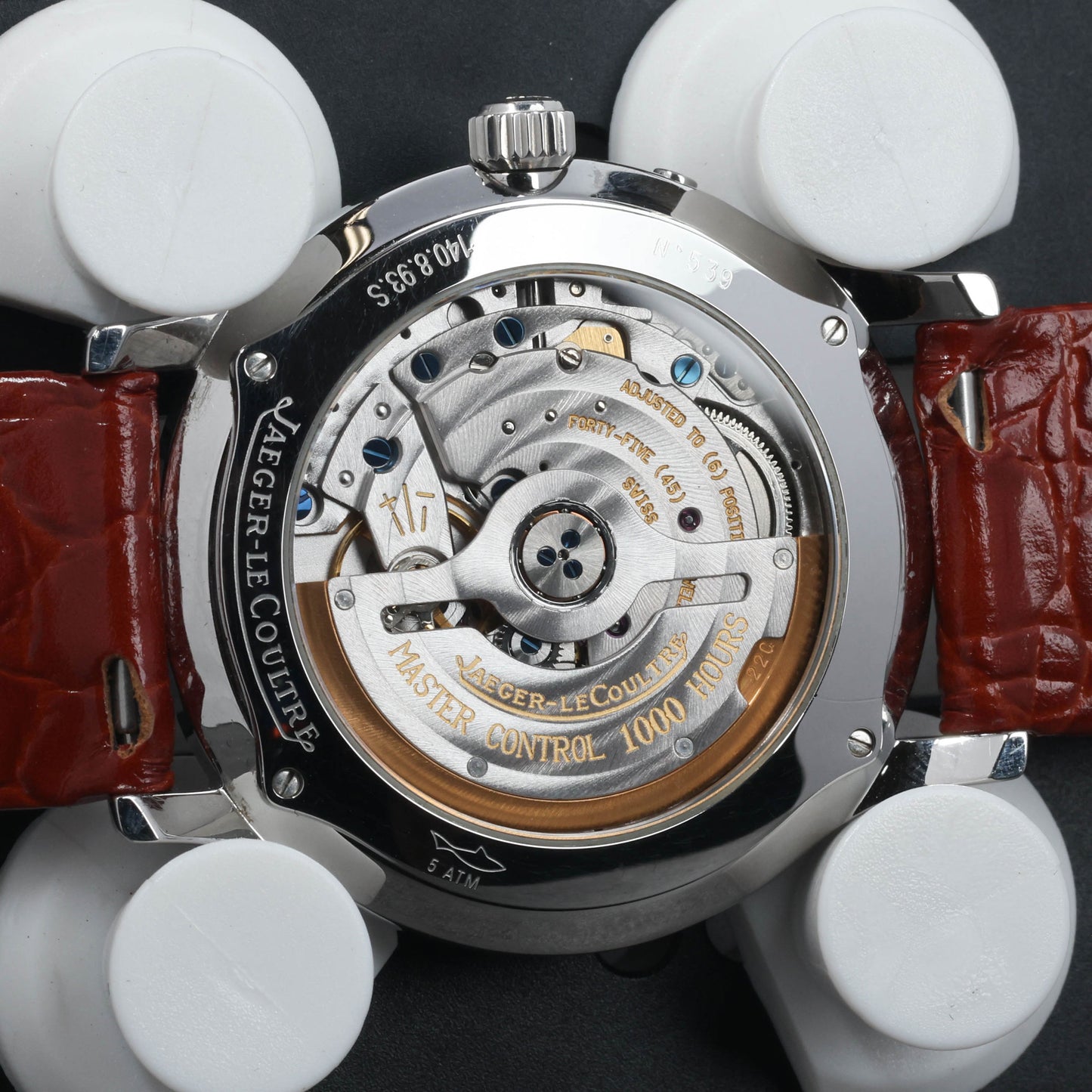
This Jaeger-LeCoultre Master Réserve de Marche ref. 140.8.93.S, 37 mm, presents in very good overall condition. The stainless steel case remains sharp with even finishing, showing only light hairlines around the lugs, flanks, and bezel under normal viewing. No dents or deep marks are evident. The sapphire crystal is clean and free of distracting scratches. The dial is very good with crisp printing and well defined indices, while the hands are clean with intact finish and no visible oxidation. Power reserve, date, and small seconds indications operate correctly during handling. Crown action is precise and winding feels smooth. Case back engravings remain clear and legible. Fitted with a brand new Hirsch calf leather strap that wears comfortably and secures positively. Movement winds, sets, and runs as expected in handling. All functions operate correctly during basic functional checks today.
Share
Why we love this watch
Why we love this watch
Jaeger‑LeCoultre Master Réserve de Marche Ref. 140.8.93.S
Introduction
Produced during the early 2000s, the Jaeger-LeCoultre Master Réserve de Marche Ref. 140.8.93.S blends classical dress-watch proportions with an automatic movement and useful complications such as a power-reserve indicator, date display and small seconds. The model resides within Jaeger-LeCoultre’s Master Control series and offers a 37 mm stainless steel case, automatic winding and elegant dial architecture. With this reference, Jaeger-LeCoultre presented a refined, practical timepiece combining its manufacture tradition with everyday functionality.
Brand Overview of Jaeger-LeCoultre
To appreciate the Master Réserve de Marche, it is important to understand the heritage of the manufacture behind it. Founded in 1833 by Antoine LeCoultre in the Vallée de Joux, the company that would become Jaeger-LeCoultre broadened its capabilities rapidly: in 1844 Antoine LeCoultre invented the Millionomètre, the first instrument capable of measuring to the micron, and in 1847 he developed a keyless winding and setting system.
Over the course of the late nineteenth and early twentieth centuries, Jaeger-LeCoultre produced movements for other makers and developed a reputation for horological innovation. In 1903, the collaboration between Edmond Jaeger and Jacques-David LeCoultre contributed to the brand becoming known as Jaeger-LeCoultre.
During the twentieth century, the manufacture introduced many important calibres: the Calibre 101 remains the smallest mechanical movement ever made; the Memovox alarm watches established the brand’s technical breadth; and the “1000 Hours Control” testing programme underscored its dedication to quality.
By the 1990s and early 2000s, Jaeger-LeCoultre had re-established itself as one of the most respected manufactures in Switzerland, offering movements designed and produced in-house. The Master series, launched in that era, emphasised classical design, discreet proportions and technical reliability. The reference 140.8.93.S is an expression of that phase of the brand’s evolution.
Model Overview: Ref. 140.8.93.S
The Master Réserve de Marche Ref. 140.8.93.S features a stainless steel case measuring 37 mm in diameter and approximately 9–10 mm in thickness, making it classically sized rather than oversized.
The dial layout is distinctive: it includes a date pointer register (commonly located at around 2 o’clock), a power-reserve indicator at roughly 10 o’clock, and a small seconds sub-dial at 6 o’clock. One version (silver dial) shows applied indices and a fan-shaped power-reserve scale.
Jaeger-LeCoultre’s automatic movement Calibre 928/2 powers the watch. According to technical sources, the calibre 928 (and its derivative 928/2) is a thinner automatic movement with a power-reserve indicator complication.
The caseback may feature a sapphire exhibition window, allowing view of the movement’s finishing in some examples. The watch is reported to be water-resistant to 5 ATM (approximately 50 metres) in certain descriptions.
Case and Design Details
The stainless steel case of the 140.8.93.S has classic curves and lugs that taper, producing an elegant wrist presence. The bezel is inclined and polished, contrasting subtly with brushed surfaces on the case band. One source lists the case thickness at 9 mm for the silver-dial version.
With a 37 mm diameter, the watch fits comfortably on a broad range of wrists. Its case width and thickness make it suitable for dress or everyday use without feeling oversized. Lug-to-lug dimensions vary depending on strap or bracelet configuration, but the overall profile is subdued. For example, one listing lists 37.0 mm x 43.0 mm for diameter x lug-to-lug.
Sapphire crystals protect the dial and, in many examples, the exhibition caseback as well. The inclined bezel and simple case architecture keep visual distractions to a minimum, emphasising the dial complications. One description notes 10 mm thickness and “concave and curved lugs”.
Water resistance is modest: many listings cite 5 ATM (50 m), which is consistent with the dress-watch orientation rather than a sports model.
Dial and Hands
Several dial variations exist for reference 140.8.93.S: silver dial with raised indices and applied baton hands, and black dial with dagger indices and luminous accents.
The layout is engineered for clarity: the fan-shaped power-reserve indicator is located at approximately 10 o’clock, often marked with “RÉSERVE DE MARCHE”, and spans a scale indicating remaining power. The small seconds sub-dial resides at 6 o’clock, and the date pointer register around 2 o’clock displays the day of the month via a central hand rather than a window.
The hands and markers are executed with attention to legibility: in the silver-dial example, steel dauphine hands with luminous fill contrast the dial; in black dial versions, applied indices with luminous accents are present.
The dial design retains a sense of restraint: there is no excessive decoration, and the complication displays (date, seconds, power reserve) are integrated in a balanced manner that avoids crowding. The small seconds sub-dial is engine-turned in some versions, adding texture without distraction.
Movement: Calibre 928 / 928/2
At the heart of the 140.8.93.S is the Jaeger-LeCoultre calibre 928 (or 928/2). According to detailed movement data, the calibre 928 was introduced around 1985 and was designed as a thin automatic movement incorporating a power reserve indicator reviving one of Jaeger-LeCoultre’s signature complications, the “réserve de marche”.
Key characteristics of Calibre 928:
- Automatic winding movement based on the established Calibre 889/1 architecture.
- Operating frequency of 28,800 vibrations per hour.
- Small seconds sub-dial at 6 o’clock and a date pointer at approximately 2:30.
- The power reserve indicator is central to the complication: a retrograde or arc display at around 10:30 indicates the remaining mainspring energy, typically up to around 40 hours or more depending on version.
The calibre 928/2 variant is a direct evolution of the 928, maintaining the visible power-reserve indicator and automatic architecture. For the reference 140.8.93.S, listings identify the movement as Cal. 928/2.
Jaeger-LeCoultre’s “1000 Hours Control” testing process also applies to many Master series watches, ensuring that movements like the 928/2 meet rigorous performance and reliability standards.
Wearability and Daily Use
Wearing the 140.8.93.S is a refined experience. The 37 mm diameter and modest thickness provide comfort for a variety of wrist sizes. The automatic movement means no daily winding is required (though a watch winder or occasional manual winding may be used if the watch is not worn regularly).
The complications-date pointer, small seconds, power reserve add utility without overwhelming the dial. The power-reserve indicator is particularly useful for the owner to monitor how much autonomy remains before winding or wear is required. The date pointer offers an elegant alternative to a date window, maintaining dial balance while giving full month indication.
The case and finishing are dress oriented but robust: the steel case holds up to everyday wear, while the sapphire crystal and subtle detail ensure the watch looks presentable in formal or casual settings. Given its modest water resistance, it is not designed for swimming or diving, and wearers should treat it as a luxury dress or office timepiece.
Historical and Collecting Context
By the early 2000s the Master series had become central to Jaeger-LeCoultre’s civilian-facing catalogue. The reference 140.8.93.S sits in this era as a model that offers manufacture movement, refined complications and elegant design without going into high complication territory.
The power reserve indicator is one of the movement’s signature features and links back to Jaeger-LeCoultre’s long tradition of complications. The calibre 928’s introduction around 1985 marked the revival of this complication and the 140.8.93.S continues that line.
In the broader collector community, the 140.8.93.S is seen as a well-balanced watch: not overly large, with useful functions, and from a respected manufacturer with in-house movement capabilities. Online forums note that its size and design make it versatile, though some comment that modern tastes favour slightly larger diameters.
Conclusion
The Jaeger-LeCoultre Master Réserve de Marche Ref. 140.8.93.S offers a thoughtful combination of classical case size, automatic manufacture movement and practical complications. The 37 mm stainless steel case, clean dial architecture with power reserve indicator, date pointer and small seconds, and the in-house calibre 928 (or 928/2) make it a refined choice for those who appreciate traditional watchmaking executed with subtlety.
If you value understatement, technical integrity and design coherence, the 140.8.93.S presents a strong example of Jaeger-LeCoultre’s capabilities in the early 2000s. Its proportions and functionality allow it to serve in a variety of roles, from everyday wear to more formal settings.
Case & Bracelet
Case & Bracelet
Case in great condition, light hairlines visible around the case. Brand new Hirsch Calf leather strap.
Dial & Hands
Dial & Hands
Very good condition.
Warranty & Condition
Warranty & Condition
Crown Vintage Watches provides a minimum 6-month mechanical warranty on pre-owned watches, from the date of purchase.
The warranty covers mechanical defects only.
The warranty does not cover damages such as scratches, finish, crystals, glass, straps (leather, fabric or rubber damage due to wear and tear), damage resulting from wear under conditions exceeding the watch manufacturer’s water resistance limitations, and damage due to physical and or accidental abuse.
Please note, water resistance is neither tested nor guaranteed.
Shipping and insurance costs for warranty returns to us must be covered by the customer. Returns must be shipped via traceable courier. Return shipment must be pre-paid and fully insured. Collect shipping will be refused. In case of loss or damages, the customer is liable.
Our Pledge
At Crown Vintage Watches, we stand by the authenticity of every product we sell. For added peace of mind, customers are welcome to have items independently authenticated at their own expense.
Condition
Due to the nature of vintage timepieces, all watches are sold as is. We will accurately describe the current condition and working order of all watches we sell to the best of our ability.
Shipping & Refund
Shipping & Refund