

Crown Vintage
Jaeger-LeCoultre Reverso Classique 250.8.86 23x38mm Circa 2000s
Jaeger-LeCoultre Reverso Classique 250.8.86 23x38mm Circa 2000s
Couldn't load pickup availability
Jaeger-LeCoultre Reverso Classique 250.8.86 23x38mm Circa 2000s
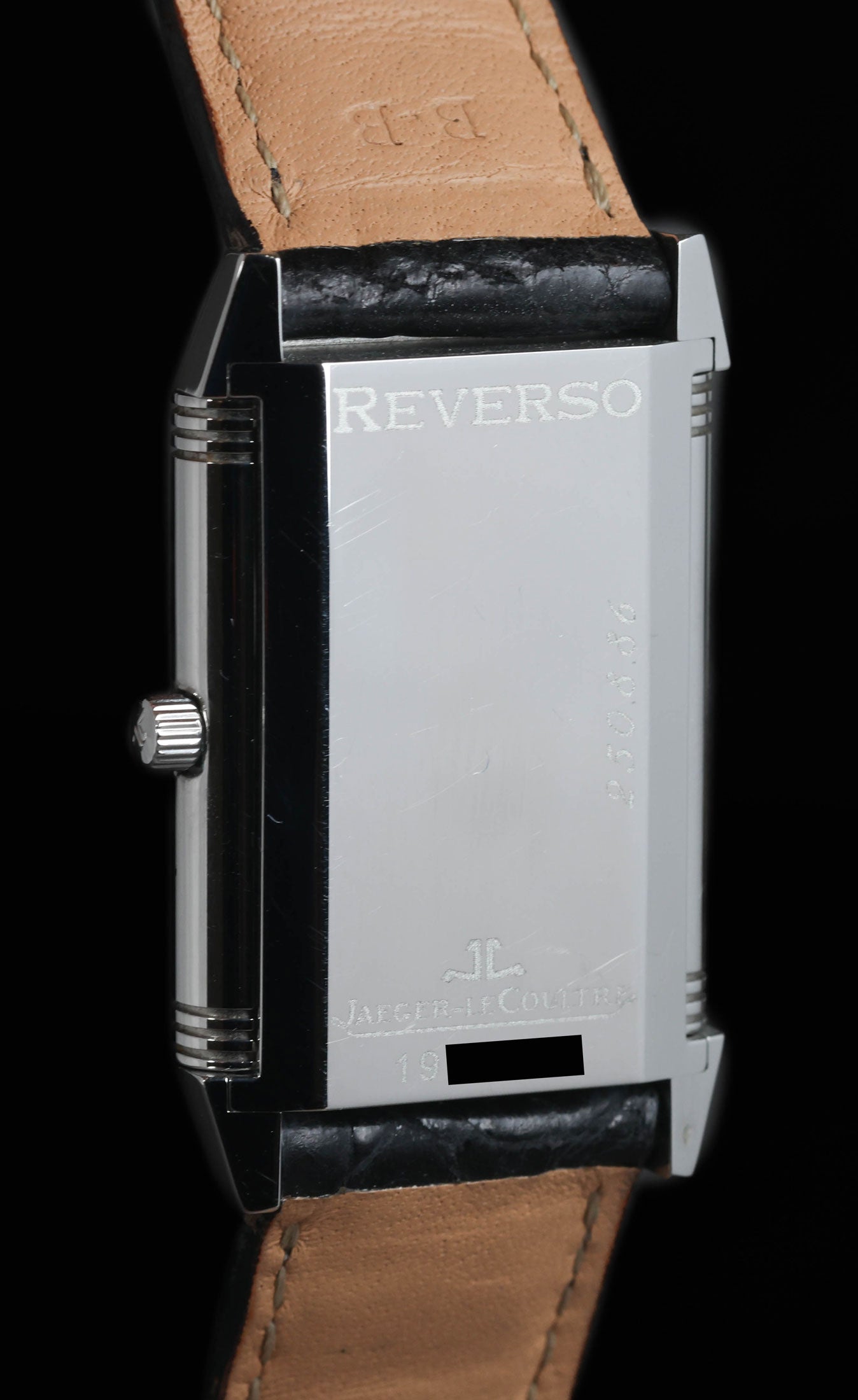
The case of this Jaeger-LeCoultre Reverso Classique 250.8.86 presents in great condition, retaining its well-defined lines and characteristic geometry throughout. Hairline scratches are visible around the edges upon close inspection, consistent with light and careful wear over time, though the case presents very well overall and the integrity of the original finishing remains clear across both the polished and brushed surfaces.
The original leather strap is in good condition, showing moderate signs of use that sit in keeping with the age and character of the piece. It remains well-presented and wearable, and its originality adds to the overall coherence of the watch as a complete example.
The dial and hands are flawless, displaying no marks, ageing, or discolouration of any kind. The applied indices and Roman numerals are crisp and perfectly intact, and the blued steel hands retain their full colour and definition throughout. This is a clean, well-kept example that presents consistently across all components.
Share
Why we love this watch
Why we love this watch
The Art of Reversal: Jaeger-LeCoultre Reverso Classique 250.8.86
There are watches that tell the time, and there are watches that tell a story. The Jaeger-LeCoultre Reverso belongs firmly in the second category. Introduced in 1931 and produced in essentially unbroken continuity ever since, the Reverso is one of the most architecturally distinctive objects in the history of decorative design, a watch whose defining feature is not a complication, a material, or a movement, but a physical action: the swivelling of the case on its carriage to reveal the plain steel back beneath. That mechanism, conceived as a protective solution for the polo field, became the aesthetic and philosophical foundation of one of the great watch designs of the twentieth century. The Classique reference 250.8.86 in its circa 2000s configuration represents the Reverso in its most enduring and considered form, a piece that has been refined continuously over seven decades without ever needing to be reconceived.
The Origins of the Reverso
The Reverso was born from a practical problem at a specific moment in time. In 1930, César de Trey, a businessman with interests in the Swiss watch trade, was watching a polo match in India and observed what any regular attendee of the sport already knew: that the crystal and dial of a wristwatch had no reliable defence against the impact of a mallet strike or a fall from horseback. The watches of the era were mechanically sophisticated but physically fragile in that particular respect, and the polo-playing community, which skewed heavily toward the wealthy and the well-connected, represented exactly the kind of clientele that a luxury Swiss manufacturer might wish to serve.
De Trey brought the problem to Jaeger-LeCoultre, then as now one of the most technically accomplished manufacture houses in the Vallée de Joux, and the collaboration that followed produced one of the most elegant engineering solutions in the history of design. The case, developed with contributions from the engineer René-Alfred Chauvot, who filed the original patent in 1931, was mounted on a fixed rectangular carriage and designed to pivot and lock in either direction, presenting either the dial and crystal for timekeeping or the plain reverse face for protection. When the polo player needed to ride, the dial could be turned inward against the carriage and locked there, shielded by the flat steel back. When the time was needed, a simple push and swivel returned the dial to the outward position.
A Design That Transcended Its Purpose
The genius of the Reverso is that the protective mechanism and the aesthetic object are inseparable. The rectangular case, the sliding action, the clean parallel lines of the carriage, the proportions of the dial within its frame: all of these elements exist because they were required by the function, and all of them together produced something that reads as pure Art Deco design of the highest order. The Reverso arrived at precisely the moment when the Art Deco movement was at its most confident and culturally dominant, and the watch absorbed that visual language so completely that it became one of its definitive objects. Had the Reverso been designed ten years earlier or ten years later, it would have looked different, but it was designed in 1931, and it looks exactly like 1931 at its best.
Jaeger-LeCoultre did not immediately appreciate the full cultural weight of what it had created. In the years following the Second World War, as round cases returned to dominance and the tool watch aesthetic took hold across much of the industry, the Reverso was produced in smaller numbers and occupied a quieter position in the catalogue. It was the revival of interest in Art Deco design during the 1970s and 1980s, combined with a broader reassessment of pre-war Swiss watchmaking, that returned the Reverso to the prominence it holds today. By the time the Classique references of the 1990s and 2000s were in production, the Reverso had been firmly re-established as one of the canonical objects of twentieth-century horology.
Jaeger-LeCoultre and the Vallée de Joux
Jaeger-LeCoultre was founded in 1833 by Antoine LeCoultre in Le Sentier, a village in the Vallée de Joux in the Swiss Jura mountains, a region with a watchmaking tradition stretching back to the seventeenth century and a climate so harsh that farming was impractical for much of the year, leaving the population with long winters in which the careful work of movement manufacture became both an occupation and a cultural identity. LeCoultre established his atelier at a moment when the industrialisation of watchmaking was beginning to transform what had been a network of individual craftsmen into something more organised and productive, and he brought to that process a particular commitment to technical depth that defined the manufacture from its earliest years.
The company's merger with the Parisian firm of Edmond Jaeger in 1937 formalised a relationship that had existed informally for some years and brought the combined entity into closer alignment with the Parisian luxury market, providing distribution and commercial reach that complemented the technical capabilities of the Le Sentier manufacture. The Jaeger-LeCoultre name, adopted formally in the years that followed, reflected that dual identity: Swiss engineering precision married to French design sensibility, a combination that would prove well suited to a watch like the Reverso, which demands both in equal measure.
The manufacture in Le Sentier remains today one of the most vertically integrated in the Swiss industry, producing its own movements, cases, and components to a degree that few other houses can match. The calibres that power the Reverso line are designed and produced in-house, and the manufacture has used the Reverso platform over the decades as a vehicle for some of its most ambitious horological complications, including perpetual calendars, tourbillons, minute repeaters, and duoface movements that use both the front and reverse of the pivoting case to display independent time indications.
The Classique Reference 250.8.86
Case and Carriage
The reference 250.8.86 presents the Reverso in its Classique configuration, the closest direct descendent of the original 1931 design and the reference that most purely expresses the architectural principles on which the watch was founded. The case measures 23 millimetres by 38 millimetres in the rectangular format established by the original, mounted on its fixed carriage in stainless steel with the characteristic straight lugs and clean parallel lines that define the Reverso silhouette. The case swivels on the carriage in the manner unchanged since Chauvot's original patent, locking positively in either the dial-out or dial-in position with a satisfying mechanical engagement that communicates the quality of the engineering beneath.
The surfaces of the Classique case are finished with a combination of polished and brushed treatments that follow the geometry of the design: the flat faces polished to mirror brightness, the sides and bevels in a finer brushed finish that provides textural contrast without introducing any decorative element not already inherent in the form itself. The effect is austere in the best possible sense, a case that draws attention through proportion and finish rather than through ornament, and that rewards examination at close quarters with a precision of construction that reflects more than ninety years of refinement.
Dial
The dial of the 250.8.86 is presented in the silver configuration with a grained or brushed finish that provides a quiet, textured ground for the applied hour markers and hands. The index layout follows the Roman numeral convention established on the original Reverso, with bold Roman numerals at the cardinal positions and applied baton markers filling the intervening hours, a combination that places the watch firmly within the Art Deco typographic tradition without tipping into pastiche. The numerals are crisp and precisely applied, reading with the clarity that the rectangular case format and the relatively modest 23-millimetre width demand.
The hands are blued steel in a leaf or dauphine profile, tapering to fine points that pass cleanly over the chapter ring and the applied indices without ambiguity. The blued steel against the silver dial is one of the enduring classic combinations of watchmaking aesthetics, and on the Reverso Classique it carries a particular resonance, connecting the watch visually to the pocket watch and dress watch tradition from which the Reverso was born. There are no complications on the standard Classique dial, no date aperture, no subsidiary seconds, and no additional text beyond the Jaeger-LeCoultre signature at twelve o'clock. The result is a dial of exceptional clarity, one that communicates time in the most direct possible terms and asks nothing more of the wearer than to read it.
Movement
The movement housed within the 250.8.86 is the Jaeger-LeCoultre calibre 600 or its variant, a manually wound manufacture movement developed specifically for the rectangular case architecture of the Reverso. The choice of manual winding is significant and deliberate. An automatic rotor requires a movement of sufficient diameter to generate adequate winding efficiency, and the constraints of the Reverso's rectangular case make a satisfying automatic architecture difficult to achieve without compromising the proportions of the case itself. Manual winding, by contrast, suits both the physical constraints of the case and the character of the watch: winding a Reverso each morning is a ritual consistent with the considered, deliberate ownership that a piece of this nature invites.
The calibre offers a power reserve of approximately 42 hours from a fully wound state and beats at 21,600 vibrations per hour, a frequency appropriate to the slim movement architecture required by the case. The movement is not visible from the reverse of the watch in the standard Classique configuration, the plain steel back of the case presenting instead when the watch is swivelled, though Jaeger-LeCoultre has offered exhibition caseback variants within the broader Reverso range for those who wish to observe the movement directly.
Final Thoughts
The Jaeger-LeCoultre Reverso Classique 250.8.86 is a watch that requires no defence of its relevance. It was relevant in 1931, when it solved a practical problem with an architectural gesture of rare elegance. It was relevant in the 1990s and 2000s, when the renewed appetite for pre-war design placed it at the centre of the conversation about what fine watchmaking could be. And it is relevant today, when the proliferation of round sport watches and technical complications has made the quiet confidence of a rectangular manual-wind dress watch more distinctive, not less, than it was at any point in its history. A circa 2000s example of the Classique sits at the end of a long period of refinement, a watch that has been made long enough for every unnecessary element to have been removed and every necessary one to have been perfected. That is a rare condition for any object to achieve, and rarer still to maintain for nearly a century.
Case & Bracelet
Case & Bracelet
Case and bracelet are in very good condition with hairline scratches visible around the case. Strap original leather in good condition.
Dial & Hands
Dial & Hands
Dial and hands are in flawless condition.
Warranty & Condition
Warranty & Condition
Crown Vintage Watches provides a minimum 6-month mechanical warranty on pre-owned watches, from the date of purchase.
The warranty covers mechanical defects only.
The warranty does not cover damages such as scratches, finish, crystals, glass, straps (leather, fabric or rubber damage due to wear and tear), damage resulting from wear under conditions exceeding the watch manufacturer’s water resistance limitations, and damage due to physical and or accidental abuse.
Please note, water resistance is neither tested nor guaranteed.
Shipping and insurance costs for warranty returns to us must be covered by the customer. Returns must be shipped via traceable courier. Return shipment must be pre-paid and fully insured. Collect shipping will be refused. In case of loss or damages, the customer is liable.
Our Pledge
At Crown Vintage Watches, we stand by the authenticity of every product we sell. For added peace of mind, customers are welcome to have items independently authenticated at their own expense.
Condition
Due to the nature of vintage timepieces, all watches are sold as is. We will accurately describe the current condition and working order of all watches we sell to the best of our ability.
Shipping & Refund
Shipping & Refund