

Crown Vintage
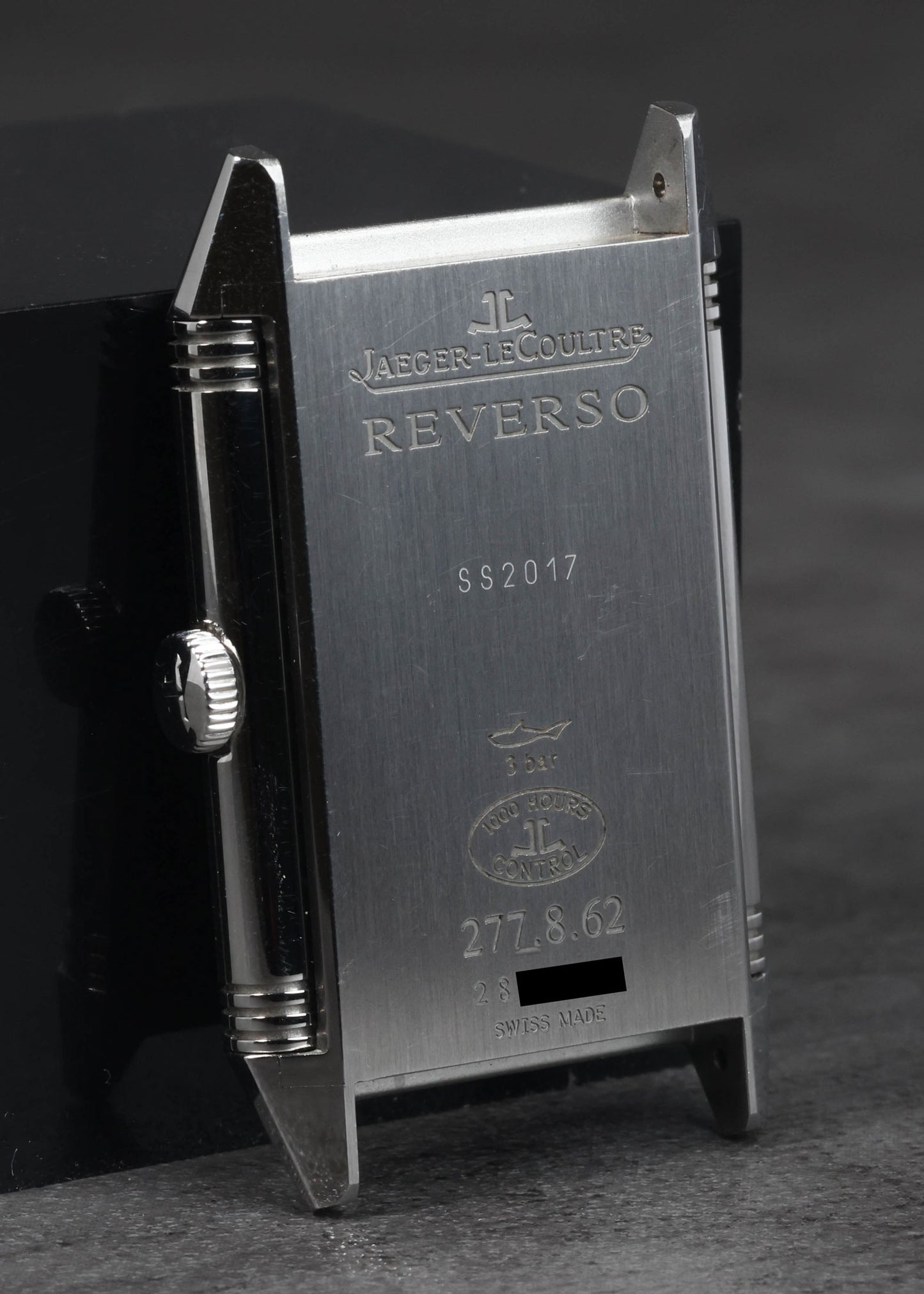
Jaeger-LeCoultre Reverso ultra thin 277.8.62 27x46mm Circa 2014
Jaeger-LeCoultre Reverso ultra thin 277.8.62 27x46mm Circa 2014
Couldn't load pickup availability
Jaeger-LeCoultre Reverso ultra thin 277.8.62 27x46mm Circa 2014
Case is in good condition with hairline scratches visible around the edges, consistent with light wear. Bracelet shows similar wear but remains well-presented overall. Original leather strap is in good condition with moderate signs of use. Dial and hands are flawless, displaying no marks, ageing, or discolouration. A clean and well-kept example throughout.
Share
Why we love this watch
Why we love this watch
Jaeger-LeCoultre Reverso Ultra Thin 277.8.62
A Modern Expression of a 1931 Design
Produced during the early 2010s, the Jaeger-LeCoultre Reverso Ultra Thin reference 277.8.62 represents a contemporary interpretation of one of the most recognisable wristwatch designs ever created. Measuring approximately 27mm by 46mm, the watch preserves the proportions and geometric elegance that have defined the Reverso since its introduction in 1931 while incorporating a modern ultra-thin mechanical movement and refined finishing.
The Reverso occupies a distinctive place within twentieth century watch design. Unlike many watches whose forms evolved gradually, the Reverso was conceived to solve a specific problem. Its reversible case allowed the dial to be protected during physical activity, particularly polo matches. More than ninety years after its introduction, that original engineering solution remains central to the watch’s identity.
The reference 277.8.62 continues this tradition while emphasising slender proportions and mechanical simplicity. The watch focuses on clarity, balance, and craftsmanship rather than complication. It reflects Jaeger-LeCoultre’s long-standing reputation as both a movement manufacturer and a designer of refined mechanical wristwatches.
Origins of the Reverso
The Reverso was introduced in 1931 at a time when wristwatches were becoming increasingly popular but were still considered relatively delicate objects. The concept originated from a request by British Army officers stationed in India who played polo and needed a watch that could withstand the impacts associated with the sport.
According to historical accounts, Swiss businessman César de Trey encountered these officers and was asked whether a watch could be produced with a dial protected from damage during matches. De Trey brought the idea to Jacques-David LeCoultre, whose company already had a reputation for producing high-quality movements.
The challenge was to create a case that could rotate while maintaining structural integrity and water resistance. The solution was developed by René-Alfred Chauvot, who patented the reversible case design in 1931. The watch could slide within its cradle and flip over so that the solid metal caseback faced outward, protecting the dial.
The Reverso quickly became associated with the Art Deco design movement of the early twentieth century. Its rectangular case, geometric lines, and decorative gadroons at the top and bottom of the dial reflected the architectural and artistic influences of the period.
While originally designed as a practical sports watch, the Reverso soon gained popularity as a refined dress watch. Over the decades, the design remained remarkably consistent even as movements and materials evolved.
The Reverso in the Modern Era
Throughout the twentieth century, the Reverso underwent several phases of development. After the Second World War, demand for rectangular watches declined as round designs became dominant. As a result, production of the Reverso slowed significantly.
Interest in the model returned during the 1970s and 1980s as collectors and enthusiasts rediscovered historical designs. Jaeger-LeCoultre reintroduced the Reverso with updated movements and refined finishing, re-establishing it as a central part of the brand’s identity.
During the 1990s and 2000s, the Reverso became a platform for a wide range of complications. Models were introduced with dual time displays, power reserve indicators, and tourbillons. Despite these innovations, Jaeger-LeCoultre also continued producing simpler versions that remained closer to the original concept.
The Reverso Ultra Thin series represents this approach. These watches focus on elegant proportions and slim mechanical movements, reflecting the aesthetic principles that defined the earliest Reverso models.
Case Design and Proportions
The reference 277.8.62 features a rectangular stainless steel case measuring approximately 27mm by 46mm. This elongated form preserves the classical Reverso silhouette while ensuring comfortable wear on the wrist.
The case consists of two primary components: the central carriage that holds the dial and movement, and the outer cradle that allows the watch to slide and rotate. When the carriage is released, it can pivot within the cradle and flip over, revealing the solid metal reverse side.
The mechanism itself is engineered with remarkable precision. The carriage moves smoothly within the rails of the cradle, and the rotation occurs along a central axis designed to maintain stability during operation.
Decorative gadroons at the top and bottom of the case remain one of the defining visual elements of the Reverso. These raised horizontal lines frame the dial and reinforce the watch’s Art Deco heritage.
Despite the complexity of the reversible mechanism, the watch maintains a slim profile. The Ultra Thin designation reflects Jaeger-LeCoultre’s focus on producing watches that sit comfortably beneath a shirt cuff while retaining mechanical integrity.
Dial Architecture and Art Deco Influence
The dial of the Reverso Ultra Thin 277.8.62 reflects the design principles established in the earliest Reverso watches. The layout emphasises symmetry, clarity, and restrained decoration.
A silvered dial surface forms the foundation of the design, often finished with a subtle guilloché or sunray texture. Applied hour markers or printed Arabic numerals provide structure while maintaining visual balance.
The minute track is typically arranged around the outer edge of the dial, creating a frame that reinforces the rectangular geometry of the watch. Slim baton hands indicate the hours and minutes, ensuring legibility without overwhelming the dial.
The Jaeger-LeCoultre signature appears beneath twelve o’clock, accompanied by minimal additional text. This restrained approach ensures that the dial remains uncluttered and harmonious.
Because the case can be reversed, the solid metal back often becomes a canvas for engraving or decorative work. Many Reverso owners choose to personalise the reverse side with inscriptions, coats of arms, or other designs.
The Ultra Thin Movement
At the heart of the Reverso Ultra Thin 277.8.62 is a manually wound mechanical movement developed by Jaeger-LeCoultre. The manufacture has long been recognised as one of the most important movement producers in Swiss watchmaking.
The movement used in the Ultra Thin Reverso is designed specifically to fit within the rectangular case while maintaining a slim profile. Manual winding allows the movement to remain thinner than many automatic alternatives.
Jaeger-LeCoultre has historically produced a large number of in-house calibres, earning the company the nickname “the watchmaker’s watchmaker.” Many other luxury brands have sourced movements from Jaeger-LeCoultre over the decades.
The movement used in this reference operates at a traditional frequency and provides a stable power reserve suitable for daily wear. Bridges and plates are finished using traditional techniques such as Geneva stripes and perlage, reflecting the manufacture’s commitment to mechanical craftsmanship.
Engineering of the Reversible Case
One of the most fascinating aspects of the Reverso is the engineering of its rotating case. The mechanism must allow the watch to flip smoothly while maintaining the alignment of the case and ensuring structural durability.
The carriage slides laterally within the cradle before rotating along its axis. Once rotated, the carriage locks back into place, creating a stable surface for the watch to rest against the wrist.
This mechanism requires precise tolerances to function correctly. Even slight variations in machining could cause the case to bind or rotate unevenly. Jaeger-LeCoultre’s expertise in case manufacturing ensures that the mechanism operates smoothly even after repeated use.
The reversible design also protects the crystal and dial when necessary. Although modern watches are far more durable than those produced in the 1930s, the rotating case remains an iconic feature that connects the watch to its origins.
Wearing Experience
On the wrist, the Reverso Ultra Thin wears differently from round watches of similar dimensions. The elongated rectangular shape creates a strong visual presence while maintaining a slim profile.
The watch sits comfortably along the wrist thanks to its curved caseback and balanced proportions. The slim movement allows the watch to remain discreet beneath clothing.
A leather strap is typically fitted to the watch, complementing its refined appearance. The strap integrates cleanly with the case, reinforcing the overall elegance of the design.
Despite its formal character, the Reverso remains practical for daily wear. The manually wound movement encourages interaction with the watch, while the reversible case adds a tactile dimension to ownership.
Historical Significance
The Reverso occupies a unique place within the history of wristwatch design. Few watches have maintained such a consistent identity over nearly a century of production.
The design reflects the broader cultural and artistic movements of the early twentieth century. The geometric lines and decorative elements align closely with the Art Deco style that dominated architecture and design during the 1930s.
At the same time, the Reverso demonstrates Jaeger-LeCoultre’s technical capabilities. The reversible case required innovative engineering and precise manufacturing techniques that were uncommon at the time.
Over the decades, the Reverso has served as a platform for both simple time-only watches and highly complicated mechanical creations. This versatility reflects the flexibility of the original design.
The Reverso Within Jaeger-LeCoultre
For Jaeger-LeCoultre, the Reverso represents more than a single watch model. It is a symbol of the manufacture’s history and its ability to combine technical innovation with refined aesthetics.
The company was founded in the Vallée de Joux, a region of Switzerland known for its long tradition of watchmaking. From its earliest years, Jaeger-LeCoultre focused on producing high-quality mechanical movements and instruments.
Throughout the twentieth century, the manufacture developed numerous calibres and complications, supplying movements to many prestigious watch brands. This reputation for technical expertise continues today.
The Reverso stands as one of the clearest expressions of this heritage. It combines mechanical ingenuity, historical continuity, and timeless design in a single object.
Final Thoughts
The Jaeger-LeCoultre Reverso Ultra Thin reference 277.8.62 represents a modern interpretation of a design first conceived in 1931. Its rectangular case, reversible mechanism, and balanced dial layout remain faithful to the original concept while incorporating contemporary manufacturing techniques.
The watch demonstrates how a single design can endure across decades without losing its relevance. By maintaining the essential elements of the Reverso while refining its proportions and movements, Jaeger-LeCoultre has preserved one of the most distinctive wristwatch designs in horology.
The reference 277.8.62 highlights the enduring appeal of simplicity. Rather than relying on complex complications or bold aesthetics, the watch focuses on proportion, craftsmanship, and mechanical integrity.
Nearly a century after its introduction, the Reverso continues to illustrate how thoughtful engineering and disciplined design can create a watch that remains relevant across generations.
References
Jaeger-LeCoultre. The Reverso Story. Manufacture archives and official publications.
Reinhard Meis. Jaeger-LeCoultre. Schiffer Publishing.
Franco Cologni. Jaeger-LeCoultre: The Story of the Grande Maison.
Phillips Watches. Historical essays and auction catalogues discussing Reverso models.
Europa Star archives covering the history of the Reverso and its development.
Case & Bracelet
Case & Bracelet
Case and bracelet in very good condition with hairline scratches visible around case. Strap original leather in good condition.
Dial & Hands
Dial & Hands
Dial and hands are in flawless condition.
Warranty & Condition
Warranty & Condition
Crown Vintage Watches provides a minimum 6-month mechanical warranty on pre-owned watches, from the date of purchase.
The warranty covers mechanical defects only.
The warranty does not cover damages such as scratches, finish, crystals, glass, straps (leather, fabric or rubber damage due to wear and tear), damage resulting from wear under conditions exceeding the watch manufacturer’s water resistance limitations, and damage due to physical and or accidental abuse.
Please note, water resistance is neither tested nor guaranteed.
Shipping and insurance costs for warranty returns to us must be covered by the customer. Returns must be shipped via traceable courier. Return shipment must be pre-paid and fully insured. Collect shipping will be refused. In case of loss or damages, the customer is liable.
Our Pledge
At Crown Vintage Watches, we stand by the authenticity of every product we sell. For added peace of mind, customers are welcome to have items independently authenticated at their own expense.
Condition
Due to the nature of vintage timepieces, all watches are sold as is. We will accurately describe the current condition and working order of all watches we sell to the best of our ability.
Shipping & Refund
Shipping & Refund