

Crown Vintage
Omega Flightmaster 145.026 44mm 1970s
Omega Flightmaster 145.026 44mm 1970s
Couldn't load pickup availability
Omega Flightmaster 145.026 44mm 1970s
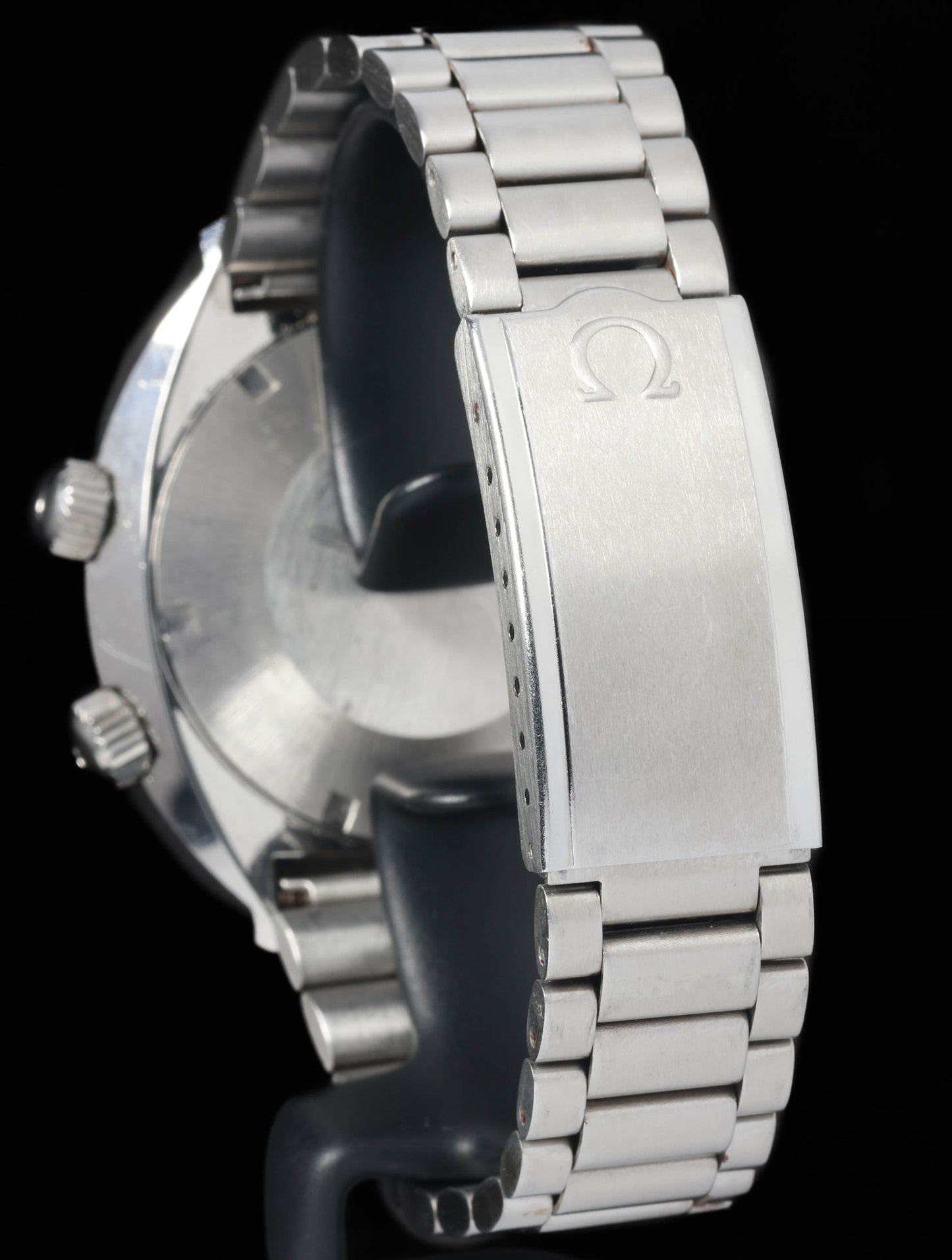
This Omega Flightmaster presents in good, unpolished condition with light, even oxidisation consistent with age. The distinctive tonneau case retains sharp edges and original radial brushing across the upper surface, with hooded lugs crisp and free of distortion; no dents or deep marks are evident in normal light. Crowns and pushers operate positively, with the chronograph starting, stopping and resetting correctly; the internal rotating bezel turns smoothly via its dedicated crown. The dial shows even oxidisation that reads honest for age, with printing remaining clear and legible. Hands are oxidised in a manner that matches the dial, with intact shape and correct alignment. The Omega steel bracelet exhibits some stretch as to be expected for the era; links articulate well and the clasp closes securely.
Share
Why we love this watch
Why we love this watch
Omega Flightmaster 145.026: The Pilot’s Chronograph For The Jet Age
Introduction
Produced between 1971 and 1972, the Omega Flightmaster 145.026 refined Omega’s dedicated pilot’s chronograph into a clearer, more intuitive instrument for real cockpit use. It kept the independent second time zone hand, added constant running seconds, and grouped operations by colour so the functions could be read and used at speed. With an internal elapsed time bezel under mineral glass, a tonneau case built to sit low and stable, and the calibre 911 inside, this reference shows how Omega approached aviation as its own design problem rather than a spin off of racing or diving watches.
Origins And Historical Context
Why Omega Built A Separate Aviation Platform
By the end of the 1960s, commercial aviation was expanding quickly and long haul routes meant time zone management was a daily task for crews. Omega already had the Speedmaster for motorsport timing and, by fortune, for spaceflight. The Flightmaster project set out to create a purpose built wrist instrument for pilots that put time zones and segment timing ahead of tachymeters or dive rings. The result was a family that speaks a distinct language of colour coding, protected timing scales and ergonomics aimed at gloved hands, glare and fatigue.
From First Flightmaster To 145.026
The series began with reference 145.013 and the calibre 910, which used a 24 hour day and night indicator at nine o’clock. Feedback from pilots was straightforward. They wanted a true running seconds on the dial so they could confirm the watch was operating at a glance without starting the chronograph. Omega answered with the calibre 911 in the 145.026. The display kept the core layout, but the sub dial at nine became constant seconds, which made the instrument behave more like a traditional chronograph while keeping the aviation tools intact.
Professional Use And Cultural Footnotes
The Flightmaster was worn by working aircrew and even appeared in training for the Apollo Soyuz Test Project on the wrist of Alexei Leonov. The Speedmaster remained the official choice for NASA missions, yet this separate aviation platform found its audience with those who valued a protected internal bezel, an independently adjustable second time zone hand and a bright, legible dial that could be parsed quickly under pressure.
Case Architecture And Wrist Presence
Tonneau Case With Hooded Lugs
The stainless steel case measures around 43 mm across, with broad shoulders and hooded lugs that pull the strap or bracelet close to the case body. The form spreads mass evenly so the watch sits low and stable rather than feeling tall. Radial brushing on the upper surface diffuses reflections, a practical touch when cockpit lighting and sun angles can create glare. Polished transitions on the flanks keep the large case from looking blocky while preserving a tool first look.
Mineral Crystal And Sealed Bezel
A hardened mineral glass crystal covers the dial and the internal 60 minute bezel. Housing the timing ring under the glass keeps it safe from knocks and debris and removes the risk of accidental movement. The case back is engraved with the Flightmaster aircraft motif around the model signature, a plain statement of purpose that sets it apart from Speedmaster and Seamaster families at a glance.
Dimensions That Wear Smaller
On the wrist the shape hugs rather than towers. The downturned case sides and the hooded lugs shorten the visual span, while the balanced mass of the head and bracelet distributes weight comfortably. The result is a large instrument that wears with more ease than the numbers suggest, helped by a centre of gravity close to the arm.
Colour Coded Controls
Blue For The Second Time Zone
A crown at ten o’clock carries a blue ring and controls the blue 12 hour hand. It adjusts in one hour steps, which keeps operation simple when crossing time zones. This hand reads like a normal hour hand and can be set to home base or destination time without any extra scales on the dial, so legibility stays clean.
Black For The Internal Bezel
A crown at roughly eight thirty wears a black ring and turns the inner 60 minute bezel. This is the quick way to mark a taxi window, a hold, or any short segment without running the chronograph. Because it sits under the crystal, it cannot be nudged off position in tight spaces.
Chronograph Pushers And Main Crown
The main crown at three winds and sets local time. The pushers at two and four start, stop and reset the chronograph. Omega matched timing hands and pusher accents to keep the storyline simple. Time zone is blue, bezel is black, timing is bright. In a cockpit, these cues reduce the chance of grabbing the wrong control by habit or fatigue.
Movement And Functionality
Calibre 911 Basics
Manual wound calibre 911 is derived from the proven 861 architecture. It beats at 21,600 vph, uses cam and lever chronograph switching refined by Omega for reliability, and is built to handle vibration, temperature swings and pressure changes. Sub dials are classic tri register. Running seconds at nine, 30 minutes at three, 12 hours at six. The centre hand carries chronograph seconds.
Independent Second Time Zone
Set local time with the main crown, then rotate the blue crown to align the blue hour hand to home or destination. Because it is a 12 hour indication, reading the second zone is immediate. Pilots can keep local time for the cockpit and a base time for logs or crew schedules without mental conversion or clutter.
Two Ways To Time Segments
For short checks, rotate the internal bezel so its triangle touches the minute hand, then read elapsed minutes at a glance. For longer or logged intervals, run the chronograph. Minutes accumulate at three, hours at six, seconds at centre. Separating bezel timing from the chronograph means one can run a long measure and still mark quick segments without losing track.
Dial Language And Legibility
Hands And Indices
The dial is built to rank information in a clear order. Time is primary, the blue second time zone is distinct, the timing set is high contrast in orange or yellow, and sub dials are pared back to strong scales and numbers. Hour markers and hands carry luminous material sized for fast reading, with enough paint for legibility but not so much that it washes detail.
Grounds And Contrasts
Period dials appear in matte or satin grey and black. The neutral grounds make colour accents work harder. The eye finds local time first, then the blue hand, then the timing set. Printing is crisp and thin, with a minute track that reads cleanly even when viewed from the side. Nothing feels decorative for its own sake. Each mark exists to support a task.
Night And Low Light
Lume plots and filled hands keep core time and timing visible in low light. The mineral glass avoids the soft distortion of acrylic at shallow angles, which helps when glancing from an instrument panel. Radial brushing on the case top cuts stray reflections that can obscure a quick read.
Variants Within The Family
145.013 To 145.036
The 145.013 introduced the idea with day and night at nine o’clock. The 145.026 replaced that disc with running seconds and kept the rest of the system intact. The 145.036 continued with calibre 911 and a slightly thicker case construction. All share the colour coded crowns, the blue 12 hour hand and the sealed inner bezel. The changes across references are logical responses to field use rather than cosmetic shifts.
Handsets And Small Details
Chronograph hands appear in orange or yellow depending on production set, both chosen to separate timing from the blue time zone. Some period dials show warm ageing on sub dials that adds visual depth without changing function. Text, logo weights and indices remain restrained so that colour can carry the hierarchy.
Bracelets And Straps
Flat link and oval link steel bracelets are commonly seen, shaped to fit the hooded lugs. They articulate smoothly and spread weight evenly. A 20 mm lug gap also welcomes leather or textiles for pilots who prefer less reflection under bright light. The case geometry keeps most straps close to the body of the watch, so the silhouette stays tidy.
Design Significance
Human Factors Done Well
The 145.026 is a clear example of human factors shaping a product. Controls are grouped, colour coded and sized for the task. The internal bezel is protected and cannot be bumped out of position. Brushing reduces glare where it matters. The dial gives priority to tasks in a hierarchy that matches real use, not showroom drama.
A Separate Identity From Speedmaster And Seamaster
Rather than borrowing a tachymeter or an external bezel, Omega built an aviation instrument with its own grammar. The Flightmaster is not a dressed up racer or a diver with an extra hand. It is a pilot’s watch that treats time zones and segment timing as primary and everything else as support. That separation explains why the reference reads coherent decades later.
Short Production, Long Echo
Although production was brief relative to other Omega lines, the lessons are durable. Modern pilot chronographs that succeed tend to follow the same guide. Keep the critical information large and distinct, keep auxiliary timing protected, and keep controls obvious enough that the user does not need to think twice when a task appears suddenly.
Final Thoughts
The Omega Flightmaster 145.026 is the crispest expression of Omega’s aviation brief from the early 1970s. It restores running seconds so status is obvious, keeps an independently adjustable 12 hour hand for the second zone, protects the 60 minute bezel under mineral glass and maps every control to a colour so the user always knows what does what. The tonneau case looks bold yet wears with surprising ease, the dial is information dense yet legible, and the feature set mirrors the real cadence of a flight. Set local time, place the blue hand on base, align the inner ring for segments and let the chronograph handle blocks. Everything is in its place, ready for work, which is exactly what a pilot’s chronograph should be.
Case & Bracelet
Case & Bracelet
- Case excellent unpolished condition with light oxidisation.
- Bracelet has some stretch as to be expected with age.
Dial & Hands
Dial & Hands
- Dial oxidised.
- Hands oxidised.
Warranty & Condition
Warranty & Condition
Crown Vintage Watches provides a minimum 6-month mechanical warranty on pre-owned watches, from the date of purchase.
The warranty covers mechanical defects only.
The warranty does not cover damages such as scratches, finish, crystals, glass, straps (leather, fabric or rubber damage due to wear and tear), damage resulting from wear under conditions exceeding the watch manufacturer’s water resistance limitations, and damage due to physical and or accidental abuse.
Please note, water resistance is neither tested nor guaranteed.
Shipping and insurance costs for warranty returns to us must be covered by the customer. Returns must be shipped via traceable courier. Return shipment must be pre-paid and fully insured. Collect shipping will be refused. In case of loss or damages, the customer is liable.
Our Pledge
At Crown Vintage Watches, we stand by the authenticity of every product we sell. For added peace of mind, customers are welcome to have items independently authenticated at their own expense.
Condition
Due to the nature of vintage timepieces, all watches are sold as is. We will accurately describe the current condition and working order of all watches we sell to the best of our ability.
Shipping & Refund
Shipping & Refund