

Crown Vintage
Omega Genève Admiralty 135.015 'Tropical' 35mm Queensland Rail 1969
Omega Genève Admiralty 135.015 'Tropical' 35mm Queensland Rail 1969
Couldn't load pickup availability
Omega Genève Admiralty 135.015 'Tropical' 35mm Queensland Rail 1969
The case is in good condition, showing wear consistent with careful use and retaining its original profile. Case edges remain fairly sharp with no major dents or deep marks visible. The bracelet presents in good condition with some stretch, links articulate smoothly, and the clasp closes securely. The bezel is in good condition with clear numerals and no notable damage.
The dial and hands are in great condition. Dial has formed a very unique tropical patina. Hands lightly oxidised but remain in good condition.
Share
Why we love this watch
Why we love this watch
The Watch That Rode the Queensland Railways: Omega Genève Admiralty 135.015 'Tropical'
There is a class of watch that earns its interest not through celebrity endorsement, space program provenance, or record-breaking auction results, but through the particular circumstances of its working life. The Omega Genève Admiralty reference 135.015 supplied to Queensland Rail from late 1969 is precisely this kind of watch. It was not designed for explorers or pilots. It was issued to railway workers in Queensland, worn through decades of service in the subtropical heat, and marked with an individual asset number engraved onto the case back by the government department that owned it. The example presented here carries the number 343. As of the most recent documented research into this batch, only a handful of Queensland Rail Admiralty pieces were known to have survived in private hands. To encounter one in this condition, with its chocolate-brown tropical dial intact and its original case showing the honest marks of working wear, is to hold a fragment of Australian horological history that the official record has barely begun to account for.
Omega and the Genève Line: A Name with Purpose
To understand where the 135.015 sits, it helps to know what the Genève designation meant. Louis Brandt founded the company that would become Omega in 1848 in La Chaux-de-Fonds, and the brand took its name from the Calibre Omega movement in 1895, the year in which its watches achieved a precision of thirty seconds per day. By the turn of the century, Omega was one of Switzerland's largest watch producers, with annual output reaching 240,000 pieces and the workforce numbering 800 people.
The Genève line was created in 1953 as a tribute to the Omega workshops in Geneva where the company's best regulators were trained and based. The name carried weight: it positioned the line not as a budget tier but as a range with a direct connection to the highest traditions of Swiss horology. By 1970, the Genève collection accounted for more than 60 percent of Omega's total sales, making it one of the most commercially successful ranges the brand had ever produced. The Genève name was eventually discontinued in 1979 under Swiss trademark law, which required a manufacturer to maintain a physical presence in the canton of Geneva in order to use the word on the dial. When it disappeared, it left behind a body of work that ranged from elegant dress references to tool-oriented sport models, and it was in that latter category that the Admiralty had carved out its particular place.
The Admiralty Reference: Sport in the Genève Range
The Omega Genève Admiralty was introduced in 1968, occupying an interesting position within the Genève collection. For Omega, the Admiralty represented what one watchmaker and historian has described as "a shy attempt to produce a 'light' sports model in the Geneva range, without interfering too much with the Seamaster line." The reference walked a careful line: it had the visual language of a professional tool watch, with bold Arabic numerals, an oversized tritium marker at 12 o'clock in place of a numeral, a full railroad minute chapter ring, and a prominent orange anchor symbol on the lower dial. That anchor, rendered in a matching orange to the sweep seconds hand, indicated water resistance to 30 metres and gave the watch its informal name. It was not a diving watch in the technical sense that the Seamaster Professional was; it was a waterproof, legible, manually wound instrument designed for general professional use by people who needed a reliable timekeeper that could handle wet and demanding conditions.
The case architecture reinforces this character. At 35mm without the crown and 38mm including it, the 135.015 wears with the authority of a proper tool watch while remaining compact enough for daily wear. Crown guards flank the signed Omega crown, providing physical protection for the winding and setting mechanism in a way that signals professional intent. The case back is a screw-down construction signed with the Omega shield and the "Waterproof" designation. The acrylic crystal sits domed above the dial, signed with the Omega logo in its centre, providing both protection and period-accurate material authenticity.
Australian Railways and the Tradition of the Issued Watch
Omega's relationship with Australian railways pre-dates the Admiralty by several decades. From 1947 to the late 1970s, Omega was an official supplier to the Western Australian and Victorian Railways as well as the New South Wales Government Rail and Tram Department. The majority of these issued timepieces were pocket watches, predominantly Calibre 38.5 T1-161 examples with enamel dials and blue hands, with dial text signed according to the department that received them. This was part of a much longer tradition: in the late nineteenth century, the NSW Government had ordered precision pocket watches from the American Watch Company in Waltham, Massachusetts, issuing every train driver and station master with a numbered timekeeper. The individual number engraved on the case back corresponded to the worker's assigned instrument, creating a chain of accountability for one of the most safety-critical tools in railway operation.
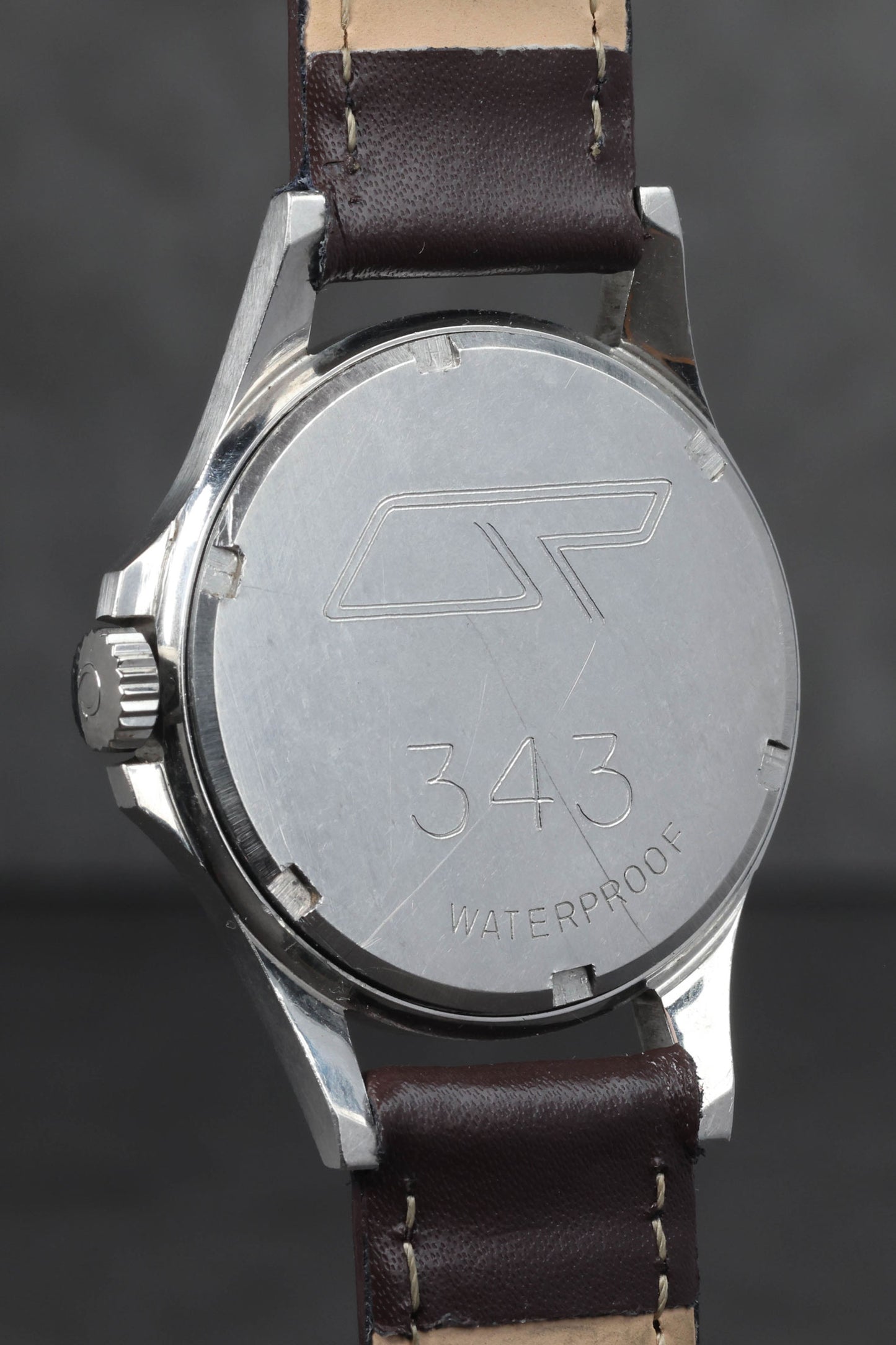
The Queensland Rail wristwatch batch represents a natural evolution of this practice into the wristwatch era. Omega supplied a small number of reference 135.015 Admiralty wristwatches to Queensland Rail from late 1969 through to the late 1970s, issued to rail workers as official railroad timekeepers. What distinguishes this batch from the standard commercial 135.015 is the dial. While production Admiralty references were offered with black military-style dials, the Queensland Rail pieces came with a dark brown, chocolate-toned Genève dial paired with the orange sweep hand. Each watch was engraved on the case back with its individual Queensland Railways asset number beneath the QR logotype. The case back of this example carries the number 343.
As of 2019, documented research by Sydney watchmaker Nicholas Hacko identified only three Queensland Rail Admiralty pieces known to have survived in private hands: numbers 31, 251, and 345. The existence of a fourth documented number adds to the emerging picture of a batch that was modest in scale, issued in working conditions, and which has largely not survived the decades intact. That this example has survived in the condition visible here, with its chocolate dial showing natural tropical patina and its original case architecture unpolished, makes it one of the more significant pieces in the documented record of Australian issued watch history.
Calibre 601: The Movement Behind the Mission
The movement inside the 135.015 is the Omega Calibre 601, a manually wound 17-jewel lever escapement calibre with a frequency of 19,800 vibrations per hour. First introduced in 1962, the Calibre 601 was produced until 1970, and its manufacturing timeline aligns precisely with the production period of the 135.015. The calibre offers a 48-hour power reserve when fully wound, is fitted with Incabloc shock protection, and features an excenter regulator for fine-tuning the rate. It is adjusted in two positions and does not carry COSC chronometer certification, but it was never intended to. The 601 was built for reliability, serviceability, and longevity. Its copper-toned plate finish has become a point of affection among watchmakers who encounter it: the movement is regarded as straightforward to service, robust in daily use, and accurate over extended periods without the need for frequent regulation.
The Calibre 601 was an evolution of the Calibre 600 and became one of Omega's most successful manual-wind calibres by production volume. As the powerhouse of the Genève line at its commercial peak, it provided the mechanical foundation for one of the best-selling Swiss watch collections of the 1960s. For a government department procuring instruments intended for daily professional use over many years, a calibre of this character was the appropriate choice: not the most complicated or expensive movement Omega produced, but one of the most durable.
The Tropical Dial: Chemistry and Time
The term 'tropical' in the context of vintage watches describes a specific kind of dial ageing, driven primarily by prolonged ultraviolet exposure, that produces a tonal shift in the lacquer or paint away from the original colour. In the Queensland Rail batch, the original dial was already chocolate brown, a departure from the matte black of standard Admiralty production. What the years and the Queensland climate have done to this example is to deepen and enrich that chocolate tone further, producing the warm, layered patina visible across the dial surface. The radial texture of the Genève dial catches light differently across this aged lacquer, creating a chromatic depth that a new dial simply cannot replicate.
The orange anchor and the orange sweep seconds hand remain vivid against this background, their colour retained with a brightness that makes the contrast between the warm dial field and the sharp orange accents more striking with age rather than less. The tritium lume plots in the Arabic numeral hour markers and the oversized triangular 12 o'clock index have taken on their own cream patina, consistent with the age of a dial manufactured in 1969. This consistent ageing across all dial elements is one of the indicators of a dial that has aged naturally in its original case, rather than one that has been replaced or treated.
Final Thoughts
The Omega Genève Admiralty reference 135.015 in Queensland Rail configuration is not a watch that announces itself. Its 35mm case is modest by contemporary standards. Its movement is not a chronometer. It carries no association with a famous race or a space mission. What it carries instead is a direct and documented connection to a specific place, a specific institution, and a specific era of Australian working life. The chocolate tropical dial, the orange anchor, the QR logotype and the number 343 engraved on the case back: each element is a fact about the watch's origin and history that no reproduction can create. Omega was an official supplier to Australian railways for over three decades. The Admiralty batch issued to Queensland Rail from 1969 represents the final chapter of that relationship in wristwatch form, issued in small numbers and worn through conditions that most watches from this period did not survive. That this example has come through them intact is worth recording carefully.
References
- Hacko, Nicholas. "Could this be the most sought after 'Queenslander's' Omega?" Nicholas Hacko Watchmaker Blog. June 21, 2019. nickhacko.blogspot.com.
- Hacko, Nicholas. "Victoria Rail watch: Peerless SHOCKMASTER." Nicholas Hacko Watchmaker Blog. June 26, 2019. nickhacko.blogspot.com.
- Hacko, Nicholas. "Welcome back to NSW, my baby." Nicholas Hacko Watchmaker Blog. June 20, 2019. nickhacko.blogspot.com.
- Vintage Watch Specialist. "Omega Geneve Admiralty Model Reference 135.015 c.1968." vintagewatchspecialist.com. Accessed May 2026.
- Wannabuyawatch.com. "Omega Geneve 'Admiralty' ref 135.015 circa 1968." Accessed May 2026.
- Ottuhr.com. "Omega Genève 135.041 Reference Report — Calibre 601." ottuhr.com. Published February 2026.
- Orologium. "HEUER Autavia 73463 Orange Boy Silver." orologium.com. Accessed May 2026.
- Timeline.watch. "1971 Omega Geneve Admiralty ref. ST 135.042 cal. 601." timeline.watch. Accessed May 2026.
- TAG Heuer. "Vintage Heuer Autavia Collection." tagheuer.com. Accessed May 2026. [Referenced for context on Australian Admiralty issued variants.]
- Wikipedia contributors. "Omega SA." Wikipedia, The Free Encyclopedia. Accessed May 2026.
Case & Bracelet
Case & Bracelet
- Case in good vintage condition
- Hairlines visible
- Strap in good condition
Dial & Hands
Dial & Hands
- Dial has formed tropical patina
- Hands good condition
Warranty & Condition
Warranty & Condition
Crown Vintage Watches provides a minimum 6-month mechanical warranty on pre-owned watches, from the date of purchase.
The warranty covers mechanical defects only.
The warranty does not cover damages such as scratches, finish, crystals, glass, straps (leather, fabric or rubber damage due to wear and tear), damage resulting from wear under conditions exceeding the watch manufacturer’s water resistance limitations, and damage due to physical and or accidental abuse.
Please note, water resistance is neither tested nor guaranteed.
Shipping and insurance costs for warranty returns to us must be covered by the customer. Returns must be shipped via traceable courier. Return shipment must be pre-paid and fully insured. Collect shipping will be refused. In case of loss or damages, the customer is liable.
Our Pledge
At Crown Vintage Watches, we stand by the authenticity of every product we sell. For added peace of mind, customers are welcome to have items independently authenticated at their own expense.
Condition
Due to the nature of vintage timepieces, all watches are sold as is. We will accurately describe the current condition and working order of all watches we sell to the best of our ability.
Shipping & Refund
Shipping & Refund