

Crown Vintage
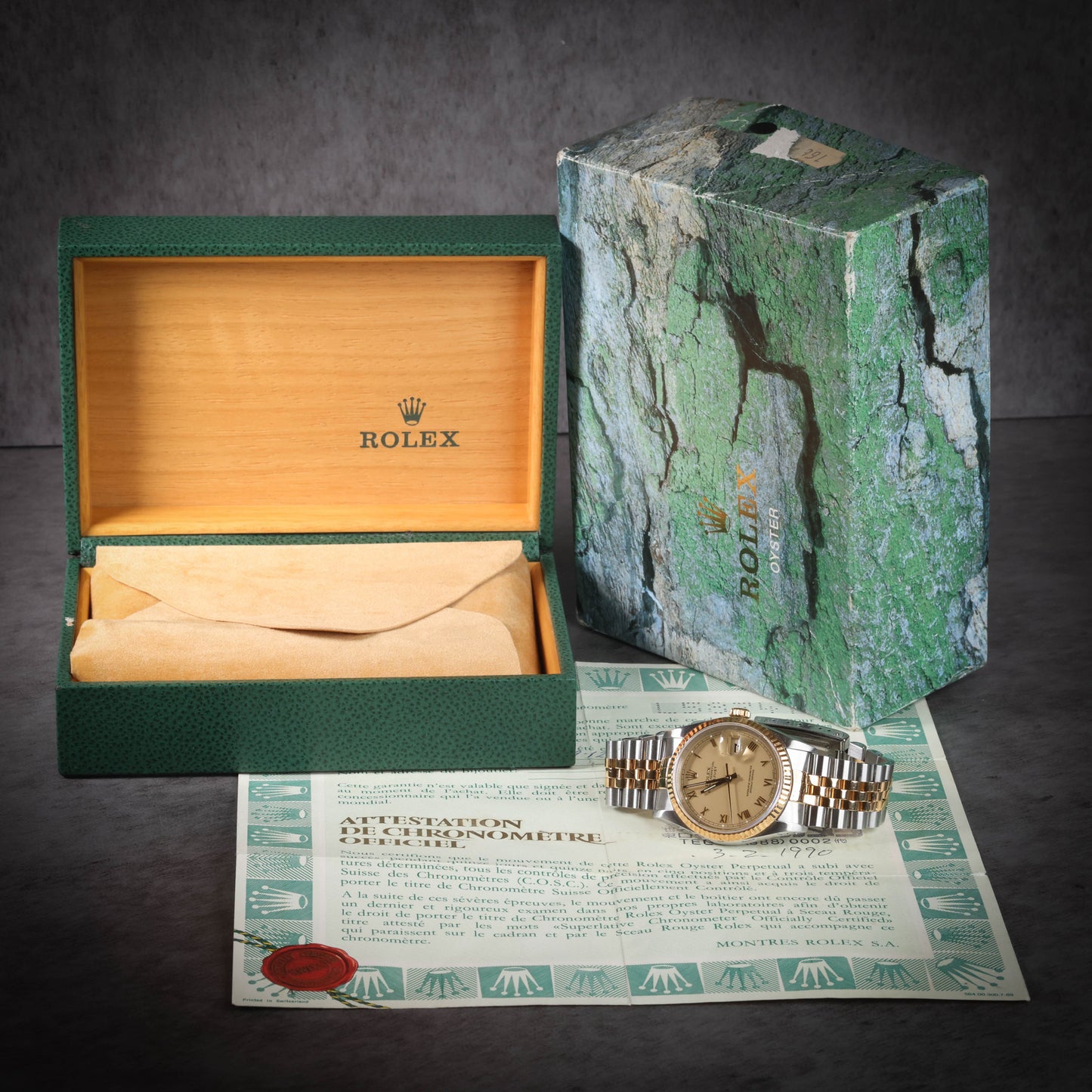
Rolex Datejust 16233 'Lemon Dial' 36mm 1989 Box & Papers
Rolex Datejust 16233 'Lemon Dial' 36mm 1989 Box & Papers
Couldn't load pickup availability
Rolex Datejust 16233 'Lemon Dial' 36mm 1989 Box & Papers
This Rolex Datejust 16233 presents in very good overall condition, consistent with careful wear over time. The stainless steel and yellow gold case remains well preserved, with light hairline marks visible around the case sides that are in keeping with age and use. Case proportions and overall geometry remain intact, with no signs of heavy wear.
The Jubilee bracelet is in very good condition, showing some stretch as expected for its age, while retaining a clean and even appearance throughout. It remains structurally sound and sits correctly on the wrist.
The dial and hands are in great condition, with clear printing and even patina across the surface. The warm lemon tone reflects natural ageing rather than a factory colour, giving the watch subtle character without detracting from legibility.
Witschi WAIO Test Results
From a performance perspective, the watch has passed a 5.0 bar water tightness test using the Witschi WAIO machine and has been demagnetised. Chronometry testing across four positions shows excellent results, with an average rate of +4.8 seconds per day, 0.1 ms beat error, and 269° amplitude, confirming strong and stable operation.
Vintage Use Note
Given this watch is over 30 years old, it should be treated as a vintage timepiece and we recommend avoiding swimming or water exposure, even though it has passed water resistance testing at the time of assessment.
Share
Why we love this watch
Why we love this watch
Rolex Datejust 16233 Roman Lemon Dial
Produced between 1988 and 2004, the Rolex Datejust 16233 represents one of the longest running and most recognisable configurations of the modern classic Datejust line, combining a 36mm stainless steel and yellow gold case with an automatic chronometer movement and the signature date display at three o’clock. The example discussed here features a Roman numeral dial with a warm lemon tone and carries an L serial, placing its manufacture in the late 1980s, a period when Rolex was refining the balance between traditional design language and modern mechanical upgrades.
The Datejust as a Foundation of Rolex Design
The Datejust occupies a unique position within the history of Rolex. Introduced in 1945 to mark the brand’s 40th anniversary, it was the first self-winding wristwatch to display the date automatically changing at midnight through an aperture on the dial. This innovation was not presented as a technical novelty alone but as a practical advancement for everyday wear, reinforcing Rolex’s focus on precision, reliability, and legibility.
From its earliest references, the Datejust established a design formula that has endured for decades: a round Oyster case, a fluted or smooth bezel, a clear date window magnified by the Cyclops lens, and a dial that prioritised balance over ornamentation. Over time, the Datejust became a platform rather than a single watch, allowing Rolex to introduce incremental changes in movements, materials, and dial configurations while maintaining a consistent identity.
The Evolution Toward the 16233
By the late 1980s, Rolex had already produced several generations of Datejust references, each reflecting gradual technical improvements rather than abrupt stylistic shifts. Earlier references such as the 1601 and 16013 had established the two-tone aesthetic as a defining option within the range, pairing stainless steel with yellow gold to create a watch that could transition easily between professional and formal settings.
The 16233 replaced the 16013 and marked an important step forward mechanically. While the external appearance remained immediately familiar, the internal upgrade to a new generation movement signalled Rolex’s ongoing commitment to refining performance and durability. This approach allowed the Datejust to remain relevant without compromising the visual continuity that had made it instantly recognisable.
Case Construction and Proportions
The 16233 is housed in a 36mm Oyster case crafted from stainless steel with a yellow gold fluted bezel. This case size has become synonymous with the Datejust name, offering a proportion that sits comfortably on a wide range of wrists without appearing oversized or delicate. The Oyster case construction, originally developed by Rolex in the 1920s, provides a robust shell that protects the movement from dust and moisture, reinforcing the watch’s everyday practicality.
The fluted bezel, executed in solid yellow gold, serves both aesthetic and functional roles. Historically, fluting was introduced as a practical method of screwing the bezel into the case to ensure water resistance. Over time, it evolved into a visual signature, catching light and adding definition to the watch’s profile. On the 16233, the contrast between the polished gold bezel and the brushed steel case surfaces creates a balanced interplay of materials without overwhelming the overall design.
Bracelet Options and Wearing Character
Most examples of the 16233 are found fitted to the Jubilee bracelet, a five-link design introduced alongside the original Datejust in 1945. The Jubilee bracelet was conceived as a more refined alternative to the Oyster bracelet, offering greater flexibility and comfort while maintaining structural integrity. Its alternating steel and gold links mirror the two-tone construction of the case, creating a cohesive visual flow from lug to clasp.
The way the bracelet integrates with the case is central to the Datejust’s enduring appeal. The bracelet does not feel like an accessory added after the fact but an extension of the watch itself, contributing to a sense of completeness that has defined the model for generations.
Dial Design and the Roman Lemon Configuration
The dial is where the character of this particular 16233 is most clearly expressed. Roman numeral dials have long been part of the Datejust catalogue, offering an alternative to baton or index layouts while maintaining clarity and symmetry. In this configuration, the Roman numerals are applied with precision, evenly spaced around the dial to preserve balance and legibility.
The lemon tone of the dial adds warmth without dominating the design. Rather than presenting as a vivid or high-contrast colour, it offers a subtle variation on the traditional champagne palette that has become closely associated with two-tone Datejust models. This restrained use of colour ensures that the dial remains versatile, complementing the steel and gold case rather than competing with it.
The date window at three o’clock, magnified by the Cyclops lens, remains a focal point of the dial. Its integration into the overall layout reflects Rolex’s long-standing emphasis on functional design, where even the most recognisable features serve a clear purpose.
Hands, Markers, and Legibility
The hands on the 16233 follow the classic Datejust template, providing clear distinction between hours, minutes, and seconds without unnecessary embellishment. Their proportions are carefully matched to the dial layout, ensuring that time can be read quickly at a glance.
Roman numeral markers, while more decorative than simple batons, are executed with restraint. Their polished surfaces catch light subtly, adding depth to the dial without compromising readability. This balance between form and function is a hallmark of the Datejust line and one of the reasons it has remained relevant across changing design trends.
Movement: Calibre 3135
At the heart of the 16233 is the Rolex Calibre 3135, an automatic movement that has become one of the most respected and widely used calibres in modern watchmaking. Introduced in the late 1980s, the 3135 represented a significant advancement in terms of reliability, accuracy, and ease of servicing.
The movement features a free-sprung balance with a Breguet overcoil, contributing to stable timekeeping across varying positions. Its quickset date function allows the wearer to adjust the date independently of the time, a practical enhancement over earlier Datejust movements. The 3135 was designed with longevity in mind, and its architecture reflects Rolex’s philosophy of building movements that prioritise robustness and consistency over unnecessary complexity.
The Significance of the L Serial
The L serial places this watch firmly in the late 1980s, a period of transition for Rolex as it introduced new movement technologies while retaining established design codes. Watches from this era often represent a bridge between vintage and modern Rolex, combining classic proportions with technical refinements that would define the brand’s output for decades to come.
This transitional quality adds context to the 16233, highlighting its role in the broader evolution of the Datejust line. It is neither a purely vintage piece nor a contemporary reinterpretation but a continuation of a lineage that values continuity over reinvention.
Historical Context of the Two-Tone Datejust
The combination of stainless steel and yellow gold has been part of the Datejust story for many decades. Known within Rolex terminology as Rolesor, this pairing was introduced to offer a balance between durability and refinement. In the context of the Datejust, Rolesor became a defining aesthetic, allowing the watch to move seamlessly between different settings without appearing out of place.
During the late 20th century, the two-tone Datejust became a familiar sight in professional and social environments alike. Its design communicated confidence and practicality rather than excess, aligning with Rolex’s broader reputation for producing watches that were aspirational yet grounded in function.
The Datejust as an Everyday Watch
While the Datejust has been produced in countless variations, its core identity has always been tied to everyday usability. The 16233 embodies this philosophy through its balanced proportions, legible dial, and robust movement. It is a watch designed to be worn regularly, offering a sense of continuity and reliability rather than fleeting novelty.
The Roman lemon dial adds individuality without compromising the Datejust’s fundamental character. It demonstrates how subtle variations can refresh a familiar design while preserving the qualities that define it.
Place Within the Broader Datejust Line
Within the expansive Datejust catalogue, the 16233 occupies a clear and important position. It represents the maturation of the 36mm two-tone Datejust at a time when Rolex was consolidating its design language and technical standards. Later references would introduce sapphire crystals, updated clasps, and further movement refinements, but the essential formula established by the 16233 remains recognisable today.
This continuity underscores the Datejust’s role as a reference point within Rolex’s wider collection. It is not a watch defined by a single era but one that has evolved steadily, reflecting changes in technology and taste without losing its identity.
Final Thoughts
The Rolex Datejust 16233 with a Roman lemon dial and L serial exemplifies the enduring appeal of the Datejust line. Its combination of a 36mm Oyster case, fluted yellow gold bezel, and Calibre 3135 movement reflects a period when Rolex was refining rather than redefining its most recognisable model. The Roman numeral dial introduces a subtle layer of character, while the lemon tone adds warmth without overshadowing the watch’s balanced design.
Case & Bracelet
Case & Bracelet
- Case in very good condition.
- Hairlines visible around case sides.
- Bracelet in very good condition, some stretch visible as to be expected with age.
Dial & Hands
Dial & Hands
Dial & hands in great condition.
Warranty & Condition
Warranty & Condition
Crown Vintage Watches provides a minimum 6-month mechanical warranty on pre-owned watches, from the date of purchase.
The warranty covers mechanical defects only.
The warranty does not cover damages such as scratches, finish, crystals, glass, straps (leather, fabric or rubber damage due to wear and tear), damage resulting from wear under conditions exceeding the watch manufacturer’s water resistance limitations, and damage due to physical and or accidental abuse.
Please note, water resistance is neither tested nor guaranteed.
Shipping and insurance costs for warranty returns to us must be covered by the customer. Returns must be shipped via traceable courier. Return shipment must be pre-paid and fully insured. Collect shipping will be refused. In case of loss or damages, the customer is liable.
Our Pledge
At Crown Vintage Watches, we stand by the authenticity of every product we sell. For added peace of mind, customers are welcome to have items independently authenticated at their own expense.
Condition
Due to the nature of vintage timepieces, all watches are sold as is. We will accurately describe the current condition and working order of all watches we sell to the best of our ability.
Shipping & Refund
Shipping & Refund