

Crown Vintage
Rolex GMT Master 1675 'Mk 2' 40mm 1977
Rolex GMT Master 1675 'Mk 2' 40mm 1977
Couldn't load pickup availability
Rolex GMT Master 1675 'Mk 2' 40mm 1977
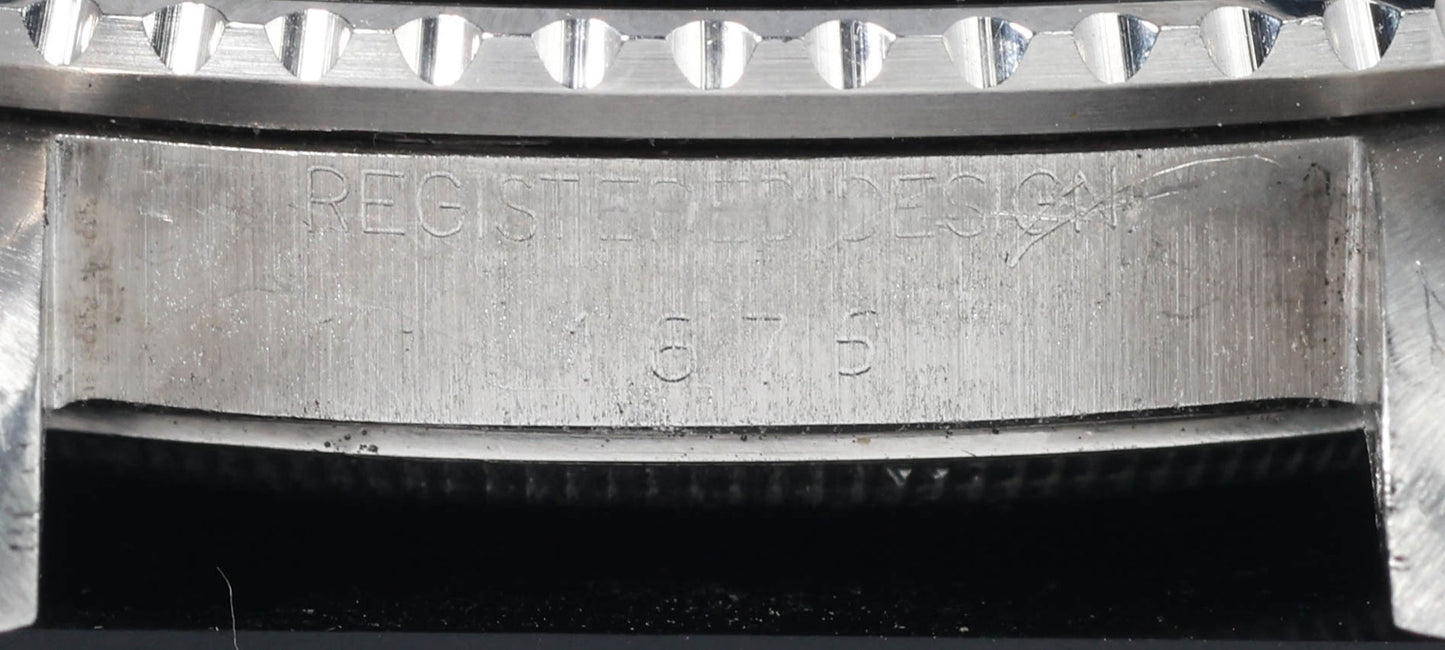
This Rolex GMT-Master 1675 is presented in great vintage condition. The stainless steel case retains strong overall definition, with light hairline marks visible from careful use over time. Importantly, the lugs remain sharp, with original factory brushing still clearly visible, preserving the correct case geometry and period finish.
The bracelet is in excellent condition, showing little to no stretch. It remains tight, well aligned, and sits comfortably on the wrist, in keeping with the watch’s well preserved overall presentation.
The dial and hands are in great condition, with clean printing, strong legibility, and evenly aged luminous material. The Mark II dial presents clearly, maintaining its correct layout and proportions, and the hands match well in tone and condition, resulting in a cohesive and honest vintage appearance.
Share
Why we love this watch
Why we love this watch
Rolex GMT-Master 1675 from 1977
Introduction
Produced from the late 1950s through to 1980, the Rolex GMT-Master 1675 stands as one of the most enduring professional models in Rolex history. A 1977 example sits firmly in the later phase of production, benefiting from years of incremental refinement while retaining the classic acrylic crystal era character that defined the GMT-Master’s identity.
Origins of the GMT-Master and Its Purpose
The GMT-Master was conceived during a period when international air travel was expanding rapidly. Long-haul flights were becoming routine, and pilots required a reliable way to track multiple time zones without mental calculation. Rolex’s response was to combine a conventional time display with a fourth hand that completed one rotation every 24 hours, read against a rotating 24-hour bezel. This allowed the wearer to track a second time zone intuitively.
From its earliest iterations, the GMT-Master was designed as a professional instrument rather than a decorative complication. The emphasis was on legibility, durability, and ease of use. The reference 1675, introduced as a successor to earlier GMT-Master references, would go on to define the model for more than two decades. Its longevity speaks to the strength of the original concept and Rolex’s preference for evolution over redesign.
The GMT-Master 1675 in the Context of the 1970s
By 1977, the GMT-Master 1675 had reached a mature stage of its production life. The watch retained the classic proportions and acrylic crystal that characterised earlier examples, but benefited from refinements in case manufacturing, dial printing, and movement reliability. This period represents a balance between vintage construction methods and improved consistency in production.
The late 1970s were also a time when the GMT-Master was no longer limited to aviation use. While it remained a practical travel tool, it had become a versatile wristwatch suited to daily wear. Despite this broader adoption, Rolex did not compromise the watch’s functional core. The 1675 from this era remains firmly rooted in its professional origins.
Case Architecture and External Design
The GMT-Master 1675 uses a 40 mm stainless steel Oyster case with crown guards, screw-down crown, and screw-down case back. Water resistance was rated to 100 metres, sufficient for everyday use and incidental exposure rather than saturation diving. The case profile is slim by modern standards, with relatively thin lugs and a narrow bezel that maximise dial presence.
Acrylic crystal is a defining feature of the 1675. It contributes to impact resistance and introduces a subtle distortion at the edge of the dial, softening transitions and enhancing legibility at angles. This optical effect is part of the reference’s visual identity and distinguishes it clearly from later sapphire crystal GMT-Masters.
The bidirectional rotating bezel is fitted with an aluminium insert marked with a 24-hour scale. On many examples from this era, the insert features the familiar red and blue colour scheme, originally intended to differentiate day and night hours. The bezel allows the wearer to track a second or even third time zone by rotating it relative to the GMT hand.
Movement and Technical Specification
A GMT-Master 1675 produced in 1977 is fitted with the Rolex calibre 1575. This automatic movement is an evolution of the calibre 1565 and represents Rolex’s mature approach to GMT functionality during the acrylic crystal era. The calibre 1575 beats at 19,800 vibrations per hour and features a free-sprung balance with Microstella regulation, enhancing stability and shock resistance.
The GMT function is achieved through a 24-hour hand geared directly to the movement. Unlike later independently adjustable GMT hands, the 1675’s GMT hand moves in conjunction with the hour hand. Time zone changes are managed via the rotating bezel rather than quickset adjustment. This system reflects the period’s mechanical philosophy, prioritising robustness and simplicity over convenience.
The movement includes a date complication with instantaneous change, displayed at three o’clock beneath a Cyclops magnifier integrated into the acrylic crystal. While not a pilot requirement, the date added everyday practicality without undermining the watch’s core purpose.
Dial Construction and Layout
The dial of the GMT-Master 1675 is designed for immediate readability. Large luminous hour markers provide orientation, while the Mercedes hour hand, pencil minute hand, and arrow-tipped GMT hand each serve distinct roles. The red GMT hand is particularly important, standing out clearly against the dial and linking visually to the bezel.
By 1977, the 1675 was fitted with matte dials rather than the earlier glossy gilt versions. These matte dials use printed white text and tritium luminous material applied to hour markers and hands. The matte finish reduces reflections and enhances legibility, aligning with the watch’s tool-oriented design.
The Mark II Dial Explained
The Mark II dial is one of several recognised dial variations found on the GMT-Master 1675. While exact classification can vary slightly among researchers, the Mark II dial is generally associated with subtle changes in font weight, spacing, and coronet execution compared to earlier and later variants.
On a Mark II dial, the Rolex coronet at twelve o’clock typically appears slightly more rounded, with defined but not exaggerated tips. Text such as “GMT-MASTER” and “OYSTER PERPETUAL” is printed with consistent thickness, and spacing between lines reflects Rolex’s evolving dial production standards of the mid to late 1970s. The minute track and hour markers remain unchanged in layout, maintaining the familiar GMT-Master look.
Functionally, the Mark II dial performs identically to other matte dials. Its significance lies in documenting incremental changes in manufacturing rather than a shift in design philosophy. For a 1977 watch, the presence of a Mark II dial is entirely consistent with the period.
Luminous Material and Ageing
The luminous material used on 1977 GMT-Master 1675 dials is tritium, indicated by the “T SWISS T” marking at six o’clock. Tritium was chosen for its brightness and reliability, and while it decays over time, it remains stable in application.
As tritium ages, it can develop a range of tones from off-white to warm cream. This ageing occurs gradually and does not affect legibility. On well-preserved examples, the luminous plots and hands age in harmony, reinforcing visual coherence across the dial. This process is a natural result of material science rather than design intent.
Wearing Experience and Use
On the wrist, the GMT-Master 1675 from 1977 wears comfortably and proportionally. The 40 mm case feels balanced, aided by the slim mid-case and acrylic crystal. The watch sits flat and does not feel bulky, even by contemporary standards.
Using the GMT function requires a degree of engagement. The wearer sets local time, aligns the bezel to the desired second time zone, and reads the GMT hand accordingly. This interaction reinforces the watch’s tool character, reflecting a time when mechanical solutions required understanding rather than automation.
The 1675 in Historical Perspective
The extended production run of the GMT-Master 1675 reflects Rolex’s confidence in the design. Rather than replacing it frequently, Rolex refined details gradually, ensuring continuity and reliability. A 1977 example represents the culmination of this process, combining vintage materials with refined execution.
During this period, the GMT-Master was worn by pilots, travellers, and professionals whose work crossed borders regularly. It served as a practical solution to a real problem, rather than a symbolic complication.
Legacy of the GMT-Master 1675
The influence of the 1675 extends well beyond its production years. Later GMT-Masters retained the core concept while introducing independent hour hands, sapphire crystals, and higher beat movements. Despite these changes, the visual language established by the 1675 remains instantly recognisable.
The Mark II dial variant adds an additional layer of historical context, capturing a specific moment in Rolex’s production evolution. It does not redefine the watch, but it documents how Rolex refined execution while preserving identity.
Final Thoughts
The Rolex GMT-Master 1675 from 1977 is a mature expression of Rolex’s original travel watch concept. Powered by the calibre 1575, housed in a slim Oyster case, and fitted with a matte Mark II dial, it reflects decades of incremental refinement rather than abrupt change. The watch remains straightforward to use, clear to read, and grounded in its original purpose. Its enduring relevance lies not in novelty, but in how effectively it solved a real problem and continued to do so, unchanged in principle, across generations of global travel.
Case & Bracelet
Case & Bracelet
- Case in great vintage condition, light hairlines visible.
- Sharp lugs with factory brushing still visible
- Bracelet in excellent condition with little to no stretch visible.
Dial & Hands
Dial & Hands
Dial & hands great condition.
Warranty & Condition
Warranty & Condition
Crown Vintage Watches provides a minimum 6-month mechanical warranty on pre-owned watches, from the date of purchase.
The warranty covers mechanical defects only.
The warranty does not cover damages such as scratches, finish, crystals, glass, straps (leather, fabric or rubber damage due to wear and tear), damage resulting from wear under conditions exceeding the watch manufacturer’s water resistance limitations, and damage due to physical and or accidental abuse.
Please note, water resistance is neither tested nor guaranteed.
Shipping and insurance costs for warranty returns to us must be covered by the customer. Returns must be shipped via traceable courier. Return shipment must be pre-paid and fully insured. Collect shipping will be refused. In case of loss or damages, the customer is liable.
Our Pledge
At Crown Vintage Watches, we stand by the authenticity of every product we sell. For added peace of mind, customers are welcome to have items independently authenticated at their own expense.
Condition
Due to the nature of vintage timepieces, all watches are sold as is. We will accurately describe the current condition and working order of all watches we sell to the best of our ability.
Shipping & Refund
Shipping & Refund