

Crown Vintage
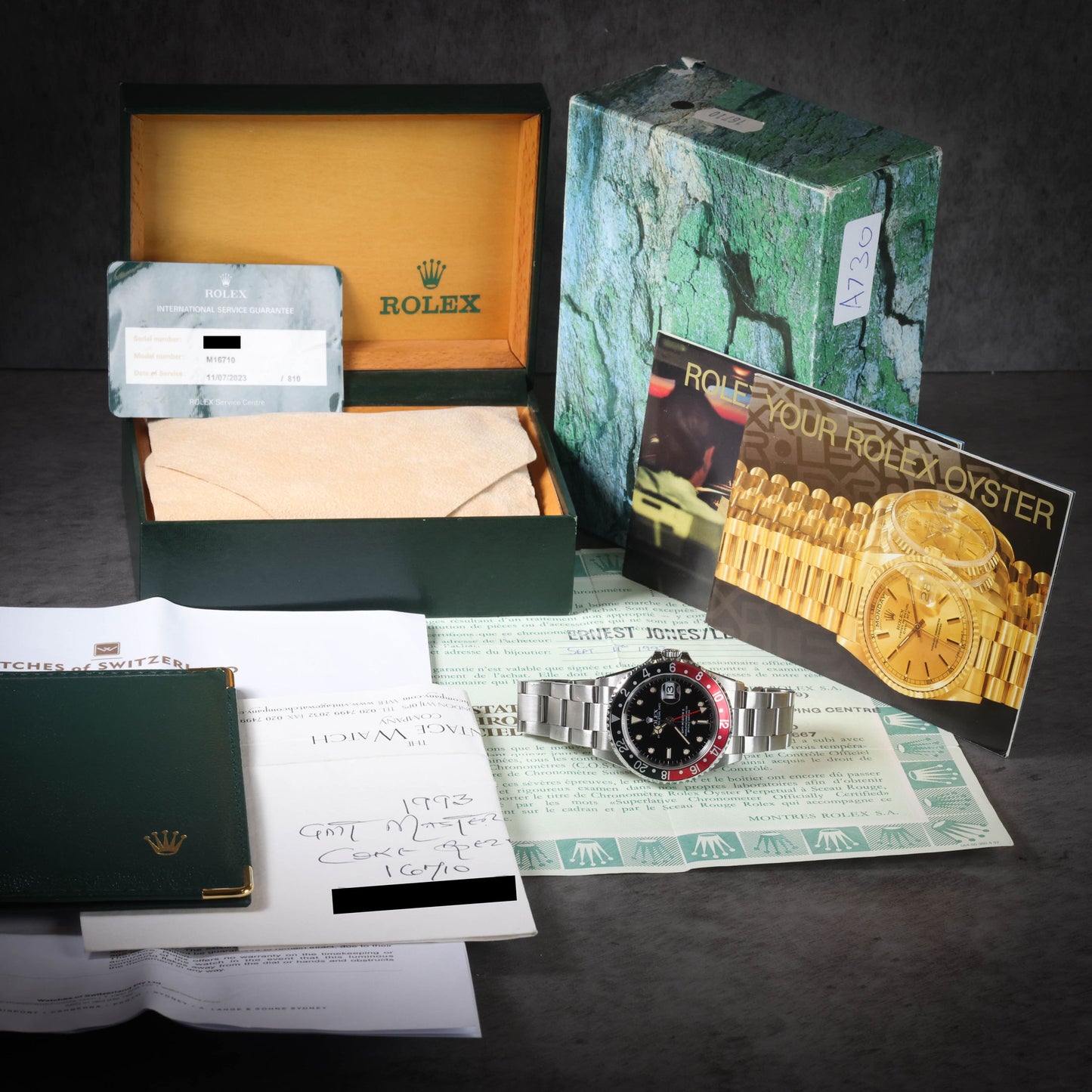
Rolex GMT Master II 16710 'Coke' 40mm 1991 Box & Papers
Rolex GMT Master II 16710 'Coke' 40mm 1991 Box & Papers
Couldn't load pickup availability
Rolex GMT Master II 16710 'Coke' 40mm 1991 Box & Papers
Case and Bracelet
The stainless steel case is in excellent, near-new condition and was replaced during an authorised Rolex service in 2023. It presents with sharp lines, clean surfaces, and no visible signs of wear, giving the watch a fresh and well-defined appearance while remaining correct for the reference. The Oyster bracelet is in excellent condition with little to no stretch, indicating careful use and strong overall integrity. The clasp operates firmly and securely.
Dial, Hands, and Bezel
The dial and hands are in excellent condition, displaying an even cream patina across the luminous material that is consistent and visually balanced. Dial printing remains crisp and legible. The red and black “Coke” aluminium bezel insert is well preserved, with strong colour and clean numerals.
Completeness and Use Advisory
The watch is accompanied by its original box and papers. As this watch is over 30 years old, it should be treated as a vintage timepiece and is not recommended for swimming or water exposure.
Share
Why we love this watch
Why we love this watch
Rolex GMT-Master II 16710 “Coke” 40mm Box & Papers
Produced between 1989 and 2007, the Rolex GMT-Master II 16710 represents the most complete and mechanically resolved expression of Rolex’s aluminium-bezel GMT lineage. A 1991 example fitted with the red and black “Coke” bezel insert sits early within this production run and captures the reference at a point where the GMT-Master II concept was fully formed but still executed with traditional materials and proportions. This article examines the 16710 “Coke” in depth, focusing on its technical construction, movement architecture, timekeeping functionality, and historical context, while explaining why this particular configuration continues to attract sustained attention through its clarity of purpose, versatility, and engineering coherence.
The Origins of the GMT-Master and the Emergence of the Coke Bezel
The GMT-Master was originally developed in the early 1950s to meet the needs of long-haul aviation, where pilots required a wrist-worn instrument capable of tracking multiple time zones simultaneously. Rolex’s solution combined a conventional twelve-hour display with an additional twenty-four-hour hand read against a rotating bezel, allowing reference to home time while adjusting local time.
The use of two-colour bezel inserts served a practical function. Dividing the twenty-four-hour scale into contrasting halves allowed the wearer to distinguish day from night at a glance. While blue and red became the earliest and most widely recognised colour pairing, Rolex later introduced a red and black bezel option. This “Coke” configuration preserved the same functional logic while offering a more subdued visual contrast, particularly well suited to low-light or professional environments.
From GMT-Master to GMT-Master II
The defining technical evolution of the GMT line came with the introduction of the GMT-Master II. Earlier GMT-Master references required the movement to be stopped when adjusting the hour hand, disrupting timekeeping accuracy. The GMT-Master II resolved this by introducing an independently adjustable local hour hand, allowing the wearer to change time zones without stopping the movement.
The reference 16710 inherited this innovation and refined it within a case profile closely aligned with earlier GMT models. In doing so, it bridged traditional GMT aesthetics with a genuinely modern travel movement, a balance that remains central to its appeal.
Position of the 16710 “Coke” Within the Rolex Professional Line
Within the Rolex professional catalogue, the GMT-Master II 16710 occupies a transitional but highly resolved position. It sits between earlier aluminium-bezel GMT references and later ceramic-bezel generations, retaining classic materials while incorporating advanced mechanical functionality.
A 1991 example benefits from mature production standards. By this period, sapphire crystals were standard across Rolex’s professional range, dial printing had stabilised, and movement architecture was well established. The result is a watch that feels technically complete without the design changes that would later alter the GMT-Master’s visual character.
Case Architecture and Proportions
The Oyster case of the GMT-Master II 16710 measures approximately 40mm in diameter. It features a screw-down caseback and a screw-down crown fitted with Rolex’s Twinlock sealing system. This construction provides dependable water resistance suitable for daily wear and frequent travel, without unnecessary complexity.
The proportions of the case are notably balanced. Lug thickness and curvature are restrained, and overall height is moderate, contributing to comfort and long-term wearability. This consistency throughout the reference’s production demonstrates how effectively Rolex resolved the core engineering challenges from the outset.
The Red and Black Aluminium Bezel
The defining visual feature of the “Coke” variant is its red and black aluminium bezel insert. Marked with a full twenty-four-hour scale, the bezel rotates bidirectionally, allowing the wearer to track an additional time zone beyond local time and home time.
The choice of aluminium reflects the GMT-Master’s origins as a functional tool. Aluminium is lightweight, legible, and practical, and it aligns with the utilitarian philosophy underpinning the reference. The red and black colour pairing provides clear day and night distinction while offering a more understated appearance than the earlier blue and red configuration.
Dial Design and Legibility
The dial of the GMT-Master II 16710 follows Rolex’s established professional watch layout. Large luminous hour markers provide instant orientation, while the Mercedes-style hour hand, sword minute hand, and lollipop seconds hand are designed to be immediately distinguishable.
The GMT hand, geared to a twenty-four-hour cycle, is read against the bezel and is visually distinct from the other hands. This layered approach to information presentation allows the wearer to absorb multiple time references at a glance, a critical requirement for a travel watch.
By 1991, Rolex was using tritium luminous material, offering consistent low-light visibility. The dial text remains minimal, reinforcing the watch’s tool-focused intent.
Sapphire Crystal and Date Integration
The GMT-Master II 16710 is fitted with a flat sapphire crystal, offering significantly improved scratch resistance compared to earlier acrylic crystals. This upgrade enhances long-term clarity, particularly important for a watch intended for frequent use in transit environments.
The cyclops magnifier over the date window improves legibility without disrupting the balance of the dial. Importantly, the date mechanism is directly linked to the independent hour hand, allowing the date to advance or retreat automatically as time zones are crossed.
The Calibre 3185 Movement
Powering the GMT-Master II 16710 is the Rolex calibre 3185. This automatic movement represents a major technical milestone in Rolex’s travel watch development. Operating at 28,800 vibrations per hour, it combines stability, durability, and intuitive functionality.
The calibre 3185 features an independently adjustable local hour hand, hacking seconds, and a quick-set date mechanism integrated with the hour hand jump system. The movement is engineered for reliability and long-term serviceability rather than decorative complexity.
Independent Hour Hand and Practical Timekeeping
The independent hour hand is the defining functional feature of the GMT-Master II. It allows the wearer to adjust local time in one-hour increments without stopping the movement or disturbing the minute and seconds hands. This preserves precise timekeeping while simplifying time zone changes.
When crossing the International Date Line, the date automatically advances or retreats in sync with the hour hand, eliminating the need for manual correction. This seamless integration of date and time adjustment is central to the reference’s usability.
Timekeeping Stability and Engineering Philosophy
Rolex designed the calibre 3185 with an emphasis on stability across varied conditions. The balance assembly and escapement are engineered to resist shock and positional variation, supporting consistent timekeeping during frequent movement.
This approach reflects Rolex’s broader engineering philosophy during the late twentieth century. Movements were built to perform reliably over decades, prioritising robustness, efficiency, and ease of service.
Bracelet Construction and Wearing Comfort
The GMT-Master II 16710 was supplied on the Oyster bracelet, designed to integrate seamlessly with the case. Bracelets from this period typically feature solid outer links with folded inner components, balancing strength and flexibility.
The clasp includes a safety mechanism to prevent accidental opening, reinforcing the watch’s suitability for active use. The bracelet’s proportions complement the case, maintaining visual and functional coherence.
Box and Papers Context
A 1991 GMT-Master II 16710 “Coke” accompanied by its original box and papers provides valuable historical context. Documentation confirms original delivery details and situates the watch within a specific production period. Packaging and warranty materials from the early 1990s reflect Rolex’s evolving approach to presentation and record-keeping.
Evolution Within the Reference
Throughout its production life, the 16710 remained remarkably consistent in appearance. Later examples transitioned to the calibre 3186, but the fundamental principles established by the 3185 remained unchanged. This continuity highlights the effectiveness of the original design.
A 1991 example represents an early but fully mature execution of the reference, combining established case architecture with the defining GMT-Master II movement.
Why the “Coke” Configuration Endures
The sustained attention given to the 16710 “Coke” configuration is rooted in its balance of function and restraint. The red and black bezel offers clear legibility without visual excess, aligning closely with the watch’s professional origins. Combined with the independent hour hand movement and robust case construction, the result is a travel watch that remains practical and intuitive decades after its introduction.
Historical Context of the Early 1990s
The early 1990s marked a period of increasing global mobility. International business travel and communication expanded rapidly, making dual-time functionality more relevant than ever. The GMT-Master II 16710 aligned closely with these developments, offering a straightforward solution to the challenges of modern travel.
Final Thoughts
The Rolex GMT-Master II 16710 “Coke” stands as a highly resolved interpretation of the dual-time wristwatch. A 1991 example with box and papers captures the reference at a point where design, movement, and manufacturing quality were fully aligned. The 40mm Oyster case, red and black aluminium bezel, and calibre 3185 movement combine to deliver intuitive, reliable timekeeping across multiple time zones.
Case & Bracelet
Case & Bracelet
- Case in Excellent near new condition (2023 Rolex Service Replacement case)
- Bracelet in excellent condition little to no stretch
Dial & Hands
Dial & Hands
Dial & hands even cream patina.
Warranty & Condition
Warranty & Condition
Crown Vintage Watches provides a minimum 6-month mechanical warranty on pre-owned watches, from the date of purchase.
The warranty covers mechanical defects only.
The warranty does not cover damages such as scratches, finish, crystals, glass, straps (leather, fabric or rubber damage due to wear and tear), damage resulting from wear under conditions exceeding the watch manufacturer’s water resistance limitations, and damage due to physical and or accidental abuse.
Please note, water resistance is neither tested nor guaranteed.
Shipping and insurance costs for warranty returns to us must be covered by the customer. Returns must be shipped via traceable courier. Return shipment must be pre-paid and fully insured. Collect shipping will be refused. In case of loss or damages, the customer is liable.
Our Pledge
At Crown Vintage Watches, we stand by the authenticity of every product we sell. For added peace of mind, customers are welcome to have items independently authenticated at their own expense.
Condition
Due to the nature of vintage timepieces, all watches are sold as is. We will accurately describe the current condition and working order of all watches we sell to the best of our ability.
Shipping & Refund
Shipping & Refund