

Crown Vintage
Breitling Navitimer 806 Tropical AOPA Dial 41mm Early 1960s
Breitling Navitimer 806 Tropical AOPA Dial 41mm Early 1960s
Couldn't load pickup availability
Breitling Navitimer 806 Tropical AOPA Dial 41mm Early 1960s
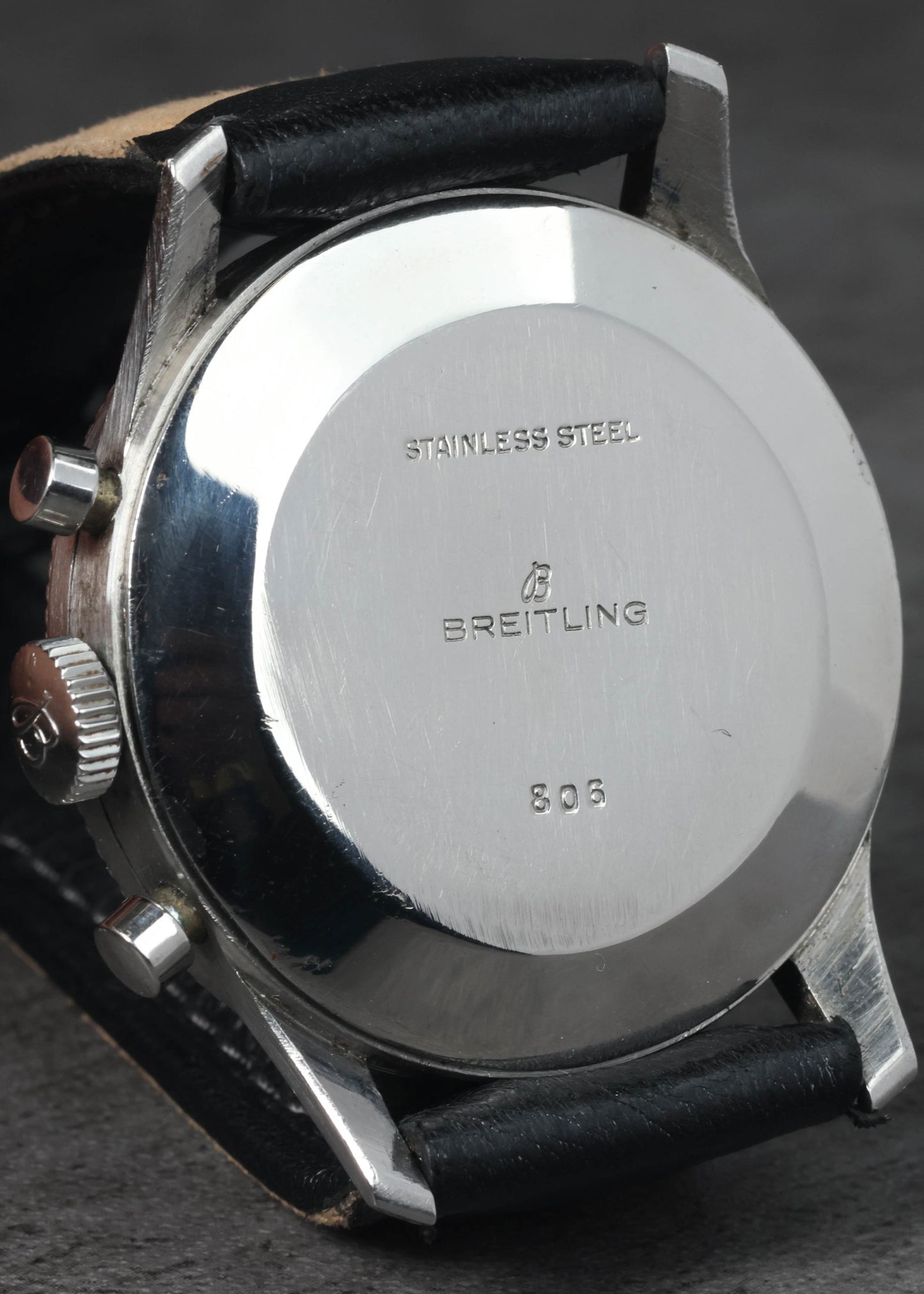
This Breitling Navitimer Reference 806 presents in excellent overall condition for a piece of its age, retaining the factory finishing across the case without evidence of polishing at any point in its life. The surfaces are sharp where they should be sharp: the lugs carry their original angles, the case flanks show the correct satin and polished finishing as applied at the time of manufacture, and the beaded bezel retains its full complement of grip beads without wear to the peaks. The pushers and crown are consistent with the case in both condition and patina. The grey leather strap is in good condition with no cracking, no excessive compression at the keeper, and secure stitching throughout.
The dial is the defining element of this example. The deep oxidation across the surface is a naturally occurring tropical patina, the product of decades of atmospheric exposure acting on the original lacquer layer, and it is entirely original to the dial. The process has produced an even, richly toned rust-brown and bronze colouration that covers the surface consistently, without lifting, without flaking, and without loss of the printed elements. The AOPA wings, Breitling and Navitimer signatures, Arabic numerals, and subdial tracks are all legible beneath the patination. The hands are in good condition and consistent with the period, retaining their form without bending or displacement. A dial of this character, in original and unrestored condition, is an inherent feature of an early 806 of this vintage rather than a deficiency.
Share
Why we love this watch
Why we love this watch
The Pilot's Computer: Breitling Navitimer Reference 806 AOPA
Before the acronym GPS existed, before digital flight management systems filled cockpit displays, and before a pilot crossing the Atlantic could query a satellite for their position, the AOPA-signed Breitling Navitimer Reference 806 was the most capable analogue flight computer a pilot could strap to their wrist. The watch on offer here dates to approximately 1958 to 1962, identified by the co-presence of the signed AOPA wings and the Breitling signature on an all-black dial, and it carries on that dial the kind of deep oxidised patination that only seven decades of existence can produce. At Crown Vintage, it is a watch that commands attention every time it comes through our doors, and the reasons for that run the full length of Breitling's history.
Léon Breitling and the Chronograph Workshop
The Breitling story begins in 1884 in Saint-Imier, Switzerland, where a 24-year-old Léon Breitling opened a workshop with a singular focus on precision chronographs. The industrial age was accelerating, and accurate timing instruments were in demand across science, sport, and industrial production. Léon was well positioned to supply them. By 1892, growth had outpaced his original premises and he relocated to La Chaux-de-Fonds, the centre of Swiss watchmaking, renaming the company the Leon G. Breitling Montbrillant Watch Factory and growing his workforce to sixty employees. The Montbrillant name, drawn from the street on which the factory stood, would persist through the brand's history as an enduring reference to these founding years.
Léon died in 1914, and the company passed to his son Gaston, who steered it through the disruptions of the First World War. Gaston in turn died young, in 1927, leaving the company in the hands of his widow until his son Willy was old enough to lead. Willy took the helm in the early 1930s and proved to be exactly the kind of restless, technically minded successor the brand needed. He understood that the chronograph was not a finished category but an evolving one, and he pushed Breitling into territory that his grandfather and father had only begun to explore.
Willy Breitling and the Aviation Department
Willy's defining contribution to the brand came from his recognition of what aviation represented. As commercial and military flight expanded through the 1930s, pilots faced a practical problem that no existing wristwatch solved: the cockpit required a wrist instrument capable not just of timing but of calculation. In 1938, Willy established the Huit Aviation Department, named for the eight-day power reserve that Breitling's aviation instruments offered, and tasked it specifically with developing precision tools for aircraft. Three years later, in 1941, Breitling applied for patent number 217012, which protected a rotating bezel containing a circular slide rule integrated beneath the watch crystal. The instrument that resulted, launched in 1942, was called the Chronomat, a compression of chronographe and mathématique. It was aimed initially at scientists and engineers rather than pilots, but the potential was unmistakable.
The slide rule on the Chronomat was designed with input from mathematician Marcel Robert, who built the scale around the three units most relevant to aviation: STAT for statute miles, KM for kilometres, and NAUT for nautical miles. By rotating the outer bezel relative to the fixed inner scale, a pilot could calculate fuel consumption, average speed, rate of climb, and distance conversions without any additional instrument. The Chronomat's 1942 instruction manual noted, with admirable candour, that the bezel required "a little time and patience to master." It was, in the most literal sense, a wrist-worn computer, and it worked on pure analogue logic.
From Chronomat to Navitimer: The AOPA Connection
The Aircraft Owners and Pilots Association was founded in 1932 as an advocacy organisation for civilian pilots in the United States. As post-war commercial aviation boomed through the late 1940s and early 1950s, the AOPA's membership grew alongside the industry, and the organisation began to exert real influence over the tools and equipment the aviation community used. It was pressure from the AOPA, combined with the evident appetite among pilots for a slide rule watch recalibrated specifically for flight navigation, that led Willy Breitling to take the Chronomat's bezel concept further.
Working with Marcel Robert and in consultation with AOPA, Willy produced a new watch in 1952 that refined the Chronomat's slide rule into a dedicated aviation instrument. He called it the Navitimer: navigation and timer compressed into a single word. Where the Chronomat had been a bicompax design, the Navitimer adopted a tri-compax layout with three subdials, distributing the chronograph counters for elapsed hours, elapsed minutes, and running seconds across a larger dial surface that could also accommodate the surrounding slide rule scales and the beaded rotating bezel. The first examples were produced from 1954 and were sold exclusively to AOPA members, with the AOPA's double-wing emblem printed on the dial in place of the Breitling name. These pre-806 examples, powered by the Valjoux 72, were produced for less than a year and are among the rarest Navitimers in existence.
Reference 806: The Navitimer Goes to Market
In 1956, Breitling brought the Navitimer into commercial production under the designation reference 806. The Valjoux 72 of the earliest examples gave way to the Venus 178, a manually wound column wheel chronograph movement that would remain inside the Navitimer through the early 1970s. The reference 806 encompassed several distinct dial variations as Breitling navigated different markets and distribution arrangements. Examples produced for the American market, distributed in partnership with the AOPA, carried the signed wings logo with the AOPA lettering visible inside the double-wing emblem. International examples, not produced under the AOPA arrangement, carried unsigned wings or the Breitling Genève combination. Crucially, the Breitling brand name did not appear on the dial at all during the earliest years of the reference: it only began appearing from the late 1950s.
The watch in this listing sits within the window defined by those two facts. The signed AOPA wings place it as an American market piece; the presence of the Breitling signature on the dial positions it no earlier than the late 1950s; and the all-black subdials place it before 1963, when Breitling introduced the reverse panda configuration with contrasting white registers. The beaded bezel, with its distinctive tactile grip designed to be operable with leather flying gloves, is the format used throughout the 806's production until the milled edge bezel replaced it in 1964. The approximate dating therefore resolves to 1958 to 1962, a tight window within which this reference was produced in a configuration that is now among the most desirable of all early Navitimers.
The Dial, Bezel, and Case
The dial is the element that demands immediate attention. What is visible is severe oxidation of the dial's lacquer layer, a process driven by decades of humidity and atmospheric exposure that has transformed the original black surface into the deep rust-brown and bronze tones visible here. This is original, irreversible, and unrestorable. It is also entirely honest. The oxidation is even across the surface, the AOPA wings remain legible, the Breitling and Navitimer signatures are intact, and the Arabic numerals at the hour positions retain their gilt character beneath the patination. The hour markers, hands, and subdial registers are consistent with the period and configuration. On an early 806 of this age, this dial condition is a document of its own history rather than a deficiency.
The slide rule bezel carries the three-scale layout around its outer edge: STAT for statute miles, KM for kilometres, and NAUT for nautical miles. The bezel rotates bidirectionally against the inner scale fixed to the dial, enabling calculations to be performed by aligning the two scales against one another. The chronograph function, driven by the Venus 178, provides the elapsed time input that feeds those calculations: a pilot using the watch as designed would time a leg of a flight with the chronograph, then use the bezel to convert the elapsed time and known speed into a distance figure, or use a known fuel burn rate against elapsed time to determine remaining range. The system is slow by modern standards and requires a working knowledge of logarithmic scales, but it is entirely self-contained and requires no battery, no network, and no external data source.
The 40mm stainless steel case retains its Oyster-style construction with screw-down pushers designed to protect the chronograph mechanism, a feature particularly relevant to the aviation context for which the watch was designed. The crown is unsigned and of the period. The movement inside, the Venus 178, is a manually wound column wheel chronograph that was considered among the more refined movements available for third-party use in the 1950s and 1960s. The column wheel regulates the start and stop functions with greater consistency than the cam-lever alternative, and the manually wound architecture keeps the mechanism relatively thin and accessible.
Scott Carpenter and the Cosmonaute
No account of the early Navitimer is complete without the Cosmonaute. In 1961, Mercury program astronaut Scott Carpenter, who had been wearing a Navitimer throughout his career as a naval aviator, approached Breitling about a specific modification for his upcoming Aurora 7 mission. In space, without the natural daylight cycle of Earth, a 12-hour dial was disorienting: Carpenter requested a 24-hour version to allow unambiguous reading of day and night. Breitling produced it, designating the modified reference 809 the Cosmonaute, and Carpenter wore it on his orbital flight on 24 May 1962. It was the first Swiss wrist-worn chronograph to travel in space. The Cosmonaute shared its case, bezel, and Venus 178 movement with the contemporary reference 806, making the architectural kinship between the watch offered here and the Cosmonaute immediate and direct.
Final Thoughts
The Breitling Navitimer Reference 806 with the signed AOPA dial represents a specific and unrepeatable moment in the watch's history. The AOPA relationship was the founding condition of the Navitimer's existence; it was not a marketing arrangement grafted onto an existing product but the original context in which the watch was conceived and first produced. A signed AOPA 806 with the Breitling name on the dial, from the late 1950s to early 1960s, is therefore the form the reference took at the moment it was simultaneously most connected to its origins and fully established as a commercial instrument. The heavily oxidised dial on this example is the most visible record of its age, and it connects the watch viscerally to a period when the slide rule bezel was not a heritage feature but a working tool. That combination of origin, function, age, and physical evidence of existence is what makes the early Navitimer so compelling to engage with, and it is what we find ourselves returning to every time one crosses our workbench.
References
- Léon Breitling, Wikipedia, en.wikipedia.org, accessed 2025.
- Breitling SA, "The Breitling Story Since 1884," breitling.com, accessed 2025.
- Phillips, "Breitling Navitimer: The Early Years," phillips.com, accessed 2025.
- Watchfinder, "Feature: The Breitling Slide Rule Bezel," watchfinder.com, accessed 2025.
- Teddy Baldassarre, "Breitling Navitimer: The Ultimate Guide," teddybaldassarre.com, accessed 2025.
- Chrono24 Magazine, "Development of a Classic: The Breitling Ref. 806," chrono24.com, accessed 2025.
- Burdeen's Jewelry, "The Beginning of Breitling, the Birth of the Chronograph," burdeens.com, accessed 2025.
- Phillips, "How It Works: The Slide Rule of the Breitling Chronomat," phillips.com, accessed 2025.
- Breitling Navitimer, Wikipedia, en.wikipedia.org, accessed 2025.
- Breitling SA, Wikipedia, en.wikipedia.org, accessed 2025.
- Chronopedia, "Breitling Navitimer 806," chronopedia.club, accessed 2025.
Case & Bracelet
Case & Bracelet
- Case in excellent condition.
- Unpolished case with factory finishing still visible
- Strap in good condition
Dial & Hands
Dial & Hands
- Dial & hands in good condition
- Tropical Patina
Warranty & Condition
Warranty & Condition
Crown Vintage Watches provides a minimum 6-month mechanical warranty on pre-owned watches, from the date of purchase.
The warranty covers mechanical defects only.
The warranty does not cover damages such as scratches, finish, crystals, glass, straps (leather, fabric or rubber damage due to wear and tear), damage resulting from wear under conditions exceeding the watch manufacturer’s water resistance limitations, and damage due to physical and or accidental abuse.
Please note, water resistance is neither tested nor guaranteed.
Shipping and insurance costs for warranty returns to us must be covered by the customer. Returns must be shipped via traceable courier. Return shipment must be pre-paid and fully insured. Collect shipping will be refused. In case of loss or damages, the customer is liable.
Our Pledge
At Crown Vintage Watches, we stand by the authenticity of every product we sell. For added peace of mind, customers are welcome to have items independently authenticated at their own expense.
Condition
Due to the nature of vintage timepieces, all watches are sold as is. We will accurately describe the current condition and working order of all watches we sell to the best of our ability.
Shipping & Refund
Shipping & Refund