

Crown Vintage
Breitling Navitimer 806 Tropical Dial 41mm Circa 1960s Unpolished
Breitling Navitimer 806 Tropical Dial 41mm Circa 1960s Unpolished
Couldn't load pickup availability
Breitling Navitimer 806 Tropical Dial 41mm Circa 1960s Unpolished
Case and Strap
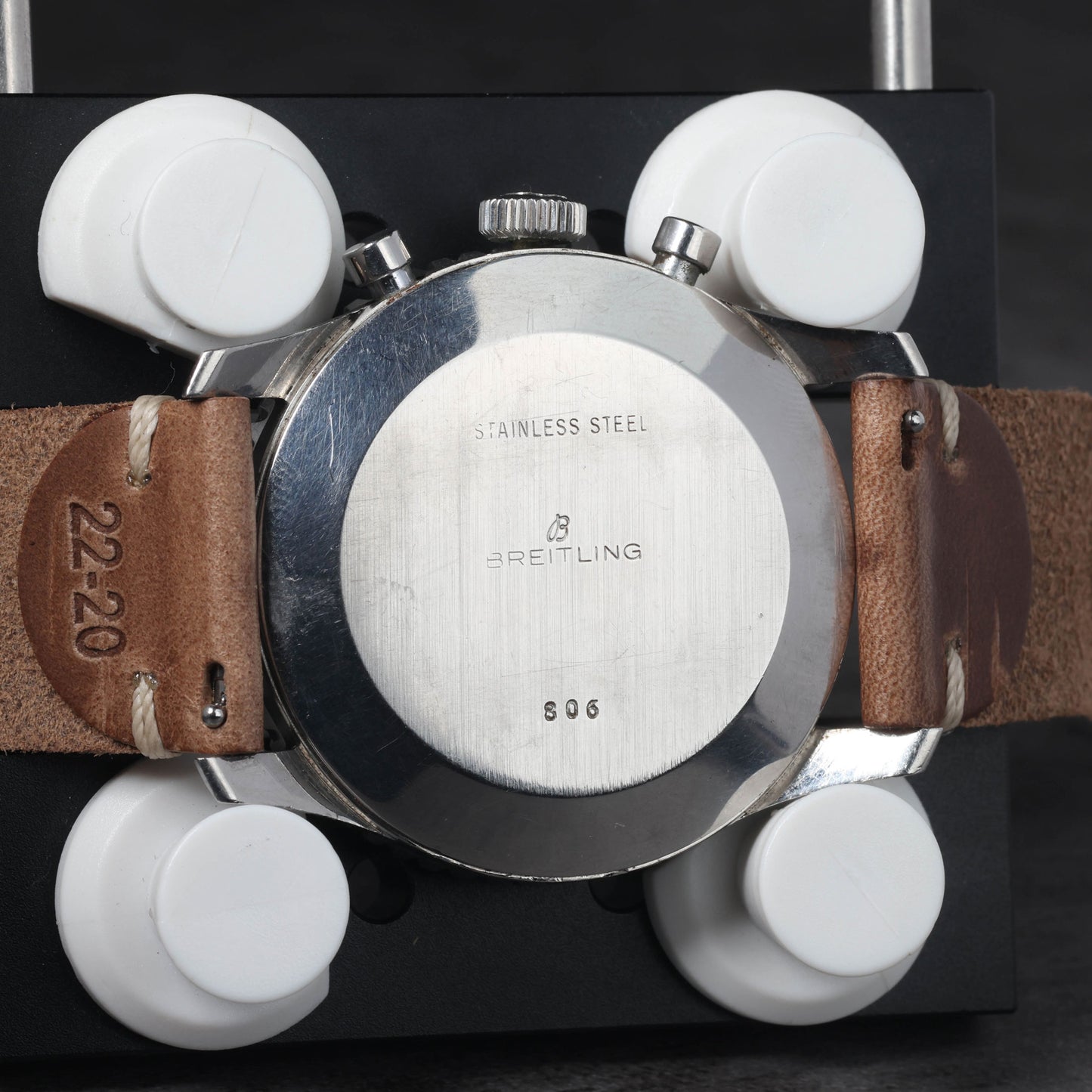
The stainless steel case is in excellent condition and, importantly, remains unpolished, with the factory finishing still clearly visible across the surfaces. The original lines of the case are intact, the bevels and brushing preserved as they left the workshop, which is increasingly uncommon on a chronograph of this age and exactly what you want to see on a vintage Navitimer. The slide rule bezel turns as it should against its fixed scale. The strap is in good condition and presents well, holding the watch securely on the wrist.
Dial and Hands
The dial and hands are in good condition. The original black dial has developed a tropical patina, warming evenly toward brown across its surface, and it gives this Navitimer a depth and character that a flat black dial does not have. The printing across the slide rule scales and the three chronograph registers remains legible, and the luminous plots and hands have aged to a settled, complementary tone. The acrylic crystal sits correctly over the dial. This is an honest, attractively aged example that wears its years well.
Use Advisory
This is a vintage timepiece, now around sixty years old, and should be treated accordingly. As a pilot's chronograph built as a cockpit instrument rather than a water-resistant tool, it should be kept away from water and moisture, and it rewards gentler handling than a modern watch would ask for. With regular servicing the manually wound Venus 178 will continue to run reliably for years to come.
Share
Why we love this watch
Why we love this watch
The Wrist Computer That Mellowed to Brown: A 1960s Breitling Navitimer 806
The black dial of this 1960s Navitimer 806 has warmed to a soft brown over the decades, but the busy ring of figures around its edge still does exactly what Breitling built it to do, which is turn a wristwatch into a flight computer. Most watches ask only to be read. This one asks to be used. The rotating slide rule that frames the dial was designed so a pilot could work out airspeed, fuel burn, and distance in the cockpit, by hand, in the years before electronics took that job over. That the dial has since aged from crisp black to a mellow tropical brown only adds to the sense that this is an instrument with a long working life behind it.
A Company Built on Chronographs
Breitling has measured elapsed time for longer than almost anyone. Leon Breitling founded the firm in 1884 in Saint-Imier, in the Swiss Jura, and from the start it concentrated on chronographs and stopwatches rather than ordinary watches. Where other houses made timepieces that happened to include a stopwatch, Breitling treated the chronograph as the whole point, and across the early twentieth century the company refined the way the complication was operated, helping to separate the chronograph pushers from the crown and arriving at the two-pusher layout that remains standard today.
That focus pulled Breitling naturally toward aviation. As powered flight grew through the 1930s and 1940s, cockpits needed reliable instruments, and Breitling's Huit Aviation department supplied clocks and timers for aircraft dashboards. The company became a fixture in the cockpit before it ever became famous on the wrist. The crucial step toward the Navitimer came in 1942 with the Chronomat, a chronograph that carried a circular logarithmic slide rule on its bezel, letting an engineer or technician perform calculations by rotating the bezel against a fixed scale. The idea of a watch that could do arithmetic was already on Breitling's bench. What it needed was a version built specifically for pilots.
The Birth of the Navitimer
That version arrived in 1952. Willy Breitling, then leading the company, was approached by the Aircraft Owners and Pilots Association, the largest body of pilots in the United States, who wanted a chronograph tailored to the calculations of flight. Breitling took the Chronomat's slide rule and recalibrated it for aviation, adding the scales a pilot actually needed for working out average speed, distance covered, fuel consumption, rate of climb and descent, and conversions between miles, kilometres, and nautical miles. The name followed the function. Navitimer is a contraction of navigation and timer, a watch for navigating as much as for timing.
The collaboration with the AOPA was central to the watch's identity. The association adopted the Navitimer as its official timepiece, and the earliest dials carried the AOPA's winged logo rather than the Breitling name, a reflection of how closely the watch was tied to the flying community it was built for. This was not a watch designed for a shop window and later sold to pilots. It was designed with pilots, for the cockpit, and only afterwards became one of the most recognisable chronographs in the world. That origin is stamped into every detail of the reference that followed.
The timing could hardly have been better. In the years after the Second World War civil aviation expanded at speed, with commercial airlines opening longer routes and private flying growing into a serious pastime, especially in the United States. More pilots in the air meant more demand for instruments that could keep a flight accurate and efficient, and a chronograph that could handle navigation maths on the wrist answered a real need rather than a manufactured one. The Navitimer arrived just as the cockpit was becoming a busier, more demanding place, and it gave pilots a tool that did several jobs at once without ever leaving the wrist.
The Reference 806
The Navitimer settled into its definitive form with the reference 806, the watch that established the layout, proportions, and functionality that have defined the model ever since. The 806 became the core production Navitimer from the mid-1950s and remained in the catalogue into the early 1970s, which is why the great majority of vintage Navitimers a person is likely to encounter wear this reference. Across that long run Breitling refined the watch continually rather than redesigning it, so an 806 from the 1960s is recognisably the same instrument as one from the 1950s, with detail changes layered on top.
Those changes are how the reference is read today. The dial logo evolved from the early AOPA wings through versions carrying the Breitling name to the winged twin-jet emblem introduced in the mid-1960s, while the Breitling signature itself only appeared on the dial from the late 1950s. The bezel changed too: the early 806 used a beaded edge, the small beads making it easier to grip, and in 1964 Breitling replaced the beading with a milled, notched bezel. A 1960s example therefore sits in the middle of that evolution, and the precise mix of logo, bezel, and dial layout is what places a given watch within the decade. The reference also had a famous sibling. In 1962 Breitling built the reference 809 Cosmonaute, a Navitimer with a twenty-four-hour dial developed with the astronaut Scott Carpenter so that a pilot could tell day from night in orbit, and Carpenter wore it aboard Aurora 7, making it the first Swiss wrist chronograph worn in space.
The Slide Rule Explained
The ring of numbers that makes the Navitimer look so complicated is a circular slide rule, the same principle as the straight slide rules engineers once carried, wrapped around the dial. One scale is fixed and one rotates with the bezel, and by lining up figures on the two scales a pilot can multiply and divide without a pencil. In practice that meant real cockpit work. Set ground speed against time and read off distance covered. Work out how much fuel a leg will burn at a given consumption rate. Convert nautical miles to kilometres, or knots to miles per hour. None of these are things most owners will ever need to do, but the point is that the watch genuinely can do them, which is what earned it the description of a wrist-worn flight computer. The slide rule is not decoration. It is the reason the Navitimer exists.
The Movement Inside
Through the 1960s the 806 was powered by the Venus 178, a manually wound chronograph movement built around a column wheel, the more sophisticated and smoother of the two ways of controlling a chronograph. It runs at 18,000 vibrations per hour and drives a three-register layout, with running seconds, a thirty-minute counter, and a twelve-hour counter arranged around the dial so that long durations can be timed at a glance. The Venus 178 was respected for the crisp action of its pushers and for its reliability, qualities that matter in a watch meant to be operated quickly and often. Toward the end of the 1960s Breitling moved the Navitimer onto a different calibre, the Valjoux 7740, but for most of the decade the Venus 178 was the engine of the 806.
Case, Bezel and Crystal
The 806 case measures roughly 41 millimetres across, large for its era and dictated by function rather than fashion, because the slide rule and the three-register dial simply needed the room to stay legible. Despite the diameter the watch wears flat, thanks to a slim mid-case and gently sloping lugs. The case is stainless steel with a snap-fit caseback, a detail that tells you the Navitimer was conceived as a cockpit instrument rather than a diving watch; it was built to be read and operated, not submerged. Over the dial sits a domed acrylic crystal, chosen partly because, in an aircraft, acrylic would craze rather than shatter if struck. The bezel, beaded or milled depending on the year, rotates to drive the slide rule and is knurled finely enough to be turned with a gloved hand.
How a Black Dial Becomes Brown
The brown of this dial was not Breitling's choice. The Navitimer left the factory with a matte black dial, and the warm brown it now shows is the work of time. Through this era dial surfaces were sealed under a varnish based on nitrocellulose, a coating that protected the dial but was also slightly porous, letting oxygen and moisture reach the surface beneath over many years. Under ultraviolet light and humidity, the chemistry of that coating and the black pigment beneath it slowly shifts, and a dial that began life a deep, even black warms gradually toward brown. The same process turns some black dials a smoky chocolate and others a richer reddish tone, and because it depends on how each individual watch was stored and exposed, no two tropical dials age in quite the same way.
It is worth saying that this is a closed chapter of watchmaking. The sealed coatings used on modern dials are far less permeable, so a Navitimer made today will not brown the way a 1960s one has. A tropical dial is therefore something that could only have been produced by a watch of roughly this age, left to decades of light and air. On a busy, instrument-style dial like the Navitimer's, the effect is particularly striking, because the warm brown softens the black background against which all that white printing sits, giving the whole dial a depth and a glow that a flat, factory-fresh black never had.
Wearing It Today
For all the information packed onto it, the Navitimer resolves on the wrist into something surprisingly legible and surprisingly wearable. At 41 millimetres it is a confident size that still sits comfortably, and the dense slide rule, which looks overwhelming in photographs, settles into a clear hierarchy once the watch is in front of you, with the time and the chronograph reading cleanly over the calculating scales. The tropical brown gives a 1960s 806 a warmth that suits its age, the luminous plots having usually mellowed to a matching cream, so that the whole dial reads as a single, gently aged object rather than a collection of mismatched parts.
That coherence is the appeal. A Navitimer is one of the few watches that wears its purpose so openly, every scale and counter there to do a job, and a 1960s example that has browned with age carries the marks of the years on top of that purpose. It looks like exactly what it is: a serious pilot's instrument from the golden age of propeller and early jet aviation that has spent half a century quietly turning from a tool into a piece of history.
Final Thoughts
The Breitling Navitimer 806 is one of the definitive pilot's chronographs, a wristwatch that genuinely worked as a flight computer in an age when pilots still did their sums by hand. A 1960s example sits at the heart of that story, built around the column-wheel Venus 178 and the circular slide rule that gave the watch its reason for being. The history of Breitling and the AOPA explains why the Navitimer was made and what it was made to do. The watch itself, with its dense calculating dial now warmed to a soft tropical brown, explains why it has lasted, an instrument that has aged into something with as much character as function. It is a tool watch in the truest sense, and time has only made it more itself.
References
1. Phillips, “Breitling Navitimer: The Early Years.” phillips.com.
2. Chronopedia, “Breitling Navitimer 806.” chronopedia.club.
3. Monochrome Watches, “The History of the Breitling Navitimer.” monochrome-watches.com.
4. The Hour Glass, “Navigating the Infinite: A Collector’s Guide to the Breitling Navitimer.” thehourglass.com.
5. Bob’s Watches, “Breitling Navitimer History: Evolution of an Aviation Icon.” bobswatches.com.
6. Experts Watches, “Breitling Navitimer 806 & 809: History, Movements & Collector Guide.” expertswatches.com.
7. Crown Vintage Watches, “The Story of the Breitling Navitimer 806.” crownvintage.com.au.
Case & Bracelet
Case & Bracelet
- Case in excellent condition.
- Unpolished case with factory finishing still visible
- Strap in good condition
Dial & Hands
Dial & Hands
- Dial & hands in good condition
- Tropical Patina
Warranty & Condition
Warranty & Condition
Crown Vintage Watches provides a minimum 6-month mechanical warranty on pre-owned watches, from the date of purchase.
The warranty covers mechanical defects only.
The warranty does not cover damages such as scratches, finish, crystals, glass, straps (leather, fabric or rubber damage due to wear and tear), damage resulting from wear under conditions exceeding the watch manufacturer’s water resistance limitations, and damage due to physical and or accidental abuse.
Please note, water resistance is neither tested nor guaranteed.
Shipping and insurance costs for warranty returns to us must be covered by the customer. Returns must be shipped via traceable courier. Return shipment must be pre-paid and fully insured. Collect shipping will be refused. In case of loss or damages, the customer is liable.
Our Pledge
At Crown Vintage Watches, we stand by the authenticity of every product we sell. For added peace of mind, customers are welcome to have items independently authenticated at their own expense.
Condition
Due to the nature of vintage timepieces, all watches are sold as is. We will accurately describe the current condition and working order of all watches we sell to the best of our ability.
Shipping & Refund
Shipping & Refund