

Crown Vintage
Heuer Autavia 11063P 'Diver' 42mm 1983
Heuer Autavia 11063P 'Diver' 42mm 1983
Couldn't load pickup availability
Heuer Autavia 11063P 'Diver' 42mm 1983
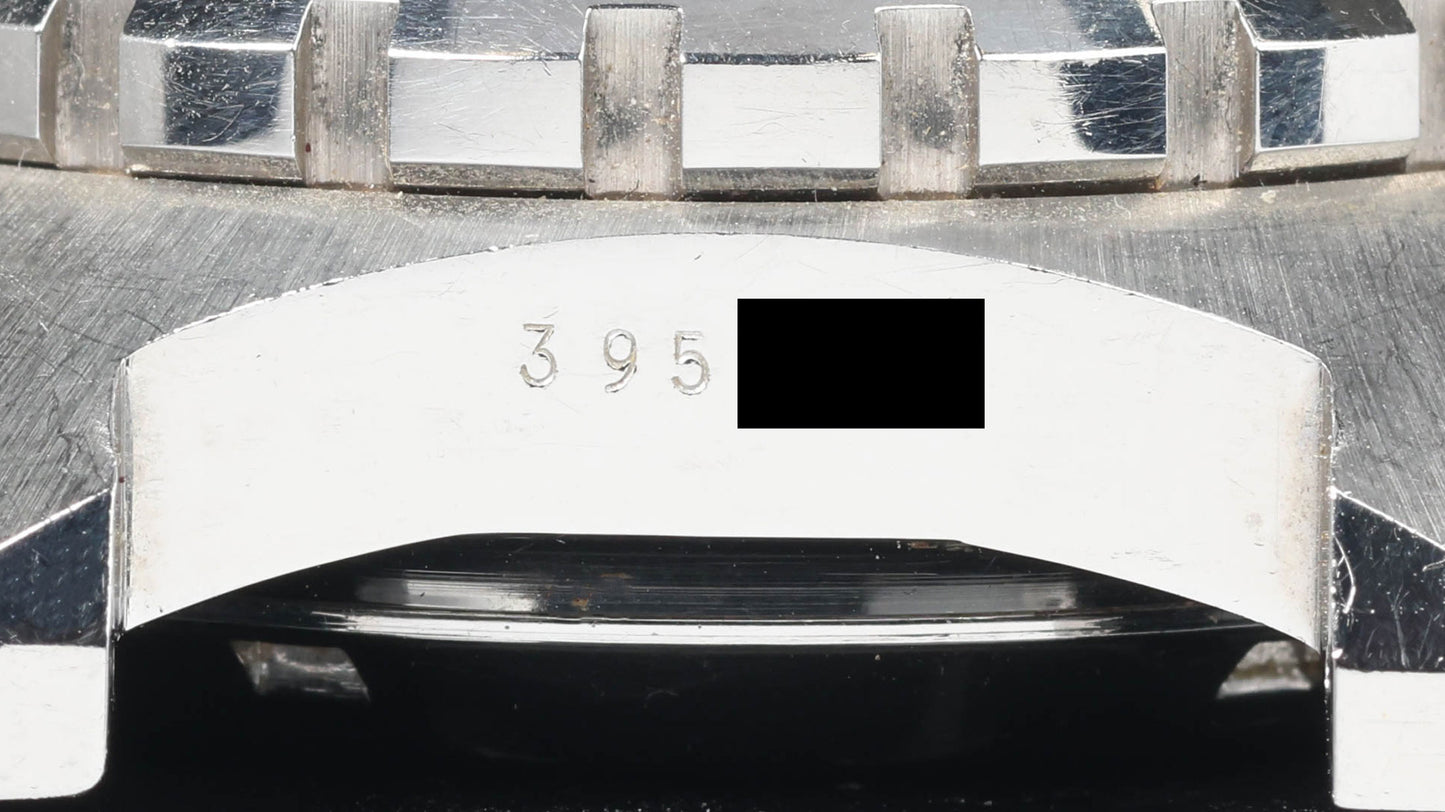
This Heuer Autavia 11063P is presented in great vintage condition. The stainless steel case shows light hairline scratches consistent with careful wear over time, with the overall case geometry remaining honest and well preserved. The watch is fitted to a strap in very good condition, showing minimal signs of use and complementing the robust late-Autavia case profile well. The dial is in excellent vintage condition, retaining strong legibility and even ageing. The hands are also in excellent condition, with only very light oxidisation visible, which is typical for an original example of this age and adds to its period-correct character.
The 11063P is considered one of the rarer Autavia references, produced in a very limited window towards the end of the Autavia line. Its Diver 100 configuration, unidirectional bezel and Mercedes-style hands set it apart from standard Autavia chronographs, and examples are seldom encountered. As this watch is over 30 years old, it should be treated as a vintage timepiece and is not recommended for swimming or water exposure, regardless of its original specifications.
Share
Why we love this watch
Why we love this watch
Heuer Autavia 11063P Diver 100
Produced between 1983 and 1985, the Heuer Autavia 11063P is the late era “Diver 100” variant that puts a hard, functional dive signal onto a platform best known for motorsport chronographs. It sits at the end of the Autavia line, using the last Autavia case design with a unidirectional bezel and 21 mm lug width, and pairing it with Heuer’s Calibre 12 automatic chronograph movement.
What “Autavia” means and why it mattered before the 11063P
“Autavia” is shorthand for automotive and aviation, and that dual purpose is baked into the watch from the beginning. Heuer’s dashboard timers and rally equipment made the brand a natural fit for wrist chronographs aimed at driving and flying, and the Autavia name carried that instrument identity into a waterproof wristwatch case from the early 1960s. TAG Heuer’s own vintage overview frames the Autavia as a long-running, highly varied series that evolved through distinct generations, ending with the final models introduced in the early 1980s.
From early waterproof chronographs to bigger, bolder cases
Across its lifespan the Autavia moved through multiple case architectures and use cases, from early screw-back waterproof designs to later forms. One widely repeated milestone is the shift around the end of the 1960s to compressor-style cases to improve water resistance, followed by the move into large cushion cases in the 1970s to accommodate the new automatic chronograph movements. Analog:Shift summarises that arc clearly, noting the Autavia’s 1962 start, the compressor case phase around 1969, and the later cushion cases associated with Calibre 12-era automatic chronographs.
The late Heuer context: why the 11063P exists at all
To understand the 11063P, it helps to place it in the early 1980s, when Swiss watchmaking was under severe commercial pressure from quartz competition. In that environment, brands either doubled down on identity or retreated into safer, lower-cost product. The 11063P is part of the “double down” camp: it is a niche, purpose-driven configuration that uses a proven movement and a robust case, then pushes the design language toward dive practicality.
The final Autavia case, and the shift toward divers’ ergonomics
TAG Heuer’s vintage Autavia page describes the last Autavia case as arriving in 1983, with two changes centred on the bezel: larger teeth for grip, and a unidirectional mechanism preferred by divers. It also notes that while the case remained 42.5 mm across the dial, the lug width increased from 20 mm to 21 mm for a more substantial stance.
Heuerworld’s reference page for the Diver 100 adds an important nuance: examples are often associated with case markings that read 11063V even when the variant is discussed as 11063P, and it reiterates the larger, deeper case and 21 mm lug width.
Reference 11063P: the “Diver 100” configuration in plain terms
The 11063P “Diver 100” is essentially a late Autavia automatic chronograph configured to read like a diver at a glance. The differentiators are not subtle. Instead of a tachymeter-first look, you get a diving-oriented bezel treatment and handset choices that deliberately echo the underwater tool-watch visual vocabulary.
The scalloped unidirectional bezel and why it changes the whole watch
In the 11063 case family, the bezel becomes a defining feature. TAG Heuer describes the final Autavia bezel geometry as having large teeth to make it easier to grip, and as being unidirectional in the diver-preferred direction. That matters because it changes how the watch is handled in real use: you can set an elapsed-time reference quickly with wet hands or gloves, and the unidirectional action is designed to be conservative if the bezel is accidentally moved.
Analog:Shift goes further on the 11063P specifically, calling out the “distinctive scalloped ‘Rolex-style’ bezel” as a hallmark of the Diver 100. Heuerworld likewise notes the “Rolex style uni-direction bezel” in describing the model.
Mercedes-style hands and high-speed legibility
The handset is one of the quickest ways to spot a Diver 100. Analog:Shift highlights Mercedes hands as an “incredibly rare feature” in the context of a Heuer chronograph, and positions it as part of what makes the Diver 100 so unusual. Heuerworld also points to Mercedes hands as a defining element of the 11063P configuration.
The practical intent is obvious: bold hour hand geometry, strong differentiation between hands, and fast orientation in low light. On a watch that also has chronograph registers and a rotating bezel, that clarity is not just aesthetic, it is functional hierarchy.
“Diver 100” and the late-Heuer approach to purpose-built variants
The “Diver 100” naming seen in period discussion ties into the idea that this watch is more than a colourway. It is a purpose-led variant within a small late production window. The Autavia name historically covered many bezel scales and professional applications, including decompression-related scales in other Heuer lines and executions, so the concept of an Autavia with a nautical or dive slant is consistent with the family’s broader intent.
The movement: Heuer Calibre 12 as the engine of the late Autavia
If the bezel and hands give the 11063P its identity, the movement gives it legitimacy. The Autavia’s transition into automatic chronographs is central to its story, and the Calibre 12 sits right at that intersection of technical ambition and real-world durability.
From Chronomatic to Calibre 12
The early automatic chronograph era involved collaborations and rapid iteration. Analog:Shift outlines the relationship between Calibre 11 and Calibre 12, describing Calibre 12 as an evolution that increased the beat rate and required changes to parts of the gear train, escapement, and balance wheel, alongside improvements to known weaknesses in the chronograph mechanism. The upshot was a more accurate chronograph movement, and one that became a signature of Heuer’s later automatic chronographs.
That technical stepping-stone matters for the 11063P because it anchors the watch as more than a stylistic outlier. The Diver 100 look is attention-grabbing, but underneath it is the same serious automatic chronograph platform used across late Autavia references. TAG Heuer’s vintage page also groups the later Autavia references around the Calibre 12 family for the period.
Why an automatic chronograph diver reads differently to a standard diver
A conventional diver’s dial is often intentionally sparse. A chronograph diver is inherently busier: sub-dials, a date, additional markings, and more handsets competing for attention. The 11063P’s design choices, especially the bold bezel grip and the high-recognition handset, can be read as Heuer’s way of restoring instant usability on a complicated dial layout. It is a tool-first solution to a tool-watch problem: how do you keep timing functions while staying legible under pressure.
Case, dimensions, and wearing experience
Late Autavia cases are big by the standards of earlier decades, and the 11063 generation doubles down on that presence. The watch was designed around a robust automatic chronograph movement and a bezel intended to be handled assertively.
The 11063 case architecture
TAG Heuer describes the final Autavia case as keeping the 42.5 mm measurement across the dial while increasing lug width to 21 mm. Those proportions are part of why the 11063 family wears with a wide, planted stance. Heuerworld reinforces this, describing the case as larger and deeper than its predecessor and again noting 21 mm lugs.
Strap and bracelet fitment considerations
A 21 mm lug width is less common than 20 mm, which can influence how the watch is configured today. Period-correct fitment varies, but the underlying point is that the 11063P was built around sturdier proportions than many earlier Autavias. The case and bezel are the experience, and the strap choice tends to follow that intent: secure, wide, and stable on the wrist.
The 11063P in the broader Autavia timeline
The strongest way to understand the 11063P is to treat it as the closing argument for the Autavia concept. The Autavia started as a waterproof chronograph rooted in driving and flying. Over time it absorbed new movements, new case designs, and new professional timing needs. By the early 1980s, the Autavia had already proven it could change without losing its core identity: readable timing, rotating bezel functionality, and a case built to take use seriously.
A late-series watch that still looks forward
TAG Heuer’s vintage outline makes clear that the final Autavia case was a deliberate redesign around bezel usability and diver-preferred behaviour, not a cosmetic tweak. That is an important point: the 11063P is not simply “a racing watch that happens to have a dive bezel”. It is a watch that intentionally merges a chronograph platform with diver ergonomics.
The “Diver 100” and the question of scarcity and distribution
Some accounts suggest the Diver 100 was produced in very small numbers and may not have been broadly distributed through normal retail channels. Analog:Shift even notes suggestions that it was never intended for sale to the general public, framing it against the corporate and financial turbulence of the period. Separate writing on the model also links it to 1982-era context for Heuer’s dive output, reinforcing that it belongs to the transitional period just before the brand’s mid-1980s corporate change.
Because documentation for niche variants can be fragmented, the safest takeaway is this: the 11063P sits at the intersection of late-Heuer pragmatism and late-Heuer experimentation, where parts availability, small runs, and unusual configurations were more likely than in the stable periods before.
How to identify a Heuer Autavia 11063P quickly
Even without getting into serial-by-serial analysis, the 11063P telegraphs itself through a few unmistakable traits. The first is the aggressive, scalloped unidirectional bezel that reads as a diver’s interface rather than a driver’s scale. The second is the Mercedes-style hour hand, which is exceptionally uncommon within Heuer chronographs and strongly associated with the Diver 100 story. The third is the case generation itself: the late Autavia case with 21 mm lugs and the overall heavier posture described by TAG Heuer and Heuerworld.
Historical significance: why the 11063P matters in Heuer’s story
The historical weight of the 11063P is not just that it is “late” or “rare”. It matters because it shows how Heuer tried to keep purpose-built mechanical watches relevant in an era when the market was rapidly shifting. The Autavia had always been an adaptable instrument concept, and by the early 1980s, adaptability was no longer optional.
It marks the end of the classic Autavia lineage
TAG Heuer positions the early 1980s as the endpoint of the vintage Autavia’s main run, with the final case introduced in 1983 and the Autavia story moving into its closing chapters soon after. In that light, the 11063P becomes a punctuation mark: the Autavia, reinterpreted with dive-first ergonomics, right at the finish line.
It captures Heuer’s technical identity in one package
The Calibre 12 automatic chronograph, the robust late cushion case proportions, and the rotating bezel as a central operating tool are all Heuer signatures of the period. Analog:Shift’s explanation of Calibre 12’s improvements over Calibre 11 is a reminder that the brand was still pushing technical refinements, not simply reissuing old ideas.
It reflects a broader 1980s tool-watch crossover
The 11063P is also a neat example of category crossover: a chronograph adopting a diver’s tactile bezel and visual cues. Worn and Wound, in discussing TAG Heuer’s dive lineage, points directly to the 11063P Autavia Diver as part of the historical run-up to later dive models. That places the watch not as a one-off curiosity, but as part of a through-line in the brand’s broader “serious water” narrative.
Final Thoughts
The Heuer Autavia 11063P is best understood as a late-series Autavia that rebalances the formula toward underwater practicality without giving up the automatic chronograph platform that defined Heuer’s 1970s and early 1980s output. Its unidirectional, high-grip bezel and 21 mm lug case architecture align with diver-focused usability, while the Calibre 12 movement keeps it rooted in the brand’s automatic chronograph progression.
Case & Bracelet
Case & Bracelet
Great vintage condition with light hairlines visible around case. Strap in very good condition.
Dial & Hands
Dial & Hands
Dial and Hands in excellent vintage condition with very light oxidisation on hands.
Warranty & Condition
Warranty & Condition
Crown Vintage Watches provides a minimum 6-month mechanical warranty on pre-owned watches, from the date of purchase.
The warranty covers mechanical defects only.
The warranty does not cover damages such as scratches, finish, crystals, glass, straps (leather, fabric or rubber damage due to wear and tear), damage resulting from wear under conditions exceeding the watch manufacturer’s water resistance limitations, and damage due to physical and or accidental abuse.
Please note, water resistance is neither tested nor guaranteed.
Shipping and insurance costs for warranty returns to us must be covered by the customer. Returns must be shipped via traceable courier. Return shipment must be pre-paid and fully insured. Collect shipping will be refused. In case of loss or damages, the customer is liable.
Our Pledge
At Crown Vintage Watches, we stand by the authenticity of every product we sell. For added peace of mind, customers are welcome to have items independently authenticated at their own expense.
Condition
Due to the nature of vintage timepieces, all watches are sold as is. We will accurately describe the current condition and working order of all watches we sell to the best of our ability.
Shipping & Refund
Shipping & Refund