

Crown Vintage
Heuer Bundeswehr 1550SG 43mm 1970s
Heuer Bundeswehr 1550SG 43mm 1970s
Couldn't load pickup availability
Heuer Bundeswehr 1550SG 43mm 1970s
Chronometry
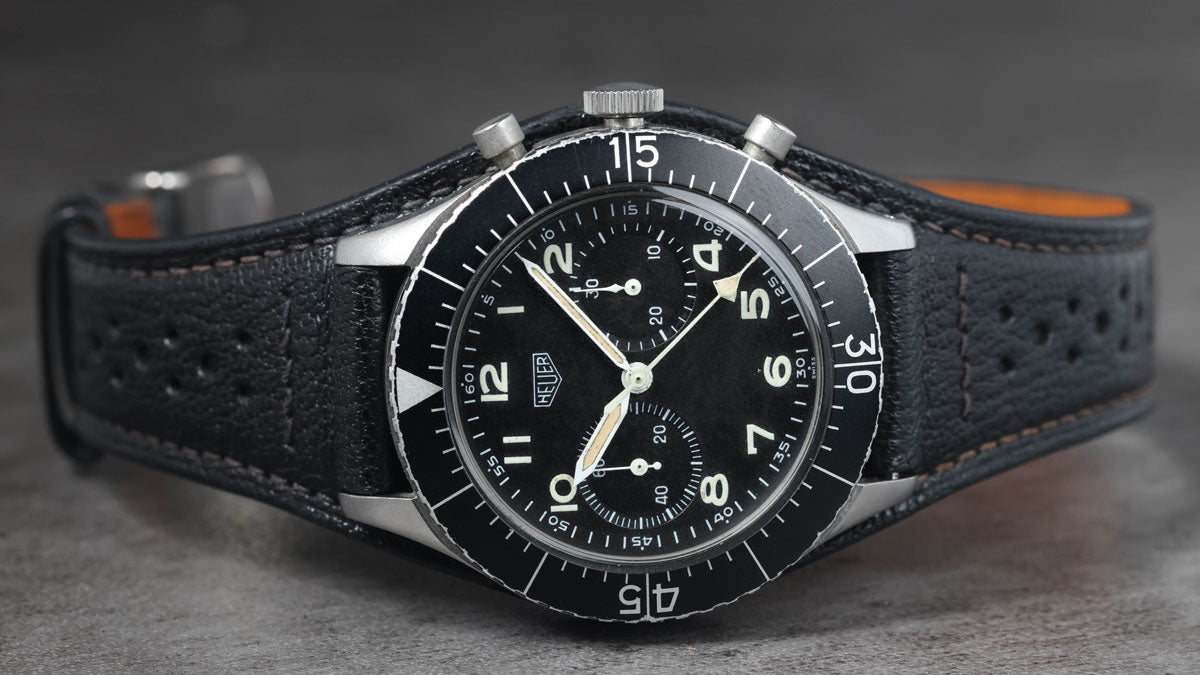
This is an honest, unrestored 1550SG, and it looks every bit the part. The matte sandblasted case presents in very good vintage condition, retaining its original surface geometry throughout with no polishing, no buffing, and no attempt to disguise the decades. The case wears its age with the quiet authority of a watch that has actually been somewhere. The plexi crystal is in excellent condition with no noticeable scratches, and given that acrylic can be polished if needed, this is a detail that matters less than on a sapphire-crystal watch; it is noted here simply because this example does not need it. The aluminium bezel insert shows fading, which on any other watch might be listed as a flaw. On a Bundeswehr 1550SG it is a period-correct characteristic: these inserts were never meant to look pristine, and a well-faded example reads as genuine where a fresh replacement would read as replaced.
The dial and hands present in good vintage condition, carrying a warm, even patina that is cohesive across the full surface. The lume plots on the hands show slight oxidation and minor cracking, the natural result of tritium ageing over fifty-plus years. The overall presentation is unambiguous: this is a genuine, original 1550SG that has not been tidied up for sale. It is fitted with an aftermarket bespoke distressed leather Bund strap in excellent condition, cut and finished in the tradition of the original Bundeswehr-issue strap, and a correct and appropriate choice for this reference.
The movement has been tested on a Witschi timing machine across four positions. Crown up registers +36.1 s/d, crown back +17.8 s/d, six o'clock up -9.2 s/d, and twelve o'clock up -17.3 s/d, yielding a mean rate of +6.9 s/d. Beat error of 0.3 ms indicates excellent poising, with the balance wheel running symmetrically and no detectable drag or irregularity between positions. Amplitude of 289.3° confirms a mainspring in good condition and a movement that is neither overwound nor starved of power. The positional spread is wide, as is characteristic of an unserviced vintage hand-wound calibre of this generation, and the mean rate sits comfortably within acceptable tolerance. The timing test was passed.
Share
Why we love this watch
Why we love this watch
Heuer Bundeswehr 1550SG: History, Dial Variations and Collector Guide
The Heuer Bundeswehr 1550SG is one of the great military chronographs. Issued to West German Luftwaffe pilots at the height of the Cold War and subsequently adopted across several NATO air forces, it is a watch of genuine operational history, serious mechanical substance, and a collector following that has grown steadily for three decades. Its large 43mm matte case, bold Arabic dial, flyback chronograph function, and famous Bund leather strap have made it one of the most visually distinctive military timepieces ever produced. And the dial variations alone are enough to sustain years of serious collecting.
Crown Vintage Watches currently has two Heuer Bundeswehr 1550SG’s available, and this article covers everything a prospective buyer or interested collector needs to know about the reference: the history from Leonidas through to Heuer's Cold War production, the Valjoux 230 movement, the case and strap specifications, the full hierarchy of dial variations, the Sternzeit Reguliert footnote, the Sinn connection, and what to look for when acquiring one.
From Leonidas to Heuer: The Origins of the Bund Chronograph
The watch that would become the Heuer Bundeswehr 1550SG did not begin life as a Heuer product. Its design lineage traces back to the Swiss manufacturer Leonidas, founded in 1841, which had developed flyback chronograph wristwatches for military use in the early 1960s. Leonidas won a contract with the Italian military designated CP-2, supplying flyback chronographs to the Aeronautica Militare Italiana (Italian Air Force) under reference AMI and a parallel version to the Esercito Italiano (Italian Army). These early Leonidas examples used the Valjoux 22 calibre, later updated to the Valjoux 222 with Incabloc shock absorption and a 36-hour power reserve. The cases were polished stainless steel with slightly bevelled lugs, distinct from the later Heuer production.
In 1965, Leonidas and the Edouard Heuer Watch Company merged. For a brief transitional period, watches were sold under a combined Heuer Leonidas branding, though documented evidence suggests no 1550SG references were ever produced under the Heuer Leonidas name. The Leonidas identity was progressively retired, and by 1967 Heuer was supplying the evolved version of the Bund chronograph to the Bundeswehr under its own name, as reference 1550SG.
The year 1967 is the correct start date for the Heuer-branded 1550SG production. Some sources have cited 1955 (the year the Bundeswehr itself was formed) as the watch's origin date, but this conflates the institution with the specific timepiece. The Bundeswehr was established in 1955; the Heuer-branded 1550SG began production in 1967. Production continued until 1990, when Germany was reunified and the Bundeswehr was restructured, giving the reference a production run of approximately 23 years under the Heuer name.
Cold War Context: Why the Bundeswehr Needed This Watch
The Bundeswehr was formed in 1955 as the armed forces of West Germany, positioned at the front line of NATO's defence against Soviet forces across the Inner German Border. West Germany sat directly on the fault line of the Cold War, and the Luftwaffe in particular was required to maintain a constant state of operational readiness. Flying fast jets such as the F-104 Starfighter and F-4 Phantom II in close proximity to Warsaw Pact airspace required precision instruments that could function reliably under demanding cockpit conditions.
A flyback chronograph was the appropriate timing instrument for this context. Unlike a standard chronograph, which must be stopped, reset, and restarted to time consecutive events, a flyback chronograph can be instantly reset and restarted with a single press of the lower pusher. In an operational cockpit environment, where a pilot may need to time a second approach, a fuel burn interval, or a navigation leg immediately after the previous one, the flyback function eliminates the delay and the additional manual steps involved in a standard reset.
The 1550SG was issued primarily to Luftwaffe pilots but its utility was recognised more broadly within the Bundeswehr. Artillery and reconnaissance units also received the watch, in some cases in specialist variants configured for specific operational uses. Beyond Germany, the 1550SG was adopted by other NATO air forces. Heuer supplied the reference to the Norwegian Air Force (Kongelige Norske Luftforsvaret) from the early 1970s, where it became known among collectors as the Luftforsvaret variant. The Yugoslav Air Force also used the reference during the same period.
Case Specifications: 43mm, Matte Finish, Four-Screw Caseback
The Heuer Bundeswehr 1550SG is housed in a 43mm stainless steel case, substantial for its era and immediately commanding on the wrist. The case thickness is approximately 13mm. The overall construction is a two-piece design with a screw-in, four-screw caseback secured at each corner. This caseback design provides the rigidity and seal required for a military instrument and is one of the immediately identifiable visual signatures of the reference when viewed from the rear.
The case finish is matte and sandblasted throughout, with no polished surfaces. This was a deliberate military specification choice: polished surfaces reflect light, which is operationally unacceptable in environments where concealment matters. The matte finish also ages with a patina that collectors appreciate, developing a worn character distinct from the bright surface of a conventionally finished watch.
The caseback carries the Bundeswehr military supply number, stamped and in many cases deeply engraved. The standard supply number format is 6645-12-146-3774, a NATO stock number identifying the watch within the Bundeswehr logistics system. Some examples carry two supply numbers, the second crossed out, indicating a reclassification within the inventory system. The watch's serial number is stamped between the lugs on the case side, separate from the military supply number. The reference designation 1550SG is also found between the lugs on the opposing side.
The lug width is 20mm. The two chronograph pushers are positioned at 2 and 4 o'clock, giving the case an asymmetric quality when viewed straight on. The crown is large and unsigned, designed for easy operation even with gloves. The crystal is acrylic (plexiglass), consistent with the specification of a military field instrument: acrylic is more impact-resistant than mineral glass and, if scratched, can be polished back to clarity.
The Valjoux 230: Movement Specifications and the Flyback Function
The Heuer Bundeswehr 1550SG is powered by the Valjoux 230, a manually-wound Swiss lever escapement movement with 17 jewels. The Valjoux 230 operates at 18,000 vibrations per hour with a power reserve of approximately 48 hours. It incorporates both a flyback chronograph complication and a hacking seconds function.
The flyback mechanism is the movement's defining technical feature in the military context. Pressing the lower pusher at 4 o'clock while the chronograph is running causes the central chronograph seconds hand to instantly fly back to zero and immediately begin counting again, without any intermediate stop or reset step. This single-action reset and restart is the essential operational advantage of the flyback complication over a conventional start, stop and reset chronograph.
The hacking function is equally important for a military instrument. When the crown is pulled to the time-setting position, the seconds hand stops, allowing the watch to be synchronised precisely to a broadcast time signal. On a military operation where timing synchronisation between multiple units can be operationally critical, hacking is not a convenience feature: it is a specification requirement.
The Valjoux 230 replaced the earlier Valjoux 22 and 222 calibres used by Leonidas in the pre-merger watches. The chronograph subdial layout on the 1550SG places the running seconds at 9 o'clock and the 30-minute chronograph counter at 3 o'clock. The movement loads into the case from the front, consistent with military watch convention of the period, rather than through the caseback.
From a servicing perspective, the Valjoux 230 is well-documented and understood by watchmakers experienced with vintage Swiss lever movements. Parts availability is reasonable. Owners should ensure the flyback function is tested by any watchmaker before and after service, as the flyback mechanism requires correct adjustment to operate cleanly.
The Bund Strap: Engineering, Not Fashion
The Heuer Bundeswehr 1550SG is inseparable from the Bund strap, to the point where the strap design itself has taken the Bundeswehr's name in common collector and horological parlance. The Bund strap is a three-component leather assembly: two conventional strap sections attaching to the lugs, plus a separate flat leather pad fitted between the caseback and the wearer's wrist.
The functional purpose of this pad is straightforward and entirely practical. Cockpit environments in jet aircraft during the Cold War era could cycle between extreme temperature ranges rapidly. A metal caseback resting directly against the wrist in these conditions could become uncomfortably hot or cold, and in extreme cases posed a genuine risk of skin contact injury. The leather pad acted as a thermal barrier, insulating the wrist from the caseback temperature while maintaining the watch securely on the arm.
Original Bundeswehr-issue Bund straps carry their own inventory numbers stamped into the leather, part of the same NATO logistics system as the watch itself. Examples with original, matching-number straps are increasingly rare. Reproduction Bund straps of high quality are available from specialist suppliers, and the design has been widely adopted by the broader watch community as both a practical and aesthetic choice across many different watch references.
Dial Variations: The Five Configurations of the Heuer Bund
The dial variations of the Heuer Bundeswehr 1550SG are among the most discussed topics in vintage military watch collecting, and for good reason. Over the 1550SG's production life, at least five distinct dial configurations were produced, each reflecting either a change in luminous material specification, a regulatory update, or a specific operational requirement. Understanding these variations is essential for any serious buyer or collector.
All standard 1550SG dials share the same fundamental layout: a matte black surface with large Arabic hour numerals and a full set of minute markers at the perimeter, two black subdials at 3 and 9 o'clock, and broad luminous hands with a prominent arrow-tipped central chronograph seconds hand. The Heuer logo sits at 12 o'clock. It is the lume notations and secondary markings that differentiate the variants from one another.
Variation 1: 3H Circle with Small T Above 6
The first and most collector-coveted variation carries a red circle at 6 o'clock containing the inscription 3H, along with a small T positioned just above the 6 o'clock index. The 3H designation refers to Hydrogen-3, the scientific notation for tritium, indicating that the luminous compound used on the dial and hands is tritium-based. The small T independently reconfirms the presence of tritium. This dual notation reflects the transitional period when the Swiss watch industry was moving from earlier radioactive luminous compounds to tritium, and military specifications required explicit confirmation of the lume type in use. This is the rarest and most desirable of the five standard configurations.
Variation 2: 3H Circle Only, No T
The second variation retains the red 3H circle at 6 o'clock but omits the small T above the 6 o'clock index. The 3H designation continues to confirm the tritium lume specification. Within collector discussions, the 3H-only dial is considered the second most desirable configuration after the 3H with T. The absence of the T appears to reflect a simplified specification update rather than a change in lume material.
Variation 3: Small T Only, No 3H Circle
The third variation removes the red 3H circle entirely and retains only the small T above the 6 o'clock index. This T continues to indicate tritium luminous material. The removal of the red 3H circle gives this dial a cleaner appearance than the first two variations, and it is considered a mid-production configuration. Examples with this dial marking are more commonly encountered than the first two variations.
Variation 4: Plain Dial, No Lume Notation
The fourth variation carries no lume notation whatsoever: no 3H circle, no T, no additional text beyond the Heuer logo at 12 o'clock and the Swiss Made designation at the base of the dial. This plain configuration appears on later production examples and is the most frequently encountered variation in the market. While it lacks the collectible premium of the 3H variants, a clean, original example of the plain dial in good condition represents an accessible entry point into 1550SG collecting.
Variation 5: Sternzeit Reguliert, the Rarest Bund
The fifth and rarest configuration carries a completely different operational purpose from the four standard variants. The Sternzeit Reguliert dial is marked with the text STERNZEIT REGULIERT across the lower centre of the dial. Sternzeit translates literally from German as star time, and Reguliert means regulated: the watch was regulated for sidereal time rather than solar time.
Sidereal time measures the Earth's rotation relative to distant stars rather than relative to the Sun. Because the Earth also moves along its orbit while rotating, a solar day is approximately four minutes longer than a true sidereal day: a sidereal day lasts 23 hours, 56 minutes, and 4.1 seconds. This four-minute daily difference is operationally significant for precise astronomical positioning.
The Sternzeit Reguliert variant was issued not to Luftwaffe pilots but to Bundeswehr artillery and rocket units, where sidereal time was used in conjunction with a theodolite to calculate true north and determine precise targeting solutions for missiles and artillery. By referencing celestial bodies and knowing the exact sidereal time, artillery surveyors could determine their exact position and orientation with a precision that solar-time measurements could not reliably achieve. Documented examples came complete with a leather document holder bearing Bundeswehr inventory numbers, containing a celestial map, booklets from the School of Rockets and Artillery, and guidance on astronomical direction-finding using a theodolite.
The Sternzeit Reguliert carries the reference number 1551 SGSZ rather than 1550SG. Estimates of total production range from approximately 100 to 150 examples, making it one of the rarest documented military chronograph variants from any manufacturer. Prices for confirmed, original examples have exceeded 10,000 USD, and provenance verification is essential before any purchase at this level.
Additional Sub-Variations: Logo and Numeral Styles
Beyond the five main dial configurations, there are further documented sub-variations in the Heuer logo size and style (three known logo variants) and in the numeral printing: early production dials feature complete Arabic numerals at 2, 4, 8, and 10 o'clock, while later production dials show these same numerals partially cut off by the subdial rings. These distinctions are well-documented by specialist resources including the OnTheDash Bundeswehr reference and the detailed PDF produced by W.A. Manning, both of which are considered authoritative references for this model. Collectors assembling a comprehensive variation set treat logo and numeral styles as a further layer of classification beyond the five primary dial types.
The Sinn Connection: Servicing, Refurbishment, and the 155 Bw Legacy
The relationship between the Heuer Bundeswehr 1550SG and the German watchmaker Sinn is an important chapter in the watch's post-production history. After the TAG Group acquired Heuer in 1985 and the brand was renamed TAG Heuer, the active Bundeswehr contract for ongoing service and maintenance of the 1550SG watches was transferred to Sinn. This is why some 1550SG examples in the market carry Sinn-branded dials: these are not fakes or Frankenwatches, but watches that were legitimately returned to Sinn for service and had their dials replaced with Sinn equivalents during the overhaul process.
Sinn subsequently produced two limited-edition reissues honouring the 1550SG. In 2005, a 200-piece run designated the 155 Bundeswehr (reference 155.020) was produced for the Japanese market, using New Old Stock cases originally intended for the military contract and fitted with hand-wound Valjoux 7760 movements. In 2008, a 272-piece run (reference 155.030) was produced for German dealer Manufactum, this time using an automatic Valjoux 7750 and featuring a day-date window at 3 o'clock. In 2024, Sinn revisited the design with the reference 158, a contemporary reissue using a modern movement but maintaining the essential design language of the original.
For collectors, the Sinn service history matters in two ways. First, it explains and contextualises the existence of Sinn-dialled 1550SG examples in the market, which should be understood as correctly serviced military watches rather than compromised originals. Second, it confirms the continuity of mechanical support for the Valjoux 230 movement through an established German service network.
Buying a Heuer Bundeswehr 1550SG: Condition, Originality, and Market
The Heuer Bundeswehr 1550SG occupies a well-defined position in the vintage military watch market. Standard examples in good condition typically trade between approximately 4,000 and 8,000 USD, with prices driven primarily by dial variation, condition, and the presence of military caseback engravings. The 3H with T dial commands the strongest premiums within the standard five configurations, while the Sternzeit Reguliert occupies a category of its own at significantly higher values.
Military caseback engravings are among the most important condition criteria. A correctly engraved supply number in legible, unaltered condition confirms that the watch was genuinely issued rather than being a civilian variant or a reassembled composite. Civilian versions of the 1550SG were also produced and sold through retail channels; these are mechanically identical but carry no military engravings and are less desirable to the specialist collector market.
The most common condition issues encountered are replaced crowns, non-original crystals, refinished dials, and Sinn-replaced dials on examples where the seller does not disclose the service history. Buyers should also be aware that many examples have been serviced multiple times during their working life, as military watches were maintained by service departments with no regard for what collectors would later consider originality. Mismatched hands and lume replacement on dials are common findings. A watch with fully matched original hands, dial, and case in unpolished condition is the benchmark, and premium pricing reflects the increasing scarcity of examples meeting this standard.
Crown Vintage Watches has a Heuer Bundeswehr 1550SG currently available. We encourage prospective buyers to contact us directly for full specifications, photographs, and condition details on our specific example.
Frequently Asked Questions: Heuer Bundeswehr 1550SG
When was the Heuer Bundeswehr 1550SG produced?
The Heuer-branded 1550SG was produced from 1967 to 1990. The watch's design lineage extends further back through Leonidas, which produced predecessor flyback chronographs for the Italian military from the early 1960s. Leonidas and Heuer merged in 1965, and Heuer began supplying the 1550SG to the Bundeswehr under its own name in 1967. Production ended in 1990 when Germany was reunified and the Bundeswehr was restructured.
What is the movement in the Heuer Bundeswehr 1550SG?
The 1550SG uses the Valjoux 230, a manually-wound 17-jewel Swiss calibre operating at 18,000 vibrations per hour with a power reserve of approximately 48 hours. The movement incorporates both a flyback chronograph function and hacking seconds, both of which were specified for the military contract.
What does flyback mean on the Heuer Bundeswehr 1550SG?
The flyback function allows the chronograph to be instantly reset and restarted with a single press of the lower pusher, without first stopping the chronograph. On a conventional chronograph, timing a second consecutive event requires three separate actions: stop, reset, and start. The flyback reduces this to one. In an operational cockpit context, this difference is operationally significant.
How many dial variations does the Heuer 1550SG have?
There are five primary dial configurations: (1) 3H circle with small T above 6 o'clock; (2) 3H circle only, no T; (3) small T only, no 3H circle; (4) plain dial with no lume notation; (5) Sternzeit Reguliert, issued to artillery units and regulated for sidereal time. Within these five configurations, further sub-variations exist in Heuer logo size and numeral styles.
What is the Sternzeit Reguliert Heuer Bundeswehr?
The Sternzeit Reguliert is the rarest variant of the Bundeswehr chronograph, carrying reference number 1551 SGSZ. It was regulated for sidereal time, measuring the Earth's rotation relative to distant stars rather than the Sun, producing a day of 23 hours, 56 minutes, and 4.1 seconds. It was issued to Bundeswehr artillery and rocket units for use with theodolites to calculate true north and determine precise targeting positions. Estimated production is between 100 and 150 examples.
What is a Bund strap?
The Bund strap is a three-part leather strap assembly consisting of two conventional strap sections and a separate leather pad fitted between the caseback and the wrist. The pad was designed to insulate the wrist from extreme caseback temperatures in jet cockpit environments. The design takes its name from the Bundeswehr watches it was originally issued with. Issued examples carry their own Bundeswehr inventory numbers stamped into the leather.
Why do some Heuer Bundeswehr watches have Sinn dials?
After TAG Group acquired Heuer in 1985, ongoing servicing of the Bundeswehr watch contract was transferred to Sinn. Some examples returned to Sinn for military service had their dials replaced with Sinn equivalents during the overhaul. These are legitimately serviced military watches, not fakes or composites, but they carry a reduced originality premium compared to examples with correct original Heuer dials.
Is the Heuer Bundeswehr 1550SG a good daily watch?
The 1550SG is a robust manual-wind chronograph with a proven military-specification movement, and it is entirely capable of daily wear. The acrylic crystal can be polished if scratched. The flyback and hacking functions are practically useful. Buyers should be aware that the water resistance specification is minimal: it was not designed as a water-resistant instrument, and it should be treated accordingly.
Crown Vintage Watches | Sydney's Vintage Rolex Specialist
Authoritative guides for the discerning collector.
Case & Bracelet
Case & Bracelet
- Watch chronometry tested in 4 positions using our Witschi WAIO with a +6.9 s/d accuracy, 0.3 ms beat error and 289 amplitude.
- Watch comes with after-market bespoke distressed leather ‘bund’ strap in excellent condition.
- Plexi crystal is in excellent condition with no noticeable scratches.
- Case is in very good vintage condition. Bezel insert has some fading.
Dial & Hands
Dial & Hands
Dial and hands are in good vintage condition with a warm patina maintaining a cohesive and period-correct appearance. Hands have slight oxidation and slight lume cracking.
Warranty & Condition
Warranty & Condition
Crown Vintage Watches provides a minimum 6-month mechanical warranty on pre-owned watches, from the date of purchase.
The warranty covers mechanical defects only.
The warranty does not cover damages such as scratches, finish, crystals, glass, straps (leather, fabric or rubber damage due to wear and tear), damage resulting from wear under conditions exceeding the watch manufacturer’s water resistance limitations, and damage due to physical and or accidental abuse.
Please note, water resistance is neither tested nor guaranteed.
Shipping and insurance costs for warranty returns to us must be covered by the customer. Returns must be shipped via traceable courier. Return shipment must be pre-paid and fully insured. Collect shipping will be refused. In case of loss or damages, the customer is liable.
Our Pledge
At Crown Vintage Watches, we stand by the authenticity of every product we sell. For added peace of mind, customers are welcome to have items independently authenticated at their own expense.
Condition
Due to the nature of vintage timepieces, all watches are sold as is. We will accurately describe the current condition and working order of all watches we sell to the best of our ability.
Shipping & Refund
Shipping & Refund