

Crown Vintage
Heuer Carrera 3647S 36mm Circa 1965
Heuer Carrera 3647S 36mm Circa 1965
Couldn't load pickup availability
Heuer Carrera 3647S 36mm Circa 1965
Case and Bracelet
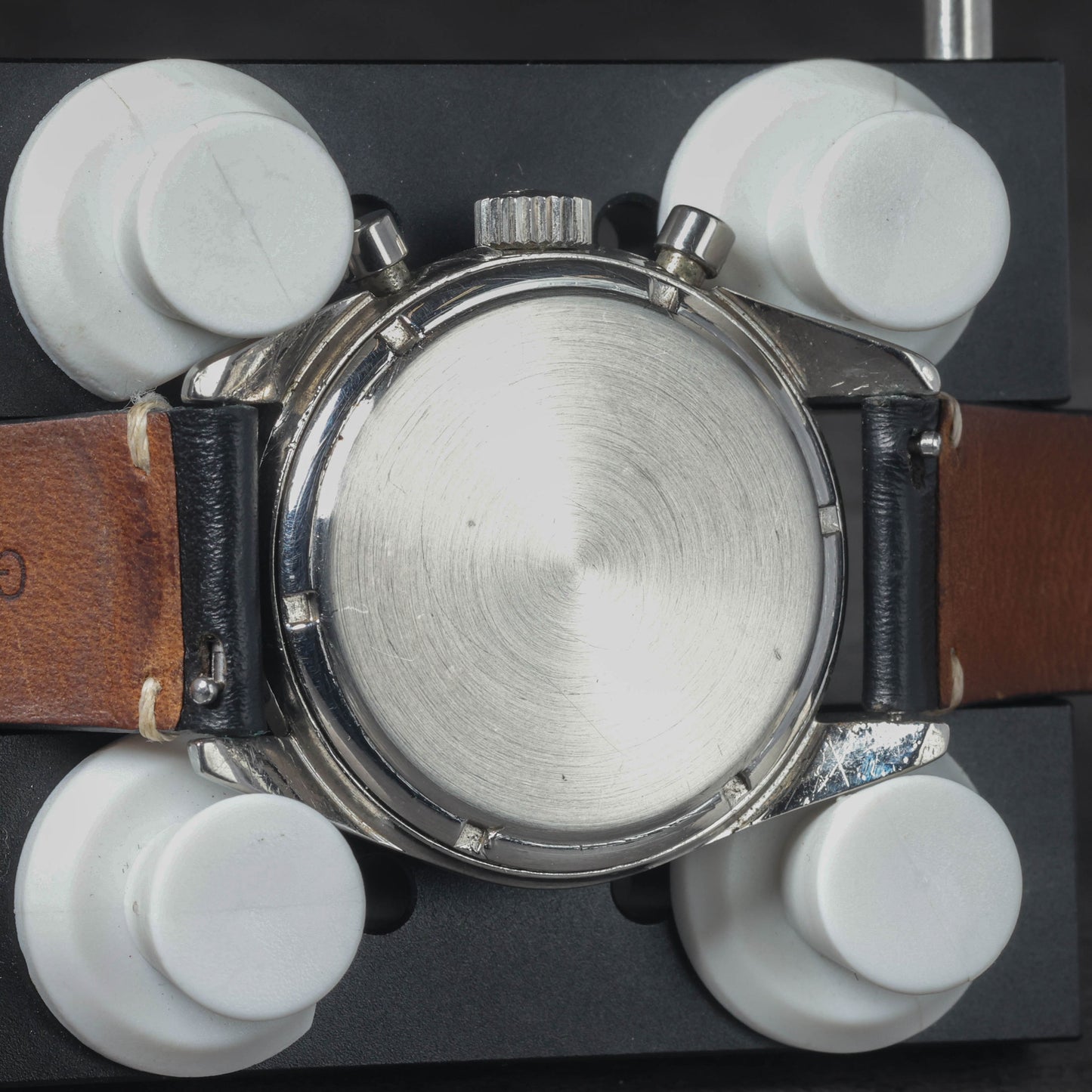
The case presents in good vintage condition, having undergone previous polishing that has softened the edges typical of a Carrera of this era while preserving the overall proportions of the 36mm profile. Hairlines remain visible under close inspection, consistent with a watch of this age and service history. The fitted strap is in good condition, supple and free of significant wear.
Dial and Hands
The dial displays good overall condition with visible oxidisation, as pictured, lending a warm, aged character typical of Carreras from this period that have not been refinished. The two-register configuration remains legible and well-defined against the aged surface. The hands are in good condition, retaining their original shape and proportion with no notable wear beyond what is expected of a watch of this vintage.
Share
Why we love this watch
Why we love this watch
The Carrera 45: Jack Heuer's Two-Register Answer to the Panamericana
A silver dial, a single 45-minute counter set at three o'clock, and a Valjoux 92 movement mark this Heuer Carrera reference 3647S as the leaner sibling to the model that made Jack Heuer's name in 1963.
A Simplified Take on the Original Carrera
When the Carrera line appeared at the Basel Fair in April 1963, its debut form was the reference 2447, a three-register chronograph built around the column-wheel Valjoux 72 and fitted with an hour counter, a minute counter and a running seconds subdial. The reference 3647, launched shortly after, offered an alternative for buyers who wanted the same design language without the third register. Heuer marketed this variant as the Carrera 45, named for the 45-minute totaliser positioned at three o'clock, and it was driven by the Valjoux 92, a two-register derivative of the 72 that dropped the hour counter entirely. The example examined here is the silver-dialled 3647S, dating to circa 1965, part of the first wave of production that stayed closest to Jack Heuer's original brief.
Jack Heuer and the Road to the Carrera Panamericana
Jack Heuer took the reins of the family firm in 1961 at twenty-eight years of age, inheriting a company that had built dashboard timers and pocket chronographs since Edouard Heuer founded the workshop in Saint-Imier in 1860. Jack's ambition was to sharpen the brand's focus on motorsport, and the catalyst arrived at the 12 Hours of Sebring in March 1962, where he was supplying timing equipment to the organisers. In the pits he met the parents of Pedro and Ricardo Rodriguez, Mexico's celebrated young racing drivers, who recounted the Carrera Panamericana, the border-to-border road race that had run through Mexico from 1950 until it was discontinued after 1954 following a string of fatal accidents. Jack later described being struck by the word itself, its meaning stretching across road, race and career, all of it aligned with what he wanted the new watch to represent. He secured the name within weeks of returning to Switzerland, and by the time the Carrera reached dealers in 1963 its identity was already fixed.
Case, Dial and the Logic of Legibility
A Case Built for the Cockpit
The 36mm stainless steel case was manufactured by the Swiss casemaker Ervin Piquerez, a specialist Heuer turned to for its expertise in water-resistant construction. Long, sharply faceted lugs give the case a distinct architectural profile, while the pump-style chronograph pushers were sized deliberately large so they could be operated by a driver wearing racing gloves. The design broke from the ring-cased chronographs Heuer had produced through the 1950s, presenting instead a cleaner, more purposeful shape that has since come to define the Carrera name.
The Tension Ring and Its Purpose
The dial's defining feature is not immediately obvious at a glance. Rather than printing the five-minute and second markers on the dial itself, Jack Heuer relocated them to an angled steel tension ring set beneath the crystal. This flange pressed against the plexiglass to improve water resistance while simultaneously clearing the dial surface of clutter, leaving only the recessed subdial and the baton hour markers to occupy the eye. The result was a chronograph designed to be read at speed, an idea drawn directly from the instrument panel of a competition car rather than from the pocket watch conventions that still shaped much of the industry in the early 1960s.
The 45-Minute Register in Practice
Where the three-register 2447 required a driver to read across an hour counter, a minute counter and a running seconds dial, the 3647 reduced that task to a single sweep. The Valjoux 92's 45-minute counter at three o'clock could track a race stint or a fuel stop without the additional hour register needed for longer intervals, trading total elapsed-time range for a faster read. Paired with the running seconds subdial at nine o'clock, the layout kept the dial balanced and the two-hand chronograph function immediate, consistent with Jack Heuer's stated aim of building a watch that gave a driver everything necessary and nothing more.
Final Thoughts
The Carrera 45 rarely receives the same attention as its three-register sibling, yet it captures Jack Heuer's design philosophy in its most distilled form. Every element, from the Piquerez case to the tension-ring flange to the simplified two-register layout, was chosen to serve a single purpose: a chronograph that could be read in an instant under pressure. Six decades on, the 3647S remains a clear statement of the thinking that shaped one of the twentieth century's most recognisable sports chronographs.
References
1. Wind Vintage, "Heuer Carrera Reference 3647S Unpolished," windvintage.com.
2. Timeline Watch, "Heuer Carrera 45 ref. 3647S from 1965," timeline.watch.
3. Waecce, "Vintage Heuer Carrera '45' Chronograph ref. 3647s," waecce.com.
4. Monochrome Watches, "The Evergreens: The History of the Heuer and TAG Heuer Carrera Chronograph," monochrome-watches.com, September 2025.
5. Teddy Baldassarre, "TAG Heuer Carrera Chronograph Guide," teddybaldassarre.com, March 2024.
6. Craft & Tailored, "1960s Heuer Carrera 12 '2nd Execution' (Ref. 2447D) Silver Decimal Dial," craftandtailored.com.
7. Dmarge, "Ultimate TAG Heuer Carrera Buyers Guide," dmarge.com, March 2021.
Case & Bracelet
Case & Bracelet
- Case in good vintage condition
- Hairlines visible
- Case polished
- Strap is in good condition.
Dial & Hands
Dial & Hands
- Dial good condition with oxidisation (pictured)
- Hands in Good condition
Warranty & Condition
Warranty & Condition
Crown Vintage Watches provides a minimum 6-month mechanical warranty on pre-owned watches, from the date of purchase.
The warranty covers mechanical defects only.
The warranty does not cover damages such as scratches, finish, crystals, glass, straps (leather, fabric or rubber damage due to wear and tear), damage resulting from wear under conditions exceeding the watch manufacturer’s water resistance limitations, and damage due to physical and or accidental abuse.
Please note, water resistance is neither tested nor guaranteed.
Shipping and insurance costs for warranty returns to us must be covered by the customer. Returns must be shipped via traceable courier. Return shipment must be pre-paid and fully insured. Collect shipping will be refused. In case of loss or damages, the customer is liable.
Our Pledge
At Crown Vintage Watches, we stand by the authenticity of every product we sell. For added peace of mind, customers are welcome to have items independently authenticated at their own expense.
Condition
Due to the nature of vintage timepieces, all watches are sold as is. We will accurately describe the current condition and working order of all watches we sell to the best of our ability.
Shipping & Refund
Shipping & Refund