

Crown Vintage
Rolex Datejust 1601 Sigma Dial 36mm 1977
Rolex Datejust 1601 Sigma Dial 36mm 1977
Couldn't load pickup availability
Rolex Datejust 1601 Sigma Dial 36mm 1977
Case and Bracelet
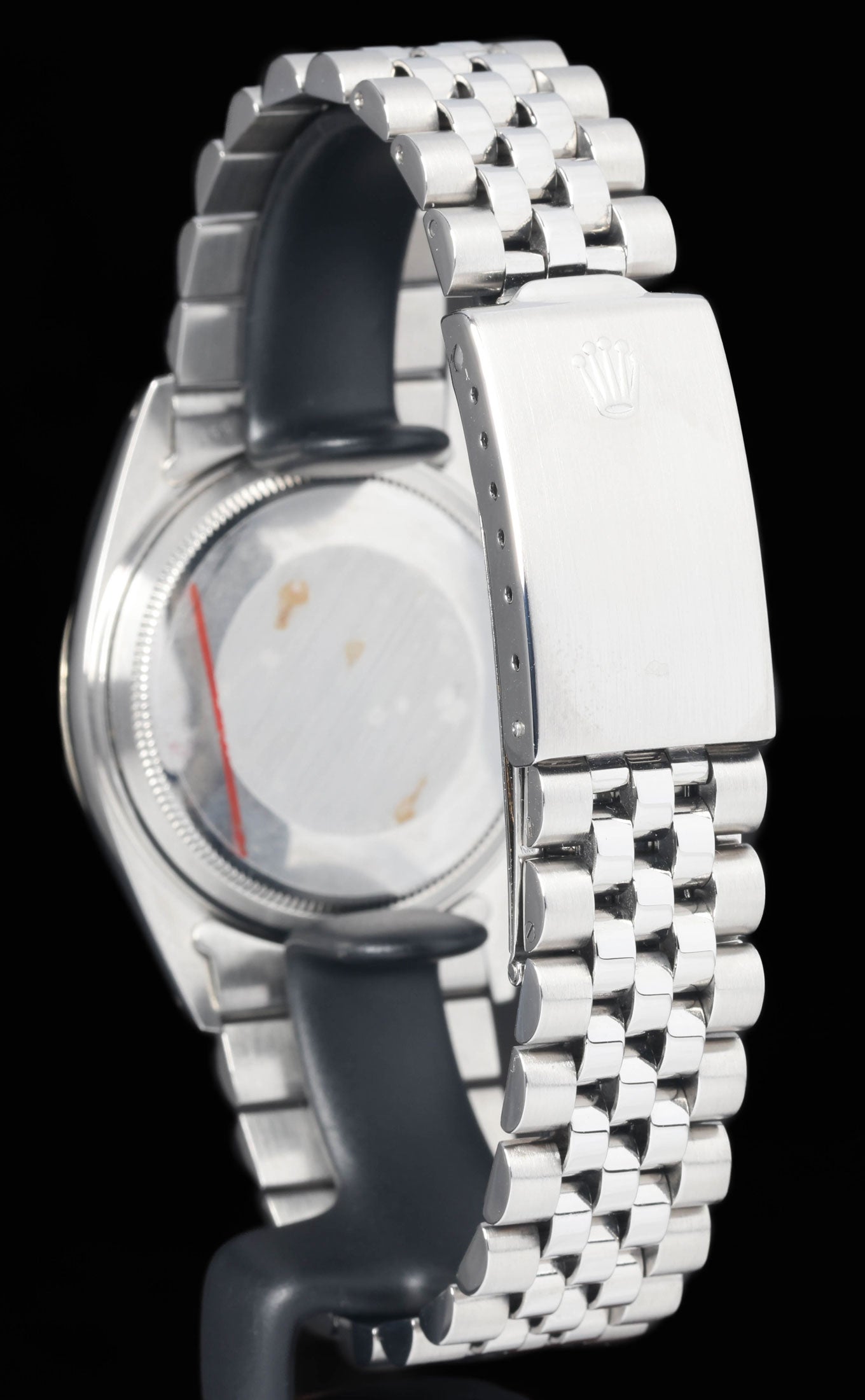
The 36mm Oyster case is in great condition, with only light hairlines visible across the surfaces from honest everyday wear. The case retains strong definition and good overall form, and the fluted white gold bezel, always the softer and more vulnerable element on a steel 1601, holds its shape well. The folded-link Jubilee bracelet shows only light stretch, modest for a bracelet of this construction and age, and still wears with the supple, fluid feel the design is known for.
Dial and Hands
The dial and hands are in great condition. The silver dial has taken on a nice, even patina that suits the watch, and the applied white gold markers and hands, certified by the sigma marks at the foot of the dial, remain crisp and bright against it. Use Advisory
This is a vintage timepiece, now approaching fifty years old, and should be treated accordingly. It rewards gentler handling than a modern Oyster would ask for, and with regular servicing the calibre will continue to run reliably for years to come.
Share
Why we love this watch
Why we love this watch
Two Greek Letters and the Quartz Crisis: A 1977 Rolex Datejust 1601 Sigma Dial
At the very bottom of this 1977 Datejust 1601's silver dial, just beneath the six o'clock marker, sit two small Greek letters that most people would never notice. They flank the line that reads T SWISS T, one on each side, and they are lowercase sigmas. They are easy to miss, and they quietly change what the watch is. They tell you that the bright applied markers and hands, which look for all the world like polished steel against the silver dial, are in fact solid white gold. Everything else here is pure, familiar Datejust: the 36mm steel case, the fluted white gold bezel, the Cyclops bubble over the date, the Jubilee bracelet. The sigmas are the small detail that ties the watch to a very particular moment in Swiss watchmaking.
The Watch That Put the Date in a Window
Rolex introduced the Datejust in 1945 to mark its fortieth anniversary, and the watch arrived with a genuine first to its name. Its debut reference, the 4467, was the first self-winding chronometer wristwatch to display the date in a window on the dial, advancing on its own as the day turned. That achievement rested on two earlier Rolex breakthroughs: the waterproof Oyster case of 1926 and the self-winding Perpetual rotor of 1931. To these the Datejust added an automatic date and a new bracelet, the five-link Jubilee, designed expressly for the launch and named for the anniversary it honoured.
The first Datejust came only in 18 carat gold, and the model name did not yet appear on the dial; that followed in the 1950s as steel and two-tone versions joined the range. Two details that now feel essential to the design were settled in those same years. The date began changing instantaneously at midnight, rather than creeping over the small hours, from around 1955, and in 1953 Rolex had introduced the Cyclops, the magnifying bubble set into the crystal over the date. The idea of a date on the dial was not entirely new in 1945, but no one had yet combined it with an automatic, chronometer-grade, waterproof movement in a way that simply worked, day after day, without the owner thinking about it. That is what the Datejust delivered, and it set the template the rest of the industry would follow. Just as importantly, the watch was never tied to a single pursuit the way the Submariner or the Daytona were. It was meant simply to be a complete everyday watch, and that openness is why it has stayed in production, in one form or another, for eighty years.
The Reference 1601
By the time this watch was made, the Datejust had settled into the four-digit family that many people still picture first. Rolex introduced the reference 1601 around 1959 and kept it in production into the late 1970s, with the last examples sold into the early 1980s. It sat at the centre of a closely matched trio. The reference 1600 carried a smooth steel bezel and the 1603 an engine-turned one, while the 1601 wore the fluted bezel that has become the defining gesture of the whole Datejust line. On a steel-cased Datejust, that fluting is always gold, because Rolex reserves it for precious metal, and on this watch it is white gold, cool and bright against the steel.
A 1977 example sits right at the end of that long run. Within a year or two Rolex would move the 36mm Datejust onto its five-digit references and a new generation of movement, so a watch from this date is among the last of the classic four-digit cars before the design quietly modernised. None of that shows on the wrist. What you get is the fully matured version of a template Rolex had been refining for nearly two decades, and one it would go on borrowing from for decades more.
The Movement Inside
Inside the 1601 of this period is the calibre 1575, the automatic movement Rolex fitted to the reference from around 1965 onward. It beats at 19,800 vibrations per hour and is chronometer-certified, which is why the dial carries the line Superlative Chronometer Officially Certified beneath the Datejust name. From 1972 the calibre gained a hacking, or stop-seconds, function, allowing the seconds hand to be halted for precise setting against a time signal.
What it does not have is a quickset date. On this generation the only way to advance the date is to rock the hands back and forth across midnight, a small ritual that the very next Datejust generation, with its calibre 3035, would finally do away with. That makes a 1977 1601 something of a hinge point, a watch built with one of Rolex's last non-quickset movements just as the quickset era was arriving. The 1500-series calibres earned their reputation honestly. They are among the most durable automatics Rolex ever produced, and a properly serviced example will keep good time for many years yet.
Case, Bezel and Bracelet
The 1601 uses the 36mm Oyster case that has aged into an almost universal size, roughly 11.7mm thick and 44mm from lug to lug. A screw-down Twinlock crown and a screw-down caseback gave it 100 metres of water resistance when new, though any vintage Oyster deserves caution around water today. The crystal is acrylic rather than sapphire, gently domed, with the Cyclops moulded in above the date. Acrylic picks up scratches but polishes out easily, and it lends older Rolex dials a warmth that flat sapphire never quite reproduces.
The fluted white gold bezel is both the watch's signature and its softest point. Gold yields more readily than steel, so careless polishing rounds off the crisp peaks of the fluting over time, and a sharp, well-defined bezel is part of how an example holds its character. The Jubilee bracelet beneath it carries the five-link form designed back in 1945, built in this era with folded links and hollow end pieces for a light, supple feel. The lugs are drilled through, a practical touch of the period that makes the bracelet easy to remove.
Reading the Sigma Dial
Now to those two letters. A sigma dial takes its name from the lowercase Greek sigma, printed twice at the foot of the dial, one mark on either side of the SWISS designation. On this watch the full line reads as sigma, T SWISS T, sigma. The T SWISS T part is straightforward: the T stands for tritium, the luminous material Rolex used on the markers and hands through this era, so the line simply records what the lume is. The sigmas are the interesting part. They certify that the applied hour markers and the hands are made of solid gold rather than steel or plated metal.
That distinction matters most on exactly this kind of watch. On a steel Datejust, white gold markers and steel can look almost identical, two cool, bright, silvery metals sitting side by side. Without some sort of mark, an owner would have no straightforward way to know whether those gleaming indices were solid gold or simply polished steel. The sigma was the answer. It quietly confirmed that the brightwork on the dial was the real thing. On a 1977 steel 1601 with a fluted white gold bezel, the sigma dial completes a consistent picture: the bezel is white gold, and so are the markers and hands, even though the case and bracelet are steel.
The lume text alongside the sigmas helps place the watch in time as well. Through this era Rolex marked its tritium dials T SWISS T, and later in the tritium period the wording shifted to a SWISS marking with a small reference to the low radioactivity of the material. A T SWISS T sigma dial therefore reads as a product of the heart of the 1970s, the years when the sigma was in active use, which is exactly where a 1977 1601 belongs. The dial and the date agree, which is part of what makes a watch like this feel so coherent.
Gold, Quartz, and a Greek Letter
The sigma did not come from Rolex alone. It was the work of a Swiss industry body usually abbreviated APRIOR, from L'Association pour la Promotion Industrielle de l'Or, the Association for the Industrial Promotion of Gold. Inspired by the way COSC certified chronometric precision, APRIOR wanted a shared, recognisable way to signal the use of solid gold in a watch, something especially useful on steel models where gold indices could be mistaken for steel. The group filed its patent for the mark in 1971, and it was registered the following year. Use was entirely voluntary; a watchmaker chose whether to apply it, which is part of why sigma dials appear on some references and periods and not others.
The timing was no accident. The early and middle 1970s were the opening years of the quartz crisis, when inexpensive, accurate quartz watches began to undercut traditional Swiss mechanical watchmaking. In that climate, established houses had a strong incentive to remind buyers of what their watches were actually made of. A small gold mark on the dial was a subtle way of asserting intrinsic value and craftsmanship at a moment when both were under pressure. The brands that adopted the sigma included some of the most serious names in the business, Rolex among them. The mark faded from use by the early 1980s, as the industry found its feet and moved on to other ways of making its case, which is why the sigma now reads so clearly as a signature of the 1970s.
A 1970s Watch Through and Through
Set in its moment, a 1977 sigma-dial 1601 is a thoroughly seventies object. This was the decade in which Rolex itself answered the quartz challenge head-on, launching the Oysterquartz around the same time, and the sigma dial belongs to that same proud, slightly defensive chapter of the brand's history. Yet the watch wears none of that anxiety. The silver sunburst dial is clean and bright, catching light across its surface, with the white gold markers and hands crisp against it. It is a restrained, formal dial, the kind that has always made the Datejust as easy under a shirt cuff as it is on a weekend.
That restraint is the appeal. The 36mm case sits flat and unobtrusive, dressy without being showy, exactly the versatility Rolex built into the Datejust when it decided the watch should belong to no single setting. The white gold bezel adds a cool flash against the steel, the domed acrylic softens the whole picture, and the sigma dial rewards a closer look without ever demanding one. It is a watch that says very little at arm's length and a good deal more once you know where to look.
Final Thoughts
The Datejust 1601 is the most archetypal form of one of the most recognisable watches ever made, and a 1977 example catches it near the close of its long four-digit run. What sets this one apart sits in two small letters at the bottom of the dial. The sigmas mark a silver Datejust whose bright markers and hands are solid white gold, and they tie the watch to a specific and slightly embattled moment in Swiss watchmaking, when the industry leaned on the honesty of its materials to weather the rise of quartz. The history of the brand and the reference explains the Datejust you can read on a spec sheet. The sigma dial explains the one you actually hold, a quietly gold-laced survivor of the 1970s.
References
1. Rolex, “Datejust.” rolex.com.
2. Wikipedia, “Rolex Datejust.” en.wikipedia.org/wiki/Rolex_Datejust.
3. Monochrome Watches, “The Evergreens: The History of the Rolex Datejust.” monochrome-watches.com.
4. Chrono24, “Rolex Datejust 36 Ref. 1601.” chrono24.com.
5. Fratello Watches, “Exploring Evergreens: Rolex Datejust 36mm Ref. 1601.” fratellowatches.com.
6. Bob’s Watches, “What Is a Rolex Sigma Dial?” bobswatches.com.
7. WatchGuys, “What is a Rolex Sigma Dial?” watchguys.com.
8. Millenary Watches, “What is a Rolex Sigma Dial? Complete Guide.” millenarywatches.com.
9. Chrono24 Magazine, “Linen, Buckley, Sigma and Other Rolex Datejust Dials.” chrono24.com.
10. Luxury Watch Supply, “Jargon Unlocked: The Rolex Sigma Dial.” luxurywatchsupply.com.
Case & Bracelet
Case & Bracelet
- Case and bracelet in great condition, light hairlines visible.
- Case condition remains strong.
- Bracelet has light stretch
Dial & Hands
Dial & Hands
- Dial & hands great condition
- Nice patina on Dial
Warranty & Condition
Warranty & Condition
Crown Vintage Watches provides a minimum 6-month mechanical warranty on pre-owned watches, from the date of purchase.
The warranty covers mechanical defects only.
The warranty does not cover damages such as scratches, finish, crystals, glass, straps (leather, fabric or rubber damage due to wear and tear), damage resulting from wear under conditions exceeding the watch manufacturer’s water resistance limitations, and damage due to physical and or accidental abuse.
Please note, water resistance is neither tested nor guaranteed.
Shipping and insurance costs for warranty returns to us must be covered by the customer. Returns must be shipped via traceable courier. Return shipment must be pre-paid and fully insured. Collect shipping will be refused. In case of loss or damages, the customer is liable.
Our Pledge
At Crown Vintage Watches, we stand by the authenticity of every product we sell. For added peace of mind, customers are welcome to have items independently authenticated at their own expense.
Condition
Due to the nature of vintage timepieces, all watches are sold as is. We will accurately describe the current condition and working order of all watches we sell to the best of our ability.
Shipping & Refund
Shipping & Refund