

Crown Vintage
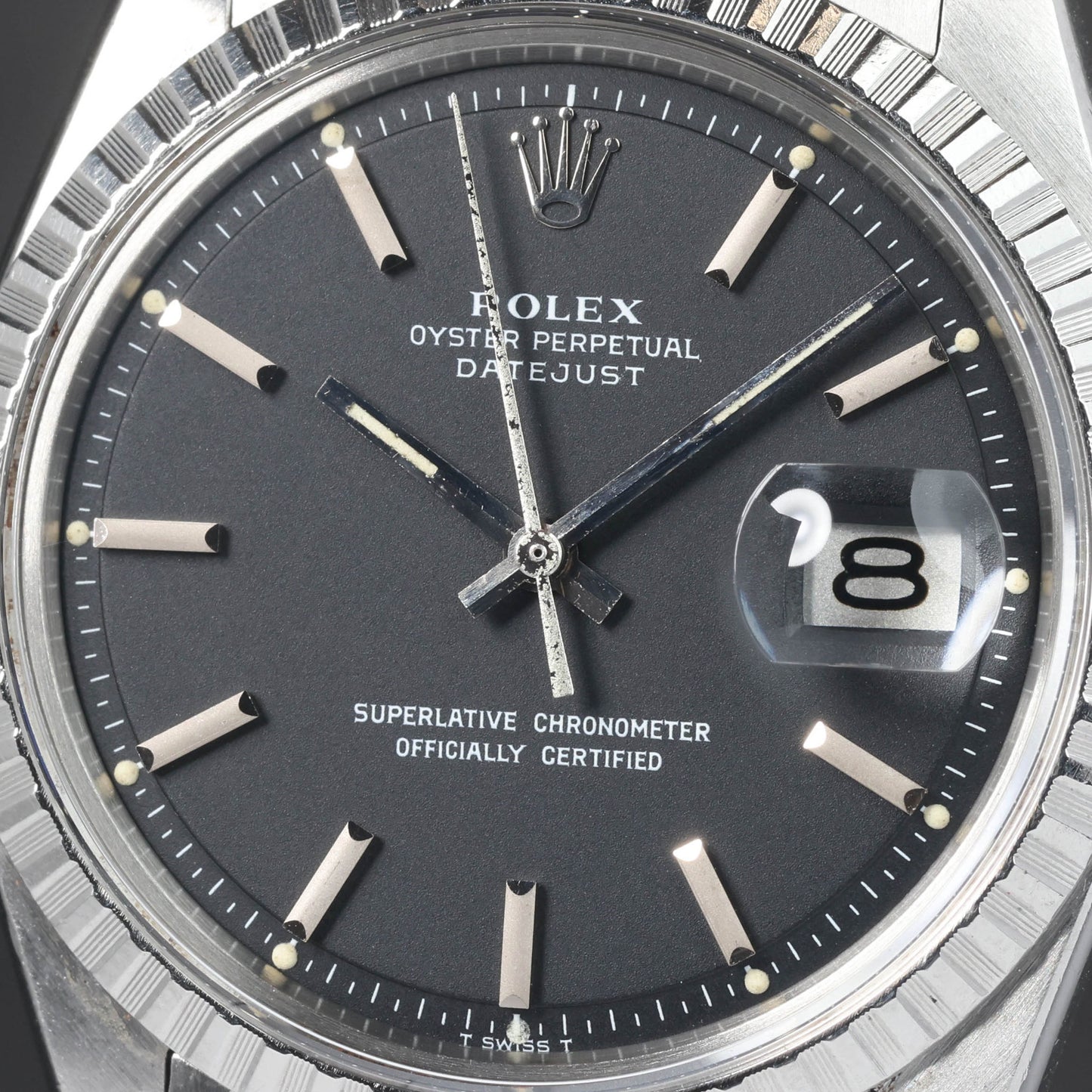
Rolex Datejust 1603 'Matte Dial' 36MM 1970s
Rolex Datejust 1603 'Matte Dial' 36MM 1970s
Couldn't load pickup availability
Rolex Datejust 1603 'Matte Dial' 36MM 1970s
The case presents in extremely sharp condition, retaining the definition across its lug profiles and case edges that is increasingly difficult to find on a 1970s 316L steel Datejust of this age. The transition between brushed and polished surfaces remains well-resolved, and the engine-turned bezel holds its machined pattern with clarity throughout. Light hairlines are visible under raking light, consistent with careful daily wear rather than any mechanical contact or polish intervention. The serial number between the lugs shows pitting / scratching, typical of bracelet removal and wear over the watch's service history and not unusual in examples that have been worn and maintained across several decades. The folded-link Jubilee bracelet presents in great condition for its age, with stretch present as expected given the construction of period folded-link examples, but with no significant elongation that would compromise comfort or drape on the wrist.
The matte dial presents in great condition. The surface is clean and even, with no spotting, lifting, or damage to the printing, and the applied stick indices sit correctly without corrosion at their feet. The tritium plots show a light, uniform oxidation across the dial consistent with the watch's age, and the handset mirrors this patination closely, indicating the hands are original and unaltered. The light oxidation to the hands is natural for tritium-era Rolex of this period and presents evenly across the set without the uneven or localised discolouration that would suggest refinishing or replacement.
Share
Why we love this watch
Why we love this watch
The Rolex Datejust Reference 1603 Matte Dial: Understated Precision in Steel
The reference 1603 is the Datejust that Rolex built without recourse to gold. Where the 1601 announced itself through its fluted white gold bezel and the 1600 retreated into a smooth polished surround, the 1603 took a different path: an engine-turned steel bezel machined with a repetitive decorative pattern that catches light obliquely and occupies a middle ground between utility and ornament that neither of its siblings managed. Add the flat matte dial that Rolex adopted for this reference in the early 1970s, a surface that absorbs rather than reflects, and what you have is a Datejust that was never trying to impress anyone. That is precisely what makes it interesting.
Rolex and the Road to the Datejust
To understand the 1603, it helps to understand how Rolex arrived at the Datejust in the first place. The company's founder, Hans Wilsdorf, was born in 1881 in Kulmbach, Bavaria. After training in commerce in Germany and working in the watch trade in Switzerland, he relocated to England and co-founded the firm then known as Wilsdorf and Davis, before the company was formally registered as Montres Rolex SA on 17 January 1920 following a move back to Switzerland driven by the disruptions of the First World War.
Wilsdorf's early preoccupation was with the wristwatch as a precision instrument. Even watches manufactured by Rolex in 1910 bore proof of chronometer testing, and chronometer certification has remained central to the brand's identity ever since. The two technical milestones that would shape everything that followed were the hermetically sealed Oyster case in 1926 and the Perpetual self-winding rotor system in 1931. Together, these developments made the modern waterproof, automatic wristwatch possible, and they remain the technical foundation of the Datejust to this day.
In 1945, to mark 40 years since the founding of the company, Rolex released a solid gold Oyster Perpetual reference, the 36mm 4467, fitted with a date complication and a new multi-link bracelet that it called the Jubilee. This was the world's first automatic, waterproof chronometer wristwatch with a date function, and it would soon come to be known as the Datejust. The date aperture was positioned at 3 o'clock, and the mechanism beneath was engineered to change the date disc instantaneously at midnight, driven by a cam and spring system. The Jubilee bracelet, purpose-designed for this reference, was offered in solid gold to match.
In 1953, Rolex added a Cyclops lens over the date aperture to improve legibility, placing the magnifying element directly on the surface of the crystal above the date window. This small addition would become one of the most recognisable visual signatures in watchmaking, appearing on virtually every Datejust produced since.
The 16xx Family and the Emergence of Reference 1603
The 16xx family of Datejust references debuted in 1959. It was the first in the Datejust series to enjoy any meaningful longevity, lasting through to approximately 1981, and holding an example next to a current Datejust makes the continuity of design immediately apparent.
Within this generation, three primary steel references defined the range, each distinguished principally by its bezel. The reference 1600 carried a smooth polished bezel, the reference 1601 a fluted 18k gold bezel, and the reference 1603 the engine-turned steel bezel that gives this particular watch its character. The reference 1603 describes a 36mm steel watch case topped with an engine-turned bezel, again in stainless steel, and these watches were made in 316L stainless steel, long before Rolex made its later switch to 904L.
The engine-turned bezel is the detail that sets the 1603 apart from its siblings in the 16xx family. Where the fluted gold bezel of the 1601 signals dressiness and the smooth bezel of the 1600 says nothing at all, the engine-turned finish of the 1603 occupies a more interesting middle ground. The pattern is machined directly into the steel, producing a textured surface that catches light without the formality of gold. These engine-turned examples were not produced in as great a number as the smooth or fluted variants, making the reference among the rarer of the vintage Datejusts.
Movement
The 16xx family began life with the Calibre 1565, running at 18,000 vibrations per hour, before graduating in the mid-1960s to the Calibre 1575, with a higher beat rate of 19,800 vibrations per hour for improved accuracy and a smoother sweep of the seconds hand. The 1575 is part of the broader 1570 calibre family, and it is the movement found in the majority of 1970s examples of the 1603. The Calibre 1570 is a certified chronometer movement. It is automatic and self-winding with 26 jewels, a power reserve of 48 hours, and is equipped with the Kif Ultraflex shock system and a free-sprung Breguet hairspring.
What the 1603 does not have is a quickset date function. The watches of the 16xx generation did not acquire a quickset date function until the mid-1970s; on these earlier references, setting the date requires winding the hands forward through 24-hour increments. This is sometimes noted as a practical inconvenience, but it is also simply the technical reality of the period in which the watch was built. The quickset function arrived with the Calibre 3035 and the subsequent five-digit references that replaced the 1603 from 1977 onward.
The Matte Dial and the Aesthetic Character of the 1970s
The matte dial of a 1970s reference 1603 is, in many ways, the defining visual element of the watch. Earlier Datejust examples from the 1960s were frequently fitted with the so-called pie-pan dial, a stepped construction in which the outer section of the dial sits at a lower plane than the central surface, creating a subtle dimensional effect. These pie-pan dials offer a layer of three-dimensionality that went away with the advent of quickset date and the five-digit Datejusts.
By the early 1970s, Rolex had moved toward a flat dial surface on the 1603. The matte finish is precisely what it sounds like: rather than reflecting light back toward the observer, the dial absorbs it. The result is a surface with a quiet depth, closer in character to a tool watch than a dress piece. Against this matte ground, the applied stick indices sit cleanly, and the printing of the Rolex text and Datejust designation reads with clarity. It is a dial that improves under close inspection, offering more textural interest than its initial appearance suggests.
Sigma Dials
In the 1970s, Rolex began using 18k gold for the hour markers and handsets on certain watches, and for a period added a pair of small Greek sigma (σ) characters to their dials to indicate this. These flanked the T Swiss T text at the base of the dial, the latter notation signifying tritium luminous material. Known as the APRIOR marks, for Association pour la Promotion Industrielle de l'Or, the sigma dials appeared on steel versions of the 1603 and are considered especially rare among this reference.
Tritium itself is the defining luminous material of the period. The luminescent material used on these dials was tritium, applied very sparingly and typically restricted to a small stripe on the baton hands and a dot above the indexes. With the passage of time, tritium plots develop a warm, honey-toned patination as the material ages. This patination is entirely natural and varies in depth and evenness from example to example, giving each watch an individual character that no two examples share precisely.
Crystal and Case
The 36mm Oyster case, acrylic crystal, and Cyclops date magnifier are classic vintage Rolex hallmarks on the 1603. The acrylic crystal, sometimes referred to as Plexiglas or hesalite, was standard on Datejust references of this generation. Unlike sapphire crystal, acrylic is susceptible to scratching but can be polished, and vintage examples in good condition will often have been maintained accordingly. The Cyclops element sits proud of the crystal surface, a practical magnification lens that makes the date window meaningfully more readable in daily use.
The 1603 was fitted with lug holes, making changing bracelets straightforward and allowing owners to move between bracelet configurations with minimal effort. This was standard practice for Rolex at the time, and it is one of the small details that distinguishes a vintage reference from the solid-lug construction that followed in subsequent generations.
The Jubilee Bracelet
Most examples of the reference 1603 are found on Rolex's Jubilee bracelet, the same bracelet designed and made for the original Datejust in 1945. The folded-link Jubilee of the 1970s differs meaningfully from the solid-link construction used on contemporary Rolex production. The vintage folded-link bracelets are lighter on the wrist, with a distinctive feel that is part of the appeal for those who appreciate the period character of the watch. The clasp on dated examples will typically carry a date stamp in the format of month and year, providing a useful reference point for establishing the approximate production period of a given bracelet.
Oyster bracelet variants of the 1603 also exist and were a factory option. Both bracelet types were entirely correct from the factory, though Jubilee examples are more commonly encountered today, with correct folded-link Oyster versions harder to find in original condition.
Rolex, the Datejust, and the Quartz Era
The production of the reference 1603 ran into the late 1970s, a period during which the wider watch industry was navigating the most significant disruption in its history. The Quartz Crisis of the 1970s, driven by the rapid development and commercialisation of quartz oscillator technology by Japanese and Swiss manufacturers, rendered many established Swiss mechanical movements commercially vulnerable almost overnight.
Watchmakers in the 1970s began moving from mechanical to quartz watches, which later impacted the Swiss watchmaking industry profoundly. Rolex's response was characteristically measured. Rolex launched the Calibre 3035 into the Datejust in 1977 with the introduction of the five-digit reference 16014, bringing a higher beat rate and, crucially, the quickset date function that allowed the date wheel to be set independently of the hands. This marked the close of the 1603's production run. The reference 1603 was released in 1959 and continued in production for nearly two decades before being retired in the late 1970s.
Rolex also produced the Datejust OysterQuartz during this period, a quartz-powered variant with a distinctively angular integrated bracelet case architecture, though the mechanical Datejust remained in continuous production throughout, its basic architecture unchanged from 1945.
Final Thoughts
The reference 1603 with its 1970s matte dial occupies a particular position in the Datejust lineage. It is late enough in the four-digit production run to carry the textural depth of the matte surface and the warm tritium patination that comes with genuine age, and yet it retains all of the period details that define the vintage Datejust experience: the acrylic Cyclops crystal, the folded-link Jubilee bracelet, the engine-turned steel bezel that no current reference can replicate, and the calibre 1575 automatic movement running without the quickset convenience of its successors.
The engine-turned bezel was discontinued for the Datejust entirely when the reference 16220 came to an end in the mid-2000s. Today there are no watches in the current Rolex lineup fitted with an engine-turned bezel. What remains are the vintage examples, produced across a production run of approximately two decades, each carrying the specific visual and mechanical character of the era in which it was made. The 1970s matte dial variant of the 1603 sits at the end of that production window, absorbing the design sensibilities of its decade while remaining, in all essential respects, the same watch that Rolex had been refining since 1945. That continuity is not a limitation. It is the point.
Case & Bracelet
Case & Bracelet
- Case extremely sharp condition, light hairlines visible.
- Serial scratched
- Bracelet in great condition, stretch as expected with age.
Dial & Hands
Dial & Hands
- Dial & hands great condition
- Hands lightly oxidised
Warranty & Condition
Warranty & Condition
Crown Vintage Watches provides a minimum 6-month mechanical warranty on pre-owned watches, from the date of purchase.
The warranty covers mechanical defects only.
The warranty does not cover damages such as scratches, finish, crystals, glass, straps (leather, fabric or rubber damage due to wear and tear), damage resulting from wear under conditions exceeding the watch manufacturer’s water resistance limitations, and damage due to physical and or accidental abuse.
Please note, water resistance is neither tested nor guaranteed.
Shipping and insurance costs for warranty returns to us must be covered by the customer. Returns must be shipped via traceable courier. Return shipment must be pre-paid and fully insured. Collect shipping will be refused. In case of loss or damages, the customer is liable.
Our Pledge
At Crown Vintage Watches, we stand by the authenticity of every product we sell. For added peace of mind, customers are welcome to have items independently authenticated at their own expense.
Condition
Due to the nature of vintage timepieces, all watches are sold as is. We will accurately describe the current condition and working order of all watches we sell to the best of our ability.
Shipping & Refund
Shipping & Refund