

Crown Vintage
Rolex Datejust 1603 'Pie Pan' 36MM 1971
Rolex Datejust 1603 'Pie Pan' 36MM 1971
Couldn't load pickup availability
Rolex Datejust 1603 'Pie Pan' 36MM 1971
This example presents in very good overall condition, with only light wear commensurate with careful use over five decades. The 36mm Oyster case is particularly strong, retaining very sharp lugs with the factory brushing still clearly visible across the tops, a detail so often lost to overpolishing on Datejusts of this era.
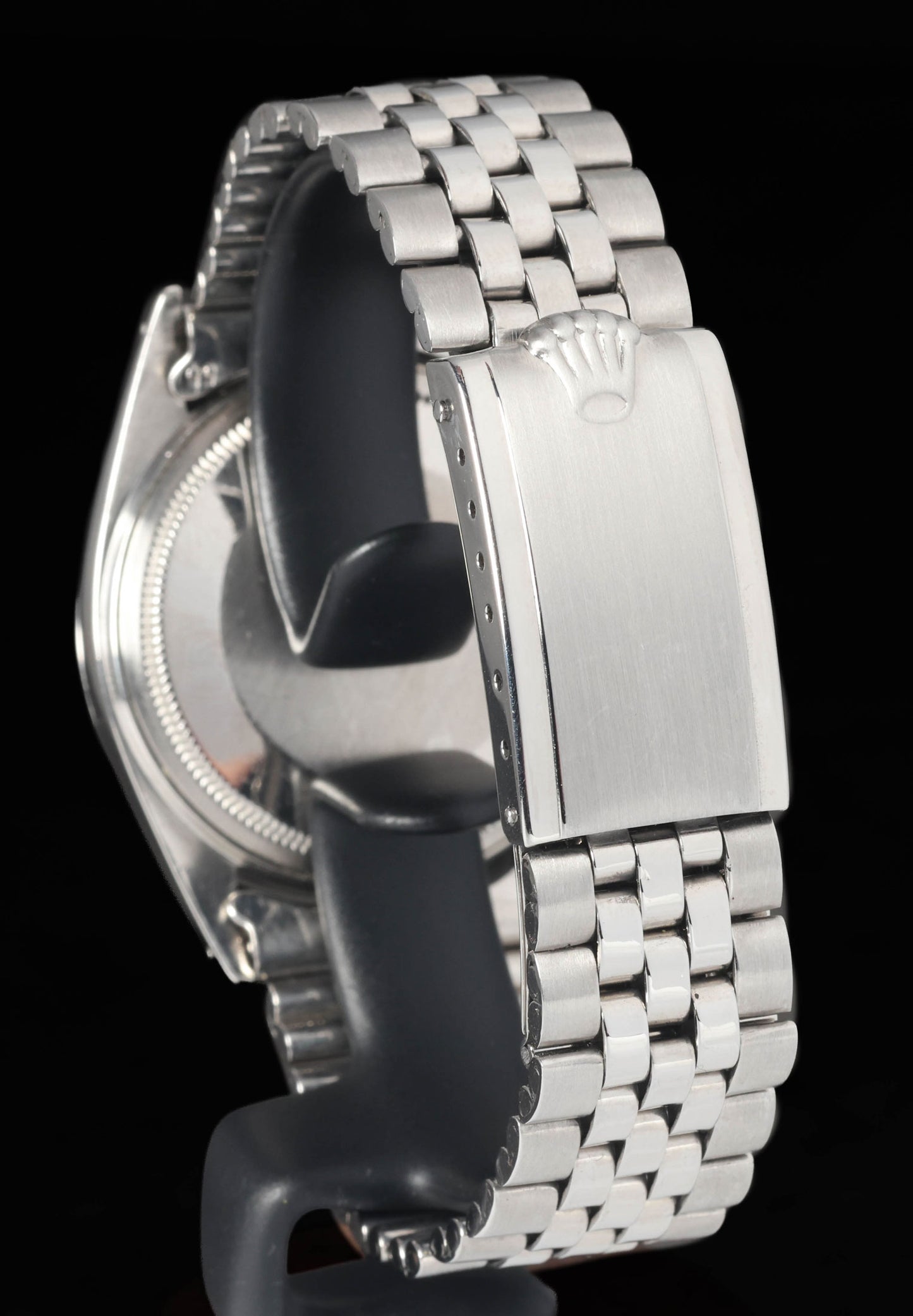
The bracelet is in great condition, showing some stretch between the links, entirely as expected for a piece of this age and a characteristic that gives vintage rivet-era bracelets their comfortable drape on the wrist.
The signature pie pan dial is in good condition, with its stepped outer edge catching the light as intended, and the hands present well alongside it. The original lume plots remain intact at each hour marker, an increasingly uncommon find on a 1971 example.
Share
Why we love this watch
Why we love this watch
Why We Love the Rolex Datejust 1603 'Pie Pan' 36MM 1971
Tilt a 1603 under a lamp and the dial does something no flat dial can: its sloped outer rim drops away from the centre like the underside of a pie tin, throwing a ring of shadow and light around the hour markers. That stepped profile, known to collectors as the pie pan, is the detail that separates the early Datejust from everything that followed, and on the reference 1603 it is paired with an engine-turned steel bezel that makes this the most quietly confident watch Rolex built in the era.
The Watch That Defined the Modern Rolex
The Datejust arrived in 1945, launched as the reference 4467 to mark Rolex's fortieth anniversary. It was a landmark by any measure: the first self-winding, waterproof, chronometer-certified wristwatch to display the date through a window on the dial. Rolex had already solved water resistance with the Oyster case in 1926 and automatic winding with the Perpetual rotor in 1931. The Datejust bound those inventions together with a date complication and, in doing so, created the template for the modern wristwatch. The five-link Jubilee bracelet was designed specifically for its launch, and the Cyclops magnifying lens over the date followed in the early 1950s, completing the visual signature the model carries to this day.
Understanding the Reference 1603
The 16xx series of Datejusts entered the catalogue at the end of the 1950s and remained in production into the late 1970s, the longest-serving generation of the model's history. Within that family, the reference number told you the bezel. The 1600 wore a smooth bezel, the 1601 a fluted bezel in white or yellow gold, and the 1603 the engine-turned bezel in stainless steel. That last configuration gives the 1603 its particular character. The finely machined pattern of the engine-turned bezel catches light the way fluting does, but in steel rather than gold, keeping the watch entirely tool-like in material while remaining decorative in effect. It is the Datejust at its most understated, and for many wearers its most wearable.
By 1971 the reference was fully mature. The 36mm Oyster case had settled into the proportions that still define the Datejust today, with a screwdown crown and caseback providing the water resistance that made the watch a legitimate daily companion rather than a dress piece to be babied. An acrylic crystal sits above the dial, doming softly at the edges and warming the view of the dial in a way sapphire never quite replicates.
The Pie Pan Dial
The defining feature of the era is the dial itself. Rather than a flat plane, the pie pan dial carries a distinct angled step around its outer edge, so that the minute track slopes downward away from the main dial surface. The effect is architectural. Light moves across the dial in two planes, the applied hour markers stand proud at the boundary, and the whole face gains a depth that photographs struggle to capture. Rolex phased the design out as the 16xx series gave way to its successors, which makes the pie pan a marker of a specific window in the company's history. A 1971 example sits comfortably within that window, late enough to benefit from two decades of refinement, early enough to carry the dial architecture that gives these watches their name.
The Calibre 1575
Inside the case runs the calibre 1575, a member of the 15xx family that ranks among the most respected movement series Rolex has produced. Introduced in the mid 1960s as the successor to the calibre 1565, the 1575 beats at 19,800 vibrations per hour, carries 26 jewels, and features a free-sprung balance with Microstella regulation, an arrangement Rolex still uses in principle today. It is a movement known above all for its durability. Examples running strongly after five decades of service are the norm rather than the exception, which is precisely why so many 1603s survive as honest, working watches rather than restoration projects. Each was chronometer-certified, the achievement recorded on the dial in the familiar two lines: Superlative Chronometer Officially Certified.
A Watch for Every Day
Part of the affection the 1603 commands comes from what it is not. It is not a sports watch chasing depth ratings, and it is not a precious-metal statement piece. It is 36 millimetres of steel, sized to disappear under a cuff and to suit almost any wrist, dressed enough for a suit and robust enough for a weekend. The Datejust was conceived as the one watch a person could wear for everything, and the 1603 in particular, with its steel bezel and restrained dial, delivers on that brief more completely than any other reference of its generation.
Final Thoughts
The 1603 Pie Pan is the Datejust before the Datejust became ubiquitous, a watch from the period when Rolex was still refining the formula rather than reproducing it. A 1971 example brings together the stepped dial, the engine-turned bezel, and the calibre 1575 in their settled, definitive forms. It is the model's founding idea, one watch for every day of a life, executed at the exact moment the idea reached maturity.
Case & Bracelet
Case & Bracelet
- Case in very good condition, light wear visible.
- Very sharp lugs with factory brushing visible
- Bracelet in great condition, some stretch as to be expected with age.
Dial & Hands
Dial & Hands
- Dial and hands are in good condition.
- Lume plots intact.
Warranty & Condition
Warranty & Condition
Crown Vintage Watches provides a minimum 6-month mechanical warranty on pre-owned watches, from the date of purchase.
The warranty covers mechanical defects only.
The warranty does not cover damages such as scratches, finish, crystals, glass, straps (leather, fabric or rubber damage due to wear and tear), damage resulting from wear under conditions exceeding the watch manufacturer’s water resistance limitations, and damage due to physical and or accidental abuse.
Please note, water resistance is neither tested nor guaranteed.
Shipping and insurance costs for warranty returns to us must be covered by the customer. Returns must be shipped via traceable courier. Return shipment must be pre-paid and fully insured. Collect shipping will be refused. In case of loss or damages, the customer is liable.
Our Pledge
At Crown Vintage Watches, we stand by the authenticity of every product we sell. For added peace of mind, customers are welcome to have items independently authenticated at their own expense.
Condition
Due to the nature of vintage timepieces, all watches are sold as is. We will accurately describe the current condition and working order of all watches we sell to the best of our ability.
Shipping & Refund
Shipping & Refund