

Crown Vintage
Rolex Datejust 1603 'Silver Dial' 36MM 1973
Rolex Datejust 1603 'Silver Dial' 36MM 1973
Couldn't load pickup availability
Rolex Datejust 1603 'Silver Dial' 36MM 1973
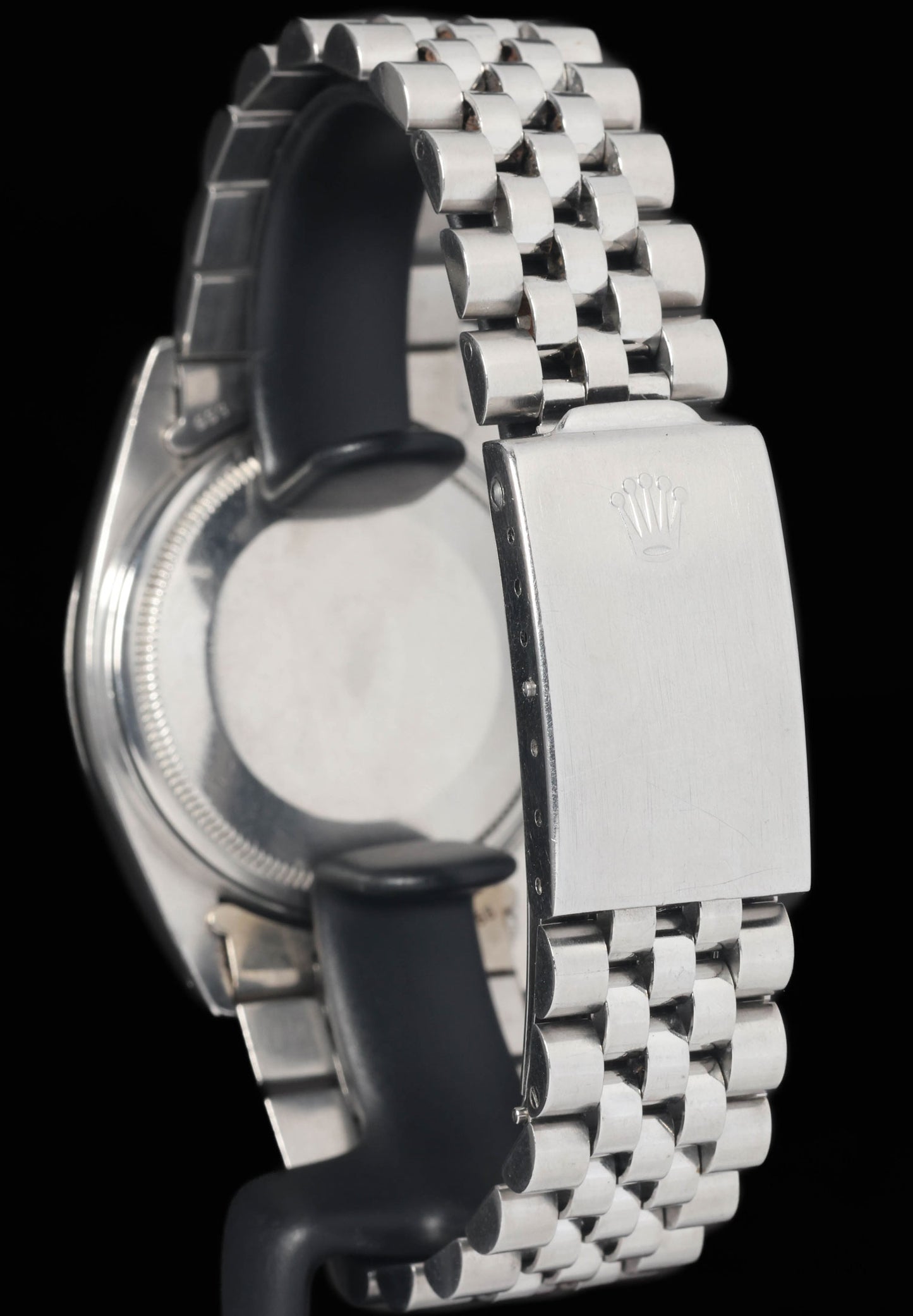
Case is in good vintage condition with well defined lugs and factory brushing still crisp. Bracelet likewise presents in good vintage order, showing stretch and light hairlines on the clasp. Dial and hands are in good condition; all lume plots are intact and stable. Given its age, this watch should be treated as a vintage timepiece—avoid swimming or any water exposure.
Share
Why we love this watch
Why we love this watch
Steel First, Always: The Rolex Datejust 1603 Silver Dial
There is a version of the Datejust that requires no gold to make its point. No fluted bezel catching light across a room, no yellow Jubilee links signalling the wearer's position before a word is spoken. Reference 1603 is the Datejust resolved entirely in stainless steel, and in that deliberate restraint it arrives at something the louder variants never quite reach: a watch that belongs to any hour of any day, without compromise or ceremony.
This particular example dates to 1973, a year deep in the reference's productive middle age, and wears a silver dial that has been quietly compelling collectors for half a century. Understanding why requires understanding where it came from.
The Watch That Made Rolex
The year 1945 saw the birth of the Datejust, the first self-winding wrist chronometer to indicate the date in a window on the dial. Rolex introduced the watch to mark the company's 40th anniversary, and it arrived as something genuinely unprecedented, combining innovations that Rolex had been developing across two decades. The Datejust brought together two Rolex developments from the prior decades, the Oyster case and the Perpetual movement, and combined them with a date indication. That synthesis, waterproof case plus automatic movement plus calendar, set the template for the modern dress watch and it has not fundamentally changed since.
The first Datejust, reference 4467, was only available in 18-karat yellow gold and was fitted with a new bracelet called the Jubilee, a five-piece metal bracelet that has since become a signature option for many Rolex watches. It was a watch conceived as an object of celebration, and it wore its gold accordingly. Steel would come later. It was not until the 1950s, with references 5030 and 5031, that stainless steel and Rolesor versions became available and the Datejust name began to appear on the dial itself.
Through the 1950s, the Datejust gathered the features that would define it for generations. In 1954, Rolex added a Cyclops magnifying lens to the crystal over the date window, giving a 2.5x magnification that has been standard on the Datejust ever since. Then came the mechanical breakthrough that transformed everyday usability. The cam-and-jewel system, introduced with the calibre 1565, creates an instantaneous date switch at midnight, replacing an older mechanism that could take several hours to complete the changeover. These accumulated refinements, the waterproof case, the automatic perpetual rotor, the instantaneous date, the magnified window, produced a watch that was complete in a way few designs before or since have matched.
The 16XX Family and the Case for Steel
The 16XX family of the Datejust debuted in 1959 and ran all the way to approximately 1981, lasting long enough to see the introduction of the quickset date generation that eventually succeeded it. It was the first Datejust lineage with genuine longevity, and within it, three references divided the configuration into distinct characters. Reference 1600 carried a smooth domed bezel on an Oyster bracelet. Reference 1601 wore a fluted bezel, typically in gold, on a Jubilee. Reference 1603 was only made in steel and featured an engine-turned bezel in steel. It was the working proposition of the three, the one that declined every gesture toward ornament.
That commitment to steel was not an economy. It was a position. The 1603 costs nothing in visual drama against a dark suit or an open collar, and it asks for nothing in return. On the right wrist, its character reads as certainty rather than restraint, a watch chosen deliberately rather than one that simply announces money.
What the Engine-Turned Bezel Means
The engine-turned bezel is the visual signature of the 1603, and it rewards attention. The surface is cut by a lathe into a pattern of fine, precise grooves that create a texture somewhere between a brushed finish and a decorative one. In direct light the bezel catches and scatters brilliance from dozens of tiny facets. In lower light it settles into a quiet complexity that a plain polished surface cannot replicate. It is a detail drawn from pocket watch tradition, applied here to a sports-capable Oyster case, and the contrast between its meticulous surface treatment and the utilitarian case beneath it is exactly what makes the watch interesting.
Compared to the gold fluted bezel of the 1601, the engine-turned steel bezel of the 1603 reads as a deliberate step back from luxury into craft. Both are technically demanding to produce. Only one of them invites extended looking without advertising the cost of what you are looking at.
The Silver Dial
The reference 1603 was released with a fairly limited selection of dials, and neutral shades of white, silver and grey are far more likely to be encountered than anything outlandishly vibrant. The silver dial is the reference in its most composed register.
On a 1973 example, the silver dial carries applied baton hour markers and matching baton hands, the geometry precise and economical. The date aperture sits at three o'clock beneath the Cyclops lens, its magnification giving clear legibility without requiring that the wrist be raised. The pie-pan dial, a defining feature of the 16XX generation, takes its name from the slightly concave profile of its surface, which slopes gently from a flat centre toward a raised outer ring. The result is a subtle three-dimensional quality that a flat dial lacks, a surface that is never quite the same twice as the angle of light shifts.
The luminescent material on any 1973 example will be tritium, applied sparingly to a small stripe on the baton hands and a dot above each index. After fifty years, tritium lume has typically aged to a warm cream or ivory tone that complements rather than conflicts with a silver dial. It is one of the details that separates a genuinely worn vintage watch from a freshly polished one, and on the 1603 it reads as evidence of a life actually lived.
Sigma Dials: A Footnote Worth Knowing
A proportion of 1603 silver dials from the early 1970s carry a pair of sigma symbols flanking the tritium text at the foot of the dial. These marks, known as APRIOR marks for the Association pour la Promotion Industrielle de l'Or, indicate that the hour markers and handset were made from 18-karat gold rather than the steel more commonly found on the reference. On sigma examples, the hour markers and hands are made from white gold rather than steel, giving an additional layer of refinement that is visible under close examination. Sigma dials are not common and collectors regard them as a meaningful variant within the reference. A 1973 serial date places this watch precisely in the period when sigma marking was current practice.
The Calibre Within
A 1973 example of the 1603 runs on the Calibre 1575, the date-equipped member of Rolex's celebrated 1500 series. The bridge inside the movement is often stamped simply 1570, an anomaly Rolex maintained deliberately because the date and non-date variants shared identical components at the bridge level. The calibre runs at 19,800 vibrations per hour, carries 25 jewels, and offers a 48-hour power reserve. It is equipped with a free-sprung Breguet overcoil hairspring and Kif Ultraflex shock protection, and it carries full COSC chronometer certification, meaning it was tested to perform within minus four to plus six seconds per day before it left the factory.
By 1973, the movement had acquired a feature that meaningfully improved daily usability. In 1972, the 1570 family gained a hacking mechanism, making it possible to stop the balance wheel by pulling the crown and set the time with real precision. A 1973 example is therefore a hacking seconds watch, a small but tangible distinction from examples made before that refinement was introduced.
A Bridge Generation
The 1575 occupies an interesting position in the arc of Rolex movement development. The calibre 3035, introduced in 1977, replaced the 1575 as Rolex's men's automatic calibre, increasing frequency to 28,800 vibrations per hour, introducing quickset date functionality, and adopting a direct-drive seconds layout. The 1575 predates all of those improvements. Setting the date requires advancing the hands through midnight, and the seconds hand sweeps at 19,800 vibrations per hour rather than the eight-beat-per-second pace that became standard with the 3035. These are not deficiencies. They are the characteristics of a movement that was engineered to last, not to be replaced, and which proved itself across two decades and dozens of references. The 1575 powered the Submariner 1680, the GMT-Master 1675, the Explorer 1016, and the Datejust simultaneously. Its reputation among watchmakers and collectors is built on evidence accumulated across an extraordinary breadth of use.
The Case, Crystal and Bracelet
The case is the 36mm Oyster, a diameter that reads differently in 2025 than it did in 1973 but which retains a precision and wearability that larger modern cases have not superseded. The Twinlock crown provides water resistance in the Rolex Oyster tradition, sealing the movement against moisture and dust. Protection is rated to 100 metres, though on any example of this age a contemporary water resistance test is the only reliable guide to current condition.
The crystal is acrylic, raised above the bezel rim in the manner typical of the 16XX generation. The acrylic crystal sits higher on the case than its successors, giving the watch a slightly elevated profile on the wrist. Acrylic scratches more readily than sapphire but can be polished back to clarity, which means that a well-maintained example carries a crystal that is genuinely bright rather than permanently marked. The Cyclops lens, bonded to the crystal above the date aperture, magnifies the date window to 2.5 times its actual size.
The engine-turned bezel in combination with the Jubilee bracelet is what makes this reference so enduringly classic. The five-piece Jubilee, introduced with the very first Datejust in 1945, remains one of the most comfortable bracelets Rolex has ever produced. Its articulation allows the watch to settle against the wrist rather than sitting above it, and the alternating brushed and polished links provide their own textural interest without competing with the bezel above.
Final Thoughts
The 1603 does not ask to be noticed. It carries no gold, makes no gesture toward the exceptional, and presents itself in the language of everyday use. What it offers instead is a design that has been correct since 1959, a movement refined over more than a decade before this example was made, and a combination of details, engine-turned bezel, pie-pan silver dial, Jubilee bracelet, COSC-certified calibre, that together produce a watch far more considered than its understated exterior suggests.
A 1973 example sits at an interesting point in the reference's history: early enough to carry the pie-pan dial that the succeeding 160XX generation abandoned, and late enough to include hacking seconds. The silver dial remains one of the most versatile in the Datejust canon. Against a steel case and engine-turned bezel, it completes a watch that answers to almost any context without asserting itself in any of them. That quality, genuine versatility worn without effort, is harder to achieve than it looks, and rarer than the market for gold dials and fluted bezels might suggest.
Case & Bracelet
Case & Bracelet
Case in good vintage condition. Defined lugs and factory brushing visible. Bracelet in good condition with noticeable stretch. Light hairlines on clasp. Crystal rand new.
Dial & Hands
Dial & Hands
Dial and hands are in good condition. Lume plots intact.
Warranty & Condition
Warranty & Condition
Crown Vintage Watches provides a minimum 6-month mechanical warranty on pre-owned watches, from the date of purchase.
The warranty covers mechanical defects only.
The warranty does not cover damages such as scratches, finish, crystals, glass, straps (leather, fabric or rubber damage due to wear and tear), damage resulting from wear under conditions exceeding the watch manufacturer’s water resistance limitations, and damage due to physical and or accidental abuse.
Please note, water resistance is neither tested nor guaranteed.
Shipping and insurance costs for warranty returns to us must be covered by the customer. Returns must be shipped via traceable courier. Return shipment must be pre-paid and fully insured. Collect shipping will be refused. In case of loss or damages, the customer is liable.
Our Pledge
At Crown Vintage Watches, we stand by the authenticity of every product we sell. For added peace of mind, customers are welcome to have items independently authenticated at their own expense.
Condition
Due to the nature of vintage timepieces, all watches are sold as is. We will accurately describe the current condition and working order of all watches we sell to the best of our ability.
Shipping & Refund
Shipping & Refund