

Crown Vintage
Rolex Datejust 69173 Champagne Dial 26MM 1991
Rolex Datejust 69173 Champagne Dial 26MM 1991
Couldn't load pickup availability
Rolex Datejust 69173 Champagne Dial 26MM 1991
The case is in very good condition and, importantly for a yellow Rolesor Datejust of this age, it has not been over-polished. The lugs remain sharp with clearly defined edges, and strong factory brushing is still visible across their upper surfaces, which is the first thing to look for on a 26mm case where the lugs are small enough that a heavy polish rounds them almost immediately. The steel middle case retains its original proportions, and the 18 ct yellow gold fluted bezel is crisp, with the flutes holding their defined peaks rather than showing the softened, washed-out profile that comes from repeated refinishing.
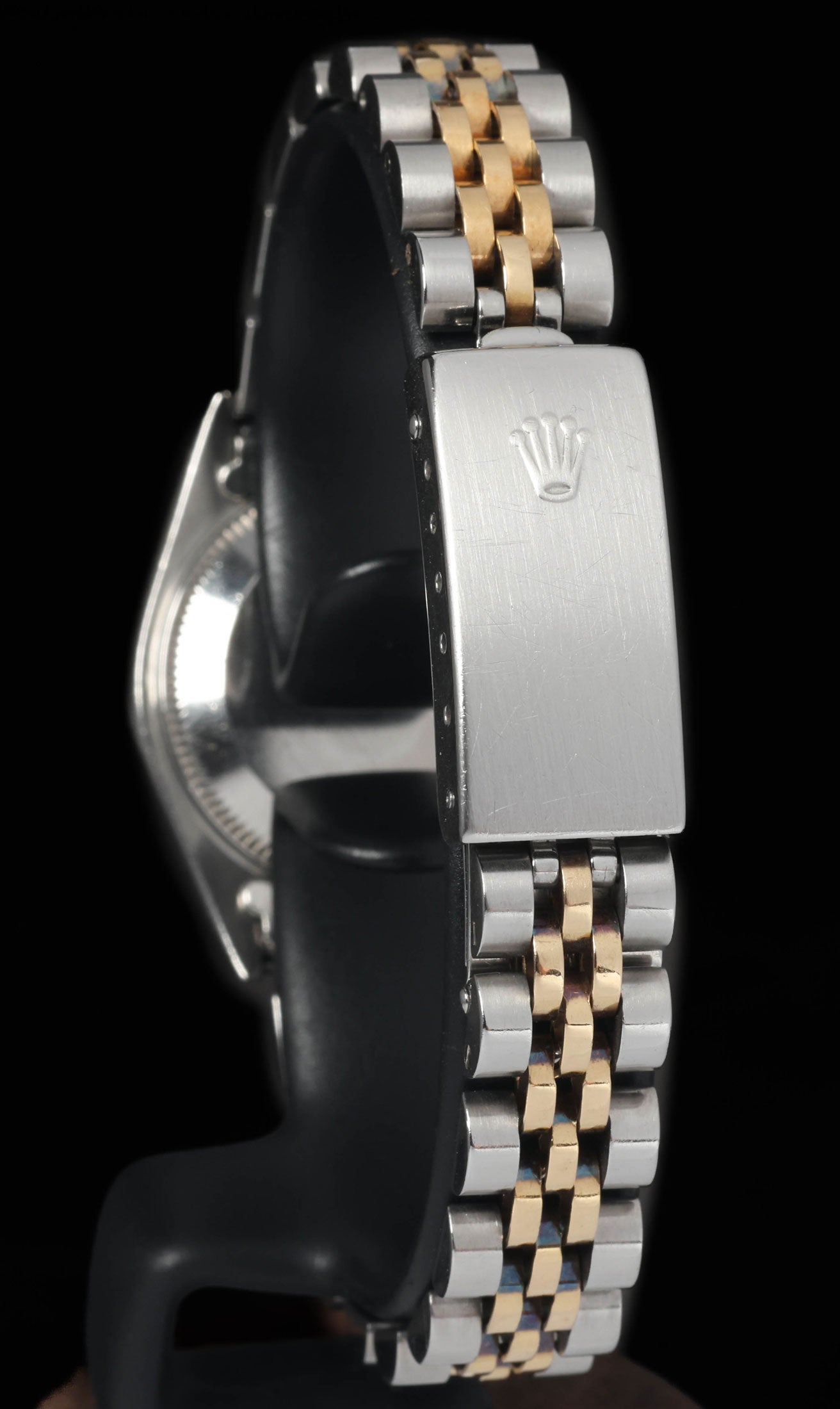
The Jubilee bracelet is in great condition with light stretch. On a five-link Jubilee from 1991 this is entirely expected and is a function of the construction rather than of neglect. Five narrow links per row means five times the number of articulation points of an Oyster bracelet, and thirty-five years of daily flexing gradually opens the pin tolerances a fraction at each one. The result here is minor and the bracelet remains secure and comfortable on the wrist, with the polished 18 ct gold centre links clean and the clasp closing positively.
The champagne dial is in very good condition, with the sunray finish intact and radiating cleanly from the centre. The applied hour markers are bright and free of the spotting that can develop on markers of this era, and there is no lifting or discolouration around the date aperture. The hands are likewise very good, matching the markers in tone with no corrosion to the tips. The sapphire crystal fitted to this generation of the reference has done its job, and the cyclops sits correctly over the date. Dial and hands present as an honest, unrestored set.
Share
Why we love this watch
Why we love this watch
Why We Love the Rolex Datejust 69173 Champagne Dial 26MM, 1991
A champagne dial does something on this watch that a white or black dial cannot. Sitting directly beneath an 18 ct yellow gold fluted bezel, it picks up the same warm light the bezel throws down onto it, so the two read as one continuous surface instead of two materials arguing across a gasket. Put that dial in a 26mm yellow Rolesor case from 1991, add a Jubilee bracelet whose gold centre links run the colour all the way to the clasp, and you have the most quietly resolved version of the Lady-Datejust that Rolex ever built. This is reference 69173, and the reasons it works are older than the watch itself.
The Datejust Story Starts in 1945
Rolex turned forty in 1945, and Hans Wilsdorf marked the anniversary with a watch that solved a problem nobody had solved neatly before.
The watch that put the date in a window
Wristwatches had shown the date before, usually with a hand sweeping a peripheral ring of numerals. The Datejust was the first self-winding chronometer wristwatch to show the date in an aperture on the dial, changing over automatically as the day turned, a claim recorded in Rolex's own account of the model and in the reference literature. The changeover on those first watches crept rather than snapped, taking several minutes either side of midnight, but the principle was set. The launch reference 4467 came in 18 ct yellow gold, and with it arrived a bracelet designed specifically for the occasion.
The Jubilee bracelet and the fluted bezel
The five-piece bracelet made for that 1945 watch was named the Jubilee for the anniversary it celebrated, as Monochrome's history of the model sets out. Its construction is the reason it still feels different on the wrist to an Oyster bracelet: five narrow links per row instead of three wide ones means more articulation, more points of flex, and a drape that follows a smaller wrist rather than bridging it. On a 26mm watch that difference is not cosmetic. A three-link bracelet on a small case can sit like a bar; a Jubilee curves.
The fluted bezel has an even older origin and a purely practical one. Rolex introduced it on the Oyster in 1926, where the milled edges gave a tool something to grip so the bezel could be screwed down tight against the case and keep water out, a history Rolex still tells on its Datejust pages. By the time it reached this watch the fluting had become decorative, machined into 18 ct gold and polished rather than knurled for torque. What it retained was the optical trick that makes it worth having: dozens of angled facets catching light from different directions at once, so the bezel reads as bright even in a dim room.
The Lady-Datejust arrives in 1957
Rolex brought the Datejust down to 26mm in 1957 with the Lady-Datejust, and that case size then held for fifty-eight years, only giving way to a 28mm case in 2015. That is an unusually long time for any watchmaker to leave a dimension alone, and it happened because the proportion was right the first time. A 26mm Oyster case with a fluted bezel and a date window has the same visual grammar as its 36mm sibling, scaled rather than simplified, with no feature dropped to make room.
The 69173 belongs to the long middle of that run. Everything the reference does was worked out over decades of the same design being refined rather than restarted, which is why a 1991 example still looks like the idea it came from rather than a period interpretation of it.
Yellow Rolesor, and Why the Gold Is Where It Is
Rolex registered the name Rolesor in 1933, a compound of Rolex and the French word for gold, and it has been the company's term for its steel and gold watches ever since, as Millenary Watches documents. Rolesor is not an alloy or a plating. It is a construction rule about which parts are made from which metal, and the rule is consistent: the bezel, the winding crown and the centre links of the bracelet are solid 18 ct gold, while the middle case and the outer bracelet links are steel.
That distribution is worth pausing on, because it explains why a two-tone Rolex looks the way it does rather than looking like a compromise. Gold goes exactly where the eye travels and where light collects: the ring around the dial, the crown you touch, and the spine running down the centre of the bracelet. Steel takes the flanks, the case sides, the parts that absorb knocks. The result on the 69173 is a watch with a gold line drawn through the middle of it from the bezel to the clasp, framed in steel that keeps the whole thing from tipping into ostentation.
Pair that with a champagne dial and the logic closes. Champagne is a pale golden tone, usually with a fine sunray or satin finish radiating from the centre, and it shifts from near-cream at one angle to a deeper amber at another as the wrist turns. Against a white dial, a gold bezel announces itself as a separate object. Against champagne, it belongs. BeckerTime's review of the reference calls the champagne dial and two-tone case the classic Rolex visual, and the reason is structural rather than sentimental: the two materials share a colour temperature.
There is a practical dividend too. Champagne is the most forgiving dial colour Rolex makes. A white dial shows every speck of dust that ever found its way under a crystal and every faint yellowing at the edges. A black dial shows every scuff on its lacquer. Champagne sits in the middle, warm enough to hide the small evidence of decades and bright enough to keep the applied hour markers legible against it. On a watch worn for thirty-five years, that matters more than it sounds like it should.
Calibre 2135: The Movement That Ended a Small Daily Annoyance
Inside is the Rolex calibre 2135, an automatic movement introduced in 1983 as the second generation of the company's in-house 2000 series for smaller cases, per BeckerTime's technical write-up and the specifications recorded at Watch Wiki.
The figures are 29 jewels, a 28,800 vibrations per hour balance and roughly 42 hours of power reserve, in a movement measuring 20mm across and 5.83mm tall. It runs a Glucydur balance, a copper-beryllium alloy chosen because it resists magnetism and holds its dimensions as temperature moves, paired with a Nivarox hairspring and Kif shock protection on the balance staff.
The detail that matters most in daily use is the quickset date. The 2135 was the first of the ladies' movements to have it, which means the date is advanced by pulling the crown to an intermediate position and turning, rather than winding the hands through twenty-four hours for every day you need to skip. Anyone who has reset a non-quickset watch after a fortnight in a drawer understands the difference. On a watch this size, where the crown is small and the fingers are working close to the case, it is the difference between a five second adjustment and a two minute one.
Both the 2130 and 2135 also carry the Superlative Chronometer certification Rolex applies after official Swiss testing, and BeckerTime notes these calibres recorded the highest first-time pass rate of any movement submitted to the Official Swiss Chronometer Testing Institute. That is a claim about consistency in manufacture more than about outright rate, and consistency is what a watch worn every day for thirty-five years actually needs.
Reading the Reference Number
The five digits are not arbitrary, and once you can read them you can read the whole family. The first three, 691, identify the 26mm Lady-Datejust in this generation. The fourth digit, 7, denotes the fluted bezel. The final digit, 3, denotes yellow Rolesor, steel with 18 ct yellow gold, a breakdown confirmed in BeckerTime's reference review.
Change that last digit and the metal changes with it: 69174 puts a white gold fluted bezel on a steel case, 69178 is solid yellow gold throughout. Change the fourth digit and the bezel changes, with a smooth or domed bezel taking a different numeral. The 69173 is therefore the two-tone, fluted, 26mm expression of the design, which is the configuration most people picture when they picture a Lady-Datejust at all.
The reference ran through the 1980s and 1990s, with BeckerTime dating production from 1983 to 1999. Across that span it was offered on either the five-link Jubilee or the three-link Oyster bracelet, and with dials in champagne, silver, white, black, blue and a range of stone and set variations, as Langedyk Vintage Watches records. The case is rated to 100 metres, which on a dress watch is less about diving than about never having to think before washing your hands.
What 1991 Means on This Watch
A 1991 example sits at a specific and rather good point in the reference's life.
By then the acrylic crystals of the earlier four-digit references had been replaced by sapphire, so the dial is protected by a surface that resists scratching rather than one that acquires a fog of them, a transition BeckerTime places with the arrival of this generation. The calibre 2135 had been in production for eight years and was thoroughly settled. The case, bracelet and bezel had reached the form they would keep until the reference was retired.
The serial number tells its own story. Rolex switched to letter-prefix serials in mid 1987, and watches from 1991 carry an X or an N prefix followed by six digits, engraved between the lugs at the 6 o'clock side of the case, according to the prefix tables published by SwissWatchExpo and Diamond Banc. It is a small pleasure of an older Rolex that the year of its making is written on it in plain sight, something the random serials introduced from 2010 took away.
Wearing 26 Millimetres
There is an argument, made often and loudly, that small watches are a compromise. It misreads what a 26mm case is for. At this diameter the watch sits entirely on the flat of the wrist, clears a shirt cuff without negotiation, and carries no weight worth noticing through a working day. The dial is uncluttered because it has to be: applied markers, a date at three under the cyclops lens that magnifies it two and a half times, and nothing else competing for the space.
The Jubilee bracelet completes it. Five links across a narrow bracelet means the metal wraps rather than spans, and the polished gold centre row gives the wrist a line of brightness that moves as the hand does. A watch built to these proportions is not a shrunken version of a larger one. It is a watch designed from the start to be worn every day by someone who would rather notice the time than the timepiece.
Final Thoughts
What we love about this 69173 is that nothing on it is there by accident. The fluted bezel began as a waterproofing tool in 1926 and stayed because of what it does to light. The Jubilee bracelet was made for an anniversary in 1945 and stayed because five links drape better than three. The Rolesor construction puts gold on the surfaces that catch the eye and steel on the surfaces that take the knocks. The champagne dial ties the whole thing together by refusing to compete with the gold above it. And the calibre 2135 quietly removed the one daily irritation a date watch can have. Thirty-five years on from 1991, none of those decisions have dated, which is the highest thing you can say about a design.
Case & Bracelet
Case & Bracelet
- Case & bracelet in very good condition, very sharp lugs with strong factory brushing visible
- Bracelet in great condition, with light stretch.
Dial & Hands
Dial & Hands
- Dial & hands very good condition
Warranty & Condition
Warranty & Condition
Crown Vintage Watches provides a minimum 6-month mechanical warranty on pre-owned watches, from the date of purchase.
The warranty covers mechanical defects only.
The warranty does not cover damages such as scratches, finish, crystals, glass, straps (leather, fabric or rubber damage due to wear and tear), damage resulting from wear under conditions exceeding the watch manufacturer’s water resistance limitations, and damage due to physical and or accidental abuse.
Please note, water resistance is neither tested nor guaranteed.
Shipping and insurance costs for warranty returns to us must be covered by the customer. Returns must be shipped via traceable courier. Return shipment must be pre-paid and fully insured. Collect shipping will be refused. In case of loss or damages, the customer is liable.
Our Pledge
At Crown Vintage Watches, we stand by the authenticity of every product we sell. For added peace of mind, customers are welcome to have items independently authenticated at their own expense.
Condition
Due to the nature of vintage timepieces, all watches are sold as is. We will accurately describe the current condition and working order of all watches we sell to the best of our ability.
Shipping & Refund
Shipping & Refund