

Crown Vintage
Rolex Day Date 18238 Ruby String Dial 36MM 1990s
Rolex Day Date 18238 Ruby String Dial 36MM 1990s
Couldn't load pickup availability
Rolex Day Date 18238 Ruby String Dial 36MM 1990s
The 18k yellow gold case remains in very good condition, exhibiting light surface wear consistent with careful use. The lugs are strong and well-defined, retaining their original factory brushing along the upper surfaces, with crisp edges that confirm the case has seen little to no polishing. The fluted bezel is sharp, showing only minor signs of wear and maintaining its distinct reflective pattern. The screw-down crown operates smoothly, securing firmly as designed.
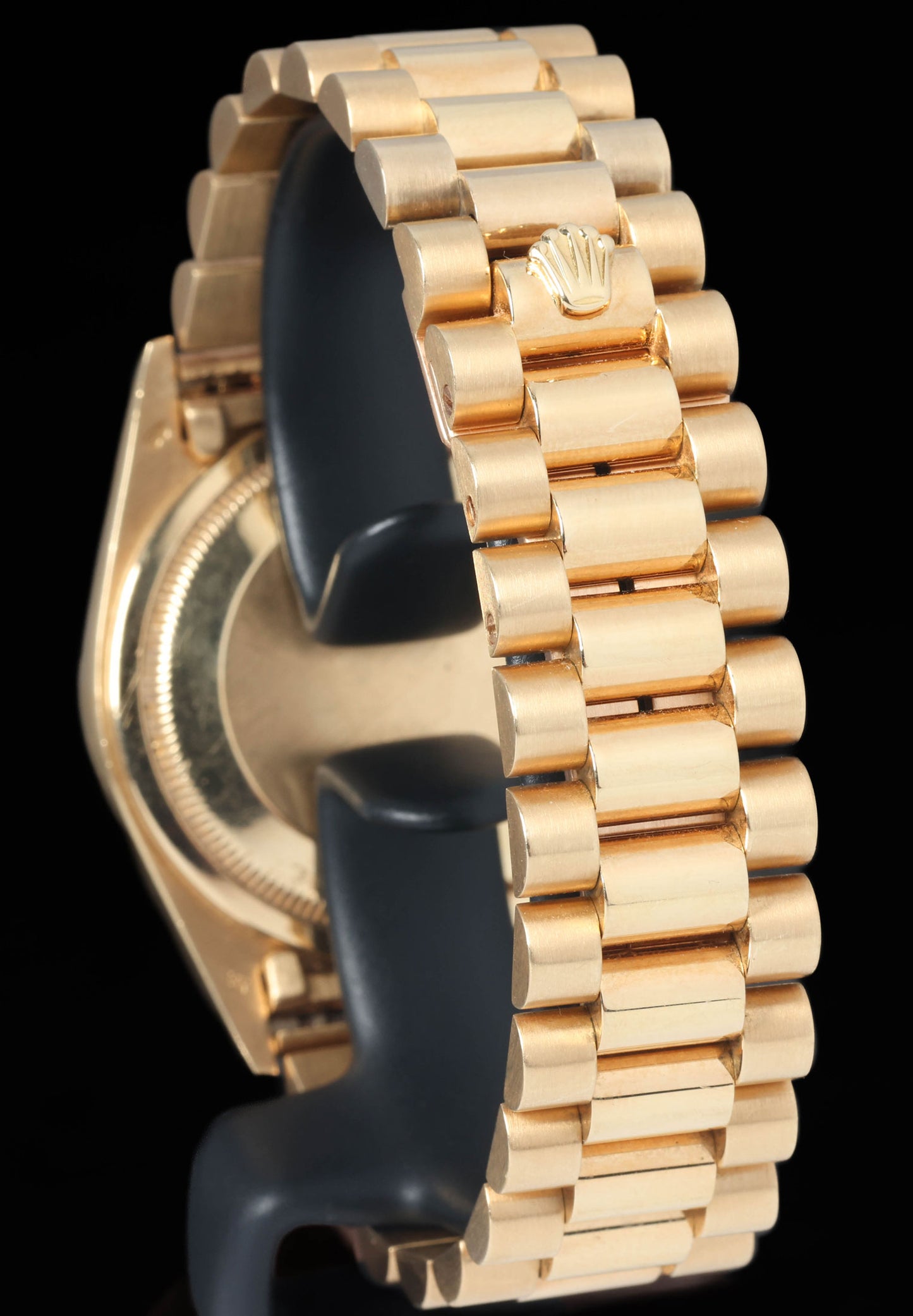
The President bracelet is also in great condition, displaying a very modest degree of stretch consistent with age and the flexible link construction typical of vintage examples. The brushed and polished finishes on the semi-circular links remain well preserved, and the concealed Crownclasp closes securely with the coronet emblem clearly defined. Overall, the bracelet presents as tight and well-maintained for its age.
The ruby string dial is in excellent condition, free from spotting, discolouration, or degradation. The applied ruby indices are clean and intact, with the luminous accents evenly aged. The gold hands are equally well preserved, exhibiting no oxidation. The Rolex sapphire crystal is clear, with no chips or scratches interrupting the view of the dial.
Overall, this Rolex Day-Date 18238 is a superb representation of the classic yellow-gold “President.”
Share
Why we love this watch
Why we love this watch
Where the Hours Glow Red: The Rolex Day-Date 18238 Ruby String Dial
A Rolex Day-Date in yellow gold is already a statement. A Rolex Day-Date in yellow gold with a champagne dial ringed in two concentric tracks of gemstones, one of diamonds at every minute marker and one of rubies at every hour, is something else entirely: a factory configuration so specific in its intention that it leaves no room for ambiguity about what it is or what it is trying to say. The reference 18238 Ruby String Dial, produced across the 1990s, is the Day-Date at its most unrestrained, and it is a watch that rewards extended attention in ways that more austere configurations do not. At Crown Vintage, it is one of the few pieces that stops conversation in the room simply by existing on the workbench.
Hans Wilsdorf and the Foundation of Rolex's Design Philosophy
To understand the Day-Date is to understand the logic of Rolex as a company, and that logic begins with Hans Wilsdorf. Born in Germany in 1881 and orphaned at twelve, Wilsdorf entered the watch trade as a young man and founded Rolex in London in 1905 under the name Wilsdorf and Davis. He moved the company to Geneva during the First World War to avoid punitive British export duties on German goods and registered the Rolex name in Switzerland, where it would remain. From the outset, Wilsdorf's ambition was not merely to make accurate watches but to make watches that were seen as accurate, and the distinction mattered: he understood that a chronometer certification meant nothing if the watch that bore it was not also positioned at the top of the market.
The instruments that established Rolex's reputation through the 1920s and 1930s were built around two technical propositions: the waterproof Oyster case, patented in 1926, and the self-winding Perpetual rotor mechanism, introduced in 1931. Together they produced a watch that could be worn continuously, needed no winding, and was protected against the elements. These were tool watch innovations in their origin, but Wilsdorf understood that their combination also produced an ideal luxury proposition: a watch of genuine technical superiority that could be worn without anxiety. Every major Rolex model that followed, including the Day-Date, rests on that foundation.
The First Wristwatch to Spell Out the Day
The Rolex Day-Date was introduced at the Basel Fair in 1956 as references 6510 and 6511, and its central claim was precise: it was the first wristwatch ever produced to display both the date of the month and the full day of the week, written out in text, simultaneously on the dial. The date appeared in a window at three o'clock with a cyclops magnifier above it; the day appeared in an arched window at twelve o'clock. The mechanism to advance both simultaneously had been patented the previous year by Rolex engineer Marc Huguenin, whose design used a seven-toothed star wheel sitting above a 31-tooth calendar wheel, both advancing at midnight.
The implications of this complication went beyond the technical. A watch that spells out Tuesday or Wednesday in full is not communicating the same thing as a watch with a date window alone. It is telling the wearer something about how their time is organised, about the week as a unit of experience rather than the day, and Rolex understood from the beginning that this display carried social weight. The Day-Date was produced exclusively in 18-karat gold and platinum from its first reference. There was never a steel version, never a titanium version, never an entry point below solid precious metal. The watch was positioned at the absolute top of Rolex's range and it has remained there for seven decades.
The President bracelet, which became the defining aesthetic companion to the Day-Date, arrived with the reference 6611 in 1957. It is a three-link bracelet with semi-circular, almost pillow-like links, made exclusively in gold or platinum, fitted with a concealed clasp. It was designed specifically for the Day-Date and remains exclusive to it among men's Rolex models. The bracelet's popular nickname, The President, crystallised around 1965 when Lyndon B. Johnson was photographed wearing his yellow gold Day-Date, and Rolex responded with advertising that described the watch as "The President's Watch." Subsequent US Presidents including Richard Nixon, Ronald Reagan, and Bill Clinton added their names to the association, and the phrase became a permanent part of the model's cultural identity.
From Single to Double: The Reference Lineage to 18238
The Day-Date's movement architecture evolved through several generations before arriving at the reference 18238. The early references of the 1950s and 1960s used the calibre 1055 and its successors, movements that required the wearer to advance the time through a full twenty-four-hour rotation to change the day display. The 1800 series of the late 1950s through the 1970s brought the calibre 1555 and later 1556, progressive refinements that improved accuracy and beat rate but retained the same manual calendar-correction procedure. Sapphire crystal arrived with the 18000 series in 1977, replacing the acrylic that had protected Day-Date dials since the beginning.
The 18000 series also brought the calibre 3055, which introduced the first quickset date function: the date could now be advanced independently of the time-keeping hands by use of an intermediate crown position. This was a significant practical improvement, but it applied only to the date, not the day. Changing the day display on an 18038 still required advancing the time past midnight until the correct day appeared, a process that could require cycling through multiple days to arrive at the right one.
The reference 18238, introduced in 1988, resolved this with the calibre 3155 and the double quickset function. Both the date and the day could now be set independently of the time and of each other, each advancing in single increments from an intermediate crown position. It was a straightforward improvement in practical terms, but it was also a statement about the kind of object a Day-Date was intended to be: a watch worn and used daily, not a display piece removed from a drawer for occasions. The 18238 was produced from 1988 through to approximately 2000, when the six-digit 118238 replaced it with revised bracelet construction and case finishing. It was also, notably, the last Day-Date reference to retain the brushed finishing on the upper lug surfaces, a detail that distinguishes 18238 examples from the fully polished specification that followed.
The Ruby String Dial
Rolex has offered gemstone dial configurations on the Day-Date since the earliest references, and the range of factory dial options available across the model's production history is considerable. Stone dials in meteorite, malachite, onyx, lapis lazuli, and coral have all appeared; full diamond-set bezels, diamond hour markers, and various combinations of precious stones at the hours have existed throughout. But the string dial configuration is a specific and particular format within this spectrum, and the ruby string variant represents it at its most vivid.
The champagne base dial is set with two concentric rings of stones. The outer ring consists of small brilliant-cut diamonds positioned at each of the sixty minute markers, running continuously around the full circumference of the chapter ring. This is the element that gives the configuration its name: the even, unbroken row of diamonds creates the appearance of a delicate chain or string traced around the edge of the dial face. The inner ring replaces the standard applied baton hour markers with rubies, set individually at each hour position except three o'clock and twelve o'clock, which are occupied by the date aperture and the day display respectively. The rubies glow a deep red against the champagne ground and the surrounding yellow gold, and the contrast they create with the white brilliance of the diamond minute track produces a dial of considerable visual complexity that somehow remains legible and organised.
The same string dial architecture exists in other gemstone configurations. Emerald and sapphire variants have appeared, with the stones at the hour positions changed accordingly while the diamond minute string remains constant. The ruby version is among the most striking of these configurations by virtue of the colour temperature of the stones: the warm red of ruby sits naturally against the yellow gold case and bracelet in a way that cooler stones do not, and the champagne dial provides a neutral ground that allows both the diamonds and the rubies to read clearly.
Case and Movement
The 36mm Oyster case is constructed entirely in 18-karat yellow gold, from the case body to the crown to the case back. The fluted bezel is integral to the case architecture and has defined the Day-Date's silhouette since the earliest references. Water resistance is rated to 100 metres, secured by a Twinlock crown with two sealing gaskets. The sapphire crystal carries a cyclops lens above the date aperture. The President bracelet, also in 18-karat yellow gold, is fitted with the concealed Crownclasp that allows the bracelet to present as a seamless loop of metal when closed.
The calibre 3155 inside is a COSC-certified chronometer movement beating at 28,800 vibrations per hour with a power reserve of 48 hours. It has 31 jewels and offers the double quickset function described above. The gold case back is solid, with no exhibition window, which is consistent with Rolex's practice for the Day-Date: the movement does not need to be seen because the watch communicates its quality through the case, the dial, and the bracelet rather than through mechanical display. The calibre 3155 remained in production long after the 18238 itself was discontinued, continuing in the 118238 and subsequent references until Rolex replaced it with the calibre 3255 in 2019.
Final Thoughts
The Day-Date 18238 Ruby String Dial occupies a specific position in the model's long history. It is the first Day-Date generation to offer the double quickset function that makes the watch genuinely easy to live with, and it was produced across the decade in which Rolex's dial-making artisans were given the widest latitude in the 18238's production run to produce unusual and gemstone-set configurations. A ruby string dial on an 18238 is not a late-production addition or a revised formula; it is the watch at exactly the moment its technology and its decorative ambition were aligned. The choice to set diamonds at every minute marker and rubies at every hour, on a champagne ground, in yellow gold, is a choice that commits entirely to what the Day-Date has always been: a watch that makes no pretence of utility and no apology for excess. The result is a piece that is completely coherent with itself, and that coherence is a significant part of what makes it so easy to engage with.
References
- Monochrome Watches, "In-Depth: The History of the Rolex Day-Date, The Presidential Watch," monochrome-watches.com, accessed 2025.
- Mondani Books, "Rolex Day-Date History: Birth of a Legend," mondanibooks.com, accessed 2025.
- RolexMagazine.com, "The Very First Rolex Day-Date," rolexmagazine.com, accessed 2025.
- Becker Time, "Rolex Decades: The 50s Day-Date Versus the 60s Day-Date," beckertime.com, accessed 2025.
- Fratello Watches, "Exploring Evergreens: The Rolex Day-Date 18238," fratellowatches.com, accessed 2025.
- Bob's Watches, "Single vs. Double Quickset Vintage Rolex Day-Date Models," bobswatches.com, accessed 2025.
- SwissWatchExpo, "Rolex President Day-Date Generations," swisswatchexpo.com, accessed 2025.
- Chrono24 Magazine, "Rolex Day-Date Buyer's Guide," chrono24.com, accessed 2025.
- Bulang and Sons, "Rolex Day-Date Reference 18238 Ruby Baguette String Dial," bulangandsons.com, accessed 2025.
- Gaillard Watches, "Rolex Day-Date 18238 Ruby String Dial," gaillardwatches.com, accessed 2025.
- Amsterdam Vintage Watches, "Rolex Day-Date 18238 Ruby String Dial," amsterdamvintagewatches.com, accessed 2025.
Case & Bracelet
Case & Bracelet
Case in very good condition. Strong lugs with factory brushing still visible. The bracelet is also in very good condition. Some stretch visible as to be expected with age.
Dial & Hands
Dial & Hands
Dial and hands in excellent condition.
Warranty & Condition
Warranty & Condition
Crown Vintage Watches provides a minimum 6-month mechanical warranty on pre-owned watches, from the date of purchase.
The warranty covers mechanical defects only.
The warranty does not cover damages such as scratches, finish, crystals, glass, straps (leather, fabric or rubber damage due to wear and tear), damage resulting from wear under conditions exceeding the watch manufacturer’s water resistance limitations, and damage due to physical and or accidental abuse.
Please note, water resistance is neither tested nor guaranteed.
Shipping and insurance costs for warranty returns to us must be covered by the customer. Returns must be shipped via traceable courier. Return shipment must be pre-paid and fully insured. Collect shipping will be refused. In case of loss or damages, the customer is liable.
Our Pledge
At Crown Vintage Watches, we stand by the authenticity of every product we sell. For added peace of mind, customers are welcome to have items independently authenticated at their own expense.
Condition
Due to the nature of vintage timepieces, all watches are sold as is. We will accurately describe the current condition and working order of all watches we sell to the best of our ability.
Shipping & Refund
Shipping & Refund