

Crown Vintage
Rolex Daytona 16520 'Inverted 6' 40mm 1991
Rolex Daytona 16520 'Inverted 6' 40mm 1991
Couldn't load pickup availability
Rolex Daytona 16520 'Inverted 6' 40mm 1991
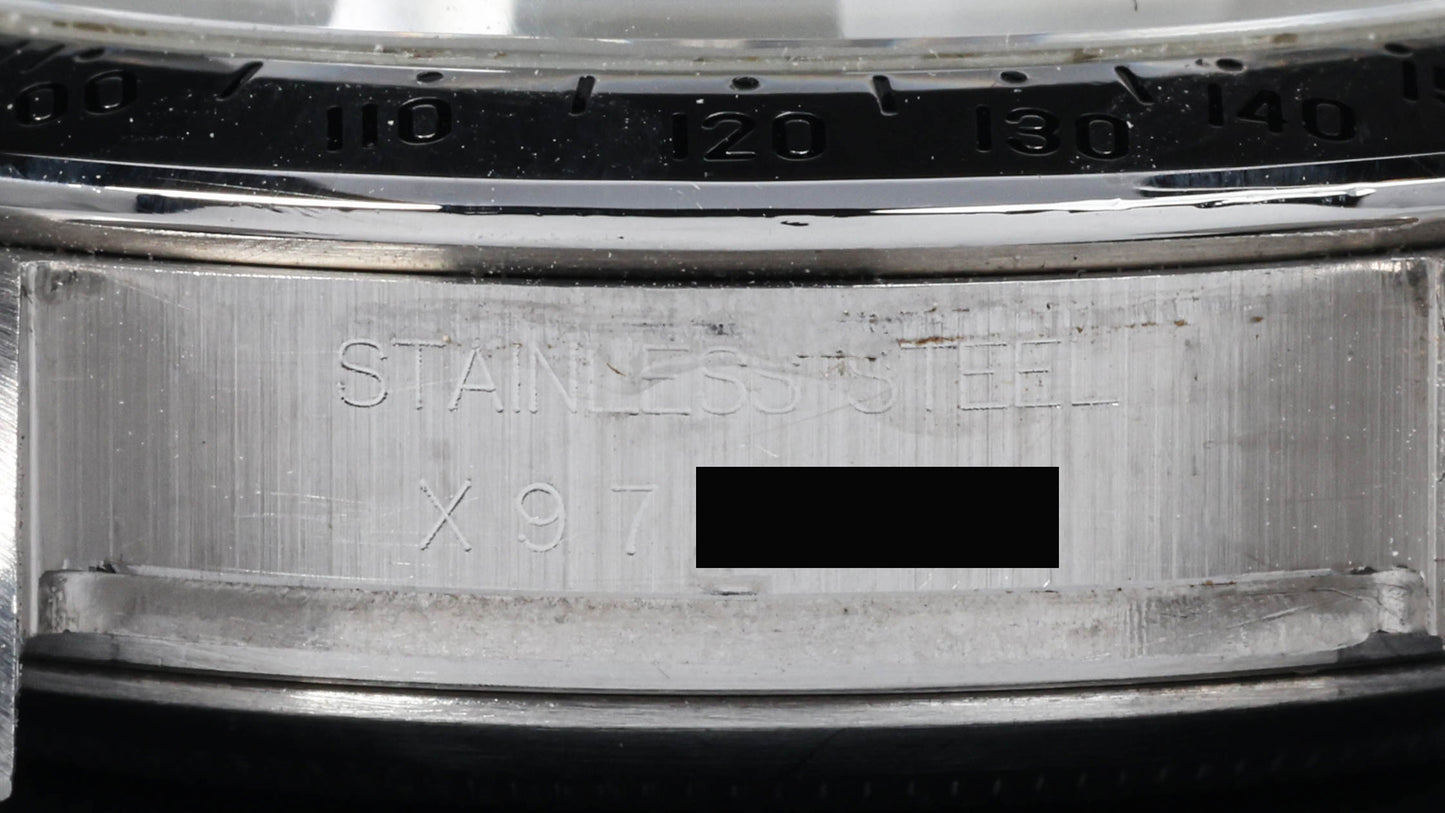
Presented in excellent condition, this Rolex Daytona 16520 ‘Inverted 6’, 40 mm, retains sharp case geometry. The lugs are crisp with factory brushing still visible, and there are no dents or deep marks. The steel tachymeter bezel shows crisp engraving with minor handling evident. The crystal is clear and free of distracting scratches. The Oyster bracelet is in great condition with light hairlines visible on links and clasp; articulation is smooth and the clasp closes securely. The rare ‘Inverted 6’ dial presents in great condition with clean printing, even lume plots and well defined sub dial rings. Hands are in excellent condition, properly aligned with intact luminous fill. Crown and screw down pushers operate positively; the chronograph starts, stops and resets correctly during handling. Given its age, this should be treated as a vintage timepiece; avoid water exposure and do not wear whilst swimming.
Share
Why we love this watch
Why we love this watch
Rolex Daytona 16520: The Zenith Era That Modernised the Chronograph
Introduction
Produced between 1988 and 2000, the Rolex Cosmograph Daytona 16520 marks the moment the brand’s flagship chronograph moved decisively into the modern age. It introduced automatic winding to the Daytona line, adopted a sapphire crystal, refined water resistance and case geometry, and paired all of that with a high grade column wheel movement derived from Zenith’s El Primero and extensively reworked in house as calibre 4030. The result preserved the DNA of the classic three register Daytona while delivering contemporary reliability and everyday usability in a way earlier hand wound references could not. Understanding the 16520 also means understanding the arc of the Daytona from its 1960s origins through the changes of the 1970s and 1980s, because this reference sits at a hinge point between mid century racing instruments and the integrated, high precision sports chronographs that followed.
Daytona Before 1988: How the Story Began
From Cosmograph to Daytona
Rolex introduced its first Cosmograph chronographs in the early 1960s, most notably the reference 6239 with a metal tachymeter bezel and a clean, high contrast dial aimed squarely at timing on the track. The Daytona name soon followed as the brand’s partnership with the Daytona International Speedway took hold, and by the mid 1960s the word Daytona was appearing above the lower sub dial on selected executions. These early watches were powered by modified Valjoux hand wound calibres, used pump pushers at first, and later added screw down pushers that consolidated the Oyster identity across the case and crown.
Screw Down Pushers and the Oyster Constraint
With references such as 6240, 6263 and 6265, screw down pushers arrived in the late 1960s to improve sealing. That detail is worth noting because it established the silhouette that carries through to the 16520 and beyond. Crown guards, a prominent tachymeter bezel, and the three register layout at 3, 6 and 9 became the visual language of the line. Acrylic crystals and manual winding kept the Daytona firmly in the tool watch camp, but by the early 1980s the wider world of Swiss chronographs was moving to automatic winding and harder wearing crystals. The stage was set for a step change.
The Debut of the 16520: A New Generation
Calibre 4030 and the Zenith Connection
The 16520’s beating heart is calibre 4030, a Rolex re engineering of Zenith’s famed high frequency El Primero. Zenith’s base calibre 400 was known for its 36,000 vph rate, integrated column wheel construction and date function. Rolex selected that architecture for its proven robustness, then altered it significantly for the Daytona brief. The beat rate was reduced to 28,800 vph to harmonise with Rolex’s established lubrication and service intervals. The date train was deleted, the escapement and balance were refitted with Rolex components including a free sprung balance regulated by Microstella screws, and a Breguet overcoil was used to promote isochronism. Bridges and plates were revised, the rotor and winding train were adapted, and the finishing and testing were brought in line with Rolex chronometer expectations. The result is recognisably an El Primero at its core yet thoroughly integrated into the brand’s movement ecosystem.
Case, Crystal and Water Resistance
The 16520 wears at approximately 40 mm with crown guards and screw down pushers that echo the late 1960s Oyster silhouette. The move to a sapphire crystal brought greater scratch resistance and a crisper view of the dial, while preserving the flat profile established by the acrylic era. Water resistance was rated to 100 metres, consolidating the Oyster promise in a chronograph that was equally comfortable on a race weekend or at a desk. The case flanks carry a clean polish, the lugs are neatly defined with a gentle downturn for comfort, and the screw back ties the package together with proven gasketed sealing.
Dial, Bezel and Readability
The classic tri compax register arrangement remains, with running seconds at 9, a 30 minute counter at 3 and a 12 hour counter at 6. Applied hour markers, a sharp minute track and precise printing keep legibility high. The steel bezel is engraved with a units per hour scale and frames the dial firmly. Early bezels read to 200 units; later versions moved to a 400 units scale that became a signpost of the period. Two dial colours are most associated with the reference, black with contrasting silver rings around the registers and white with matching black rings. The sapphire, the tidy print and the engraved bezel together produce a display that feels technical without clutter.
What Rolex Changed in the El Primero Architecture
Beat Rate, Regulation and Escapement
Reducing the frequency from 36,000 vph to 28,800 vph was not simply a numerical preference. It aligned the movement with Rolex’s oils and service cadence, reduced sliding friction at the escapement, and supported long term amplitude stability. The free sprung balance with Microstella screws replaced a conventional index regulator, allowing fine mass based adjustments without moving curb pins. A Breguet overcoil aided breathing symmetry, and the anvils, jewels and lever geometry were set to Rolex specifications.
Chronograph Train and Column Wheel Integrity
Rolex retained the column wheel and lateral clutch, a central part of the El Primero appeal. Actuation remained crisp and controlled, with start, stop and reset providing a positive feel at the pushers. The brand revised tolerances across the train, adjusted spring strengths and fitted its own chronograph driving wheel solution to secure consistent engagement. The 4030 therefore preserves the tactile satisfaction of a traditional column wheel while delivering the reliability expected from the Oyster case that surrounds it.
How the 16520 Wears and Works
Everyday Proportions and Balance
At 40 mm by roughly 12 millimetres in thickness, the 16520 sits close to the wrist. The sapphire crystal’s flatness keeps the visual height under control, and the crown guards provide a natural grip without feeling intrusive. The bracelet integrates smoothly so the head does not feel top heavy. It is a watch that takes the Daytona’s tool roots and makes them easy to live with daily.
Legibility During Use
The sub dial layout is familiar and quickly learned. The black dial emphasises depth with its silver chapter rings, while the white dial reads brighter and slightly more formal. Baton hands with luminous fill, applied markers and a finely engraved bezel scale make for quick reads whether one is timing a session or simply glancing for the time. The screw down pushers are firm but intuitive, and their action reinforces the sense of a sealed instrument rather than a dress chronograph.
Dial and Bezel Evolutions Within the Reference
From 200 to 400 Units
When the 16520 launched, bezels graduated to 200 units per hour appeared. Early in the run the scale evolved to 400 units, reflecting a wider industry trend toward higher upper limits on tachymeters. The font and placement of the numerals also changed subtly across the years, which gives the period a set of small design markers without changing the underlying function.
Floating Cosmograph and Inverted 6
Early dials are sometimes described as floating Cosmograph because the word Cosmograph sits on its own line with a subtle separation from the chronometer text above. Later print stacks tightened that spacing. Another period cue is the so called inverted 6 on certain 12 hour counters where the six can appear with a form that reads like a nine depending on orientation. These are typographic choices of the era rather than functional changes, but they tell the production story in a way that is specific to the 1990s.
Lume Materials and the Patrizzi Phenomenon
Tritium remained the luminous compound through most of the run before Super Luminova arrived near the end. On some black dials from the mid 1990s, the clear varnish used on the silver chapter rings oxidised with time and light exposure, turning those rings a warm brown. This change, widely known by a shorthand name derived from a noted watch writer, is a material behaviour rather than an intentional aesthetic. It reflects the chemistry of the varnish interacting with the environment and has become part of the reference’s visual landscape.
Bracelets, Clasps and Case Back Details
Oyster Bracelets of the Period
The 16520 typically shipped on an Oyster bracelet sized to the 20 mm lug span. Throughout the 1990s the bracelet construction evolved in small ways, with hollow end links at the start of the period and later revisions that subtly tightened tolerances and clasp feel. The brushed outer links and polished centre links provided a durable finish, while the stamped clasp with safety lock spoke to the sports purpose of the watch.
Case Back and Crown
The screw back is smooth with interior stamping that aligns with the period’s production approach. The Triplock crown with three dots beneath the coronet is standard, threading positively and seating with a firm stop against the case tube. Screw down pushers use a similar thread logic, and their knurled caps are easy to handle without gloves. Together, these elements secure the Oyster objectives of sealing and predictable operation.
Why the 16520 Was Pivotal for the Daytona Line
The First Automatic Daytona
For a name so closely associated with high speed timing, manual winding remained the default in the Daytona family for more than two decades. The 16520 changed that permanently, establishing automatic winding as the Daytona norm and opening the door to the integrated modern chronographs that would follow. The convenience of a self winding movement coupled with robust sealing and a sapphire crystal transformed the Daytona from a pure instrument into an everyday sports chronograph with few practical compromises.
A Bridge to the In House Era
The 16520 also set up the next chapter. In 2000 Rolex launched the reference 116520 with the fully in house calibre 4130. That movement retained a column wheel but introduced a vertical clutch for zero jump starts and continuous seconds with the chronograph running, simplified the chronograph architecture, and moved the small seconds from 9 to 6 at a glance signal that the movement was different. Without the 4030 period, the engineering and testing pathway to 4130 would have been longer and less direct. The 16520 therefore serves as both a destination and a starting point.
The Daytona’s Wider History and Motorsport Ties
Timing and Racing Culture
From the beginning, the Cosmograph layout, engraved tachymeter and external bezel spoke to timing intervals on the track. The association with Daytona International Speedway gave the watch a clear narrative and helped anchor its identity within motorsport. Over the decades the Daytona appeared on wrists that had little to do with a pit wall, yet its visual code never drifted from the idea of a timing instrument first and a luxury item second. The 16520 preserved that identity while making it easier to wear in more places.
The Continuity of Design
If one places a 6239, a 6263 and a 16520 side by side, the continuity is obvious. Three registers at 3, 6 and 9. Tachymeter on the bezel. Crown guards and screw down pushers on later examples. Clear, functional printing. The 16520 refined materials and movement technology but did not abandon the core silhouette. It is the same concept seen with modern eyes, which is why the lineage reads so cleanly from the 1960s to the present.
Variants and Reference Markers Without Overcomplication
Dials, Fonts and Small Cues
Within the 16520 family there are legitimate period cues that help place a watch within the run. Floating Cosmograph spacing, inverted 6 typography on some 12 hour counters, changes in dial script weight, and the shift from tritium to Super Luminova all belong to the period record. They enrich the story of the reference because they show the normal evolution of an active production line addressing print, material and supply changes through the 1990s.
Bezels and Case Refinements
The 200 to 400 units change on the bezel, the subtle thickening of fonts in some years, and the sharpening of engraving techniques are likewise part of that story. Cases retained their core geometry, yet finishing improved incrementally as production methods did. These are the small signals that the 16520 was not static, even if its overall form appears consistent.
The 16520 and the Daytona Legacy
A Reference That Defined Expectations
By the time it bowed out in 2000, the 16520 had defined what a modern Daytona should be. Automatic, precise, comfortable under a sapphire crystal, water resistant to a standard that suited real life, and anchored by a column wheel chronograph that felt mechanically satisfying to use. Everything that arrived with the in house 4130 built on those expectations.
The Link Between Eras
It is easy to think of the Daytona as two halves, the hand wound era and the in house automatic era. The 16520 shows that the real story has a crucial middle chapter. It carried forward a revered dial layout, preserved the instrument character and used a carefully revised movement to bridge past and future. For those interested in the design and engineering arc of the model, that bridging role is the heart of its significance.
Final Thoughts
The Rolex Daytona 16520 stands as the chronograph that modernised a legend without erasing its identity. Automatic winding transformed practicality. Sapphire crystal, 100 metre sealing and refined case work consolidated the Oyster promise. The calibre 4030 kept the best of the El Primero architecture, added Rolex regulation, beat rate and balance philosophy, and delivered the column wheel feel that defines a traditional high grade chronograph. Dial and bezel changes across the period created a set of small historical signposts without disturbing the core idea. Above all, the 16520 honours the Daytona’s racing origin by keeping the display clean, the pushers purposeful and the timing tools front and centre. Seen within the broader history of the line, it is the hinge that connects the hand wound classics of the 1960s and 1970s to the integrated chronographs that followed from 2000 onward. That continuity explains why the silhouette remains recognisable across six decades, and why the 16520 holds such a clear place in the story of Rolex’s most famous chronograph.
Case & Bracelet
Case & Bracelet
- Case in excellent condition, extremely sharp lugs with factory brushing still visible.
- Bracelet in great condition, light hairlines visible.
Dial & Hands
Dial & Hands
- Dial rare inverted 6 in great condition
- Hands in excellent condition
Warranty & Condition
Warranty & Condition
Crown Vintage Watches provides a minimum 6-month mechanical warranty on pre-owned watches, from the date of purchase.
The warranty covers mechanical defects only.
The warranty does not cover damages such as scratches, finish, crystals, glass, straps (leather, fabric or rubber damage due to wear and tear), damage resulting from wear under conditions exceeding the watch manufacturer’s water resistance limitations, and damage due to physical and or accidental abuse.
Please note, water resistance is neither tested nor guaranteed.
Shipping and insurance costs for warranty returns to us must be covered by the customer. Returns must be shipped via traceable courier. Return shipment must be pre-paid and fully insured. Collect shipping will be refused. In case of loss or damages, the customer is liable.
Our Pledge
At Crown Vintage Watches, we stand by the authenticity of every product we sell. For added peace of mind, customers are welcome to have items independently authenticated at their own expense.
Condition
Due to the nature of vintage timepieces, all watches are sold as is. We will accurately describe the current condition and working order of all watches we sell to the best of our ability.
Shipping & Refund
Shipping & Refund