

Crown Vintage
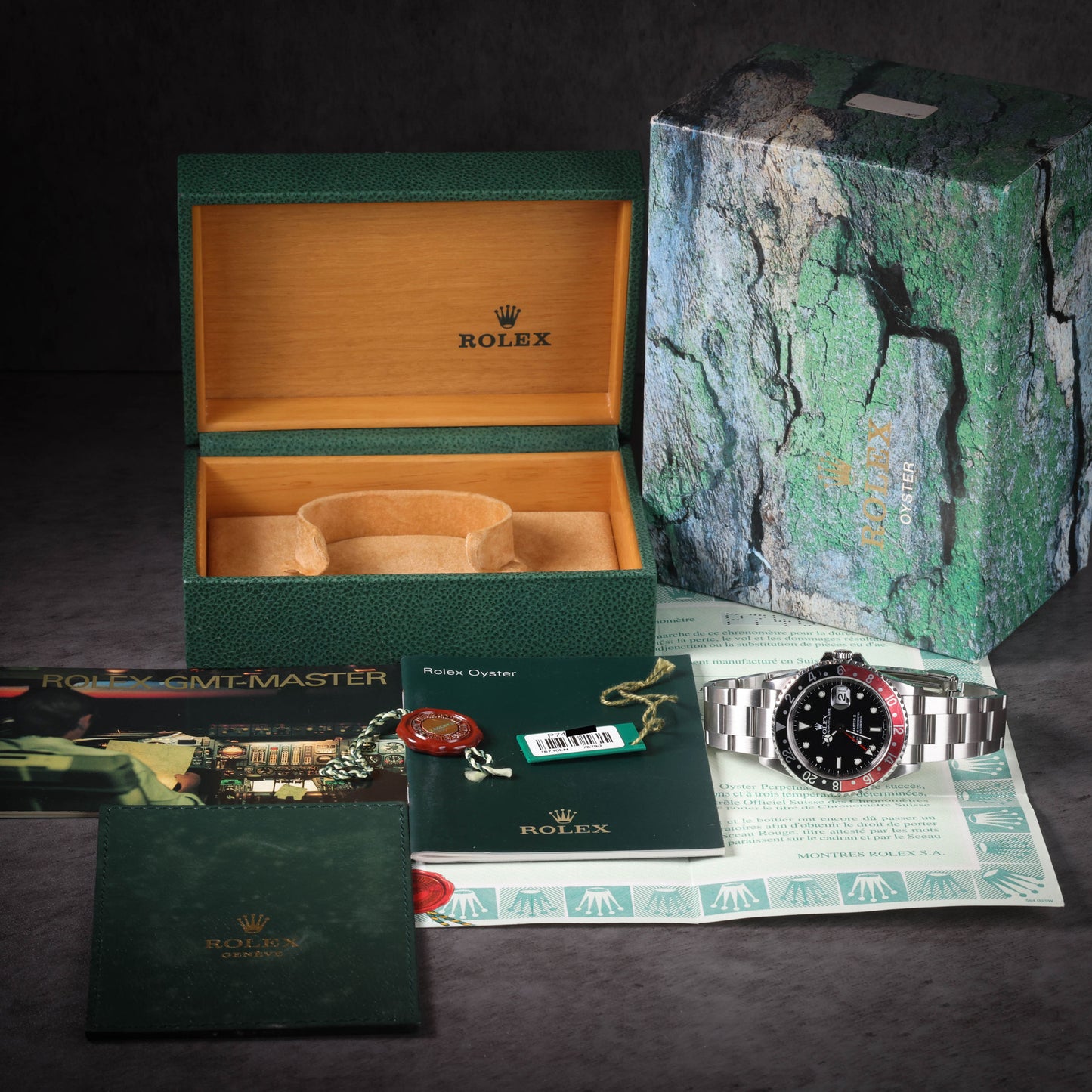
Rolex GMT Master II 16710 'Coke' 40MM 2000 Box & Papers
Rolex GMT Master II 16710 'Coke' 40MM 2000 Box & Papers
Couldn't load pickup availability
Rolex GMT Master II 16710 'Coke' 40MM 2000 Box & Papers
The previously polished case of this Rolex GMT-Master II 16710 presents in very good condition, retaining strong, well-defined lugs with factory brushing still visible across the surfaces. The Oyster bracelet is in excellent condition, presenting with very little wear visible across the links. A minimal degree of stretch is present, as is entirely expected and consistent with the age of the piece, and does nothing to detract from the overall presentation of the bracelet.
The dial and hands are in flawless condition, displaying crisp, well-defined details and an entirely untouched finish. The applied hour markers remain bright and secure, and the lume plots are uniform and clean throughout. This is a superbly preserved example that reflects careful, considered ownership across its lifetime.
WAIO Report:
Tested over 4 positions the watch is running at +3.1s/d | 0.1MS beat error | 276.8 Degrees of amplitude.
The watch has successfully passed a 5BAR pressure test.
Share
Why we love this watch
Why we love this watch
The Colour the GMT-Master II Made Its Own: Rolex GMT-Master II 16710 'Coke' 40MM in 2000
The Coke is the only bezel the GMT-Master II can truly call its own. Where the Pepsi traces its red and blue back to 1954, the black and red Coke was born with the GMT-Master II itself, arriving on the very first reference to carry the name in 1983. The 16710, produced from 1989 through to 2007, carried that configuration to the end of the aluminium bezel era, and when the reference was retired the Coke left the Rolex catalogue entirely. It has never returned. A 2000 example sits at a particularly appealing point in the production run: mature enough to benefit from a decade of refinement, fitted with the proven calibre 3185, and produced in the final years before the reference began its long farewell. Today the 16710 Coke stands as one of the defining sports watches of the modern era, and the last chapter of a colourway that exists nowhere else in the Rolex story.
A Tool Watch Born From Aviation
The story of the GMT-Master begins not in a watchmaker's atelier but aboard an aircraft. In the early 1950s, Pan American World Airways was expanding its transatlantic operations and opening routes that placed flight crews across multiple time zones within a single working day. The practical problem this created was straightforward: pilots and navigators needed a reliable means of tracking home time alongside local time simultaneously, without the complication of carrying a second watch or performing mental arithmetic at altitude. Rolex, already well established as a supplier of professional tool watches to aviation, military, and diving communities, recognised an opportunity to solve that problem mechanically.
The result was the original GMT-Master, introduced in 1954 as the reference 6542 and developed in direct collaboration with Pan Am. The 6542 introduced what would become one of the most recognisable complications in watchmaking: a bidirectional rotating bezel with a 24-hour graduated insert, paired with a fourth central hand that completed one revolution every 24 hours rather than every 12. By setting the GMT hand to a reference time zone and reading it against the bezel, the wearer could track a second time at a glance without disturbing the primary timekeeping display. It was a practical instrument conceived to solve a specific operational problem, and its visual identity followed directly from that function. The two-tone bezel insert, divided between day and night hours, gave the watch an immediately readable 24-hour reference and established the template that every later colourway, the Coke included, would follow.
From the 6542 to the 1675
Rolex developed the GMT-Master through the reference 1675, introduced in 1959 and produced until 1980. The 1675 retained the core function of the 6542 while introducing a crown-protecting Oyster case with shouldered lugs, a more robust and refined architecture that set the physical template for GMT-Masters to follow. During its two-decade production run, the 1675 appeared with a range of bezel configurations including the Pepsi in red and blue, the Gilt in black and gold, and the all-black variant, and it served a generation of pilots, navigators, and travellers as the standard-issue professional GMT. By the time it was retired, the GMT-Master had moved well beyond its original Pan Am brief and into the broader vocabulary of professional watchmaking.
The reference 16750 followed in 1980, introducing an updated calibre 3075 with a quickset date function. It was a transitional reference, bridging the aesthetic of the 1675 with the more modern engineering that Rolex was applying across its professional line during that period, and it remained in production until 1988.
The GMT-Master II and the Birth of the Coke
The GMT-Master II, introduced in 1983 with the reference 16760, represented a fundamental rethinking of the complication. On the original GMT-Master, setting the local time required adjusting the main hour hand, which was mechanically linked to the 24-hour GMT hand. Changing one meant changing the other. The 16760 resolved this with a redesigned movement that allowed the local hour hand to be set independently, advancing or retreating in one-hour increments while the GMT hand and the seconds continued to run uninterrupted. This distinction, captured in the 'II' designation, is the core functional difference between the two generations and the reason the GMT-Master II became the preferred professional specification.
Crucially for the story of this watch, the 16760 was offered with one bezel and one bezel only: black and red. Rolex chose the new colourway deliberately, giving the new generation a visual identity distinct from the Pepsi that had defined the GMT-Master for three decades. Collectors soon reached for the obvious counterpart nickname, and the Coke was born. The 16760 itself earned a nickname of its own, the 'Fat Lady', from the wider case profile and thicker dimensions demanded by the new movement architecture. It was a capable tool watch but not the most elegant expression of the GMT-Master form, and Rolex addressed this with the 16710, introduced in 1989 as the direct successor.
Refining the Formula
The 16710 returned the GMT-Master II to a case width more in keeping with the proportions of the earlier references. At 40 millimetres the watch wore with the authority of a professional instrument without the bulk of the 16760, and the combination of brushed and polished surfaces gave it a visual refinement that suited the reference's expanding role as both a working tool and a dress-adjacent sports watch. The Oyster bracelet, with its flat three-piece links and deployant clasp, remained the canonical pairing, though Rolex also offered the more formal Jubilee bracelet as an alternative configuration for those who preferred a softer wrist presence.
The Coke Configuration
The 16710 Coke takes its nickname from the colour combination of the bezel insert: red occupying the upper half, representing daytime hours from six in the morning to six in the evening on the 24-hour scale, and black occupying the lower half for the corresponding night hours. The association with the Coca-Cola livery requires no defence, and the nickname has long since entered official collector parlance. What makes the configuration historically significant is that it belongs to the GMT-Master II alone. Of the three bezel configurations offered on the 16710, being the Pepsi in red and blue, the Coke in red and black, and the all-black variant, the Coke is the one that was created for this generation rather than inherited from the original GMT-Master. It is the founding livery of the independently adjustable GMT, worn first by the Fat Lady and refined here into its definitive form. Where the Pepsi looks back to 1954, the Coke is the GMT-Master II wearing its own colours. The pairing of red and black also gives the watch a quieter, more versatile presence on the wrist, with the black half of the insert flowing into the dial and the red half providing the flash of colour that identifies the reference across a room.
Technical Specifications
Case and Bezel
A 2000 example of the 16710 Coke presents with a case measuring 40 millimetres in diameter, machined from stainless steel and finished to the standard that defines the Oyster Professional range. The case construction follows the Oyster architecture: a three-piece design comprising the middle case, the screwdown caseback, and the bezel assembly, with a screwdown winding crown providing water resistance rated to 100 metres. The combination of brushed flanks and polished bevels across the lugs gives the case its characteristic interplay of textures, functional in the sense that the brushed surfaces resist showing wear while the polished edges maintain visual definition.
The bezel is bidirectional, graduated across 24 hours rather than the 60-minute scale used on dive watches, and fitted with an aluminium insert in the Coke configuration. Aluminium inserts are the correct and period-appropriate specification for all 16710 production, predating the ceramic Cerachrom materials that would arrive with the next generation. The insert on a well-preserved 2000 example will carry the red and black tones in good balance, though some natural softening of the red toward a deeper burgundy or orange cast is a characteristic of aged aluminium and is rightly read as evidence of honest wear rather than a flaw.
Dial and Hands
The dial on a standard 2000 16710 is the gloss black configuration, a deep lacquered surface that provides maximum contrast for the applied hour markers and printed text beneath the sapphire crystal. The hour markers are applied indices framed in white gold surrounds, and the hands follow the Mercedes configuration: a distinctive three-spoke hand at the hour position that has been a feature of Rolex professional watches since the 1950s. The GMT hand is an arrow-tipped fourth hand in red, echoing the daytime half of the bezel and providing immediate visual separation from the hour, minute, and seconds hands so that the 24-hour reference can be read at a glance against the bezel graduation.
By 2000, Rolex had completed its transition from tritium to non-radioactive Super-LumiNova luminescent compound across its professional line, meaning the lume plots on the hour markers and hands of a 2000 16710 will present clean and white rather than with the warmer patina associated with tritium-filled examples from the 1980s and early 1990s, with the dial signed accordingly at six o'clock. The dial text follows the standard hierarchy established across the Oyster Professional range: 'ROLEX' beneath the coronet at twelve o'clock, 'OYSTER PERPETUAL DATE' in the second register, and 'GMT-MASTER II' completing the identification in the third line. The date aperture at three o'clock is magnified by a cyclops lens set into the sapphire crystal directly above it, a detail that has been a consistent feature of the date-equipped Rolex range since the mid-1950s.
Movement
The movement powering the 16710 is the calibre 3185, a Rolex manufacture automatic developed from the calibre 3085 that preceded it in the 16760. The 3185 beats at 28,800 vibrations per hour, offers a nominal power reserve of approximately 50 hours from a fully wound state, and incorporates the independently adjustable hour hand mechanism that defines the GMT-Master II function. The local hour is set by pulling the crown to the first position and rotating it, advancing or retreating the hour hand in one-hour increments while the movement continues to run and the GMT hand maintains its reference time without interruption. The seconds hand does not stop during this adjustment, a detail that distinguishes the quick-set hour function from the more common quickset date operation found across the Oyster range.
The 3185 is housed behind a solid screwdown caseback rather than an exhibition back, consistent with Rolex's approach across the Oyster Professional line. The decision to use a solid caseback reflects both the water resistance architecture of the Oyster case and Rolex's long-standing philosophy that a professional tool watch should present itself by what it does rather than what it reveals.
Final Thoughts
What makes the 16710 Coke a reference worth understanding carefully is its position as a true endpoint. When the 16710 was discontinued in 2007, the Pepsi eventually found its way back into the catalogue in Cerachrom ceramic, first in white gold in 2014 and then in steel in 2018. The Coke did not. The red and black configuration that launched the GMT-Master II in 1983 disappeared with the 16710 and has never been reissued in any material. That makes the 16710 the final expression of the only colourway the GMT-Master II ever originated, a continuous thread running from the Fat Lady of 1983 to the last aluminium bezels of 2007. A 2000 example represents that lineage at its most refined: a watch built to work, designed to last, and carrying the founding colours of the GMT-Master II on the wrist.
Case & Bracelet
Case & Bracelet
- Case in very good condition with little wear visible. Strong lugs with factory brushing still visible.
- Bracelet in great condition with very light wear visible.
Dial & Hands
Dial & Hands
- Dial and hands are flawless
Warranty & Condition
Warranty & Condition
Crown Vintage Watches provides a minimum 6-month mechanical warranty on pre-owned watches, from the date of purchase.
The warranty covers mechanical defects only.
The warranty does not cover damages such as scratches, finish, crystals, glass, straps (leather, fabric or rubber damage due to wear and tear), damage resulting from wear under conditions exceeding the watch manufacturer’s water resistance limitations, and damage due to physical and or accidental abuse.
Please note, water resistance is neither tested nor guaranteed.
Shipping and insurance costs for warranty returns to us must be covered by the customer. Returns must be shipped via traceable courier. Return shipment must be pre-paid and fully insured. Collect shipping will be refused. In case of loss or damages, the customer is liable.
Our Pledge
At Crown Vintage Watches, we stand by the authenticity of every product we sell. For added peace of mind, customers are welcome to have items independently authenticated at their own expense.
Condition
Due to the nature of vintage timepieces, all watches are sold as is. We will accurately describe the current condition and working order of all watches we sell to the best of our ability.
Shipping & Refund
Shipping & Refund