

Crown Vintage
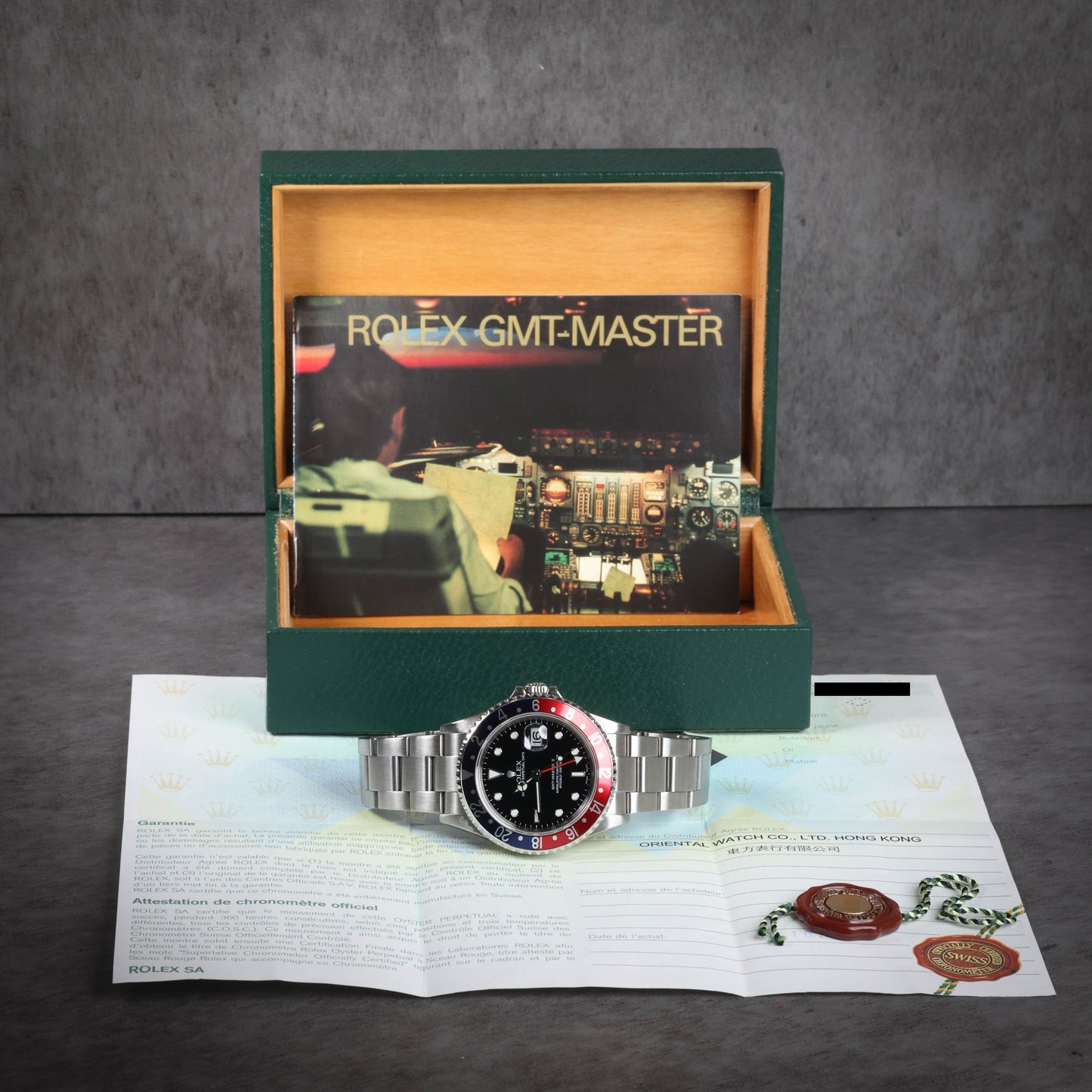
Rolex GMT Master II 16710 'Pepsi' 40MM 2005 Box & Papers
Rolex GMT Master II 16710 'Pepsi' 40MM 2005 Box & Papers
Couldn't load pickup availability
Preloved Rolex GMT Master II 16710 'Pepsi' 40MM 2005 Box & Papers
The previously polished case of this Rolex GMT-Master II 16710 presents in excellent condition, retaining strong, well-defined lugs with factory brushing still clearly visible across the surfaces. There is minimal wear apparent, and the lines of the Oyster case remain crisp, consistent with a piece that has been carefully kept throughout its life.
The Oyster bracelet is in great condition, presenting with light wear visible across the links.
The dial and hands are in very good condition, displaying crisp, well-defined details and an entirely untouched finish. The dial has a light scratch at 3 o clock. The applied hour markers remain bright and secure, and the lume plots are uniform and clean throughout. This is a superbly preserved example that reflects careful, considered ownership across its lifetime.
Share
Why we love this watch
Why we love this watch
Red Above, Blue Below: The Rolex GMT Master II 16710 Pepsi
When Rolex retired the reference 16710 in 2007, the red and blue anodised aluminium bezel that had defined the GMT Master II for nearly two decades left the catalogue with it, and the model's most recognised colour combination would not return to production for another eleven years. That gap alone tells you something about what this reference represents. The 16710 Pepsi is not a watch that has been continuously available or periodically refreshed; it is a closed chapter, eighteen years of production, and the last expression of a design philosophy that connected a 2005 wristwatch directly to a commission placed by an airline in the early years of commercial jet travel. At Crown Vintage, it is among the GMT Master references we find most compelling, and the reasons run through the full length of its history.
Pan American and the Commission That Built the GMT Master
The GMT Master's origin is one of the most well-documented in watchmaking, but it is worth returning to because it explains every design decision that followed. In the early 1950s, as Pan American World Airways began operating transatlantic flights at commercial scale, the airline faced a problem that no existing wristwatch adequately solved. Crews flying between continents needed to read home time and local time simultaneously, not sequentially, and they needed to do so at a glance in the cockpit. Pan Am approached Rolex with a brief that was operationally precise: build a watch capable of displaying two time zones at once, clearly, on a wrist.
The result was the GMT Master reference 6542, introduced in 1954. Rolex's solution was mechanically elegant: a fourth hand, running on a 24-hour cycle, sat above the standard hour and minute hands, and a bidirectional rotating bezel graduated to 24 hours allowed the wearer to align the scale with any reference time zone. The 24-hour hand then tracked a fixed time while the standard hour hand could be read against the chapter ring for local time. The bezel insert on those earliest examples was moulded in bakelite, the first fully synthetic plastic, coloured in red and blue. Red indicated daytime hours, blue indicated night, and the combination was a functional coding system before it became an aesthetic signature. The nickname "Pepsi" arrived informally, drawn from the similarity to the American soft drink company's brand colours, and it has remained in common use ever since.
The 6542 ran until 1959, when it was succeeded by the reference 1675. That transition introduced crown guards flanking the winding crown, hardened the case architecture, and replaced the bakelite bezel insert with anodised aluminium, a more durable material that resolved the fragility issues associated with the earlier moulded construction. The 1675 remained in production for over two decades, accumulating dial and hand variations across its run and establishing the GMT Master as a watch with genuine professional utility and an increasingly wide civilian following. By the time it was discontinued in 1980, the red and blue Pepsi bezel had become one of the most recognisable visual elements in Swiss watchmaking.
The GMT Master II and the Road to Reference 16710
Reference 16760: The Fat Lady
The GMT Master II was a separate model from the outset, distinct from its predecessor in one fundamental mechanical respect. Where the original GMT Master linked the local hour hand and the 24-hour GMT hand together, requiring the rotating bezel to do the work of time zone separation, the GMT Master II decoupled them. The local hour hand could now be advanced or retarded independently of the GMT hand, allowing the wearer to jump local time in one-hour increments without disturbing the home time setting. In practical terms, this meant the watch could track three time zones simultaneously: home time on the 24-hour hand, local time on the standard hour hand, and a third zone via the bezel graduation.
This improvement was made possible by the calibre 3085, and it arrived in 1983 inside the reference 16760. The new movement was dimensionally larger than its predecessor, and the case had to grow thicker to accommodate it. The result was a watch that wore noticeably more substantial than any GMT that had come before it, and the proportions earned it an immediate nickname: the Fat Lady. The 16760 was produced for roughly five years, was only ever offered with a Coke red and black bezel, and remains a significant reference in its own right as the first GMT Master II. When Rolex replaced it in 1989, they used a redesigned, slimmer movement to bring the case back to proportions that matched the established GMT aesthetic.
Reference 16710: Eighteen Years of Production
The reference 16710 inherited the Fat Lady's mechanical function but shed its bulk. The calibre 3185, which powered the 16710 throughout the majority of its production, retained the independently adjustable local hour hand of its predecessor while occupying significantly less vertical space, allowing the case to slim down to a profile in keeping with the GMT Master tradition. The 16710 was also the first GMT Master II to be offered in the full range of bezel options: all black, the red and black Coke, and the red and blue Pepsi. That breadth of choice, combined with the option of either an Oyster or a Jubilee bracelet, made the reference the most configurable GMT Master II Rolex had ever produced.
Production ran from 1989 to 2007, and across that period the reference underwent a series of incremental refinements. Tritium lume plots gave way to Luminova and then to SuperLuminova as the industry transitioned away from radioactive compounds; the dial legend changed accordingly, with "Swiss Made" appearing from 2000 onwards to denote SuperLuminova fills. Solid bracelet end links replaced the hollow earlier versions in 2000, improving both the structural integrity and the wrist feel of the bracelet. A no-drill case, eliminating the lug holes used for spring bar removal, was phased in from 2003 onwards. A 2005 example sits comfortably within this most mature period of the reference: SuperLuminova dial, solid end links, no-hole case, and the calibre 3185 in its fully developed form.
The Watch in Detail
Dial, Bezel, and Case
The 16710 dial is black, with applied white gold surrounds encircling each luminous index. The surrounds serve a functional purpose, preventing the aluminium of the case from oxidising against the lume plots and maintaining the integrity of the dial surface over time. The date aperture at three o'clock carries a cyclops magnifier integrated into the sapphire crystal, a detail that has appeared on Rolex date models since the 1950s and which on the 16710 sits above a date wheel with white numerals against a black background. The red GMT hand, with its distinctive arrowhead tip, provides immediate visual separation from the standard hour hand, its 24-hour cycle keeping it perpetually out of phase with the 12-hour hand beneath it.
The bezel insert on the Pepsi variant is anodised aluminium, graduated to 24 hours with numerals and indices printed in two tones: the upper half, spanning the hours from 12 noon to midnight, is red; the lower half, spanning midnight to noon, is blue. The insert sits within a bidirectional rotating bezel that clicks in 120 increments, each click representing two minutes. This graduation is finer than the 60-click construction found on dive watch bezels, and it reflects the precision required when tracking time zone offsets rather than elapsed minutes. The complete 40mm Oyster case in stainless steel is water resistant to 100 metres, with a screw-down crown secured by crown guards and a solid case back.
The bracelet on a 2005 example is the Oyster in stainless steel, fitted with solid end links and an Oysterlock folding clasp. The Jubilee was also available on this reference, and some examples left production on the five-link bracelet, but the Oyster configuration represents the more utilitarian and arguably more resolved expression of a watch that was designed as a professional tool.
Calibre 3185
The calibre 3185 is a COSC-certified chronometer movement beating at 28,800 vibrations per hour. It is a self-winding mechanism with a bidirectional rotor, a hacking seconds function that stops the seconds hand when the crown is fully extended, and a quickset date that advances independently of the time-setting position. The mechanism that defines the GMT Master II designation is the independently settable local hour hand: with the crown in the intermediate position, the hour hand can be advanced or retarded in one-hour jumps without affecting either the running seconds or the GMT hand's 24-hour tracking. The power reserve runs to approximately 50 hours from full wind.
The 3185 represented a meaningful technical improvement over its predecessor, the 3085, not only in its slimmer construction but in the refinement of the independent hour hand mechanism and the accuracy of the COSC certification. It would serve the 16710 for the majority of the reference's production life before being succeeded by the 3186 in the final months of the run, a movement that introduced a Parachrom hairspring for improved resistance to temperature variation and shock. A 2005 piece is firmly within the 3185 era.
Final Thoughts
The Rolex GMT Master II 16710 Pepsi occupies a specific and unrepeatable position in the model's lineage. It was the last steel GMT Master II to carry the red and blue aluminium bezel in a regular production form, and when the 116710LN replaced it in 2007 with a black ceramic insert, the Pepsi combination disappeared entirely until the ceramic 126710BLRO arrived in 2018. In the intervening eleven years, the only way to wear a Pepsi GMT was to find a 16710. That context is now a permanent part of what the reference means.
What makes the 2005 example particularly coherent is the convergence of refinements it represents. The SuperLuminova dial, solid end links, no-hole case, and fully developed calibre 3185 collectively mark it as a late-production 16710 in which every incremental improvement Rolex made across the reference's run has been incorporated. It is a watch at the end of a long development arc, settled and resolved, and carrying in its red and blue bezel a visual language that connects it directly to the aircraft cockpits of the 1950s where the GMT Master's brief was first written. That is not a common condition for any object to be in.
References
- Bob's Watches, "Getting Baked: The Highly Collectible GMT Master 6542," bobswatches.com, accessed 2025.
- The Transatlantic Journal, "Pan Am & the Rolex GMT Master," thetransatlanticjournal.com, accessed 2025.
- Revolution Watch, "The Rolex GMT-Master: A Chronology," revolutionwatch.com, accessed 2025.
- Bob's Watches, "The First Rolex GMT-Master II: Coke Bezel for the Fat Lady," bobswatches.com, accessed 2025.
- Chrono24, "5 Things to Know Before Buying a Rolex GMT-Master II," chrono24.com, accessed 2025.
- Gray & Sons, "History and Evolution of the Rolex GMT-Master II," grayandsons.com, accessed 2025.
- Bob's Watches, "GMT Master II 16710 History," bobswatches.com, accessed 2025.
- Monochrome Watches, "In-Depth: The History of the Rolex GMT-Master and GMT-Master II," monochrome-watches.com, accessed 2025.
- Sotheby's, "Rolex GMT Master II Pepsi, Ref 16710, circa 2004," sothebys.com, accessed 2025.
- WatchBase, "Tudor 70330N Series Sub-Reference Notes," watchbase.com, accessed 2025.
- Chrono24, "Rolex GMT-Master II 16710," chrono24.com, accessed 2025.
Case & Bracelet
Case & Bracelet
- Case in excellent condition with little wear visible. Strong lugs with factory brushing still visible.
- Bracelet in great condition with little wear visible.
Dial & Hands
Dial & Hands
- Dial and hands great condition
Warranty & Condition
Warranty & Condition
Crown Vintage Watches provides a minimum 6-month mechanical warranty on pre-owned watches, from the date of purchase.
The warranty covers mechanical defects only.
The warranty does not cover damages such as scratches, finish, crystals, glass, straps (leather, fabric or rubber damage due to wear and tear), damage resulting from wear under conditions exceeding the watch manufacturer’s water resistance limitations, and damage due to physical and or accidental abuse.
Please note, water resistance is neither tested nor guaranteed.
Shipping and insurance costs for warranty returns to us must be covered by the customer. Returns must be shipped via traceable courier. Return shipment must be pre-paid and fully insured. Collect shipping will be refused. In case of loss or damages, the customer is liable.
Our Pledge
At Crown Vintage Watches, we stand by the authenticity of every product we sell. For added peace of mind, customers are welcome to have items independently authenticated at their own expense.
Condition
Due to the nature of vintage timepieces, all watches are sold as is. We will accurately describe the current condition and working order of all watches we sell to the best of our ability.
Shipping & Refund
Shipping & Refund