

Crown Vintage
Rolex GMT Master II 40MM 16710 'Pepsi' 2000
Rolex GMT Master II 40MM 16710 'Pepsi' 2000
Couldn't load pickup availability
Rolex GMT Master II 40MM 16710 'Pepsi' 2000
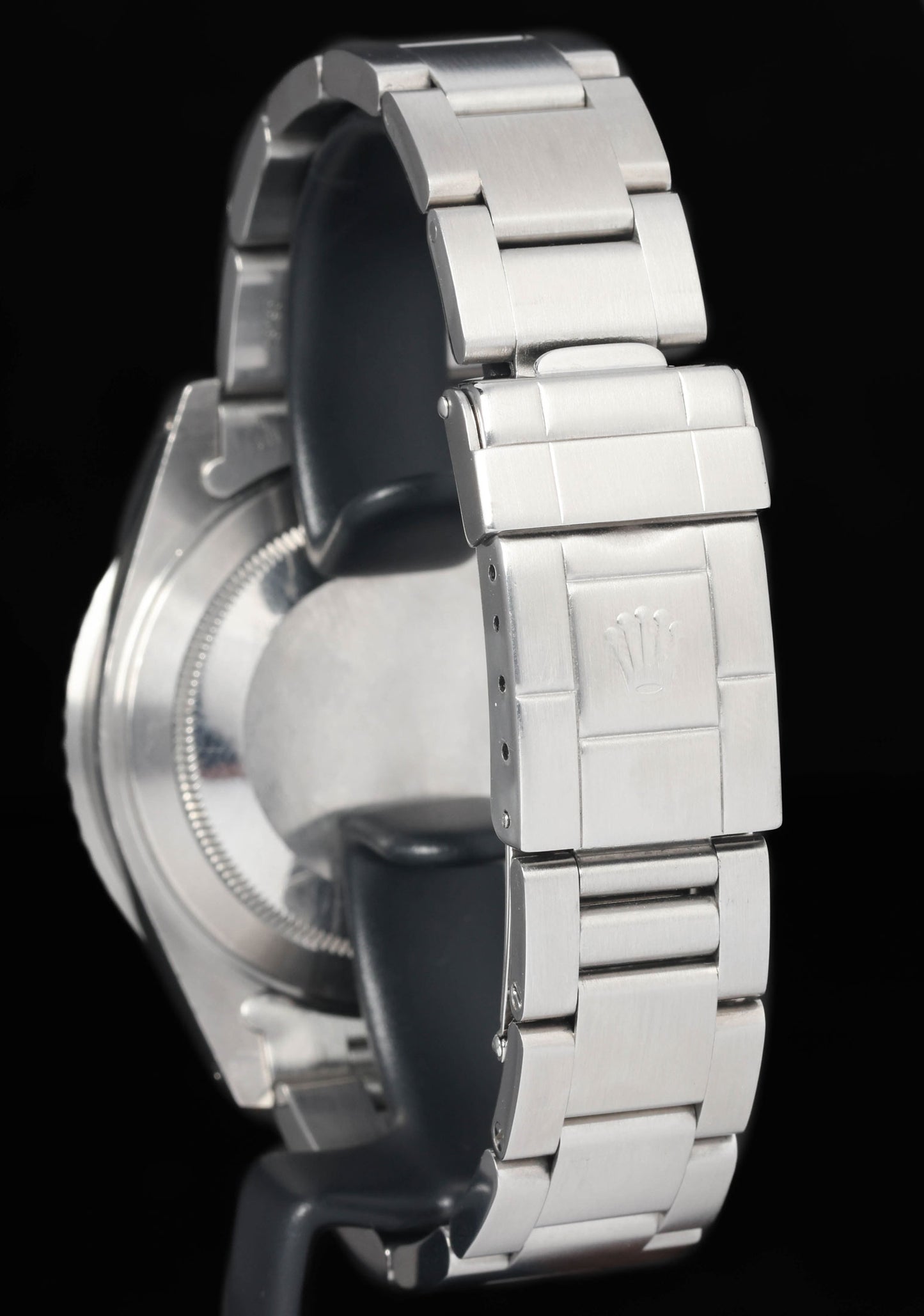
This Rolex GMT-Master II 16710 is presented in great overall condition. The stainless steel case and bracelet show strong definition with nice, sharp edges retained. Very light hairline marks are visible on close inspection, consistent with careful wear, and there are no distracting marks or damage. The bracelet remains tight and well aligned, complementing the clean case profile.
The dial and hands are brand new, having been replaced during a Rolex service in 2025. They present in flawless condition, with crisp printing, clean luminous material, and excellent legibility throughout.
This watch underwent a major service at Rolex Service Centre in Melbourne December 2025 and is accompanied by a Rolex Service Card. It is covered by Rolex’s 2-year international service warranty, providing reassurance around both condition and recent mechanical attention.
Share
Why we love this watch
Why we love this watch
Rolex GMT-Master II 16710 from 2000 (Pepsi)
Introduction
Produced from 1989 until 2007, the Rolex GMT‑Master II 16710 represents one of the most important transitional references in the GMT-Master lineage. A 2000 production example sits squarely in the middle of that run and captures the model at a point where vintage construction and modern functionality overlap. Retaining the aluminium “Pepsi” bezel insert and acrylic-era proportions while introducing an independently adjustable local hour hand, the 16710 bridges two worlds.
Origins of the GMT-Master II
The original GMT-Master was developed in the 1950s to meet the needs of long-haul pilots who required an intuitive way to track a second time zone. For decades, the solution relied on a 24-hour hand geared to the main time display, read against a rotating bezel. While effective, it required bezel manipulation to change reference time zones.
By the late 1980s, global travel had expanded well beyond professional aviation. Business travellers, diplomats, and frequent flyers needed faster adjustment when crossing time zones. Rolex responded by re-engineering the GMT mechanism, creating the GMT-Master II. The defining change was an independently adjustable local hour hand, allowing the wearer to change local time in one-hour increments without stopping the movement or disturbing the 24-hour reference hand. The reference 16710 was the stainless steel expression of that solution.
The 16710 in the Context of 2000
By the year 2000, the GMT-Master II 16710 had already benefited from more than a decade of refinement. The case profile had settled into its familiar slim Oyster form, dial printing was consistent, and the movement architecture was proven. At the same time, Rolex had not yet transitioned the GMT line to ceramic bezels or maxi cases. This places a 2000 example in a period where the watch remains visually close to earlier GMT-Masters while offering genuinely modern usability.
Importantly, Rolex did not alter the external appearance to signal the technical upgrade. The watch looks like a classic GMT-Master, but behaves differently in use. That restraint reflects Rolex’s broader design philosophy during this era.
Case Architecture and External Design
The GMT-Master II 16710 uses a 40 mm stainless steel Oyster case with crown guards, screw-down crown, and screw-down case back. Water resistance is rated to 100 metres, suitable for everyday wear and travel rather than saturation diving. The case is slim by contemporary standards, with narrow lugs and a relatively thin bezel that maximises dial opening.
An aluminium bezel insert marked with a 24-hour scale is fitted to a bidirectional rotating bezel. On the Pepsi configuration, the insert is split red and blue, originally intended to differentiate daytime and nighttime hours on the 24-hour scale. Aluminium was chosen for lightness and ease of replacement, and it contributes to the reference’s period character.
The crystal is sapphire, marking a clear departure from the acrylic crystals of earlier GMT-Masters. Sapphire improves scratch resistance and offers a flatter profile, giving the watch a slightly crisper appearance while retaining familiar proportions.
Dial Execution Around 2000
The dial of a 2000 GMT-Master II 16710 is matte black with white printed text and applied hour markers filled with luminous material. Depending on production timing, dials from this period may feature late tritium or early Luminova. Tritium dials are marked “SWISS-T<25” at six o’clock, while Luminova examples read “SWISS” or “SWISS MADE” depending on exact year.
Layout is clean and balanced. The Mercedes hour hand, pencil minute hand, and lollipop seconds hand are familiar from other professional Rolex models. The red GMT hand, with its arrow tip, provides immediate differentiation and ties visually to the red half of the bezel insert.
Legibility is a defining strength. The black dial absorbs light, the white markers and hands stand out clearly, and the GMT hand remains readable without dominating the display. The Cyclops magnifier over the date window enhances legibility without disrupting the overall balance.
Movement and Technical Specification
A GMT-Master II 16710 produced around 2000 is fitted with either the Rolex calibre 3185 or, in some later examples, the calibre 3186. Both are automatic movements beating at 28,800 vibrations per hour and featuring Rolex’s independently adjustable local hour hand.
The calibre 3185 is the more commonly encountered movement for this year. It includes a free-sprung balance with Microstella regulation and a full balance bridge, improving stability and shock resistance. The GMT function allows the local hour hand to jump in one-hour increments forwards or backwards, while the 24-hour hand continues to track reference time.
The calibre 3186, introduced later, incorporates a Parachrom hairspring for improved resistance to magnetism and temperature variation. While functionally similar, its appearance in 16710 production is limited to the final years. For a 2000 watch, the calibre 3185 is the expected and period-correct movement.
How the GMT-Master II Is Used
The practical advantage of the GMT-Master II becomes clear in daily use. When travelling, the wearer unscrews the crown to the first position and jumps the local hour hand to match the new time zone. The minute and seconds hands continue uninterrupted, preserving accuracy. The GMT hand remains set to home or reference time.
The rotating bezel adds a further layer of functionality. By rotating it, the wearer can track a third time zone relative to the GMT hand. While this requires a small mental adjustment, it reflects the watch’s roots as a professional instrument rather than an automated device.
This combination of independent hour hand and rotating bezel is what distinguishes the GMT-Master II from earlier GMT-Masters. It transforms the watch from a dual-time display into a true travel tool.
Bracelet Options and Wear
The 16710 was supplied on either the Oyster bracelet or the Jubilee bracelet, both fitted with solid end links by this period. The Oyster bracelet emphasises a sport-focused aesthetic, while the Jubilee offers greater flexibility and comfort over long wear.
Bracelet construction in this era still relied on hollow centre links, which keep weight down and contribute to comfort. Clasp design is straightforward and secure, reflecting Rolex’s emphasis on function over embellishment.
On the wrist, the 16710 wears comfortably and proportionally. Its slim case and balanced dimensions make it suitable for extended wear, whether travelling or working. The watch sits flat and avoids the top-heavy feel of later, larger GMT models.
The Pepsi Bezel in Context
The red and blue Pepsi bezel is the most recognisable configuration of the GMT-Master. By 2000, it had already become an established part of the model’s identity. In aluminium form, the colours are vivid but not glossy, and they age naturally with use.
Unlike later ceramic bezels, aluminium inserts can fade or soften in tone over time. While this article focuses on period correctness rather than ageing outcomes, it is important to note that the aluminium bezel was chosen for practicality and ease of replacement, not permanence.
The Pepsi insert reinforces the GMT-Master’s original purpose by visually separating day and night hours, a feature that remains intuitive even decades after its introduction.
The 16710 as a Transitional Reference
The GMT-Master II 16710 occupies a transitional position within Rolex’s catalogue. It introduces modern GMT functionality while retaining classic proportions and materials. Later references would move to ceramic bezels, larger cases, and more overt visual differentiation.
For a watch produced in 2000, this balance is particularly evident. It feels contemporary in operation yet traditional in appearance. This duality explains why the 16710 remains relevant as a practical watch rather than a purely historical object.
Historical Role and Longevity
The long production run of the 16710 reflects Rolex’s confidence in the design. Rather than replacing it quickly, Rolex refined details incrementally while preserving the core architecture. This continuity allowed the watch to serve a wide range of users across nearly two decades.
In the broader history of the GMT-Master, the 16710 marks the point where the model fully adapted to the realities of modern travel. It acknowledges that wearers move frequently between time zones and need a solution that is fast, intuitive, and reliable.
Final Thoughts
The Rolex GMT-Master II 16710 from 2000, in its Pepsi configuration, is a clear expression of Rolex’s approach to functional evolution. Powered by the calibre 3185, housed in a slim Oyster case, and equipped with an independently adjustable local hour hand, it delivers genuine travel utility without abandoning the visual language established decades earlier. It is a watch designed to be used, adjusted, and relied upon, not merely admired. That balance between tradition and practicality defines the enduring significance of the 16710 within the GMT-Master story.
Case & Bracelet
Case & Bracelet
Case & bracelet in great condition, nice sharp edges, very light hairlines visible.
Dial & Hands
Dial & Hands
Dial & hands brand new 2025 service.
Warranty & Condition
Warranty & Condition
Crown Vintage Watches provides a minimum 6-month mechanical warranty on pre-owned watches, from the date of purchase.
The warranty covers mechanical defects only.
The warranty does not cover damages such as scratches, finish, crystals, glass, straps (leather, fabric or rubber damage due to wear and tear), damage resulting from wear under conditions exceeding the watch manufacturer’s water resistance limitations, and damage due to physical and or accidental abuse.
Please note, water resistance is neither tested nor guaranteed.
Shipping and insurance costs for warranty returns to us must be covered by the customer. Returns must be shipped via traceable courier. Return shipment must be pre-paid and fully insured. Collect shipping will be refused. In case of loss or damages, the customer is liable.
Our Pledge
At Crown Vintage Watches, we stand by the authenticity of every product we sell. For added peace of mind, customers are welcome to have items independently authenticated at their own expense.
Condition
Due to the nature of vintage timepieces, all watches are sold as is. We will accurately describe the current condition and working order of all watches we sell to the best of our ability.
Shipping & Refund
Shipping & Refund