

Crown Vintage
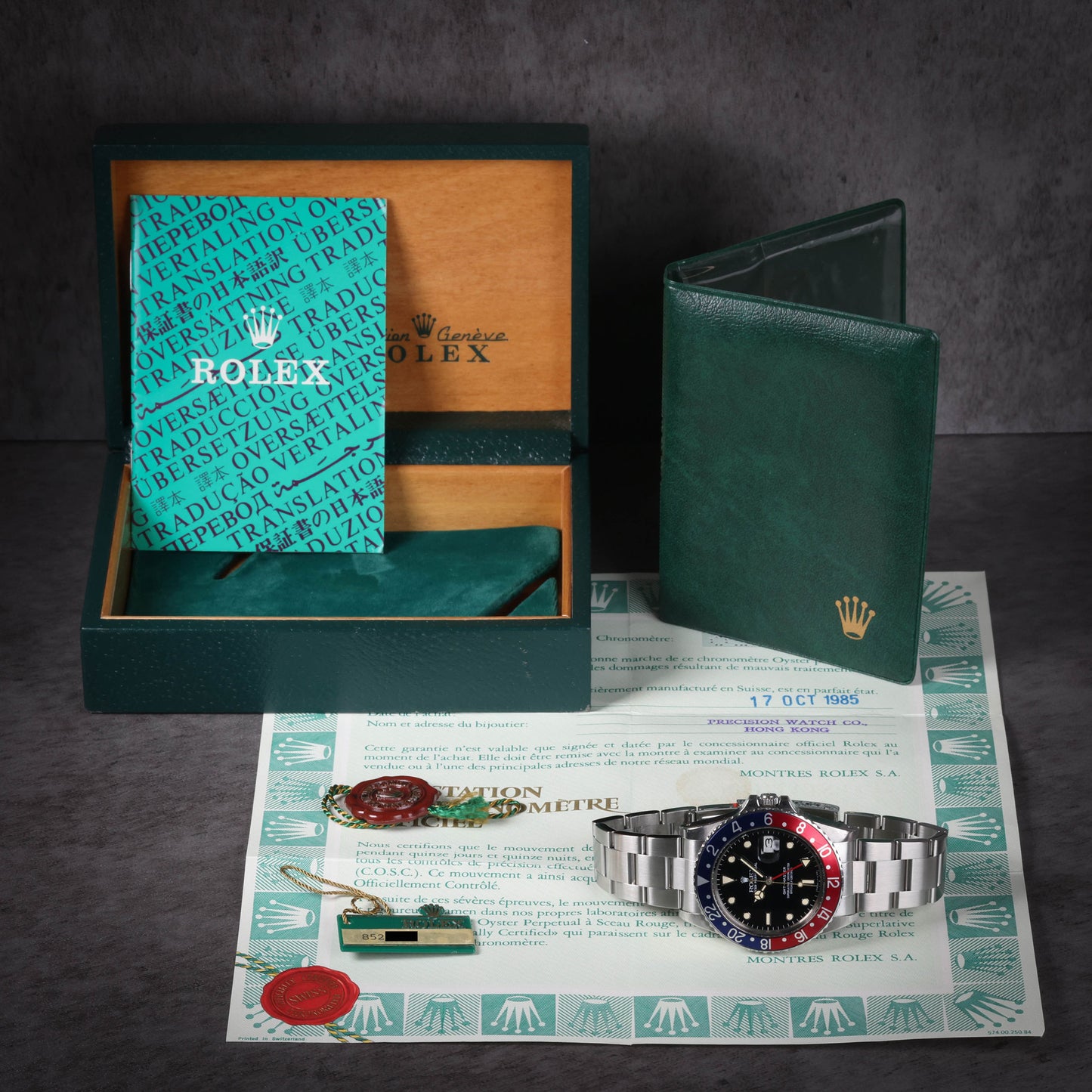
Rolex GMT Master 'Pepsi' Spider Dial 40mm 16750 1984 Box w Papers
Rolex GMT Master 'Pepsi' Spider Dial 40mm 16750 1984 Box w Papers
Couldn't load pickup availability
Rolex GMT Master 'Pepsi' Spider Dial 40mm 16750 1984 Box & Papers
This Rolex GMT-Master 16750 (1984) is presented in excellent overall vintage condition, retaining strong originality across its key components.
The case remains in great unpolished condition, with well-defined lugs, sharp edges and only light, honest hairlines visible from wear. The original case proportions are fully intact, preserving the presence and geometry expected of this reference.
The bracelet is a NOS Rolex service replacement, presenting in excellent condition with no stretch and crisp links throughout. It complements the watch well while offering a tight and secure feel on the wrist.
The tritium “spider” dial is in excellent condition, displaying the characteristic fine lacquer cracking that defines this variation. The surface remains stable and highly legible, with all printing crisp and intact. Tritium hour plots are fully present and have aged evenly.
The hands show light oxidation, with patina that matches the dial well, maintaining a cohesive and period-correct appearance.
Overall, a strong and honest example of the GMT-Master 16750 with a well-preserved spider dial.
It has passed a 5-bar water-proof test and has been demagnetised.
Share
Why we love this watch
Why we love this watch
Rolex GMT-Master 16750: The Definitive Collector's Guide
The Rolex GMT-Master 16750 occupies a singular place in the vintage watch market. Produced from 1981 to 1988, it is a transitional reference that bridges the classic GMT-Masters of the 1970s and the more technically complex GMT-Master II that followed. For collectors who want genuine vintage character combined with practical, daily wearability, the 16750 delivers on every count.
Whether you are discovering the Rolex GMT-Master 16750 for the first time or refining an existing collection, this guide covers the full picture: movement specifications, dial variations, bezel patina, the spider dial phenomenon, and current collector demand.
The Origins of the GMT-Master: From Pan Am to the 16750
The Rolex GMT-Master was first developed in the early 1950s in collaboration with Pan American World Airways. As transatlantic and transpacific commercial routes expanded, flight crews required a reliable method of tracking two time zones simultaneously. Rolex answered with the GMT-Master: a 40mm stainless steel sports watch fitted with a fourth hand and a rotating 24-hour graduated bezel, allowing wearers to read a second time zone at a glance.
The reference lineage progressed through the 6542, 1675, and 16750 before culminating in the GMT-Master II (reference 16760 and subsequent models). Each generation retained the functional DNA while incorporating incremental improvements. The 16750, introduced in 1981, was the last single-piece GMT-Master to feature a non-independently adjustable hour hand, making it the final expression of the original design concept.
Calibre 3075: The Movement That Defined the 16750
The most significant technical advancement in the Rolex GMT-Master 16750 was the introduction of the Calibre 3075 movement. This replaced the earlier Calibre 1575 used in the reference 1675 and brought two important improvements.
Quickset Date Function
The Calibre 3075 introduced a quickset date mechanism, allowing the date to be advanced directly via the crown without cycling the hands through 24 hours. This was a long-overdue practical upgrade that transformed the 16750 into a genuinely convenient daily wearer.
Increased Beat Rate
The movement operates at 28,800 vibrations per hour (8 beats per second), up from the 19,800 vph of its predecessor. The higher beat rate produces a smoother sweep of the seconds hand and improves positional accuracy, bringing the movement in line with the performance standards Rolex maintained across its professional range during the 1980s.
Dial Variations: Matte, Gloss, and the Spider Dial Phenomenon
The Rolex GMT-Master 16750 was produced across two distinct dial generations, and understanding the difference is essential for any serious collector.
Matte Dials with Tritium Lume
Early 16750 examples featured matte black dials with painted indices and tritium lume plots. The subdued texture and warm patina that develops on tritium lume over time gives these dials a distinctly vintage character that collectors prize highly. The matte surface absorbs light rather than reflecting it, producing a depth that many feel is unmatched by later glossy variants.
Glossy Dials with White Gold Surrounds
Later production 16750 examples transitioned to glossy black dials featuring white gold index surrounds. The polished surface and refined index treatment give these dials a crisper, more contemporary appearance. Both dial types have passionate advocates within the collector community, and neither should be considered lesser.
The Spider Dial: A Sought-After Ageing Characteristic
The spider dial is one of the most discussed ageing characteristics associated with the Rolex GMT-Master 16750. It occurs on glossy black tritium dials produced during the early to mid-1980s and results from the natural deterioration of the clear lacquer applied over the dial surface.
Over time, prolonged exposure to UV light, humidity, and temperature fluctuations causes the lacquer layer to develop fine hairline cracks across its surface. These cracks spread in an interconnected network that closely resembles a spider's web, hence the name. Critically, the cracking is confined to the top lacquer layer and does not typically affect the underlying printing or the legibility of the dial. Each spider dial is unique: the density, distribution, and visual character of the cracking varies from watch to watch.
Rather than representing damage, the spider dial is now recognised as a period-specific ageing characteristic that reflects the materials and manufacturing techniques of the era. For many collectors, a well-developed spider dial significantly enhances the desirability of a 16750.
Case Design and the Aluminium Bezel Insert
The 16750 case measures 40mm in stainless steel and retains the classic GMT-Master silhouette: broad crown guards, a relatively slim profile, and the iconic Mercedes-style hands. The rotating 24-hour graduated bezel remains the centrepiece of the design, both functionally and aesthetically.
All 16750 examples were fitted with aluminium bezel inserts, available in the classic Pepsi (red and blue) and root beer (black and brown/gold) colour combinations, as well as all-black variants. Unlike the hard ceramic bezels fitted to modern GMT-Master II references, the aluminium inserts on the 16750 are susceptible to UV fading and surface wear over time.
This ageing quality is considered a significant part of the watch's appeal. A Pepsi bezel that has faded to softer, uneven shades of blue and pink, or a root beer bezel that has developed a rich, complex patina, tells the story of decades of genuine use. Original, unpolished bezel inserts in good condition are increasingly scarce and command collector premiums.
Production Period and the GMT-Master II Transition
The Rolex GMT-Master 16750 was produced from 1981 until approximately 1988, when it was superseded by the GMT-Master II reference 16760. The GMT-Master II introduced an independently adjustable 12-hour hand, allowing the local hour to be set separately from both the GMT hand and the running movement. This made tracking a third time zone considerably easier for frequent travellers.
The 16750 therefore occupies a defined historical position: the last reference to carry the original GMT-Master architecture before the complication was expanded. This contributes directly to its collector standing. It is modern enough to service and wear daily, yet old enough to possess genuine vintage character and a clearly bounded production history.
Rolex GMT-Master 16750 Collector Demand and Market Value
Collector demand for the Rolex GMT-Master 16750 has grown consistently as the broader vintage Rolex market has matured. The reference benefits from strong name recognition, a well-documented production history, and a compelling combination of practical functionality and period-specific aesthetic appeal.
Among the most sought-after examples are matte dial variants in original, unpolished condition with matching serial numbers and original bracelet components. Spider dial examples with strongly developed cracking patterns attract significant collector interest, as do examples retaining their original, unswapped bezel inserts with natural fading.
Condition and originality are the primary value drivers. Examples that have been repolished, had their dials refinished, or fitted with replacement bezel inserts are valued considerably lower than honest, unrestored examples. Buyers in this segment are increasingly sophisticated and the market rewards documentation: original box, papers, and service history all contribute positively to value.
Why the Rolex GMT-Master 16750 Remains a Smart Acquisition
The Rolex GMT-Master 16750 is one of the few vintage sports Rolex references that combines genuine historical significance with practical everyday wearability. The Calibre 3075 is robust, well-supported by Rolex service centres, and accurate enough for daily use. The 40mm case size translates well to modern wrists. The water resistance, certified to 100 metres on the original specification, remains serviceable with regular maintenance.
For collectors drawn to the GMT-Master lineage, the 16750 sits at an interesting intersection. It lacks the extreme rarity premiums attached to earlier references such as the 6542 or 1675, yet it possesses more genuine vintage character than the GMT-Master II models that followed. It is, in short, a watch that rewards both the wearer and the collector.
Frequently Asked Questions: Rolex GMT-Master 16750
What years was the Rolex GMT-Master 16750 produced?
The reference 16750 was produced from 1981 until approximately 1988, when it was replaced by the GMT-Master II reference 16760.
What movement does the Rolex GMT-Master 16750 use?
The 16750 is powered by the Calibre 3075, a self-winding movement with a quickset date function and a beat rate of 28,800 vibrations per hour.
What is a Rolex GMT-Master 16750 spider dial?
A spider dial refers to a glossy black tritium dial on which the top lacquer layer has developed a network of fine hairline cracks over time, resembling a spider's web. This occurs naturally through exposure to UV light, humidity, and temperature changes and is considered a desirable ageing characteristic by collectors.
What bezel colours were available on the 16750?
The 16750 was offered with aluminium bezel inserts in Pepsi (red and blue), root beer (black and brown/gold), and all-black configurations.
How does the 16750 differ from the GMT-Master II?
The 16750 uses the original GMT-Master architecture in which the 24-hour GMT hand cannot be independently adjusted from the local hour hand. The GMT-Master II introduced an independently settable local hour hand, adding greater flexibility for travellers crossing multiple time zones.
Is the Rolex GMT-Master 16750 a good daily watch?
Yes. The 16750 is a robust, well-built sports watch with 100-metre water resistance and a reliable, serviceable movement. With appropriate care and regular servicing, it is entirely suited to daily wear.
Case & Bracelet
Case & Bracelet
- Case in great unpolished condition
- Bracelet NOS service replacement
Dial & Hands
Dial & Hands
- Tritium Spider dial in excellent condition
- Hands lightly oxidised with matching patina
Warranty & Condition
Warranty & Condition
Crown Vintage Watches provides a minimum 6-month mechanical warranty on pre-owned watches, from the date of purchase.
The warranty covers mechanical defects only.
The warranty does not cover damages such as scratches, finish, crystals, glass, straps (leather, fabric or rubber damage due to wear and tear), damage resulting from wear under conditions exceeding the watch manufacturer’s water resistance limitations, and damage due to physical and or accidental abuse.
Please note, water resistance is neither tested nor guaranteed.
Shipping and insurance costs for warranty returns to us must be covered by the customer. Returns must be shipped via traceable courier. Return shipment must be pre-paid and fully insured. Collect shipping will be refused. In case of loss or damages, the customer is liable.
Our Pledge
At Crown Vintage Watches, we stand by the authenticity of every product we sell. For added peace of mind, customers are welcome to have items independently authenticated at their own expense.
Condition
Due to the nature of vintage timepieces, all watches are sold as is. We will accurately describe the current condition and working order of all watches we sell to the best of our ability.
Shipping & Refund
Shipping & Refund