

Crown Vintage
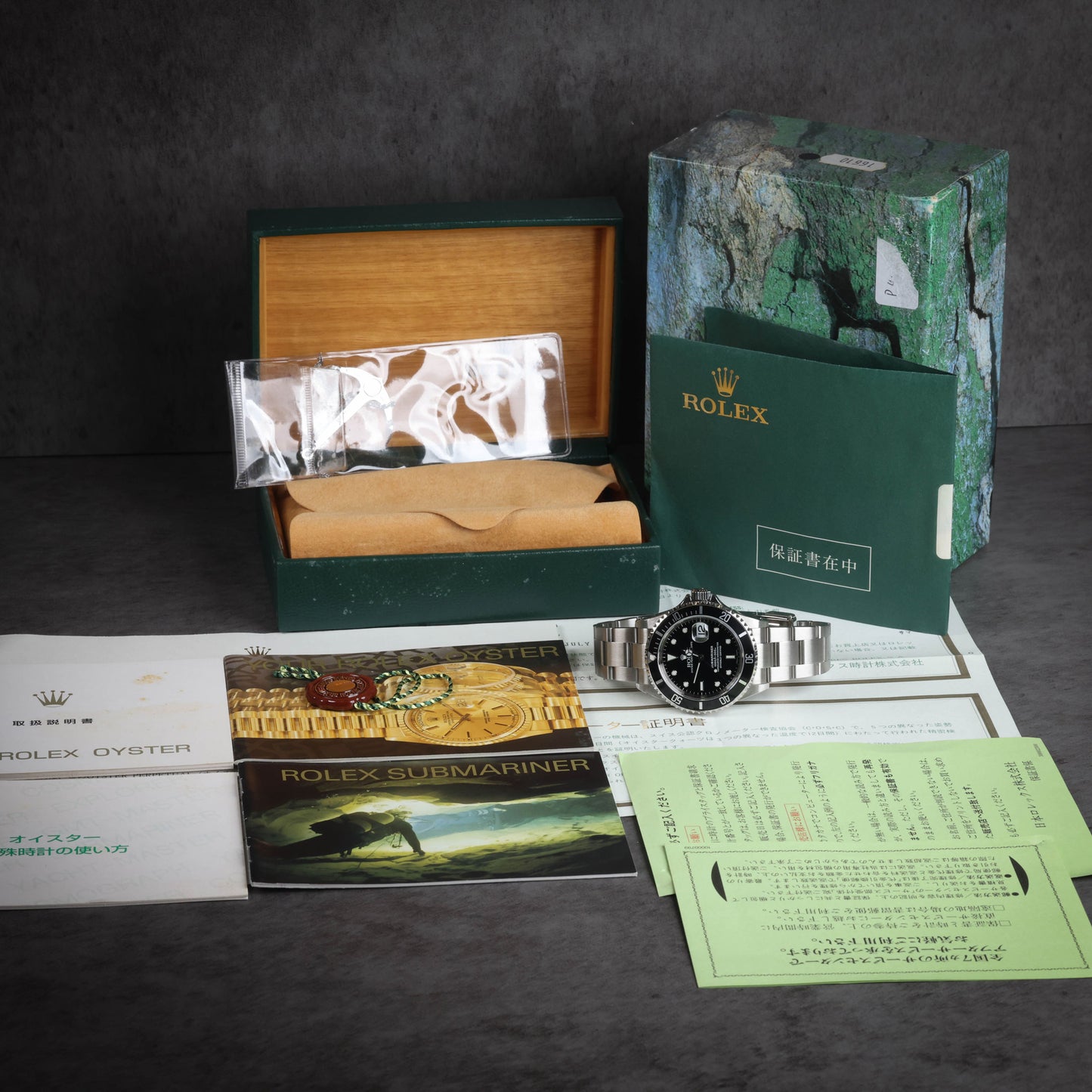
Rolex Submariner 16610 40mm 1999 Full Set
Rolex Submariner 16610 40mm 1999 Full Set
Couldn't load pickup availability
Preloved Rolex Submariner 16610 40mm 1999 Box & Papers
The stainless-steel Oyster case is in excellent condition, displaying sharp geometry with strong chamfered lugs that retain their original shape and definition. The factory brushing on the upper lug surfaces remains clearly visible, with polished flanks exhibiting a consistent mirror finish. The case shows only minor surface marks from light, careful wear with no polishing. The unidirectional bezel is clean, with crisp coin-edge teeth and a well-preserved black aluminium insert showing no significant scratches or fading.
The Oyster bracelet is likewise in very good condition, with little to no stretch evident across the solid links. The brushing on the outer surfaces remains even and original, and the polished sides retain their reflective quality. The Oysterlock clasp operates smoothly, securing firmly with the Rolex coronet clearly defined.
The gloss black dial is flawless, presenting a deep, uniform finish free from marks or discolouration. The white-gold hour markers are pristine, with clean luminous plots that glow evenly. The Mercedes hands are equally immaculate, showing no signs of oxidation or age-related wear, and the luminous material matches the dial perfectly. The sapphire crystal is clear and unmarked, ensuring unobstructed visibility of the dial.
Tested across four positions on the Witschi WAIO, the Calibre 3135 returns a rate of +3.0 seconds per day, a result that remains comfortably within the Official Swiss Chronometer Testing Institute's tolerance of minus four to plus six seconds per day and reflects well on a movement with a quarter-century of service behind it. Beat error measures at 0.2 milliseconds, indicating the pallet fork is distributing impulse with near-symmetrical evenness across each oscillation. Amplitude of 252 degrees is a composed result for a 3135 of this age, demonstrating that the mainspring and barrel are sustaining drive with sufficient authority. The watch has also passed a 5 BAR pressure test, confirming that the Triplock crown and case seals remain intact and that the Oyster case continues to perform its primary function.
Overall, this Submariner 16610 presents as an exceptionally well-preserved example, retaining strong case definition, a tight bracelet, and a dial and hands set in immaculate condition — a standout example of the reference in original form.
Share
Why we love this watch
Why we love this watch
An Instrument at the Crossroads: Rolex Submariner Reference 16610, 1999
A Brand Built Around a Single Argument
Rolex was founded in London in 1905 by Hans Wilsdorf and his brother-in-law Alfred Davis. The company's founding proposition was straightforward: a wristwatch could be made to function as a precision instrument, reliable enough to be certified to chronometric standards and durable enough to operate in conditions that would destroy lesser timepieces. That argument was proved incrementally across the following decades. The Oyster case, patented in 1926, demonstrated that a hermetically sealed wristwatch was achievable. The Perpetual rotor, developed in the late 1920s and refined through the 1930s, showed that self-winding could be made practical. Relocation to Geneva in 1919 brought Rolex into the centre of Swiss watchmaking, and over the decades that followed the brand built the professional tool watch range that came to define it.
The Submariner, Rolex's dive watch, debuted at the Basel Fair in 1954, though Rolex marks 1953 as its birth year, when the first production models were completed. Before its public launch, Rolex demonstrated the concept in characteristically direct fashion: in September 1953, a prototype was fixed to the outer hull of Swiss inventor Auguste Piccard's bathyscaphe and descended with it to 3,131.8 metres in the Tyrrhenian Sea. The watch surfaced intact and in working order. The reference 6204, the original production Submariner, offered water resistance to 100 metres, a rotating bezel for measuring elapsed dive time, and luminous markers designed for legibility in conditions of poor underwater visibility. It was an instrument designed around a specific physical environment, and it was immediately recognisable as such. Over the seven decades that followed, Rolex updated the Submariner with steady discipline, improving materials and movements and manufacturing tolerances without disturbing the fundamental architecture of the design. The proposition remained the same: a watch worthy of what the ocean asks of it.
The Submariner Date: From Tool to Icon
The addition of a date complication to the Submariner with the reference 1680 in 1969 marked the moment when the model's identity began to expand. Where the non-date Submariner was a pure dive instrument, the 1680 was something more versatile: a watch that could be worn daily, read at the office, and taken into the water at the weekend. The date at three o'clock beneath a Cyclops magnifying lens gave the Submariner a utility that extended far beyond its original brief. It became, in time, the version of the watch that most people meant when they said "Submariner."
The reference 1680 was followed by the reference 16800 in the late 1970s, which introduced sapphire crystal, a ratcheted unidirectional bezel, and the Calibre 3035 with its quickset date function. In 1988, after the transitional reference 168000, which existed primarily to introduce 904L stainless steel to the Submariner line, the reference 16610 arrived. It brought with it the Calibre 3135, a movement that would go on to become the most widely used calibre in Rolex's modern history, and it carried the 904L Oystersteel construction that the 168000 had introduced. The 16610 would remain in production for twenty-two years, and within that run the 1999 example represents one of its most characterful moments.
Reference 16610: The Movement and the Material
The reference 16610 introduced the Calibre 3135 to the Submariner, and this movement became the defining calibre of Rolex's professional range across the following three decades. It operates at 28,800 beats per hour, carries 31 jewels, and delivers a 48-hour power reserve. It is certified by the Official Swiss Chronometer Testing Institute to within minus four to plus six seconds per day. Mechanically, it is distinguished by the full balance bridge introduced with the 3135 family, which replaced the simpler balance cock used in earlier Rolex calibres and significantly improved the stability and shock resistance of the balance assembly. The Glucydur balance wheel, a beryllium-copper alloy chosen for its dimensional stability under temperature variation, works with Microstella regulation screws to allow precise rate adjustment. Quickset date and hacking seconds complete the functional specification.
The case housing the movement is machined from 904L stainless steel, an alloy substantially more resistant to corrosion and surface degradation than the 316L used across most of the watchmaking industry. Rolex invested in the tooling required to work with this harder material, and the result is a case that polishes more cleanly, holds a brushed finish longer, and resists the oxidation that saltwater environments impose on lesser alloys. The 40mm Oyster case, with its specific geometry of brushed lug tops and polished case sides, had been resolved in its essential form by the time the 16610 was introduced and was not revised during its production run. This dimensional consistency means a 16610 from 1988 and one from 1999 wear identically on the wrist. What differentiates them is in the details.
1999: The End of the Radioactive Era
A 1999 reference 16610 sits at one of the most precise moments in the watch's long production history. Between 1988 and approximately 1998, Rolex used tritium as the luminescent compound for the dial markers and hands. Tritium, a radioactive isotope of hydrogen, offered reliable low-light legibility through self-illumination: it did not require an external light source to charge, and it glowed consistently over time. The regulatory limits on tritium in Swiss-produced watches were identified by the "T SWISS T" or "SWISS-T<25" text printed at the base of the dial, indicating that the tritium content was within permissible limits. As safety standards around radioactive materials tightened during the late 1990s, Rolex moved to LumiNova, a non-radioactive phosphorescent compound that stores ambient light and releases it in darkness.
The 1999 production year falls precisely at this transition. Examples produced at this point carry the "SWISS" designation at the base of the dial without the subsequent "MADE" addition, marking them as LumiNova-generation watches. This "Swiss only" dial text occupied a narrow production window, distinguishing these examples from both the tritium watches that preceded them and the SuperLumiNova "SWISS MADE" examples that followed from 2000. The distinction is not merely typographical. The 1999 example represents the exact moment when a material that had defined the Submariner's luminous identity for decades was retired, and a new generation of photoluminescent compound took its place. The watch's documentation, its box and papers, establishes this moment precisely.
A Bracelet of an Earlier Character
The bracelet fitted to a 1999 reference 16610 is the 93150 Oyster bracelet with hollow end-links, a construction that distinguishes early-production 16610s clearly from the solid end-link examples that replaced it from around 2000. The hollow end-link, referenced as the 93150, connects the bracelet to the case in a way that gives the watch a lighter, slightly more articulated feel on the wrist. The solid end-link 93250 that followed offered greater sturdiness at the cost of a few additional grams and a more monolithic bracelet-to-case connection. Neither is incorrect, but they give the watch a different character on the wrist, and the 93150 belongs to a specific chapter of the 16610's production. The flip-lock clasp, with its simple fold-over security mechanism, was standard on these earlier examples.
Drilled Lugs and a Clean Rehaut
Two further details define the 1999 reference 16610 within the broader run. The lugs carry drilled holes at their outer ends, a construction detail that made bracelet and strap changes straightforward and that gave the case its earlier, more tool-oriented appearance. These drilled lug holes were removed from the 16610 in 2003, giving later examples a cleaner and more monolithic lug profile. Their presence on the 1999 watch places it firmly in the first half of the reference's production life, among the examples that still carried the practical engineering details of the Submariner's earlier generations.
The inner circumference of the case, the rehaut, is finished in plain brushed steel with no text. From approximately 2007 onwards, Rolex began engraving the rehaut with the Rolex name repeated around its circumference as an anti-counterfeiting measure, and late examples also carry the watch's serial number engraved here. The 1999 example carries neither. The rehaut is simply a clean, functional surface, uninterrupted by text. This gives the dial area a visual clarity that distinguishes it from later-production examples.
The Dial: Resolved and Restrained
The glossy black dial of the reference 16610 represents the most fully developed form of the Submariner's visual language as it existed at the turn of the millennium. Applied white gold hour markers with luminous fill are paired with Mercedes-style hands finished in the same white gold and charged with the same luminous compound. The date window at three o'clock is magnified by the Cyclops lens integrated into the sapphire crystal above it. The fixed brushed-steel caseback carries the Submariner and Rolex text. The unidirectional aluminium bezel insert, graduated across sixty minutes, sits within the characteristic stepped bezel frame of the 16610's thinner case profile, a geometry that distinguishes the reference clearly from the heavier Super Case that arrived with the 116610 in 2010.
Nothing in this dial composition is decorative for its own sake. The applied markers are sized for underwater legibility at the distances professional diving requires. The Mercedes hands are proportioned to fill the dial without crowding the minute track. The bezel graduation serves a timing function that predates the Submariner's evolution into a lifestyle object by several decades. The 1999 example presents all of this in the condition it left Geneva: without the later-production modifications that updated its specification but also, quietly, changed its character. The thinner lug profile of the pre-Super Case era, the lighter bracelet of the 93150, and the plain rehaut all belong to a version of this watch that Rolex itself no longer produces in any form.
Box and Papers at a Pivotal Year
A 1999 reference 16610 offered with its original box and papers carries a particular significance at a watch that sits at the intersection of several production transitions. The papers establish the year precisely, resolving any ambiguity about whether the watch is a late tritium example or an early LumiNova one, and whether it carries the 93150 or the 93250 bracelet. At a reference that changed as much as the 16610 did across its twenty-two years of production, that precision matters. The box preserves the object's original presentation and completes the record of the watch's documented life.
Final Thoughts
The Rolex Submariner reference 16610 from 1999 is a watch that arrived at a precise and unrepeatable moment. The tritium that had illuminated Submariner dials since 1954 was being retired. The solid end-link bracelet and the non-drilled lugs of the later production years were still a year or two away. The clean, unengraved rehaut had not yet been updated with anti-counterfeiting text. What the 1999 example offers is the 16610 in its original engineering form, at the exact moment when Rolex was updating its luminous material to meet the standards of a new decade, carrying that change on a watch that was otherwise unchanged from the one that had entered production eleven years earlier.
Calibre 3135 continued to operate beneath the screw-down caseback, as it had since the reference's introduction. The 904L case continued to resist the conditions the Submariner was built to handle. The dial continued to read clearly in darkness, by a different chemical mechanism than the one it had used for four and a half decades. That continuity of function across a change of material is itself a statement about what the Submariner, in any form, is for. The original box and papers accompanying this example anchor that statement to a specific moment in time, making the record of the watch as complete as the watch itself.
Case & Bracelet
Case & Bracelet
- Case in very good condition, strong chamfered lugs with factory brushing still visible.
- Bracelet in very good condition, little to no stretch.
Dial & Hands
Dial & Hands
- Dial and hands are flawless
Warranty & Condition
Warranty & Condition
Crown Vintage Watches provides a minimum 6-month mechanical warranty on pre-owned watches, from the date of purchase.
The warranty covers mechanical defects only.
The warranty does not cover damages such as scratches, finish, crystals, glass, straps (leather, fabric or rubber damage due to wear and tear), damage resulting from wear under conditions exceeding the watch manufacturer’s water resistance limitations, and damage due to physical and or accidental abuse.
Please note, water resistance is neither tested nor guaranteed.
Shipping and insurance costs for warranty returns to us must be covered by the customer. Returns must be shipped via traceable courier. Return shipment must be pre-paid and fully insured. Collect shipping will be refused. In case of loss or damages, the customer is liable.
Our Pledge
At Crown Vintage Watches, we stand by the authenticity of every product we sell. For added peace of mind, customers are welcome to have items independently authenticated at their own expense.
Condition
Due to the nature of vintage timepieces, all watches are sold as is. We will accurately describe the current condition and working order of all watches we sell to the best of our ability.
Shipping & Refund
Shipping & Refund