

Crown Vintage
Rolex Submariner 16800 'Pumpkin Dial' 40mm 1985
Rolex Submariner 16800 'Pumpkin Dial' 40mm 1985
Couldn't load pickup availability
Rolex Submariner 16800 'Pumpkin Dial' 40mm 1985
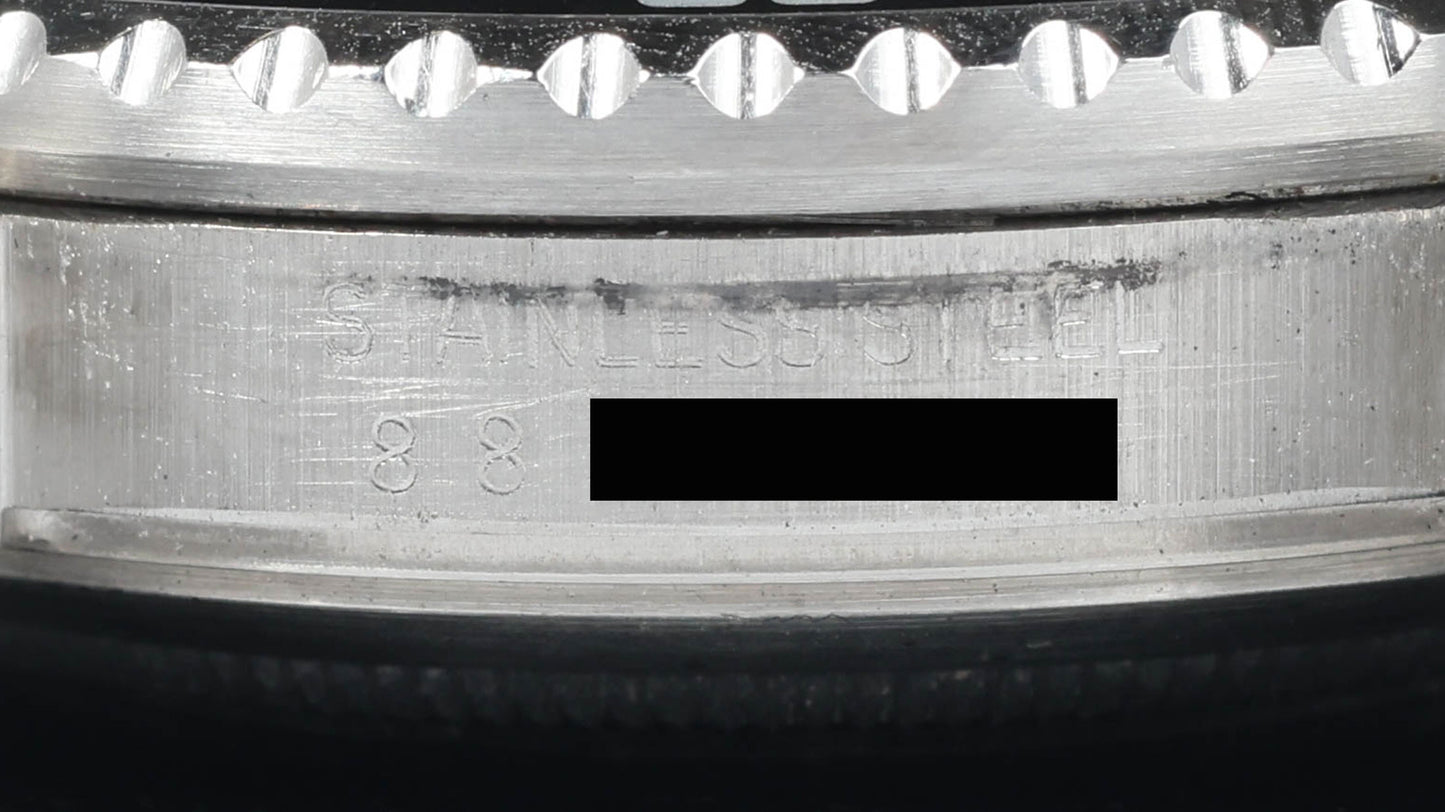
This 1984 Rolex Submariner 16800 exhibits a beautifully consistent pumpkin patina on its dial and hands, which remain in excellent condition. The case is exceptionally sharp & unpolished, reflecting very light signs of wear for a watch from this period, while the stainless steel bracelet shows light stretch. The combination of a patinated dial with a well-preserved exterior creates a blend of vintage appeal and refined presentation, making this Submariner a striking choice for enthusiasts and collectors.
Tested across four positions on the Witschi WAIO, the Calibre 3035 returns a rate of +1.1 seconds per day, a result that sits well within the Official Swiss Chronometer Testing Institute tolerance of minus four to plus six seconds per day and speaks to the movement's underlying precision despite its four decades in service. Beat error measures at 0.1 milliseconds, a figure that is effectively indistinguishable from perfect symmetry and indicates the pallet fork is operating with full mechanical evenness. Amplitude of 241.5 degrees confirms a mainspring and barrel in sound condition, the movement swinging with the authority expected of a well-maintained 3035. The watch has also passed a 5 BAR pressure test, confirming case integrity consistent with its rated 300-metre water resistance.
Share
Why we love this watch
Why we love this watch
The Colour of Time: Rolex Submariner Reference 16800 Pumpkin Dial
A Brand Forged on Precision
Rolex was founded in London in 1905 by Hans Wilsdorf and his brother-in-law Alfred Davis under the name Wilsdorf & Davis. From the outset, Wilsdorf was consumed by a single idea: the wristwatch, then dismissed by much of the establishment as impractical, could be made as accurate and dependable as any pocket watch. He pursued that idea with a methodical intensity that would come to define everything Rolex produced. In 1908, Wilsdorf registered the Rolex name. In 1919, the company relocated to Geneva. In 1926, Rolex patented the Oyster case, a hermetically sealed construction with a screw-down caseback and crown that brought genuine waterproofing to the wristwatch for the first time. These were not incremental refinements. They were fundamental shifts in what a watch could be asked to do.
The decades that followed built on that foundation systematically. Each new reference added capability: greater accuracy, deeper water resistance, longer power reserve, more legible dials. Rolex never pursued complication for its own sake. The philosophy was to make an instrument worthy of the environments people actually worked in, whether that was the open ocean, a mountain summit, or the cockpit of an aircraft. This thinking eventually produced what became one of the most recognised pieces of industrial design of the twentieth century.
The Submariner: A Tool Watch with Staying Power
The Rolex Submariner came to public attention at the Basel Fair in 1954, though Rolex considers its birth year to be 1953, when the first production models were completed. Its arrival was preceded by one of the more audacious demonstrations in watchmaking history. In September 1953, Swiss inventor Auguste Piccard descended 3,131.8 metres into the ocean aboard his bathyscaphe. Affixed to the vessel's hull was a Rolex watch. When the submersible surfaced, the watch was in perfect working order.
The first Submariner, reference 6204, offered water resistance to 100 metres, a rotating bezel for tracking elapsed dive time, and luminous markers built for legibility in low-light conditions. It was a tool designed around a specific set of demands. Yet from very early in its production life, the Submariner began to transcend those demands. It accompanied early Jacques Cousteau expeditions. It was worn on screen by Sean Connery as James Bond, beginning an association with the character that would span decades and place the watch in the cultural imagination far beyond the diving community. The design, so clearly resolved from the beginning, barely needed to change to remain relevant.
From the Depths to the Wrist
As the Submariner matured through the late 1950s and into the 1960s, Rolex refined it without disrupting it. Water resistance improved progressively. Movements were upgraded. Crown guards were introduced to protect the winding crown. The case grew to 40mm. What remained consistent was the fundamental grammar of the design: the brushed and polished Oyster case, the broad Mercedes hands, the matte black dial, the aluminium bezel insert graduated for sixty minutes. Each iteration was recognisably a Submariner, yet each moved the instrument forward.
By 1969, Rolex introduced the reference 1680: the first Submariner to carry a date complication. Displayed at three o'clock beneath a Cyclops lens, the date transformed the Submariner from a pure diving instrument into something that could be worn throughout the week. The reference 1680 remained in production until the late 1970s, and it was this watch that the reference 16800 was designed to succeed.
Reference 16800: The Transitional Submariner
The reference 16800 was launched circa 1979 and went on to define the decade in which it was produced. It is described as a transitional reference, a designation that understates the significance of the changes it introduced. The 16800 did not simply refine the formula established by the 1680; it restructured it. The decisions made at its introduction set the template for every Submariner produced in the decades that followed.
Calibre 3035: A Movement Ahead of Its Time
At the heart of the reference 16800 is the Calibre 3035, introduced by Rolex in 1977 and fitted to the Submariner from the reference's launch. It was the first men's high-beat calibre Rolex had ever produced. By increasing the balance rate from 19,800 to 28,800 beats per hour, the movement beat eight times per second, producing the smooth sweep of the seconds hand that became one of Rolex's most recognisable traits. The Calibre 3035 carries 27 jewels, a Breguet overcoil hairspring, and Rolex's Microstella regulating system, four timing screws acting as weights on the balance rim that allow for fine rate adjustment. Power reserve stands at 48 hours.
Alongside its higher frequency, the 3035 introduced the quickset date function: the first automatic calibre from Rolex to allow the wearer to advance the date independently of the hands, simply by pulling the crown to its intermediate position. Previously, correcting the date required advancing the hands a full 24 hours. The convenience this represented for everyday wear was substantial, and it positioned the Submariner Date as a genuinely practical instrument rather than a specialist tool worn only during certain activities. The Calibre 3035 was certified by the Official Swiss Chronometer Testing Institute as a Superlative Chronometer, meeting Rolex's own tolerances of minus four to plus six seconds per day, a standard that has underpinned every subsequent Submariner generation.
Crystal and Depth: The Sapphire Upgrade
The reference 16800 was the first Submariner to be fitted with a sapphire crystal. All previous iterations of the model had used acrylic, a material that was easily scratched, though it could be polished. Sapphire, vastly harder on the Mohs scale, brought near-total scratch resistance at the cost of that repairability. Alongside the crystal change, Rolex increased the water resistance rating of the Submariner Date from 200 to 300 metres, matching the 1,000-foot depth rating that remains the standard on modern Submariner references. The sapphire crystal required a slightly thicker case profile, giving 16800 examples a subtly more substantial presence on the wrist that distinguishes them from the earlier acrylic-crystal references.
A Bezel Redesigned for Safety
In 1981, Rolex introduced a further change to the reference 16800 mid-production: a ratcheted, unidirectional rotating bezel. Every Submariner produced before this point, including the earliest examples of the 16800 itself, carried a bezel that could be rotated in either direction. For a professional diving tool, this presented a genuine hazard. A bezel accidentally knocked anti-clockwise during a dive could overstate the remaining time underwater, with potentially serious consequences. By locking rotation to a single counterclockwise direction, Rolex ensured that any accidental movement of the bezel could only reduce the apparent remaining dive time, never extend it. A 1984 example of the reference 16800 carries this ratcheted bezel as standard, along with the sixty-minute graduated black aluminium insert. The insert on surviving 16800s often displays degrees of fade, the aluminium losing its original depth of colour in a manner that speaks directly to the life the watch has led.
The Pumpkin Dial: Chemistry Made Beautiful
The early reference 16800 left the factory with a matte black dial. Unlike the glossy lacquered dials that appeared on later-production examples and became standard on the successor references 168000 and 16610, the matte dial was built around a different visual logic. Its surface absorbed light rather than reflecting it, lending the dial a depth and seriousness that aligned with the watch's instrumental origins. The hour markers were painted directly onto the dial surface rather than applied as separate units, and they were filled with tritium luminous compound.
Tritium, a radioactive isotope of hydrogen, was the luminous material of choice across the watch industry through much of the twentieth century. It offered reliable low-light legibility without requiring an external light source to charge it. Over time, tritium degrades. The compound that was originally a pale cream or white begins to shift through yellow, through amber, and in certain conditions towards a vivid orange. On matte-dial 16800 examples that have aged naturally, this progression can produce what enthusiasts have come to call the pumpkin dial: a state in which the lume plots on the dial, the hands, and the bezel pearl have reached a warm, deep orange that cannot be replicated in production. It is the watch's autobiography written in colour.
The 1984 reference 16800 occupies a particularly interesting position within the run. By this point in production, the unidirectional bezel had been in place for three years and the Calibre 3035 was well established. The matte dial was still the standard on examples produced at this time, though Rolex was beginning to transition towards glossy lacquer as the decade progressed. A 1984 example with a fully developed pumpkin patina represents the matte-dial era of the reference at its most characterful: a watch that carries the visual warmth of its age while remaining technically current by the standards of its era.
A Dial That Only Time Can Produce
The pumpkin dial is not something that can be manufactured. It is the product of chemistry, time, and the specific conditions in which the watch was stored and worn. Two 16800s from the same production run, leaving the factory as identical instruments, can age entirely differently depending on the humidity, temperature, and light exposure they encountered across their lives. Some matte-dial examples retain near-original cream lume decades later. Others reach full pumpkin over a similar period. This variability is precisely what gives the condition meaning. A dial in this state arrived here through decades of existence, and that existence cannot be faked or reversed.
The consistency of the patina across dial, hands, and bezel pearl is the detail that matters most. When all three elements have aged in step, the watch reads as a coherent whole, each component having lived the same life. A dial that has turned pumpkin while the hands remain bright suggests a replacement at some point. When the match is complete, it is among the most aesthetically resolved conditions a vintage Submariner can present.
The Reference in the Wider Submariner Story
The reference 16800 was produced from circa 1979 until the late 1980s, when it was succeeded first by the brief reference 168000 and then by the reference 16610 with its Calibre 3135. Its position in the Submariner lineage is defined by what it introduced and what it retained. The sapphire crystal, the quickset Calibre 3035, the 300-metre depth rating, and the unidirectional bezel all entered the Submariner vocabulary with the 16800 and have not left it since. At the same time, the matte-dial examples from its earlier production years carried the tactile and visual weight of the vintage references that preceded them. It was genuinely two watches in one reference: an updated professional instrument wearing the face of the earlier, more purely instrumental era.
The 1984 example distils this character. Old enough to carry the matte dial and the patina it enables, modern enough to carry all the functional architecture of the contemporary Submariner. It belongs to neither era entirely. That ambiguity is part of what makes it so resolved as an object.
Final Thoughts
The Rolex Submariner reference 16800 with a pumpkin dial is the product of several decades of accumulated change. Rolex built the company on the belief that a watch should be worthy of the conditions imposed on it, and the Submariner was the clearest expression of that belief across the second half of the twentieth century. The reference 16800 formalised a set of technical decisions that remain in place on every Submariner produced today, while wearing a dial that the factory could not have anticipated and cannot reproduce.
What the pumpkin dial represents is time made visible: tritium chemistry at work across forty-odd years, producing something that looks nothing like the watch did when it left Geneva in 1984 and yet is entirely itself. The Calibre 3035 continues to operate beneath the caseback, beating at the same 28,800 vibrations per hour it managed on the day it was cased. The matte dial has settled into its orange warmth. The bezel pearl has aged with the rest. It is a watch that has arrived at its present condition through the simple fact of existing, and that is, in the end, what makes it worth understanding.
Case & Bracelet
Case & Bracelet
- Case & bracelet in very good unpolished condition, extremely sharp case, bracelet shows some stretch and wear.
Dial & Hands
Dial & Hands
- Dial & hands pumpkin patina
- Hands lightly oxidised
Warranty & Condition
Warranty & Condition
Crown Vintage Watches provides a minimum 6-month mechanical warranty on pre-owned watches, from the date of purchase.
The warranty covers mechanical defects only.
The warranty does not cover damages such as scratches, finish, crystals, glass, straps (leather, fabric or rubber damage due to wear and tear), damage resulting from wear under conditions exceeding the watch manufacturer’s water resistance limitations, and damage due to physical and or accidental abuse.
Please note, water resistance is neither tested nor guaranteed.
Shipping and insurance costs for warranty returns to us must be covered by the customer. Returns must be shipped via traceable courier. Return shipment must be pre-paid and fully insured. Collect shipping will be refused. In case of loss or damages, the customer is liable.
Our Pledge
At Crown Vintage Watches, we stand by the authenticity of every product we sell. For added peace of mind, customers are welcome to have items independently authenticated at their own expense.
Condition
Due to the nature of vintage timepieces, all watches are sold as is. We will accurately describe the current condition and working order of all watches we sell to the best of our ability.
Shipping & Refund
Shipping & Refund