

Crown Vintage
Seiko 6105-8110 'Willard' 44mm Circa 1970s
Seiko 6105-8110 'Willard' 44mm Circa 1970s
Couldn't load pickup availability
Seiko 6105-8110 'Willard' 44mm Circa 1970s
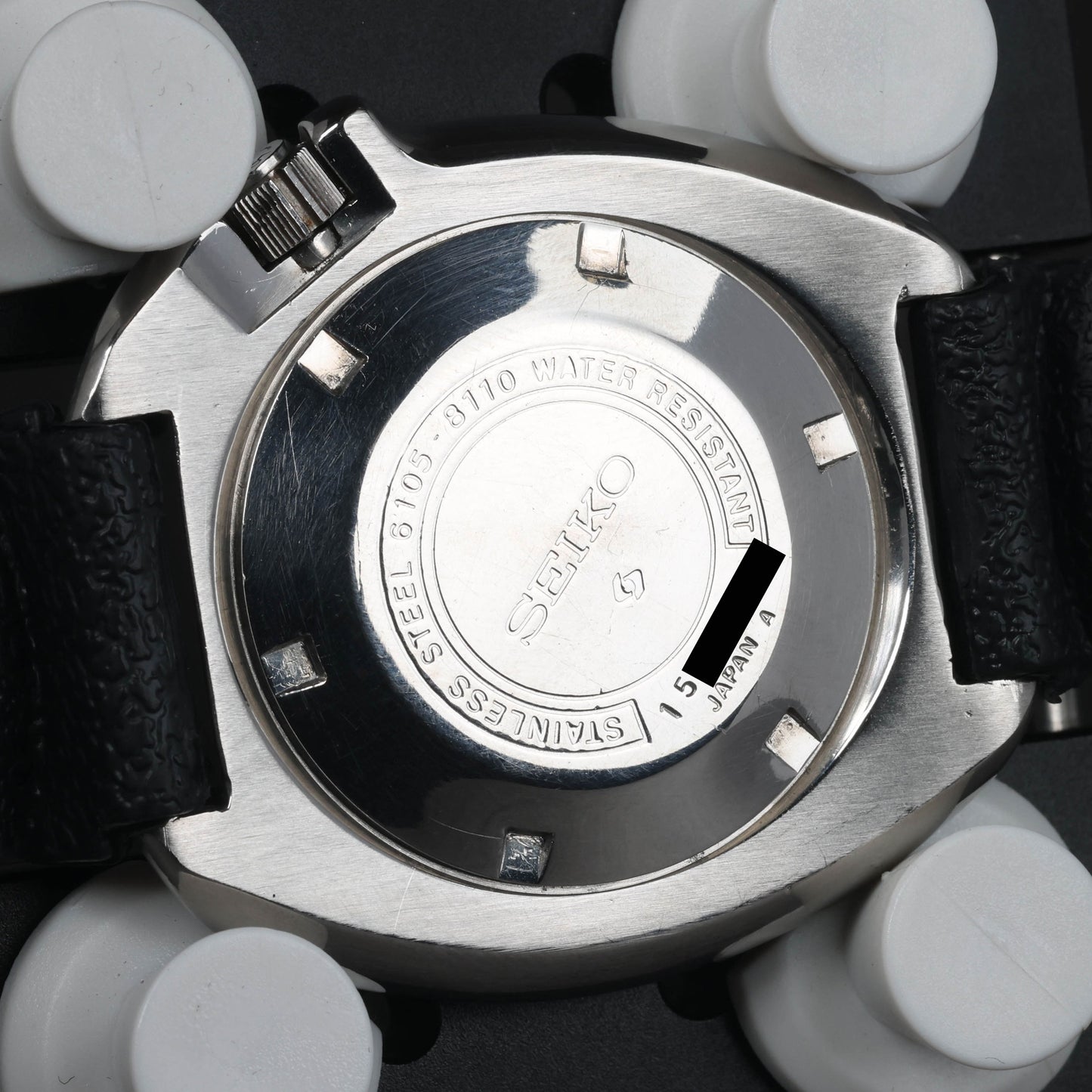
This Seiko 6105-8110 (circa 1970s) is presented in good overall vintage condition, retaining the character expected of this iconic Seiko diver.
The case is in good vintage condition, showing honest wear throughout with light hairlines and signs of use consistent with age. The overall case shape remains intact, with no major dents or structural issues observed.
The strap is in good condition, remaining functional and well-suited to the utilitarian nature of the watch, with visible signs of wear that align with its vintage profile.
The dial and hands are in good condition, with clear legibility and original character preserved. Luminous material remains present, with ageing consistent across both dial and handset.
Overall, a solid and honest example of the 6105-8110 that reflects its history as a purpose-built tool watch.
Share
Why we love this watch
Why we love this watch
Seiko 6105-8110: The Captain Willard Watch and Its Collector Legacy
Few vintage watches carry the weight of history quite like the Seiko 6105-8110. Produced between 1970 and 1977, it is one of the most recognisable and historically significant Japanese dive watches ever made: a tool built for professionals, adopted by soldiers in the jungles of Southeast Asia, worn on screen in one of cinema's most celebrated war films, and today fiercely sought after by collectors on every continent. This is a watch that earned its reputation the hard way, in the field, under conditions that broke lesser instruments. It has never needed marketing to make it interesting.
Seiko's Diver Lineage: Where the 6105-8110 Fits
To understand the 6105-8110 properly, its position within Seiko's diver development needs to be established. Seiko's first purpose-built diving watch was the 6217-8001, widely known today as the 62MAS, introduced in 1965. This was Seiko's opening statement in the professional diver category: a 150-metre-rated automatic with a rotating bezel and all the functional credentials the category required.
The 62MAS was succeeded by the first generation of the 6105 series, references 6105-8000 and 6105-8009 (the latter for the North American market), produced from 1968 to 1970. These watches retained a broadly symmetrical cushion case but moved the crown to the 4 o'clock position, a design decision that would carry forward into the next generation. The 6105A movement in these early examples did not hack, meaning the seconds hand continued running when the crown was pulled out.
In 1970, Seiko introduced the 6105-8110, the reference this article concerns. It replaced the symmetrical case with a genuinely asymmetric design, added integrated crown guards, and upgraded to the Calibre 6105B movement, which introduced hacking. The twin reference 6105-8119 was produced simultaneously for the North American market: the watches are technically identical, distinguished only by the caseback reference number. Production of both ran until 1977, at which point the design DNA was carried forward into the 6309 Turtle series.
Case Design: Asymmetry as Engineering
The most immediately distinctive feature of the Seiko 6105-8110 is its asymmetric cushion-shaped case. At 44mm in diameter with a lug-to-lug measurement of approximately 49mm and a thickness of around 12.5mm, the watch is substantial by the standards of its era, yet it sits with remarkable comfort on the wrist. The short lug geometry and the 4 o'clock crown position keep the case from digging into the hand during activity, and the overall package wears considerably smaller than the raw dimensions suggest.
The asymmetry is not decorative. The bulging crown guard integrated into the right side of the case at 4 o'clock serves a clear protective function, shielding the crown from impact during underwater work, heavy physical activity, or any environment where a protruding crown would be a liability. This was the first Seiko diver to incorporate integrated crown guards of this type, and the design principle carries through to Seiko's professional diver range to this day. The case is finished with brushed surfaces on the top planes and polished sides, a combination that gives it a functional but well-considered appearance.
The caseback is solid stainless steel with a screw-in design, engraved with Seiko's wave logo, the 150-metre water resistance rating, and the serial number and movement reference. The lug width is 19mm. The crystal is flat Hardlex mineral glass, which was a considered choice for durability in field conditions, resisting scratching and impact better than standard mineral glass while remaining replaceable in the field by non-specialist watchmakers.
The Crown-Locking Mechanism: Clever Engineering, Demanding Maintenance
The crown system on the 6105-8110 is one of its most discussed engineering details. Rather than the screw-down crown used on many Swiss dive watches of the period, Seiko developed a turn-and-lock bayonet mechanism: the crown is pushed in and rotated approximately 60 degrees to engage a cam that locks it securely against the case. When correctly engaged, the mechanism provides reliable water resistance without the threading wear associated with screw-down systems. It also allows faster crown operation, which matters when time-sensitive adjustments are needed.
The mechanism has a known weakness, however. Repeated operation, particularly by owners unfamiliar with the correct locking procedure, can wear the cam over time. Many examples in the current market have degraded locking mechanisms, and original replacement crowns are increasingly difficult to source. A functional, correctly operating turn-lock crown is one of the most important originality and condition criteria when evaluating a 6105-8110 for purchase, and examples with intact, properly functioning examples command a premium accordingly.
Collectors classify crown condition carefully: a working original crown with a functioning lock is the benchmark, followed by working original crowns with weakened locks, then replacement crowns. Any example described as having its original crown should be verified, as the demand for correct crowns has made misrepresentation a known risk in this market.
The Bezel: Bi-Directional, Aluminium Insert, Click-Ball Mechanism
The 6105-8110 is fitted with a bi-directional rotating elapsed-time bezel. This distinguishes it from many contemporary Swiss dive watches, which used unidirectional bezels as a safety feature to prevent accidental overestimation of remaining dive time. Seiko's choice of bi-directional rotation reflects the broader professional tool context in which the watch was designed: it was intended for timed operations that could require tracking in either direction, not only for depth-diving safety.
The bezel action is controlled by a click-ball mechanism, providing positive but not overly stiff engagement at each graduation. The insert is aluminium, with a 60-minute scale. As with all aluminium bezel inserts from this period, the material is subject to fading and wear over time. Original inserts in good, unfaded condition are a significant condition indicator; replacement inserts are widely available but reduce the originality value of an example considerably.
The Dial: Proof vs Resist, Date Window, and Lume Plots
The dial of the 6105-8110 is matte black with applied rectangular hour indices filled with tritium luminous compound and a set of hands that prioritises legibility above all else. The baton hour and minute hands are broad and heavily lumed, and the seconds hand carries a distinctive lollipop counterweight at the tail. The overall layout is clean and highly functional: nothing on this dial is present for aesthetic reasons alone.
A date window sits at 3 o'clock with a white background providing strong contrast against the dark dial. The date display is driven by the Calibre 6105B's quickset date mechanism, a practical feature for a watch worn under conditions where losing track of the date is a real operational concern.
Proof vs Resist: The Most Important Dial Classification
The most significant dial classification for collectors is the Proof vs Resist distinction. Early production examples from 1970 carry the text WATER 150m PROOF on the dial and WATERPROOF on the caseback. As Japanese regulatory standards changed during 1970, Seiko updated the text to WATER 150m RESIST on the dial and WATER RESISTANT on the caseback. There are also transitional examples where the dial reads PROOF and the caseback reads RESIST, producing the three collector classifications commonly seen in sale listings: Proof/Proof, Proof/Resist, and Resist/Resist.
Proof/Proof examples are the earliest production and the most desirable to collectors. They are also genuinely rare: the changeover happened within the first year of production, meaning the window for Proof/Proof examples is narrow. Any example described as Proof/Proof should be verified carefully, as the dial text is easily read but caseback text requires inspection. Proof/Proof examples in good original condition carry a meaningful premium over standard Resist/Resist examples.
Calibre 6105B: The Movement That Powered the Captain Willard
The Seiko Calibre 6105B is a 17-jewel automatic movement operating at 21,600 vibrations per hour with a power reserve of approximately 46 hours. It is an in-house Seiko calibre with several features worth noting in detail.
The 6105B hacks: when the crown is pulled to the time-setting position, the seconds hand stops, allowing the watch to be synchronised precisely to a time signal. This is a practical feature that the earlier Calibre 6105A, used in the first-generation 6105-8000 series, did not offer. The 6105B also incorporates a quickset date function, which was not universal among dive watches of the period.
The movement does not support hand winding. This was a deliberate design choice consistent with Seiko's tool-watch philosophy at the time: automatic winding was considered sufficient for professional daily-wear contexts, and the elimination of hand-winding simplified the movement architecture. In practice, the automatic winding mechanism is efficient enough that a few seconds of wrist motion from a stopped state will restart the movement.
From a finishing standpoint, the 6105B is entirely functional in character. There is no decorative finishing, no bevelling for aesthetic effect, no stripes or anglage of the kind associated with Swiss movements of comparable prestige. The movement was built to run reliably under difficult conditions, and that is precisely what it does. Across fifty years of collector experience, the 6105B has earned a strong reputation for durability and serviceability. Parts can still be sourced with patience, and the movement is well within the competence of any watchmaker experienced with vintage Seiko calibres.
Vietnam, Apocalypse Now, and the Captain Willard Nickname
The Seiko 6105-8110's place in popular culture rests on two foundations: its genuine use by American servicemen during the Vietnam War, and its subsequent appearance on the wrist of Martin Sheen in Francis Ford Coppola's Apocalypse Now in 1979.
The Vietnam War Connection
American military personnel deployed in Vietnam during the late 1960s and early 1970s were typically issued field watches from American manufacturers including Hamilton and Benrus. These were functional instruments but were not optimised for the specific challenges of the Southeast Asian operational environment: high humidity, river crossings, monsoon conditions, and extended periods in the field without access to maintenance or replacement parts. Water resistance, in particular, was limited on standard military issue.
The Seiko 6105-8110 offered a compelling alternative. Available through PX stores on military bases and through local markets at a retail price of approximately USD 95 in 1970, which represented a significant but manageable expense for most ranks, the watch was large, automatic, water resistant to 150 metres, and built with a robustness that the standard issue simply could not match. Word spread among servicemen, and the watch accumulated a genuine field reputation through actual use rather than through marketing or endorsement.
There is considerable anecdotal evidence for this adoption, though no precise production or sales figures exist to quantify the extent of military use. What is documented clearly is that when servicemen returned home, they brought their Seikos with them, and the watch's reputation for reliability followed them into the collector community.
Apocalypse Now and the Birth of the Captain Willard Nickname
In Francis Ford Coppola's 1979 film Apocalypse Now, Martin Sheen plays Captain Benjamin Willard, a U.S. Army Special Operations officer sent upriver into Cambodia to locate and eliminate a rogue colonel. Throughout the film, Willard wears a Seiko 6105-8110 on his wrist. The watch is never named, never referenced in dialogue, and never made the subject of any particular attention. It simply sits on Sheen's wrist, doing what it was designed to do.
The watch was chosen for the production because of its genuine association with American servicemen in Vietnam. It was not a prop department invention or a product placement: it was selected because it was the watch that soldiers actually wore. That authenticity is precisely what has made it so significant to collectors in the decades since. The 6105-8110 is now universally known in collector circles as the Captain Willard, a nickname that has become as firmly attached to the reference as any official designation.
It is worth stating plainly that Apocalypse Now amplified a reputation the watch had already earned in the field. The film did not create the legend from nothing; it gave existing history a face and a name. For collectors, this distinction matters: the 6105-8110 is not famous because it appeared in a film. It appeared in a film because it was already famous among the people who used it.
Naomi Uemura: The Other Chapter in the 6105-8110's Story
The Vietnam War connection dominates the popular narrative around the 6105-8110, but it is not the only chapter of genuine historical interest. Japanese adventurer Naomi Uemura wore a 6105-8110 during his extraordinary 12,000-kilometre solo dog-sled expedition from Greenland to Alaska across the North Pole. Uemura had already become the first Japanese mountaineer to summit Everest in 1970 and, in the same year, the first person to reach the highest peak on all five continents. His polar traverse placed the 6105-8110 in an environment as extreme and demanding as the jungles of Southeast Asia, and the watch performed with equal reliability.
The Uemura connection is less widely known in Western collector circles but is celebrated in Japan and adds an important dimension to the watch's documented field record. The 6105-8110 was not a watch that happened to be worn during historic events: it was the watch that serious professionals chose when the conditions were most demanding.
Original Straps and Period-Correct Wearing Options
The 6105-8110 was supplied from new on a rubber dive strap, not a steel bracelet. Seiko produced several rubber strap variants for this reference during its production life, most notably the XGL731 and the ZLM01, as well as a third unmarked variant. These original straps are now genuinely scarce: the rubber compound used during the period is prone to cracking and deterioration with age, and examples in good original condition are rare and command significant prices when they surface.
The question of whether the 6105-8110 was ever supplied with an original steel bracelet from the factory remains debated in collector circles. There is some anecdotal evidence of bracelets being available through PX stores during the Vietnam period, but no confirmed factory pairing has been conclusively documented. For the purposes of originality assessment, a rubber strap should be considered the correct new-delivery configuration.
Today, collectors pair the 6105-8110 with a wide range of options: modern rubber straps, vintage-style NATO configurations, and even custom leather. The 19mm lug width is well-served by the aftermarket. The most contextually appropriate choices for those seeking to honour the watch's history are rubber straps in the style of the originals or NATO straps in olive drab or khaki, reflecting the military heritage that defines the reference.
Legacy: The 6309 Turtle, the SLA033, and the 6105-8110's Lasting Influence
The 6105-8110's production ended in 1977, but its design principles did not. The asymmetric cushion case, the 4 o'clock crown position, the integrated crown guard architecture, and the general character of the tool-first professional diver carried directly into the 6309 Turtle series that followed. The Turtle remains one of the most beloved vintage Seiko dive references in the collector market today, and its lineage from the 6105-8110 is direct and unambiguous.
More recently, Seiko produced the Prospex SLA033, a limited reissue released in 2019 that pays explicit tribute to the 6105-8110. The SLA033 reproduces the asymmetric case silhouette, the crown guard architecture, and the general dial layout with contemporary materials and movement technology. It is a respectful acknowledgement of the original's importance within Seiko's history. However, as with all reissues, it lacks the specific quality that only time and genuine use can provide. The SLA033 tells you where the design came from. The original 6105-8110 tells you why it mattered.
Buying a Seiko 6105-8110: Collector Market, Condition, and What to Avoid
The Seiko 6105-8110 has appreciated significantly in price over the past decade as its cultural and horological significance has become more widely understood. Examples that could be found at modest prices in the early 2010s now command substantially more, particularly for well-preserved, original examples. The market rewards condition and originality with a precision that punishes shortcuts.
The key condition criteria, in order of importance, are as follows. The dial must be original and unrestored: refinished or replaced dials are the single most damaging condition issue for value. The crown and locking mechanism should be original and functional. The bezel insert should be original, with natural wear consistent with the watch's age rather than replacement. The case should be unpolished, retaining its original brushed and polished surface geometry. The crystal, while replaceable, should ideally be a period-correct Hardlex example rather than a modern aftermarket substitution.
The most common issues encountered in the market are replaced crowns, non-original or refinished dials, polished cases, and replaced bezel inserts. The crown issue is particularly significant: demand for correct original crowns has made this one of the most frequently misrepresented components in 6105-8110 listings. Buyers should request detailed photographs of the crown locking mechanism in operation and, wherever possible, inspect the watch in person before committing to a purchase.
Proof/Proof examples represent the upper tier of the market and should be approached with particular care regarding dial and caseback text authenticity. The premium attached to early production examples makes this configuration a target for misrepresentation, and buyers should be confident in the seller's provenance before paying the associated premium.
Frequently Asked Questions: Seiko 6105-8110
What is the Seiko 6105-8110 Captain Willard?
The Seiko 6105-8110 is a professional dive watch produced by Seiko between 1970 and 1977. It is nicknamed the Captain Willard after the character played by Martin Sheen in the 1979 film Apocalypse Now, in which Sheen wears a 6105-8110 throughout. The watch was chosen for the film because of its genuine association with American servicemen during the Vietnam War.
What is the difference between the 6105-8110 and the 6105-8119?
The 6105-8119 is the North American market variant of the same watch. The two references are technically identical: the final digit in the reference number indicates the intended market, with the 9 suffix denoting North American distribution. Differences, where they exist, are confined to caseback engravings.
What movement does the Seiko 6105-8110 use?
The 6105-8110 is powered by the Seiko Calibre 6105B, a 17-jewel in-house automatic movement operating at 21,600 vibrations per hour with a power reserve of approximately 46 hours. The 6105B hacks (the seconds hand stops when the crown is pulled out) and incorporates a quickset date function. It does not support hand winding.
What is the Proof vs Resist dial classification?
Early production 6105-8110 examples from 1970 are marked WATER 150m PROOF on the dial and WATERPROOF on the caseback. Later examples read WATER 150m RESIST and WATER RESISTANT respectively, following a change in Japanese regulatory standards during 1970. Collectors classify examples as Proof/Proof, Proof/Resist, or Resist/Resist based on these markings. Proof/Proof examples are the earliest production and the most desirable.
Does the Seiko 6105-8110 have a date complication?
Yes. The 6105-8110 has a date complication at 3 o'clock, driven by the quickset date function of the Calibre 6105B.
Is the Seiko 6105-8110 suitable for diving?
When new, the 6105-8110 was rated to 150 metres water resistance. Vintage examples should not be used for diving unless they have been fully serviced, pressure tested, and cleared as water resistant by a competent watchmaker. Seals and gaskets deteriorate over time, and no vintage diving watch should be assumed to retain its original water resistance specification without independent verification.
What is the Seiko SLA033 and how does it relate to the 6105-8110?
The Seiko Prospex SLA033 is a limited-edition modern reissue released in 2019, designed as a tribute to the 6105-8110. It reproduces the asymmetric case design, crown guard architecture, and dial layout using contemporary movement technology and materials. It is a faithful homage but a distinct watch from the original.
What should I look for when buying a Seiko 6105-8110?
Prioritise original, unrestored dials; a functional original crown with a working locking mechanism; an unpolished case retaining original surface finishing; and an original bezel insert with natural age-appropriate wear. Verify Proof/Proof classification carefully if paying the associated premium. Request detailed photographs and, where possible, inspect the watch in person before purchasing.
Case & Bracelet
Case & Bracelet
- Case in good vintage condition
- Strap in good condition
Dial & Hands
Dial & Hands
- Dial & hands good condition
Warranty & Condition
Warranty & Condition
Crown Vintage Watches provides a minimum 6-month mechanical warranty on pre-owned watches, from the date of purchase.
The warranty covers mechanical defects only.
The warranty does not cover damages such as scratches, finish, crystals, glass, straps (leather, fabric or rubber damage due to wear and tear), damage resulting from wear under conditions exceeding the watch manufacturer’s water resistance limitations, and damage due to physical and or accidental abuse.
Please note, water resistance is neither tested nor guaranteed.
Shipping and insurance costs for warranty returns to us must be covered by the customer. Returns must be shipped via traceable courier. Return shipment must be pre-paid and fully insured. Collect shipping will be refused. In case of loss or damages, the customer is liable.
Our Pledge
At Crown Vintage Watches, we stand by the authenticity of every product we sell. For added peace of mind, customers are welcome to have items independently authenticated at their own expense.
Condition
Due to the nature of vintage timepieces, all watches are sold as is. We will accurately describe the current condition and working order of all watches we sell to the best of our ability.
Shipping & Refund
Shipping & Refund