

Crown Vintage
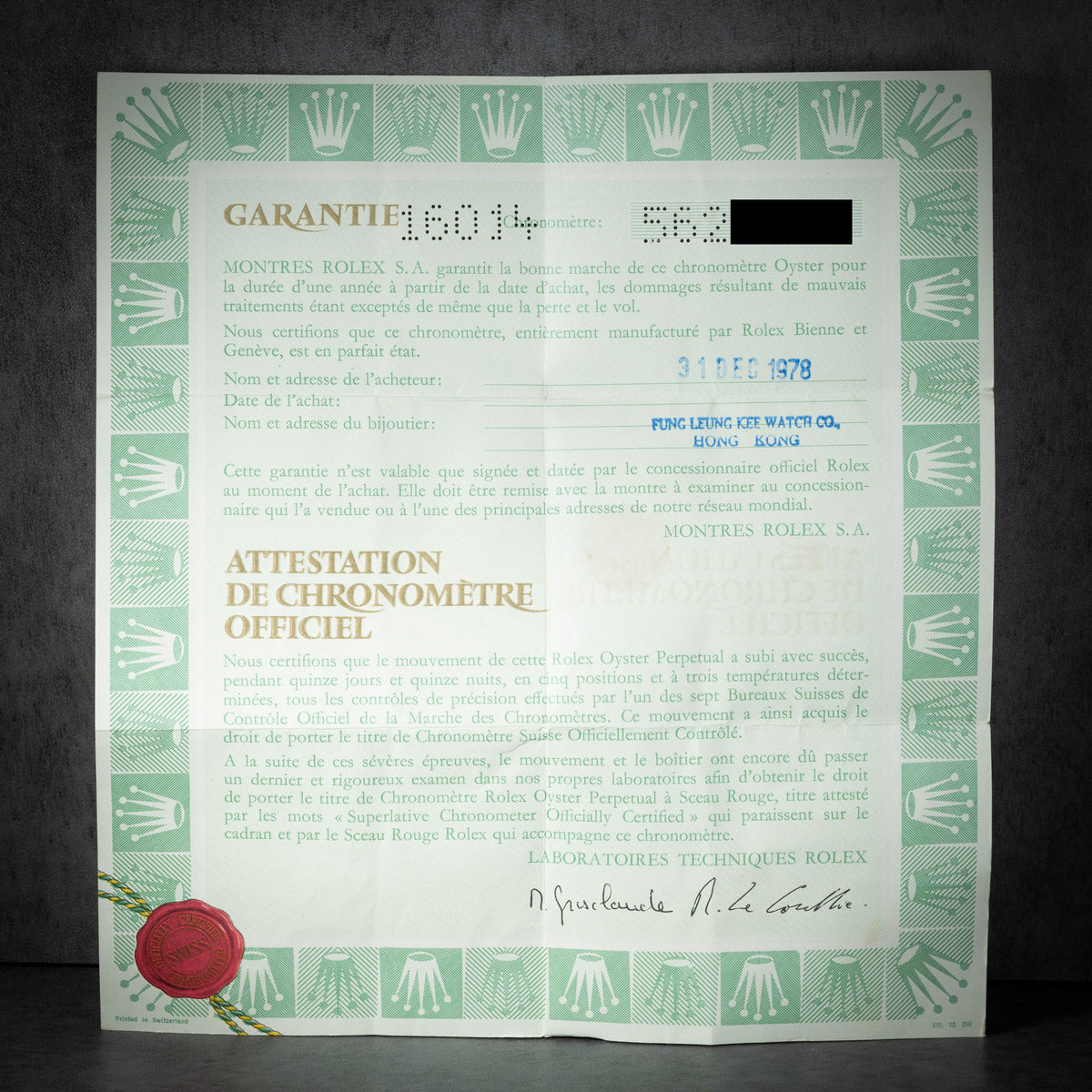
Rolex Datejust 16014 'Linen Dial' 36MM 1978 Papers
Rolex Datejust 16014 'Linen Dial' 36MM 1978 Papers
Couldn't load pickup availability
Rolex Datejust 16014 'Linen Dial' 36MM 1978 Papers
This Rolex Datejust 16014 is in great overall condition, retaining well-defined edges and factory finishing. The case remains sharp, showing only light hairline scratches, consistent with careful wear over time. These minor surface marks do not detract from the watch’s overall appeal but rather add to its authentic vintage character.
The stainless steel Jubilee bracelet is also in good condition, featuring sharp edges and well-preserved links. There is some stretch, typical for a watch of this age, but the bracelet remains structurally sound and secure on the wrist.
The dial and hands are in good condition, with the original hour markers and hands maintaining their crisp detailing with light oxidisation visible. The luminous has formed a lovely warm patina and remains intact, and the dial surface is free from significant blemishes, fading, or discoloration, ensuring a clean and well-preserved vintage aesthetic. The white gold fluted bezel remains sharp, providing an elegant contrast to the dial and case.
Overall, this Rolex Datejust 16014 is a well-preserved vintage piece, offering a strong balance of originality and wearability. With its untouched case, well-maintained dial, and classic proportions, this watch is an excellent choice for collectors and enthusiasts looking for an authentic, vintage Datejust with timeless appeal.
Vintage watches should not be considered water-proof, even if they were originally designed as dive or sports models. Over time, gaskets dry out, seals deteriorate and case tolerances change, reducing their ability to resist moisture. Unless a watch has been recently pressure tested and specifically certified for water resistance, it should be kept away from swimming pools, the ocean and showers. Steam and sudden temperature changes can also force moisture into the case, potentially damaging the dial and movement. As a general rule, vintage timepieces are best treated as splash resistant at most and worn with care around water.
Share
Why we love this watch
Why we love this watch
Rolex Datejust 16014: White Gold Fluting Meets the Quickset Date
Reference 16014 paired an 18k white gold fluted bezel with calibre 3035, the 28,800 vibrations per hour movement that from 1977 let a Datejust owner change the date without winding the hands through a full day. It is the steel and white gold Datejust of the late 1970s and 1980s, the reference that sits between the slower-beating calibre 1575 generation and the sapphire-crystal 16234 that replaced it. This example wears a silver dial on a Jubilee bracelet, a pairing that keeps steel, white gold and dial in one tonal family.
To understand why the Rolex Datejust 16014 looks and works the way it does, you have to go back past 1977, past 1945, to a London company that spent its first two decades trying to prove a wristwatch could be trusted.
The Rolex Story Before the Datejust
Wilsdorf, Davis and the Pursuit of Certified Precision
Rolex began in London in 1905 as Wilsdorf & Davis, founded by Hans Wilsdorf and his brother-in-law Alfred Davis. It became the Rolex Watch Company in 1915 and moved its headquarters to Geneva in 1919. Wilsdorf's early argument was that a small wristwatch could keep time as dependably as a pocket watch, and he set out to prove it with certificates rather than claims. In 1910 a Rolex became the first wristwatch to receive the Swiss Certificate of Chronometric Precision, and in 1914 the brand secured certification from the Kew Observatory in England.
That habit of documenting accuracy runs directly to the 16014. Its dial carries the Superlative Chronometer Officially Certified wording, a phrase Rolex began printing on its dials in 1957 to signal that its watches were regulated beyond the basic chronometer requirement.
The Oyster, the Perpetual and the Fluted Bezel
In 1926 Rolex introduced the Oyster, a sealed case that the brand presents as the first waterproof and dustproof wristwatch. A year later Wilsdorf gave one to Mercedes Gleitze for her swim across the English Channel, turning an engineering claim into a public test. From 1931 Rolex registered a series of patents on a self-winding system built around a free rotor, which it called the Perpetual. Waterproofness, chronometric precision and automatic winding became the three foundations of the Oyster Perpetual range, and every Datejust since has been built on them.
The fluted bezel on the 16014 also traces back to the Oyster. Rolex explains that the fluting originally had a mechanical purpose: it allowed the bezel to be screwed onto the case to help seal it, mirroring the fluting on the caseback, which was tightened with dedicated Rolex tools. Over time those ridges moved from function to signature. The mix of steel and gold that defines the 16014 is nearly as old. Rolex has combined the two metals since the early 1930s and registered the Rolesor name in 1933. Steel with white gold is what the brand now calls White Rolesor, and the 16014 is a White Rolesor Datejust in everything but the modern name.
1945: The Datejust Arrives
A Watch for the Fortieth Anniversary
Rolex launched the Datejust in 1945, its fortieth anniversary year, and describes it as the first self-winding waterproof chronometer wristwatch to show the date in a window on the dial. The original reference 4467 was made only in 18k yellow gold. Its date disc printed even numerals in red and odd numerals in black, and the dial was signed Oyster Perpetual Chronometer rather than Datejust. The Datejust name would not appear on the dial until the 1950s.
The 4467 was housed in the domed self-winding case that later earned early Oyster Perpetuals the Bubbleback nickname, and the reference itself is known as the Ovettone, an Italian nod to its rounded, egg-like profile. That deep caseback made room for the Perpetual rotor. Over the following decades the case grew flatter and the dial cleaner, but the date at three o'clock, the fluted bezel and the Jubilee stayed put, and all three carry straight through to the 16014.
Rolex also created a bracelet for the occasion. The Jubilee, a five-piece link design, was made specifically for the Datejust in 1945, and its name nods to the anniversary it marked. More than three decades later it remained the default partner for the 16014.
Correcting the Record on the Midnight Change
A widely repeated claim holds that the 1945 Datejust switched its date instantly at midnight. The earliest examples did not. On the first generation the date wheel crept across gradually in the hours before midnight, and an instantaneous change arrived in 1955, introduced alongside calibre 1065. In the same period the Datejust gained the feature that now defines its profile. Rolex patented the Cyclops lens in the early 1950s and first fitted it to a Datejust in 1953 to magnify the date. Steel and two-tone versions joined the gold watches during that decade.
By the time the 16014 appeared, the core vocabulary was settled: a fluted bezel, a Jubilee bracelet, a date at three o'clock and a Cyclops above it. What Rolex changed in 1977 was the engine underneath.
Reference 16014 and Calibre 3035
The First Five-Digit Generation
The 16014 belongs to the first generation of five-digit Datejust references, produced from around 1977 until 1987 or 1988, when the sapphire-crystal 16234 took over. It sat in the catalogue beside sibling references such as the 16030 and 16013, differing mainly in metal and bezel. What separated this generation from the four-digit Datejusts before it was the movement. In the 1970s Rolex developed an entirely new movement family that shared a basic gear train between its mechanical watches and the Oysterquartz, and launched calibre 3035 in 1977 alongside the quartz calibre 5035.
Inside the Calibre 3035
The 3035 raised the beat rate from the 19,800 vibrations per hour of its predecessor, calibre 1575, to 28,800. A faster balance divides each second into eight steps, giving the seconds hand on the 16014 a finer sweep than on earlier Datejusts. The movement measures 28.5 mm across and 6.3 mm high and runs on 27 jewels. Its free-sprung balance uses a Breguet overcoil hairspring with Microstella regulation, Kif shock protection guards the balance, and it winds in both directions. Pulling the crown to its outer position stops the seconds hand for precise setting, and the power reserve is generally given as around 48 hours.
The feature owners notice first is the quickset date. With the crown pulled to its first position, turning it advances the date wheel one day at a time, so correcting the calendar after a week in a drawer takes seconds rather than a long session spinning the hands past midnight. The function moves the date only, and only forward. Rolex used the 3035 as the base for a wider family, including the Day-Date calibre 3055, and kept it in production until 1988, when calibre 3135 replaced it.
The same calibre powered some of the most demanding Rolex tool watches of the period, including the Submariner Date 16800 and the Sea-Dweller 16660. That is a useful way to read the 16014. The movement under its silver dial is the one Rolex trusted at depth in the early 1980s, simply housed in a dress case with a white gold bezel instead of a rotating diver's insert.
Every 3035 was submitted for official chronometer certification. That standard allows an average daily rate of minus four to plus six seconds, measured on the uncased movement. The tighter minus two to plus two seconds per day figure often attached to vintage Rolex belongs to the Superlative Chronometer standard that Rolex formalised for finished, cased watches in 2015, decades after the 16014 left production.
Design and Construction
Case, Steel and the White Gold Bezel
The 16014 measures 36 mm across, roughly 44 mm from lug to lug and around 11 mm thick, with 20 mm between the lugs. The case is stainless steel, and it is worth being exact about which steel. Until the late 1980s Rolex, like most of the industry, used 316L, a low-carbon marine grade alloy. The 904L steel that Rolex now markets as Oystersteel came later, first on the Sea-Dweller, and the full range was converted by 2003. The 16014 is a 316L watch.
The case uses the screw-down crown and caseback of the Oyster system and is crowned by the 18k white gold fluted bezel. White gold is the clever choice here. Beside brushed and polished steel it reads as almost the same metal, so the bezel stands out through texture rather than colour, with the fluting catching light as the wrist turns. It is a far quieter statement than a yellow Rolesor Datejust, and that restraint is the character of the reference.
Acrylic Crystal and Dial
The 16014 was the last steel and white gold Datejust to use an acrylic crystal. Its successor, the 16234, brought a sapphire crystal to the line together with calibre 3135. The domed acrylic stands proud of the bezel and softens the edge of the dial, and its Cyclops sits over the date at three o'clock exactly as it had since 1953. It is one of the clearest visual markers that separates the 16014 from the flatter, sharper-edged sapphire watches that followed.
Rolex offered the 16014 with a broad spread of dials over its decade in production, from silver and black baton versions to Roman numeral dials. This example carries silver, which suits the white gold bezel and lets the applied markers and printed chronometer text do the work under the light.
The Jubilee Bracelet
Datejusts of this period were commonly fitted with the 62510H Jubilee, the H denoting a men's bracelet, attached with 555 end links. Those end links were hollow and removable, a construction Rolex later replaced with solid end pieces. The clasp is a folding Oyster deployant stamped with the bracelet reference, rather than the concealed Crownclasp sometimes attributed to these bracelets. The five-piece links make the 62510H lighter and more supple than a modern Jubilee, so it drapes around the wrist rather than sitting on top of it, which suits the slim profile of the acrylic-crystal case.
Wearing the Rolex Datejust 16014
Proportions That Explain the Model
At 36 mm with a short lug span, the 16014 wears the way the Datejust was designed to wear in 1945: close to the wrist, with the bezel and the Cyclops doing the visual talking. The 11 mm case slides under a shirt cuff without catching, and the domed crystal adds height in the centre rather than at the edges. On the Jubilee the whole watch moves with the wrist, and the alternating polished and brushed links pick up the same light as the white gold fluting.
Mechanically, the 3035 gives the 16014 the habits of a modern watch. The quickset date, the hacking seconds and the faster beat remove most of the small frustrations of older Datejusts, while the acrylic crystal, 316L case and lightweight Jubilee keep the period feel intact. It is a reference that captures Rolex at a specific moment: the five-digit movement architecture already in place, the sapphire crystal not yet arrived.
Final Thoughts
The Rolex Datejust 16014 is a record of how Rolex refined rather than reinvented. The fluted bezel began as a way to screw down an Oyster, the Jubilee began as an anniversary bracelet, and the date window began as a wheel that crept forward before midnight. Reference 16014 inherited all three and added the calibre 3035, with its higher beat and quickset date, inside a 316L case under a domed acrylic crystal. That combination existed for roughly a decade before sapphire and calibre 3135 moved the line on. In silver on a Jubilee, this 16014 shows that decade clearly: an 18k white gold bezel, a 28,800 vibrations per hour movement and a date you can set in seconds.
Case & Bracelet
Case & Bracelet
- Case in very good condition. Very light hairlines visible.
- Bracelet in Excellent condition, nice sharp edges, very light stretch.
Dial & Hands
Dial & Hands
- Dial & hands great condition,
Warranty & Condition
Warranty & Condition
Crown Vintage Watches provides a minimum 6-month mechanical warranty on pre-owned watches, from the date of purchase.
The warranty covers mechanical defects only.
The warranty does not cover damages such as scratches, finish, crystals, glass, straps (leather, fabric or rubber damage due to wear and tear), damage resulting from wear under conditions exceeding the watch manufacturer’s water resistance limitations, and damage due to physical and or accidental abuse.
Please note, water resistance is neither tested nor guaranteed.
Shipping and insurance costs for warranty returns to us must be covered by the customer. Returns must be shipped via traceable courier. Return shipment must be pre-paid and fully insured. Collect shipping will be refused. In case of loss or damages, the customer is liable.
Our Pledge
At Crown Vintage Watches, we stand by the authenticity of every product we sell. For added peace of mind, customers are welcome to have items independently authenticated at their own expense.
Condition
Due to the nature of vintage timepieces, all watches are sold as is. We will accurately describe the current condition and working order of all watches we sell to the best of our ability.
Shipping & Refund
Shipping & Refund