

Crown Vintage
Breitling Navitimer 8806 42mm 1960s
Breitling Navitimer 8806 42mm 1960s
Couldn't load pickup availability
Breitling Navitimer 8806 42mm 1960s
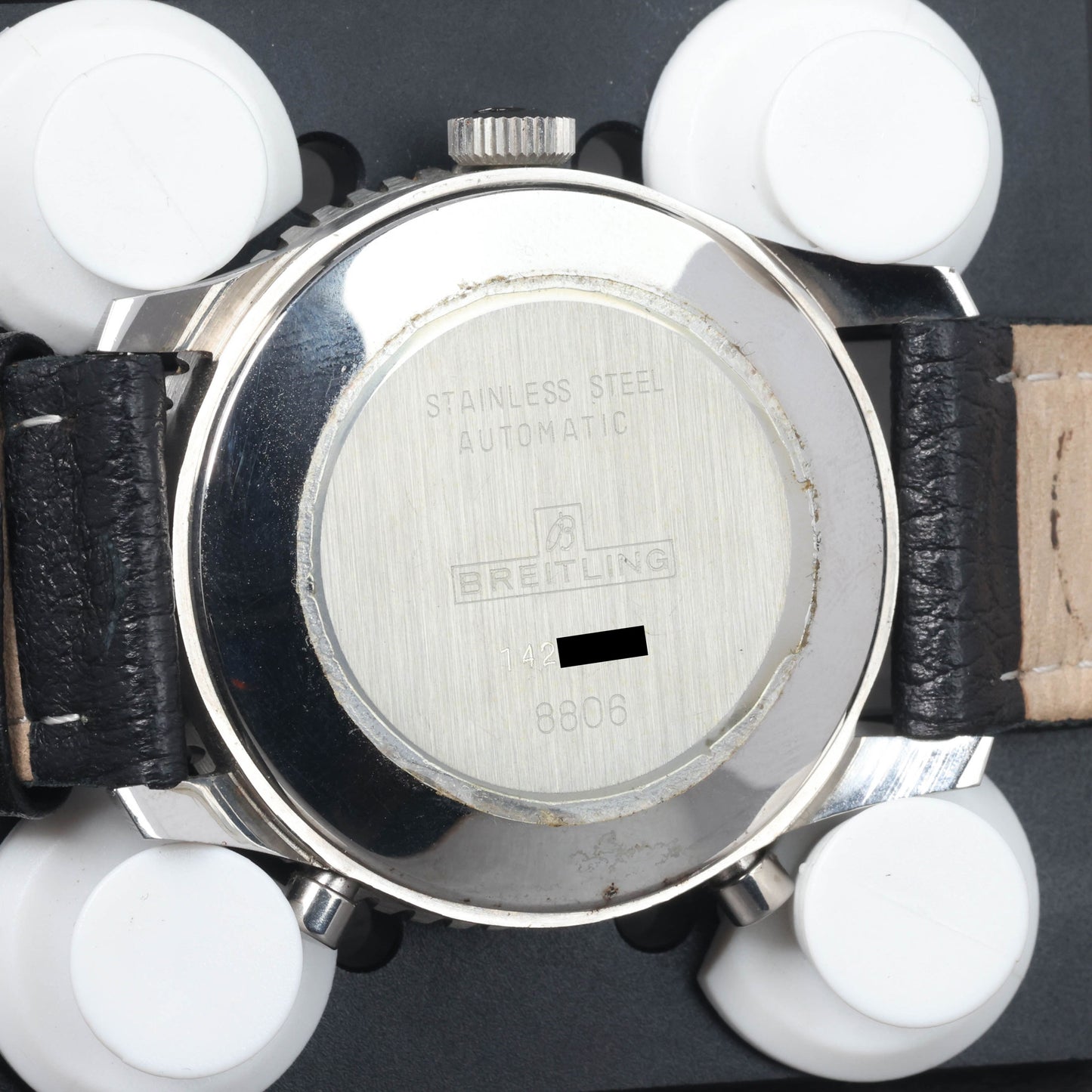
This Breitling Navitimer 8806 42mm, dating to the 1960s, is presented in excellent vintage condition. The stainless steel case remains unpolished, with original factory finishing still clearly visible. Edges are well defined and surfaces show minimal wear, consistent with careful use over time and long-term preservation.
The dial and hands are in good overall condition, displaying a warm, even patina that has developed naturally with age. Printing remains legible, the slide rule scales are clear, and contrast is preserved across the dial. The hands match the dial well in tone, creating a cohesive and period-correct appearance without distracting corrosion or damage.
Overall, this Navitimer presents as an honest and well-kept example from the 1960s. As with all watches of this age, it should be treated as a vintage timepiece and is not recommended for swimming or water exposure, regardless of original specifications.
Share
Why we love this watch
Why we love this watch
Breitling Navitimer 8806: The Manual Wind Aviation Chronograph
Produced during the 1960s and into the early 1970s, the Breitling Navitimer sits firmly within the period when the Navitimer functioned as a professional aviation instrument rather than a lifestyle chronograph. The 8806 is defined by its automatic movement, absence of a date complication, and fully functional slide rule bezel, all of which reflect the operational requirements of pilots during the jet age. This reference occupies an important place within Breitling’s aviation history and provides insight into how wrist chronographs were used in real world flight operations before electronic navigation became standard.
Breitling and the Origins of the Navitimer
Breitling was founded in 1884 by Léon Breitling and built its reputation on chronographs and timing instruments from its earliest years. By the early twentieth century, the company was already supplying chronographs for scientific, industrial and sporting use. Breitling’s involvement with aviation intensified after the Second World War, as civil and military aviation expanded rapidly and required reliable onboard and personal timing instruments.
The Navitimer was introduced in 1952, developed in cooperation with the Aircraft Owners and Pilots Association. Unlike conventional chronographs that focused solely on elapsed time, the Navitimer incorporated a circular slide rule bezel that allowed pilots to perform essential flight calculations directly on the wrist. These included fuel consumption, airspeed, rate of climb, distance and time conversions. This functionality distinguished the Navitimer from other chronographs of the era and positioned it as a specialised aviation tool.
Early Navitimers were supplied to pilots and aviation organisations rather than marketed broadly to the public. This professional orientation shaped the design language of the watch, prioritising information density, clarity of scales and mechanical reliability over decorative elements.
Development of the Navitimer Reference 8806
The reference 8806 emerged as part of the second generation of Navitimer production. While earlier Navitimers were often co branded with aviation organisations, the 8806 represents a more standardised Breitling production reference while retaining the core functional attributes of the model line.
The defining characteristic of the 8806 is its automatic chronograph movement and clean dial layout without a date window. This configuration reflects the needs of pilots who valued uninterrupted dial symmetry and mechanical simplicity. Removing the date complication reduced visual clutter and eliminated an additional mechanism that could distract from timing and calculation tasks.
During the period of its production, wrist worn navigation instruments were still widely used in aviation. Cockpit avionics were improving, but redundancy was essential, and pilots often relied on their watches as a backup or cross check for onboard instruments. The 8806 fits squarely within this operational context.
Case Architecture and Dimensions
The Breitling Navitimer 8806 uses a stainless steel case measuring approximately 41 mm in diameter. This size was large for its time but necessary to accommodate the complex dial layout and slide rule bezel. The case features straight lugs and a relatively thin mid case, helping to balance the overall proportions despite the watch’s diameter.
The bidirectional slide rule bezel is a core functional element. It consists of an inner rotating scale and an outer fixed scale, allowing pilots to align values and perform calculations by rotating the bezel. The bezel action is firm and precise, designed to maintain alignment once set. This was critical in flight environments where vibration and movement could otherwise disrupt calculations.
The caseback is solid and screw down, providing structural rigidity and protection for the movement. Water resistance was modest by modern standards but sufficient for cockpit use and daily wear outside of immersion.
Dial Layout and Aviation Functionality
The dial of the Navitimer 8806 is dense by design. It incorporates multiple concentric scales, including the primary timekeeping track, chronograph registers and slide rule markings. Despite the complexity, the layout follows a logical hierarchy that reflects aviation use.
Arabic numerals are used for the primary hour markers, offering immediate orientation at a glance. Sub dials are arranged in a tri register configuration, typically with a running seconds register, a 30 minute counter and a 12 hour chronograph counter. This layout allows the measurement of extended elapsed times relevant to flight legs and navigation intervals.
The absence of a date window on the 8806 preserves dial symmetry and ensures that no scale is interrupted. This was a deliberate design choice rather than a cost saving measure. In aviation use, uninterrupted scales were critical for accurate slide rule calculations.
Hands are proportioned to their respective scales, with the chronograph seconds hand extending fully to the outermost track. Luminous material is applied to the main hands and numerals, supporting low light legibility during night flights or instrument only conditions.
The Slide Rule Bezel Explained
The slide rule bezel is the defining feature of the Navitimer and central to the 8806’s purpose. It operates on logarithmic scales similar to a traditional slide rule. By aligning values on the inner and outer scales, pilots could perform multiplication, division and unit conversions.
In practical terms, this allowed calculations such as fuel burn per hour, total fuel required for a given distance, ground speed based on time and distance, and conversion between nautical miles and kilometres. These calculations were essential in an era when flight planning relied heavily on manual computation.
The Navitimer slide rule did not replace dedicated navigation tools, but it provided a readily accessible reference that could be used quickly without consulting charts or cockpit instruments. This functionality explains why the Navitimer became standard equipment for many pilots during the 1950s and 1960s.
Movement: Calibre 12 Automatic Chronograph
The Breitling Navitimer reference 8806 is powered by the automatic Calibre 12, part of the Chrono-Matic family of movements introduced in 1969. This calibre was developed through a joint project between Breitling, Heuer-Leonidas, Hamilton-Buren and Dubois-Dépraz, representing one of the first commercially available automatic chronograph solutions.
The Calibre 12 is a modular automatic chronograph, combining a Buren micro-rotor automatic base with a Dubois-Dépraz chronograph module. This construction dictated several external characteristics of the watch, most notably the left-hand crown position at 9 o’clock, which is a direct result of the movement’s internal architecture rather than a design choice.
The movement operates at 19,800 vibrations per hour and provides an approximate 42-hour power reserve. Automatic winding eliminated the need for daily manual winding, a functional evolution that reflected broader changes in professional and civilian chronograph use during the early 1970s.
The Calibre 12 supports a tri-register chronograph layout with a date display, typically positioned at 6 o’clock on the Navitimer 8806. Chronograph engagement is controlled via a cam-actuated system rather than a column wheel, consistent with the movement’s modular design.
From a servicing perspective, the Chrono-Matic architecture allowed for the chronograph module to be removed independently from the automatic base, a practical advantage in professional maintenance environments. This movement configuration places the Navitimer 8806 firmly within the first generation of automatic aviation chronographs and distinguishes it mechanically and historically from earlier manual-wind Navitimer references.
Use in Aviation
During the 1960s, pilots commonly used wrist chronographs as part of their navigation workflow. The Navitimer 8806 would typically be synchronised with official time before departure. During flight, the chronograph could be used to time legs between waypoints, calculate estimated time of arrival and cross check fuel consumption against planned figures.
Anecdotal accounts from commercial and private pilots of the era describe the Navitimer as a practical companion rather than a novelty. Its size allowed calculations to be performed quickly, and its manual movement ensured predictable behaviour without reliance on automatic winding systems that could be affected by wrist movement.
In training environments, student pilots were often taught slide rule calculations using tools similar to the Navitimer bezel. This made the watch a familiar extension of flight planning techniques rather than a specialised or obscure instrument.
Variations Within the 8806 Reference
While the reference number 8806 defines the core configuration, variations exist across production. These include differences in dial printing, logo styles and luminous material. Early examples may feature the winged Breitling logo, while later dials adopt simplified branding.
Subtle changes in typography and scale spacing reflect ongoing refinements rather than major redesigns. These variations correspond to production batches and supplier changes rather than shifts in functional intent.
What remains consistent across 8806 examples is the absence of a date complication, manual wind movement and full slide rule bezel functionality. These elements define the reference and distinguish it from later Navitimers that introduced automatic movements and additional features.
Transition Away From Manual Wind Navitimers
By the early 1970s, automatic chronograph movements became more widespread, and Breitling began transitioning parts of the Navitimer line to automatic calibres. This shift reflected broader changes in consumer expectations rather than aviation requirements.
At the same time, cockpit avionics were advancing rapidly. Electronic navigation systems reduced reliance on manual calculations, and the operational role of wrist worn slide rules diminished. As a result, later Navitimers increasingly balanced heritage design with general wearability.
The 8806 belongs to the final phase when the Navitimer functioned primarily as a professional aviation instrument rather than a heritage inspired chronograph.
Position Within Breitling’s History
The Navitimer 8806 sits at the intersection of Breitling’s core identities as a chronograph manufacturer and an aviation specialist. It demonstrates how mechanical watchmaking adapted to the practical needs of flight before digital systems became dominant.
Breitling’s close relationship with aviation organisations and pilots shaped the Navitimer’s development. The 8806 reflects this collaboration in its design choices, movement selection and functionality. It was not conceived as a commemorative or stylistic exercise, but as a working instrument aligned with contemporary aviation practice.
Final Thoughts
The Breitling Navitimer 8806 is best understood as a professional aviation chronograph shaped by the operational realities of its time. Its calibre 12 movement, uninterrupted dial layout and fully functional slide rule bezel reflect the requirements of pilots navigating before the digital era. Rather than being defined by later reinterpretations of the Navitimer concept, the 8806 stands as a reference point for what the Navitimer was originally designed to be: a wrist worn navigation instrument built for use in flight.
Case & Bracelet
Case & Bracelet
- Case in excellent condition, minimal wear visible.
- Unpolished case with factory finishing still visible.
- Strap in good condition.
Dial & Hands
Dial & Hands
Dial & hands in good condition, warm even patina visible.
Warranty & Condition
Warranty & Condition
Crown Vintage Watches provides a minimum 6-month mechanical warranty on pre-owned watches, from the date of purchase.
The warranty covers mechanical defects only.
The warranty does not cover damages such as scratches, finish, crystals, glass, straps (leather, fabric or rubber damage due to wear and tear), damage resulting from wear under conditions exceeding the watch manufacturer’s water resistance limitations, and damage due to physical and or accidental abuse.
Please note, water resistance is neither tested nor guaranteed.
Shipping and insurance costs for warranty returns to us must be covered by the customer. Returns must be shipped via traceable courier. Return shipment must be pre-paid and fully insured. Collect shipping will be refused. In case of loss or damages, the customer is liable.
Our Pledge
At Crown Vintage Watches, we stand by the authenticity of every product we sell. For added peace of mind, customers are welcome to have items independently authenticated at their own expense.
Condition
Due to the nature of vintage timepieces, all watches are sold as is. We will accurately describe the current condition and working order of all watches we sell to the best of our ability.
Shipping & Refund
Shipping & Refund