

Crown Vintage
Cartier Tank Must ‘Vermeil’ Blank Ivory Dial 1613 20x28mm Circa 1990s
Cartier Tank Must ‘Vermeil’ Blank Ivory Dial 1613 20x28mm Circa 1990s
Couldn't load pickup availability
Cartier Tank Must ‘Vermeil’ Blank Ivory Dial 1613 20x28mm Circa 1990s
Case & Bracelet
The vermeil case is in very good condition with little wear visible. Vermeil is sterling silver finished in 18 carat gold, and the corners of the brancards and the edges of the caseback are where the gold usually shows its age first. Here the surfaces remain warm and even, and the clean lines of the Tank are intact.
The strap is in excellent condition. On a watch this slim and light, the strap is as much a part of the look as the case, so its condition matters more than it would on a heavier piece.
Dial & Hands
The ivory dial and hands are in very good condition. On a watch this pared back, where the dial is the only thing framed between the brancards, its condition sets the tone for the whole piece, and here the ivory reads clean.
ALL QUARTZ WATCHES WILL HAVE BATTERIES REPLACED BEFORE LISTING / PURCHASE
Share
Why we love this watch
Why we love this watch
Sterling Under Gold: The Must de Cartier Tank Vermeil Small Model, 1990s
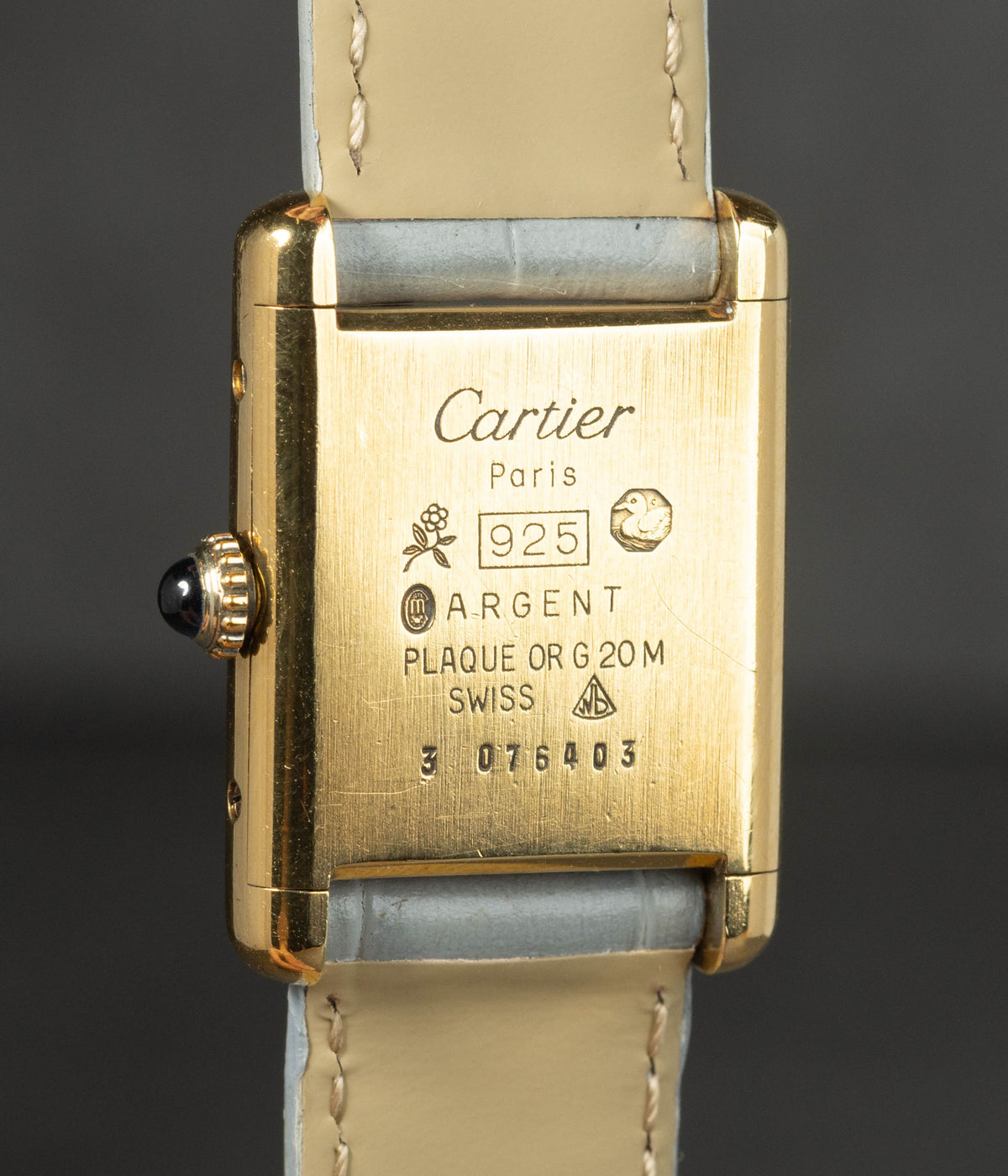
Stamped on the caseback of this watch is a mark no solid gold Cartier will ever carry: a small punch reading PLAQUE OR G 20M, sitting alongside the number 925. Those two marks are the entire argument of the Must de Cartier. Underneath the warm surface is sterling silver, and over it is a layer of 18 carat gold many times thicker than the plating on a piece of costume jewellery. It is not a shortcut to a gold watch. It is a different material with its own rules, and Cartier chose it deliberately, in a decade when the company had every reason to be careful about what it put its name on.
Cartier Before the Tank
The Tank is a watch drawn by a jeweller, and the house behind it had been making jewellery for seventy years before it made this shape.
A Paris workshop, 1847
Louis-Francois Cartier founded the business in 1847 by taking over the Paris workshop of his master, Adolphe Picard. His son Alfred took charge in 1874, but it was Alfred's three sons, Louis, Pierre and Jacques, who turned a Paris jeweller into an international name. Louis moved the house to the Rue de la Paix in 1899. Pierre opened in New York in 1909 and in 1917 moved into 653 Fifth Avenue, acquiring the mansion in exchange for a double strand natural pearl necklace valued at the time at a million dollars. King Edward VII called Cartier the jeweller of kings and the king of jewellers, and granted the firm a royal warrant in 1904.
A watch for an aviator
The same year brought Cartier's first serious step into watchmaking. The Brazilian aviator Alberto Santos-Dumont complained to his friend Louis Cartier that he could not read a pocket watch while keeping both hands on the controls, and Cartier answered with a flat wristwatch with a square bezel, the first Cartier wristwatch for men. In 1907 Cartier signed an exclusive agreement with the movement maker Edmond Jaeger, whose skill at making calibres small and thin gave Louis the freedom to design around shapes rather than around mechanisms, and in 1911 the Santos went on general sale. Everything the Tank would become rests on that combination: a jeweller's eye for form, supported by a movement specialist able to fit a calibre inside it.
The Tank Was Drawn in 1917 and Sold in 1919
Everything about the case on this watch was settled before the Second World War, by a man looking at military hardware.
A shape taken from the Western Front
Louis Cartier designed the Tank in 1917, taking his cue from the Renault FT tanks then in use with Allied forces in France, as both Cartier's own historical accounts and the standard reference literature record. Seen from above, a tank is a hull sitting between two parallel treads. Seen from above, the watch is a dial sitting between two parallel bars, and those bars are called brancards. They are the single most important element of the design and the one most often missed.
A conventional watch has a round case with lugs added to the outside of it, so the case is one object and the strap is another. On a Tank the brancards run the full height of the watch and continue straight into the leather, so there is no visual join at all. The line of the strap passes through the case and out the other side. It is why a Tank looks calm on a wrist when a similar sized round watch looks like an interruption.
Six watches, gone by January
Louis Cartier presented a prototype to General John Pershing of the American Expeditionary Force. Commercial examples entered Cartier's inventory between 15 November and 26 December 1919, and by 17 January 1920 all six of them had sold. Six watches is a small beginning for one of the most copied case shapes in watchmaking, but the design was right at the first attempt and has never needed rescuing. Roman numerals, a railway minute track around the edge, sword shaped hands and a cabochon set into the crown were there from the start, and they are all still here, seventy years later, on a watch built for a fraction of the price.
A family of Tanks
Once the proportions were settled, Cartier spent the following decades varying them. The Tank Louis Cartier and the Tank Chinoise both arrived in 1922, the curved Tank Americaine followed in 1989 and the Tank Francaise in 1996. Each changed the brancards, the curvature or the proportions, and each kept the underlying idea of a dial framed between two rails. The Must Tank is the purest of them, because it keeps the original rectangle almost exactly as Louis drew it.
How Les Must de Cartier Began
The reason a Tank exists in silver at all is a story about a company in trouble.
Cartier in pieces
By the early 1970s Cartier was not really one company. The Paris, London and New York houses had drifted into separate hands after the founding generation, and the family sold its interests in 1964. A group led by Robert Hocq, with Joseph Kanoui and Alain Dominique Perrin, bought Cartier Paris in 1972 and brought London back in 1974 and New York in 1976, pulling the three houses into a single business again, as Teddy Baldassarre's history of the line and the standard company histories set out. They inherited a name with enormous prestige and very little volume. Cartier was selling in the region of 3,000 watches a year, a figure Revolution puts against what came next.
At the same moment, Japanese quartz was rewriting the price of accuracy. A watch that kept better time than a Swiss chronometer could be bought for the cost of a good dinner. A house selling only solid gold jewellery watches was on the wrong side of that arithmetic.
The word must
Hocq's answer was a phrase rather than a product. Les Must de Cartier, roughly the essential things from Cartier, framed a range of goods, lighters, leather, pens and eventually watches, as things a stylish person simply had to own, as Bob's Watches and The 1916 Company both record. The concept arrived in 1973. The watches took another four years.
1977, and the number that followed
The Must watches launched in 1977 with vermeil cases at prices around $300 to $500 depending on model and market. What happened next is the reason the line matters. Cartier's annual watch sales went from roughly 3,000 to more than 160,000 by the end of the decade. That is not simply a marketing success. It is the moment Cartier stopped being a jeweller who occasionally made watches and became a watch company, and every Tank made since sits on the volume the Must generated.
Yves Saint Laurent wore one for his 1983 Irving Penn portrait, which tells you how the watch was regarded at the time by people with unlimited access to the alternative.
A signature hidden in the dial
Success brought counterfeits, and Cartier answered in the late 1970s with a secret signature. Sotheby's records that the word Cartier was worked into the printing of one of the Roman numerals, most commonly the VII or the X, in type so fine that it reads as part of the numeral until you look for it. It was an anti counterfeiting measure first, since forgers struggled to reproduce printing that small, and it is still one of the quiet pleasures of a period Must dial.
Vermeil, and Why It Is Not Plating
The word is French and it is old. Vermeil means gilded silver, and the technique behind it predates electricity by centuries.
Fire, then current
Until about 1840, silver was gilded by fire. Gold was ground into powder, mixed with mercury into an amalgam, painted onto the silver and heated until the mercury vaporised away, leaving gold bonded to the surface. It produced a warm, slightly mottled tone and it poisoned the people who did it, which is why the practice was abandoned in the mid nineteenth century. Electrogilding, commercialised by Elkington and Company in Birmingham in 1840, replaced it with an electric current depositing gold from solution, laying down a thinner and far more even layer. Modern vermeil, including the Must cases, is made by that electrolytic method.
What 20 microns actually means
Modern trade standards set a low bar. United States rules require only sterling silver, gold of at least 10 carat, and a coating of 2.5 microns before a piece may be called vermeil. Cartier used 18 carat gold at 20 microns on the Must cases, a figure documented in detail by Antique Sage and stamped on the watches themselves. For comparison, ordinary fashion jewellery is plated at two or three microns and cheap costume pieces at around half a micron.
The practical consequence is wear. Twenty microns is thick enough that the gold behaves like a surface rather than a film, taking decades of cuff contact before the silver begins to show through at the corners of the brancards and the edges of the caseback, which are the two places it goes first. It is also why a vermeil case ages the way it does rather than simply failing. When the gold does thin, what appears underneath is not base metal or brass but sterling silver, a respectable material in its own right, which develops its own quiet grey patina.
The caseback of a period Must carries the evidence: ARGENT for silver, the number 925, PLAQUE OR G or PLAQUE OR G 20M for the gold layer, and Swiss silver hallmarks alongside the reference and serial. Few watches at any price are as explicit about what they are made of.
What the 1990s Changed
Early Must Tanks from the late 1970s ran the Cartier calibre 78-1, a 17 jewel manual wind movement based on the ETA 2512-1, beating at 21,600 vibrations per hour with around 42 hours of reserve, per Caliber Corner. Winding a watch this size every morning is a pleasure for about a fortnight.
By the 1990s the line had moved to quartz, using Cartier calibres including the 057, 157, 90 and 690, several of them produced through the company's joint venture with Ebel. On a watch of these proportions that decision earns its keep. A quartz calibre is thinner than a mechanical one, so the case stays slim, the caseback stays flat against the wrist, and the profile of the Tank remains the crisp slab Louis Cartier drew rather than a swollen version of it. It also means the watch keeps time to within seconds a month, which is what most people want from a dress watch.
By the 1990s Cartier sat within the Swiss group now known as Richemont, while the design of the Must Tank stayed exactly where Louis Cartier had left it. The Must line ran until the mid 2000s, when Cartier withdrew it, and the Tank Must name returned in 2021 on a steel case with a solar powered movement. The vermeil originals were therefore made across roughly twenty five years, and the 1990s examples sit at the end of that run, with the design fully settled and the secret signature in place.
Final Thoughts
What we love about this watch is how little of it is compromise. The case shape is the 1917 original, brancards and all, drawn by a jeweller who had already put a wristwatch on an aviator. The dial layout is the one Cartier has printed for a century, complete with a hidden signature that exists only to be found. The blue cabochon is where it has always been. The only thing that changed is the metal, and the metal chosen was not a cheaper imitation of gold but sterling silver wearing 20 microns of the real thing, marked plainly on the case for anyone who cares to look. Cartier made that decision in 1977 because the company needed to reach further than solid gold could take it, and the watch that resulted turned a jeweller into a watchmaker. Nearly fifty years on, the small vermeil Tank still looks exactly like what it is, which is a Cartier Tank.
References
1. Wikipedia, Cartier (jeweler): https://en.wikipedia.org/wiki/Cartier_(jeweler)
2. Swisswatches Magazine, How the Cartier Santos Took Flight: https://swisswatches-magazine.com/how-the-cartier-santos-took-flight/
3. Worldtempus, The Origins of the Cartier Tank: https://en.worldtempus.com/article/watch-knowledge/origins-cartier-tank-cartier-79814.html
4. Wikipedia, Cartier Tank: https://en.wikipedia.org/wiki/Cartier_Tank
5. Teddy Baldassarre, Les Must de Cartier: The Misunderstood Entry-Level Cartier: https://teddybaldassarre.com/blogs/watches/les-must-de-cartier
6. Revolution, Watch I Love: The Must de Cartier: https://revolutionwatch.com/watch-i-love-the-must-de-cartier/
7. Bob's Watches, What is Must de Cartier: https://www.bobswatches.com/rolex-blog/cartier/what-is-must-de-cartier.html
8. The 1916 Company, 10 Iconic Cartier Creations You Should Know: https://www.the1916company.com/blog/10-things-you-should-know-about-cartier.html
9. Sotheby's, Hiding in Plain Sight: The Cartier Secret Signature: https://www.sothebys.com/en/articles/hiding-in-plain-sight-the-cartier-secret-signature
10. Antique Sage, Vintage Must de Cartier Watches: https://www.antiquesage.com/vintage-must-de-cartier-watches-luxury-wristwatch/
11. Mozeris Fine Antiques, Silver Gilt and Vermeil Complete Guide: https://www.mozerisfineantiques.com/silver-gilt-vermeil-guide
12. Caliber Corner, Cartier Caliber 78-1: https://calibercorner.com/cartier-caliber-78-1/
13. Analog:Shift, The Definitive Guide to the Cartier Tank: https://www.analogshift.com/blogs/transmissions/cartier-tank-buying-guide-history
14. 1stDibs, Cartier Tank Vermeil ref. 3 66001: https://www.1stdibs.com/jewelry/watches/wrist-watches/cartier-tank-vermeil-3-66001/id-j_27276002
15. Antiqurious, The appeal of Cartier Must Tank dial variations: https://antiqurious.com/en/blogs/news/cartier-dial-variations
Case & Bracelet
Case & Bracelet
- Case in very good condition, little wear visible.
- Strap in excellent condition
Dial & Hands
Dial & Hands
- Dial & hands very good condition
Warranty & Condition
Warranty & Condition
Crown Vintage Watches provides a minimum 6-month mechanical warranty on pre-owned watches, from the date of purchase.
The warranty covers mechanical defects only.
The warranty does not cover damages such as scratches, finish, crystals, glass, straps (leather, fabric or rubber damage due to wear and tear), damage resulting from wear under conditions exceeding the watch manufacturer’s water resistance limitations, and damage due to physical and or accidental abuse.
Please note, water resistance is neither tested nor guaranteed.
Shipping and insurance costs for warranty returns to us must be covered by the customer. Returns must be shipped via traceable courier. Return shipment must be pre-paid and fully insured. Collect shipping will be refused. In case of loss or damages, the customer is liable.
Our Pledge
At Crown Vintage Watches, we stand by the authenticity of every product we sell. For added peace of mind, customers are welcome to have items independently authenticated at their own expense.
Condition
Due to the nature of vintage timepieces, all watches are sold as is. We will accurately describe the current condition and working order of all watches we sell to the best of our ability.
Shipping & Refund
Shipping & Refund