

Crown Vintage
Cartier Tank Must ‘Vermeil’ Column Dial 1613 20x28mm Circa 1990s
Cartier Tank Must ‘Vermeil’ Column Dial 1613 20x28mm Circa 1990s
Couldn't load pickup availability
Cartier Tank Must ‘Vermeil’ Column Dial 1613 20x28mm Circa 1990s
Case & Bracelet
The vermeil case is in very good condition with little wear visible. The case is sterling silver carrying 20 microns of 18 carat gold, and the corners of the brancards and the edges of the caseback are where that gold shows its age first. Here the surfaces remain warm and even, and the clean lines of the Tank are intact.
The strap is in excellent condition. On a watch this slim and light, the strap is as much a part of the look as the case, so its condition matters more than it would on a heavier piece.
Dial & Hands
The dial and hands are in very good condition. On a watch this pared back, where the dial is the only thing framed between the brancards, its condition sets the tone for the whole piece, and here it presents clean against the warm gold of the case.
ALL QUARTZ WATCHES WILL HAVE BATTERIES REPLACED BEFORE LISTING / PURCHASE
Share
Why we love this watch
Why we love this watch
Twenty Microns of Gold: The Must de Cartier Tank Vermeil Small Model, 1990s
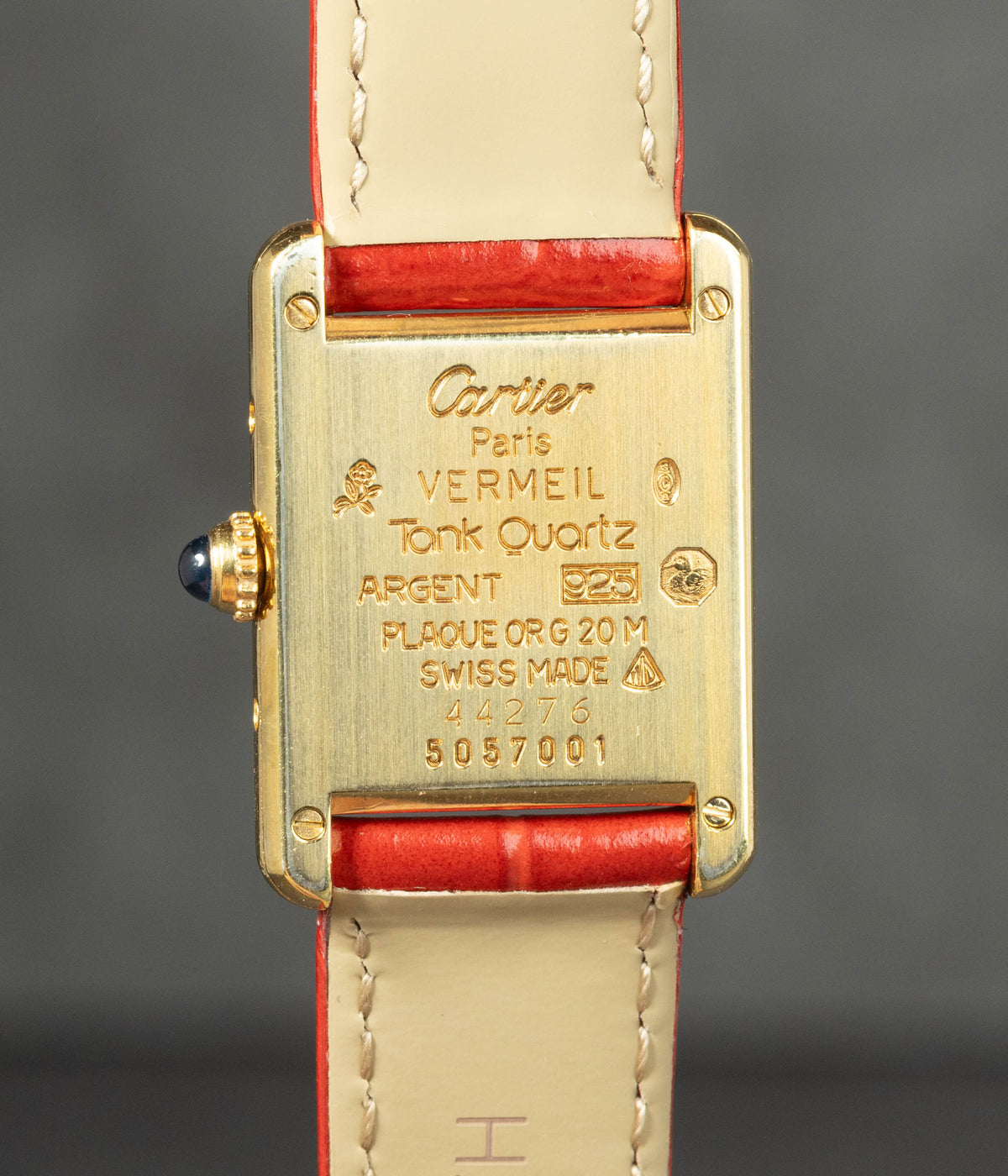
Turn this watch over and the caseback carries a mark no solid gold Cartier will ever wear: a small punch reading PLAQUE OR G 20M beside the number 925. Between them, those two stamps make the whole case for the Must de Cartier. Beneath the warm surface sits sterling silver, and over it lies 18 carat gold at a thickness costume jewellery never approaches. This is not a shortcut to a gold watch. It is a different material with rules of its own, and Cartier chose it on purpose, at a time when the company had every reason to be careful about what carried its name.
Drawn in 1917, Sold in 1919
The case on this watch was settled before the Second World War, by a man studying military hardware.
A shape from the Western Front
Louis Cartier designed the Tank in 1917, drawing on the Renault FT tanks then serving with Allied forces in France, as Cartier's own historical accounts and the standard reference literature both record. From above, a tank is a hull set between two parallel treads. From above, the watch is a dial set between two parallel bars, the brancards. They are the most important element of the design and the one people most often overlook.
On a conventional watch, the lugs are added to the outside of a round case, so case and strap read as two separate objects. On a Tank the brancards run the full height of the watch and carry straight on into the leather, leaving no visual join. The line of the strap passes through the case and out the other side, which is why a Tank sits calmly on the wrist where a round watch of similar size looks like an interruption.
Six watches, sold by January
Louis Cartier gave a prototype to General John Pershing of the American Expeditionary Force. The first commercial examples entered Cartier's stock between 15 November and 26 December 1919, and all six had sold by 17 January 1920. It was a modest start for one of the most copied case shapes in watchmaking, but the design was right first time and has never needed saving. Roman numerals, a railway minute track, sword shaped hands and a cabochon in the crown were all there from the beginning, and all of them are still here some seventy years later, on a watch made for a fraction of the price.
How Les Must de Cartier Began
A silver Tank exists at all because of a company in difficulty.
A house in three pieces
By the early 1970s Cartier was barely one company. The Paris, London and New York houses had drifted into separate ownership after the founding generation, each running its own affairs. Between 1972 and 1979 a group led by Robert Hocq, with Joseph Kanoui and Alain Dominique Perrin, bought the branches back and rebuilt them into a single business, as Teddy Baldassarre's history of the line sets out. They took over a name with great prestige and very little volume: Cartier was selling around 3,000 watches a year, a figure Revolution sets against what followed.
At the same time, Japanese quartz was redrawing the price of accuracy. A watch that kept better time than a Swiss chronometer could now be had for the price of a good dinner, and a house selling only solid gold jewellery watches was on the wrong side of that sum.
The word must
Hocq answered with a phrase rather than a product. Les Must de Cartier, loosely the essentials from Cartier, presented a range of lighters, leather, pens and eventually watches as things a stylish person simply had to own, as Bob's Watches and The 1916 Company both record. The idea arrived in 1973, and the watches followed four years later.
1977, and the numbers that followed
The Must watches launched in 1977 in vermeil cases at around $300 to $500, depending on model and market. What came next is why the line matters. Cartier's annual watch sales rose from roughly 3,000 to more than 160,000 by the end of the decade. That was more than a marketing win. It was the point at which Cartier stopped being a jeweller that sometimes made watches and became a watch company, and every Tank since stands on the volume the Must created.
Yves Saint Laurent wore one for his 1983 portrait by Irving Penn, which says a good deal about how the watch was seen by people who could have worn anything.
A signature in the numerals
Success brought copies, and in the late 1970s Cartier responded by hiding its name in the dial. Sotheby's records that the word Cartier was worked into the printing of a Roman numeral, most often the VII or the X, in type fine enough to pass as part of the stroke until you look for it. It began as an anti counterfeiting measure and remains one of the quiet pleasures of a period Must dial.
Vermeil, and Why It Is Not Plating
The word is French and the craft is old. Vermeil means gilded silver, and the technique predates electricity by centuries.
Fire, then current
Until around 1840, silver was gilded with fire. Powdered gold was mixed with mercury into an amalgam, brushed onto the silver and heated until the mercury burned off, leaving the gold bonded to the surface. The result had a warm, slightly mottled tone, and the process poisoned the craftsmen who used it, which is why it was abandoned in the mid nineteenth century. Electrogilding, commercialised by Elkington and Company in Birmingham in 1840, replaced it with an electric current that deposits gold from solution, giving a thinner and far more even layer. Modern vermeil, the Must cases included, is made by that electrolytic method.
What 20 microns means
The modern trade standard is modest. United States rules ask only for sterling silver, gold of at least 10 carat and a coating of 2.5 microns before a piece can be sold as vermeil. Cartier used 18 carat gold at 20 microns on the Must cases, eight times that minimum, a figure documented by Antique Sage and stamped on the watches themselves. For comparison, ordinary fashion jewellery is plated at two or three microns, and cheap costume pieces at about half a micron.
The practical result shows up in wear. At 20 microns the gold behaves like a surface rather than a film, and it takes decades of cuff contact before silver begins to show at the corners of the brancards and the edges of the caseback, the two places it always appears first. That is also why a vermeil case ages rather than simply fails. When the gold does thin, what shows through is not brass or base metal but sterling silver, a respectable material in its own right, which settles into a soft grey patina of its own.
The caseback of a period Must spells all of this out: ARGENT for silver, 925, PLAQUE OR G or PLAQUE OR G 20M for the gold layer, and Swiss silver hallmarks beside the reference and serial. Few watches at any price are so open about what they are made of.
What the 1990s Changed
The first Must Tanks of the late 1970s used the Cartier calibre 78-1, a 17 jewel hand wound movement based on the ETA 2512-1, running at 21,600 vibrations per hour with about 42 hours of reserve, according to Caliber Corner. Winding a watch this small every morning is charming for about two weeks.
By the 1990s the line had moved to quartz, with Cartier calibres including the 057, 157, 90 and 690, several made through the company's joint venture with Ebel. On a watch of these proportions the change pays for itself. A quartz calibre is thinner than a mechanical one, so the case stays slim, the caseback sits flat on the wrist, and the Tank keeps the crisp slab profile Louis Cartier drew rather than a thickened version of it. It also keeps time to within seconds a month, which is what most people want from a dress watch.
Cartier withdrew the Must line in the mid 2000s, and the Tank Must name returned in 2021 on a steel case with a solar powered movement. The vermeil originals were therefore made over roughly twenty five years, and the 1990s watches come from the end of that run, with the design fully resolved and the secret signature in place.
Final Thoughts
What we love about this watch is how little of it is a compromise. The case is the 1917 shape, brancards and all. The dial follows the layout Cartier has printed for a century, down to a hidden signature that exists only to be found. The blue cabochon sits where it always has. Only the metal changed, and the metal chosen was not a cheap imitation of gold but sterling silver carrying 20 microns of the real thing, declared plainly on the case for anyone who looks. Cartier took that decision in 1977 because it needed to reach further than solid gold could take it, and the watch that followed turned a jeweller into a watchmaker. Nearly fifty years later, the small vermeil Tank still looks exactly like what it is: a Cartier Tank.
References
1. Worldtempus, The Origins of the Cartier Tank: https://en.worldtempus.com/article/watch-knowledge/origins-cartier-tank-cartier-79814.html
2. Wikipedia, Cartier Tank: https://en.wikipedia.org/wiki/Cartier_Tank
3. Teddy Baldassarre, Les Must de Cartier: The Misunderstood Entry-Level Cartier: https://teddybaldassarre.com/blogs/watches/les-must-de-cartier
4. Revolution, Watch I Love: The Must de Cartier: https://revolutionwatch.com/watch-i-love-the-must-de-cartier/
5. Bob's Watches, What is Must de Cartier: https://www.bobswatches.com/rolex-blog/cartier/what-is-must-de-cartier.html
6. The 1916 Company, 10 Iconic Cartier Creations You Should Know: https://www.the1916company.com/blog/10-things-you-should-know-about-cartier.html
7. Antique Sage, Vintage Must de Cartier Watches: https://www.antiquesage.com/vintage-must-de-cartier-watches-luxury-wristwatch/
8. Mozeris Fine Antiques, Silver Gilt and Vermeil Complete Guide: https://www.mozerisfineantiques.com/silver-gilt-vermeil-guide
9. Sotheby's, Hiding in Plain Sight: The Cartier Secret Signature: https://www.sothebys.com/en/articles/hiding-in-plain-sight-the-cartier-secret-signature
10. Caliber Corner, Cartier Caliber 78-1: https://calibercorner.com/cartier-caliber-78-1/
11. Analog:Shift, The Definitive Guide to the Cartier Tank: https://www.analogshift.com/blogs/transmissions/cartier-tank-buying-guide-history
Case & Bracelet
Case & Bracelet
- Case in very good condition, little wear visible.
- Strap in excellent condition
Dial & Hands
Dial & Hands
- Dial & hands very good condition
Warranty & Condition
Warranty & Condition
Crown Vintage Watches provides a minimum 6-month mechanical warranty on pre-owned watches, from the date of purchase.
The warranty covers mechanical defects only.
The warranty does not cover damages such as scratches, finish, crystals, glass, straps (leather, fabric or rubber damage due to wear and tear), damage resulting from wear under conditions exceeding the watch manufacturer’s water resistance limitations, and damage due to physical and or accidental abuse.
Please note, water resistance is neither tested nor guaranteed.
Shipping and insurance costs for warranty returns to us must be covered by the customer. Returns must be shipped via traceable courier. Return shipment must be pre-paid and fully insured. Collect shipping will be refused. In case of loss or damages, the customer is liable.
Our Pledge
At Crown Vintage Watches, we stand by the authenticity of every product we sell. For added peace of mind, customers are welcome to have items independently authenticated at their own expense.
Condition
Due to the nature of vintage timepieces, all watches are sold as is. We will accurately describe the current condition and working order of all watches we sell to the best of our ability.
Shipping & Refund
Shipping & Refund