

Crown Vintage
CWC W10 British Military Watch 36mm 1976
CWC W10 British Military Watch 36mm 1976
Couldn't load pickup availability
CWC W10 British Military Watch 36mm 1976
Case and Strap
The monocoque tonneau case is in very good condition, with only light hairlines visible across the surfaces from wear, as you would expect from a field watch that has been used as intended. The form remains clean and well defined. The fixed spring bars are intact and secure, which matters on a watch built this way, since the one-piece bars are integral to the case rather than removable. The strap is in excellent condition and sits the watch correctly on the wrist.
Dial and Hands
The dial and hands are in excellent condition. The matte black dial reads cleanly, with the white Arabic numerals and railway minute track crisp and intact, and the CWC signature clear. The tritium markers and hands, denoted by the circled T on the dial, have aged to the soft, even tone typical of the material at this age and present well across the dial and the handset.
Use Advisory
This is a vintage timepiece, now approaching fifty years old, and should be treated accordingly. It rewards gentler handling than a modern watch would ask for, and with regular servicing the hand-wound calibre will continue to run reliably for years to come.
Share
Why we love this watch
Why we love this watch
A New Name on the Army's Watch: The 1976 CWC W10
In 1976 the small black field watch issued to British soldiers carried a new name on its dial for the first time. Not Smiths, the firm that had supplied it at the end of the 1960s, and not Hamilton, which had made it through the early 1970s, but three new letters: CWC. The watch itself barely changed. It was the same tonneau-cased, hand-wound, broad-arrow-marked general service watch the Army had been issuing for years. What changed was the company stamping its initials on the dial, and behind that small change lies one of the more quietly remarkable stories in British watchmaking. This is a 1976 example, from the very first year CWC supplied it.
A Watch Born From a Withdrawal
The Cabot Watch Company exists because another company left. Through the early 1970s the British general service watch was made by Hamilton, but by the middle of the decade Hamilton, squeezed like the rest of the traditional industry by the rising tide of cheap quartz, withdrew from its British military supply business. One of the people who saw both the gap that left and the continuing demand from the Ministry of Defence was Ray Mellor, who had run Hamilton's UK division. Rather than let the work lapse, Mellor set up his own firm to take it on.
The name has a fittingly British origin. As the story goes, Mellor was driving down to Bristol when he passed the Cabot Tower, the monument raised in honour of John Cabot, the explorer who had sailed from Bristol in the fifteenth century. The parallel between Cabot's new venture and his own was not lost on him, and the company became the Cabot Watch and Clock Company, soon shortened to the Cabot Watch Company, or CWC. Established in 1972 for the express purpose of making watches for the military, CWC stepped in to continue supplying the MoD, and the first CWC-branded general service watches reached the British Army in 1976. From that foothold the company went on to supply almost every part of the British forces, from Royal Navy divers' watches and RAF pilots' chronographs to the quartz G10 and the watches issued to the Special Boat Service. More than fifty years later it is still doing it.
What is striking about CWC is how completely it was built around a single customer. This was not a fashion house or a heritage brand chasing the public; it was a company founded specifically to win and hold a government supply contract, making watches to a written specification at a price the Ministry could justify. That focus shaped everything about the W10. There was no marketing department deciding the dial should be prettier, no commercial pressure to add a feature that looked good in a shop window. The watch had to be legible, reliable, repairable, and cheap enough to issue in the tens of thousands, and that is precisely what it is. The honesty people respond to in a W10 is not an accident of taste but a direct result of how and why the watch was made.
The W10 and Its Lineage
The watch itself sits in a long and surprisingly continuous British tradition. The term W10 comes from the military stores system; it is the category under which the Army's general service wristwatch was catalogued, and it is now used specifically for the tonneau-cased watches issued through the 1970s. It is often confused with G10, which was in fact the name of the form a serviceman filled in to draw a watch from stores, and which later became the name of CWC's quartz model. The watch here is a W10, the mechanical Army field watch of the 1970s.
Its design did not appear from nowhere. The first W10 was issued by Smiths between 1967 and 1970, a strikingly simple field watch with white Arabic numerals on a black dial and a railway-style minute track around the edge. An updated Defence Standard published in 1971 set out the tonneau-shaped case that defines the watches that followed, and Hamilton produced this version from 1973 until the middle of the decade. When CWC took over in 1976 it used the same components and the same Swiss suppliers, so the CWC W10 is essentially identical to the Hamilton it replaced, distinguished mainly by the name on the dial. Step further back and the lineage reaches the general service watches of the Second World War, the twelve makers of which are remembered as the Dirty Dozen, and the family resemblance is real, down to the font of the numerals. One small detail marks the watch as distinctly British. Unlike American field watches, which almost always add an inner ring of thirteen-to-twenty-four-hour numerals, the British field watch keeps its dial clean, with no twenty-four-hour track at all.
That continuity is part of what makes the W10 so interesting. Across roughly four decades, from the wartime watches of the 1940s to the end of the mechanical line in 1980, the British Army's idea of what a field watch should be barely shifted. A black dial, clear white numerals, a railway track, a hand-wound movement, and the minimum of fuss; the brief stayed remarkably stable even as the makers changed from Smiths to Hamilton to CWC. The 1976 watch is a single link in that chain, recognisably related to the watch a soldier might have worn on the wrist a generation earlier. Few watches of any kind can claim that sort of unbroken design heritage, and almost none of them were made to a government budget.
The 1976 CWC W10 Up Close
For all its history, the W10 is a study in doing only what is necessary. There is nothing on it that does not serve a purpose, and that restraint is exactly what gives the watch its character.
The Dial
The dial is matte black, chosen to kill reflections, with bold white Arabic numerals from one to twelve and a fine railway minute track running around the outer edge for precise reading. A small circled T sits on the dial, denoting the use of tritium for the luminous markers and hands. Tritium is a mildly radioactive isotope with a half-life of around twelve years, so the lume on a 1976 watch no longer glows, but it has typically aged to a soft, creamy tone that suits the watch. The CWC name appears on the dial in place of the Hamilton and Smiths signatures that came before. Everything is built for legibility at a glance, in poor light, by someone with more pressing things to think about than reading a watch.
The Case and Movement
The case is the tonneau, or cushion, shape laid down by the 1971 Defence Standard, a compact form of roughly thirty-five to thirty-six millimetres that wears smaller and sits flat under a cuff or a sleeve. It is a monocoque, one-piece construction, which seals the movement against dust and moisture and means the watch can only be opened by lifting out the acrylic crystal from the front rather than removing a caseback. The strap bars are fixed rather than removable, a deliberately practical choice so that the watch cannot shed its strap in the field, which is why these are almost always worn on a single-piece military strap threaded straight through.
Inside is the ETA 2750, a manually wound movement marked CWC on the bridge. It is a hand-wind rather than an automatic, in keeping with the watch's no-frills brief, and crucially it has a hacking seconds function, which stops the seconds hand when the crown is pulled out. That feature matters more than it sounds, because it lets a group of soldiers synchronise their watches to the exact second, which is the small piece of coordination that military timekeeping is really for.
The Markings on the Back
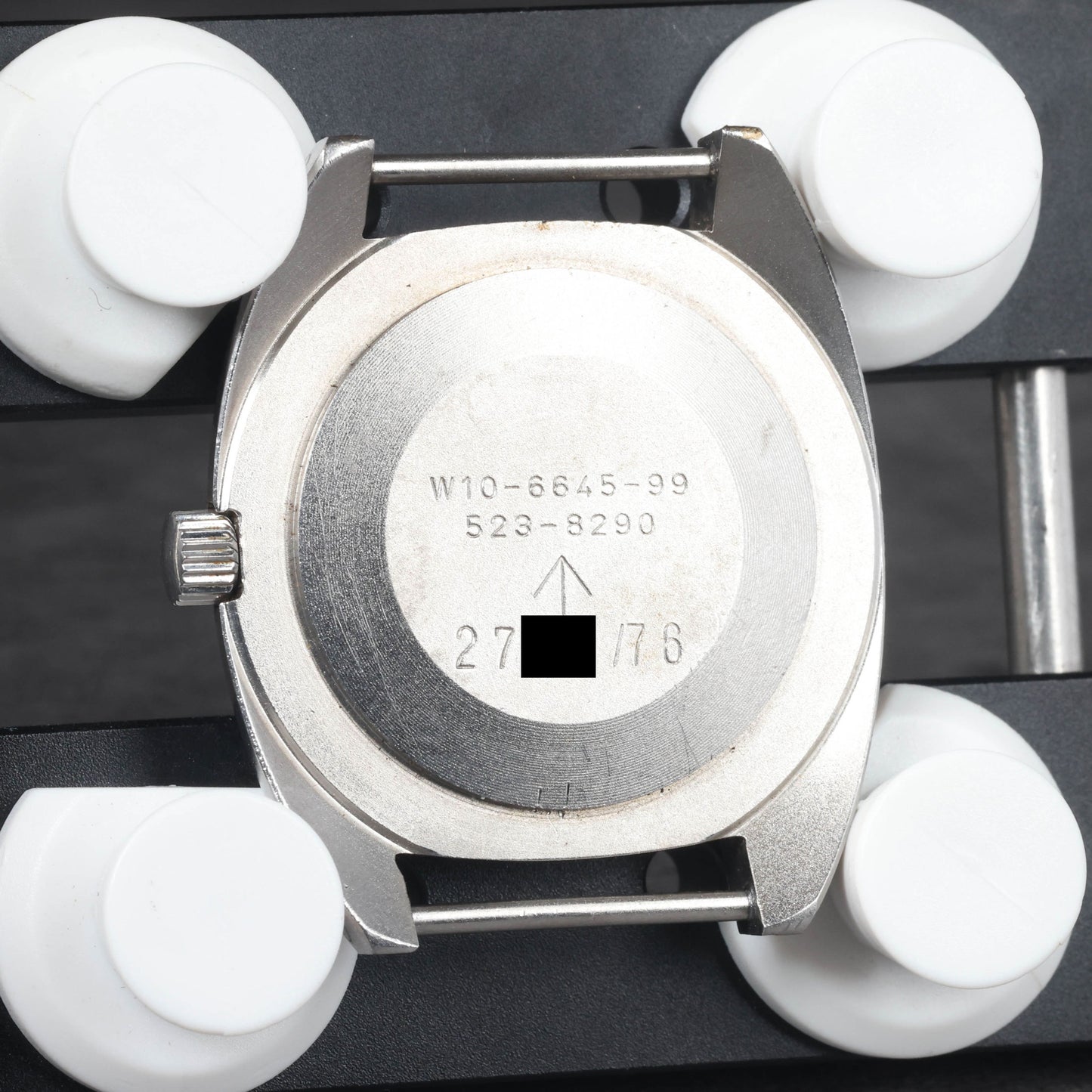
Turn the watch over and you find the language of military issue. The broad arrow, or pheon, is the mark that has denoted British government property for centuries, and it sits among a set of engraved codes: the W10 stores designation, a NATO stock number identifying the watch within the alliance's supply system, the year of issue, and an individual issue number. On a 1976 example the year tells you this was among the first batch CWC delivered, part of the roughly ten thousand issued to the Army that year, out of around twenty-four thousand CWC W10s the Army would take across the second half of the decade. These markings are not decoration. They are the watch's service record, the proof that it was drawn from stores, issued to a soldier, and expected back.
That last point is worth dwelling on, because it sets a military watch apart from almost everything else in horology. A W10 was never owned in the way a Rolex or a dress watch is owned. It was government property, signed out against a form, worn on duty, returned to stores, serviced, and issued again to someone else. The marks on the caseback are the paperwork of that cycle made permanent. When one of these watches survives into civilian hands today, it carries the residue of a working life that had nothing to do with the watch market and everything to do with the job it was built for, which is a large part of why a small black field watch can feel so quietly weighty on the wrist.
Why a Humble Field Watch Endures
The W10 is, by any measure, a modest watch. It is small, hand-wound, made to a price set by a government contract, and entirely without luxury. And yet it has a pull that far more expensive watches often lack, because every part of it is honest. Nothing about a W10 is there to impress. The matte dial, the fixed bars, the plain steel case, the simple hand-wound movement, all of it exists to do a job reliably and to be repaired and reissued rather than admired. A watch like this was genuinely carried by someone in service, and it wears that history without any need to announce it.
There is also a sense of an ending to the 1976 W10. By 1980 the mechanical general service watch had been retired and replaced by the quartz G10, as the British military followed the rest of the world into the quartz age. The W10 was the last of the hand-wound British Army field watches in this long line, and the CWC examples were the final chapter of that mechanical story before the technology changed for good. A 1976 watch therefore sits near the start of CWC's involvement and near the end of the mechanical tradition at the same time, which gives it a particular place in the timeline.
Final Thoughts
The 1976 CWC W10 is a small watch carrying a large story. It marks the year a new British company, born out of Hamilton's retreat and named for an explorer who sailed from Bristol, took over the job of arming the British Army's wrists, and it does so in a design that traces back through Hamilton and Smiths to the field watches of the Second World War. The history of CWC explains how the name came to be on the dial. The watch itself, austere, legible, broad-arrow-marked, and built to be issued rather than sold, explains why a humble field watch from 1976 still earns such affection. It is about as honest as a watch can be.
References
1. Chronopedia, “CWC W10 1976-1980.” chronopedia.club.
2. Chronopedia, “CWC.” chronopedia.club.
3. anOrdain, “100 Years of British Military Watches, Part 2.” anordain.com.
4. CWC Addict, “The W10 Mechanical General Service Watch.” cwcaddict.com.
5. Cabot Watch Company, “CWC Military Watches.” cwcwatch.com.
6. Hairspring, “CWC W10 British Military Field Watch.” hairspring.com.
7. WatchCrunch, “The CWC G10 Story.” watchcrunch.com.
Case & Bracelet
Case & Bracelet
- Case in very good condition, light hairlines visible.
- Fixed Springbars intact
- Strap in excellent condition
Dial & Hands
Dial & Hands
- Dial & hands excellent
Warranty & Condition
Warranty & Condition
Crown Vintage Watches provides a minimum 6-month mechanical warranty on pre-owned watches, from the date of purchase.
The warranty covers mechanical defects only.
The warranty does not cover damages such as scratches, finish, crystals, glass, straps (leather, fabric or rubber damage due to wear and tear), damage resulting from wear under conditions exceeding the watch manufacturer’s water resistance limitations, and damage due to physical and or accidental abuse.
Please note, water resistance is neither tested nor guaranteed.
Shipping and insurance costs for warranty returns to us must be covered by the customer. Returns must be shipped via traceable courier. Return shipment must be pre-paid and fully insured. Collect shipping will be refused. In case of loss or damages, the customer is liable.
Our Pledge
At Crown Vintage Watches, we stand by the authenticity of every product we sell. For added peace of mind, customers are welcome to have items independently authenticated at their own expense.
Condition
Due to the nature of vintage timepieces, all watches are sold as is. We will accurately describe the current condition and working order of all watches we sell to the best of our ability.
Shipping & Refund
Shipping & Refund