

Crown Vintage
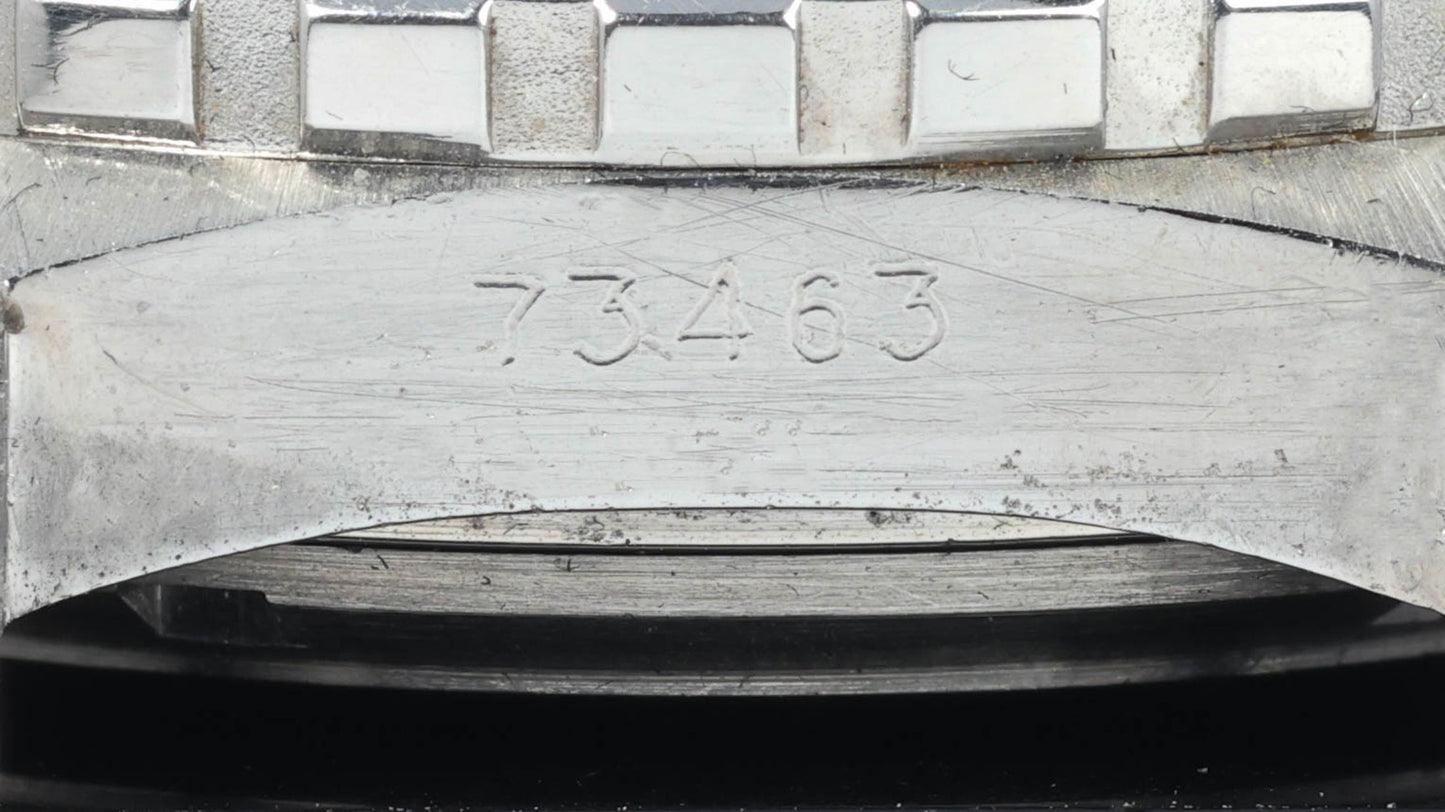
Heuer Autavia 'Israeli Defense Force - IDF' 73463 Unpolished 42mm 1970s
Heuer Autavia 'Israeli Defense Force - IDF' 73463 Unpolished 42mm 1970s
Couldn't load pickup availability
Heuer Autavia 'Israeli Defense Force - IDF' 73463 Unpolished 42mm 1970s
This Heuer Autavia ‘Israeli Defense Force (IDF)’ 42mm, dating to the 1970s, is presented in excellent vintage condition. The stainless steel case shows little to no visible wear and remains UNPOLISHED, with extremely sharp edges and well-preserved original geometry throughout. Case surfaces retain strong definition, reflecting careful use and long-term preservation.
The leather strap is in good condition, showing expected signs of wear consistent with age while remaining fully wearable and appropriate to the watch’s military character.
The dial and hands are in good overall condition, with clear printing, stable luminous material, and strong legibility. Any ageing present is consistent with period use and does not detract from function or appearance.
Vintage Use Note
Given this watch is a vintage timepiece, it should be treated as such and we recommend avoiding swimming or water exposure, even if it has passed water resistance testing at the time of assessment.
Share
Why we love this watch
Why we love this watch
Heuer Autavia IDF: A Military Issued Chronograph for the Israeli Air Force
Produced between the late 1960s and mid 1970s, the Heuer Autavia IDF was supplied as a wrist chronograph for pilots of the Israeli Air Force. Unlike civilian Autavia references sold through retail networks, this configuration was issued for operational use. Its specification reflects the requirements of military aviation during a period when wrist worn chronographs were routinely used for flight timing, navigation intervals and mission coordination. The Autavia IDF sits within Heuer’s pre TAG period and demonstrates how an existing chronograph platform was adapted for formal military supply rather than commercial distribution.
Heuer and Professional Timing Before Military Issuance
Heuer’s involvement with aviation timing predates the Autavia wrist chronograph by several decades. From the early 20th century, the company manufactured dashboard timers and stopwatches for aircraft, automobiles and industrial use. These instruments were supplied to airlines, race organisers and military contractors as timing equipment rather than consumer products. By the interwar period, Heuer stopwatches were already being used for flight timing and navigation calculations.
Following the Second World War, military aviation increasingly relied on wrist worn instruments. Aircraft cockpits were becoming more complex, and pilots required independent timing devices to measure elapsed minutes and hours during flight. Chronographs were used to support dead reckoning navigation, fuel consumption estimates and synchronised manoeuvres. Swiss manufacturers with existing aviation timing experience were natural suppliers, and Heuer was among them.
The Autavia as a Military Platform
The Autavia name originated in the 1930s as a contraction of “AUTomobile” and “AVIAtion,” first applied to dashboard timers. When Heuer reintroduced the Autavia as a wrist chronograph in the early 1960s, the design retained this dual heritage. Early references such as the Autavia 3646 were built with large stainless steel cases, rotating bezels and multi register chronograph layouts. These characteristics were aligned with professional use rather than dress wear.
The Autavia case design evolved incrementally rather than radically. Case diameter increased to approximately 42 mm, offering more dial surface area compared to many contemporary chronographs. The rotating bezel provided an additional method of tracking elapsed time independently of the chronograph mechanism. This feature had direct relevance for aviation, where multiple timing intervals could be required simultaneously.
Israeli Air Force Procurement Context
During the 1960s and 1970s, the Israeli Air Force operated a diverse fleet of aircraft sourced from multiple countries. Standardisation of equipment was often secondary to availability, performance and reliability. Wrist chronographs issued to pilots were expected to be functional, serviceable and sourced from established manufacturers with proven movements.
While surviving documentation is limited, multiple verified examples of Autavia chronographs with Israeli Air Force provenance confirm that Heuer supplied watches directly for military use. These were not modified civilian retail pieces but watches delivered in configurations consistent with military requirements of the period. The absence of retail packaging and the presence of service wear on most known examples supports their status as issued equipment.
Dial Configuration and Case Construction
The Autavia IDF is characterised by a specific dial layout that differs from most civilian Autavias. Arabic numerals are used for the primary hour markers rather than applied batons or mixed indices. These numerals are evenly sized and positioned, creating a uniform layout across the dial. Sub dials are recessed and placed symmetrically, typically in a tri register configuration consistent with Valjoux 72 architecture.
Hands are straight, functional and proportioned to their respective scales. Luminous compound was applied to the hour and minute hands and to the numerals, consistent with military specifications of the era. Branding on the dial is minimal, usually limited to the Heuer signature and chronograph designation. There are no racing references or decorative colour accents found on contemporary civilian Autavias.
The stainless steel case retains the standard Autavia form, including pump pushers and a screw down caseback. Case finishing is utilitarian, with brushed surfaces dominating over polish. This finishing approach is consistent with other military issued watches from the same period, where glare reduction and ease of refinishing were prioritised.
Movement Selection and Rationale
The majority of known Autavia IDF examples are powered by the Valjoux 72 manual wind chronograph movement. This calibre was widely used in aviation, motorsport and military chronographs during the mid 20th century. Its column wheel construction allowed for precise engagement of the chronograph functions, and its architecture was well understood by military and civilian watch technicians.
Manual winding was not considered a limitation in military service. Pilots were trained to wind and synchronise their watches as part of pre flight routines. The absence of an automatic winding system reduced mechanical complexity and made servicing more straightforward in non commercial settings. The Valjoux 72’s availability of spare parts during the period also supported its selection for issued equipment.
Operational Use in the Field
Anecdotal accounts from former Israeli Air Force personnel indicate that wrist chronographs were routinely used during training flights and operational missions. Pilots used chronographs to time legs of flight plans, calculate fuel reserves and coordinate manoeuvres. In aircraft without fully integrated digital timing systems, the wrist chronograph served as an independent reference.
In interviews conducted decades later, some pilots described synchronising their watches prior to flight briefings to ensure consistent timing across a formation. The rotating bezel was used to mark key time thresholds, such as fuel checks or navigation waypoints, while the chronograph measured shorter intervals. These practices align with standard aviation procedures of the era and explain the functional configuration of the Autavia IDF.
The watches were worn over flight suits or directly on the wrist depending on personal preference and cockpit ergonomics. This resulted in visible wear to cases and bezels on surviving examples, consistent with repeated use rather than storage.
Markings and Identification
Not all Autavia IDF watches are engraved, which reflects variability in military procurement practices. Some examples show caseback markings associated with inventory control, while others rely on configuration and provenance for identification. The lack of a single standard engraving does not detract from their issued status but rather reflects decentralised supply practices common in the period.
Serial ranges overlap with civilian Autavias produced during the same years, reinforcing that these watches were built on the same production lines but delivered to different end users. The distinction lies in specification rather than entirely separate manufacture.
Relationship to Other Military Chronographs
The Autavia IDF exists alongside other military issued chronographs of the same era, including those supplied to European and American air forces. Compared to purpose built military references from some manufacturers, the Autavia IDF demonstrates how an adaptable civilian design could meet military needs without extensive redesign.
This approach reduced development time and leveraged existing production capacity. It also ensured continuity of parts and servicing knowledge, an important factor for long term operational use.
Final Thoughts
The Heuer Autavia IDF is best understood as issued equipment rather than a styled military inspired watch. Supplied to the Israeli Air Force, it reflects the practical realities of aviation timing during the late 1960s and 1970s. Its configuration, movement choice and wear patterns align with documented operational use. Within Heuer’s pre TAG output, the Autavia IDF stands as a clear example of the brand’s role in supplying professional timing instruments for active service rather than civilian consumption.
Case & Bracelet
Case & Bracelet
- Case in excellent condition, little to no wear visible.
- Case is unpolished with extremely sharp edges
- Leather strap in good condition.
Dial & Hands
Dial & Hands
Dial & hands good condition.
Warranty & Condition
Warranty & Condition
Crown Vintage Watches provides a minimum 6-month mechanical warranty on pre-owned watches, from the date of purchase.
The warranty covers mechanical defects only.
The warranty does not cover damages such as scratches, finish, crystals, glass, straps (leather, fabric or rubber damage due to wear and tear), damage resulting from wear under conditions exceeding the watch manufacturer’s water resistance limitations, and damage due to physical and or accidental abuse.
Please note, water resistance is neither tested nor guaranteed.
Shipping and insurance costs for warranty returns to us must be covered by the customer. Returns must be shipped via traceable courier. Return shipment must be pre-paid and fully insured. Collect shipping will be refused. In case of loss or damages, the customer is liable.
Our Pledge
At Crown Vintage Watches, we stand by the authenticity of every product we sell. For added peace of mind, customers are welcome to have items independently authenticated at their own expense.
Condition
Due to the nature of vintage timepieces, all watches are sold as is. We will accurately describe the current condition and working order of all watches we sell to the best of our ability.
Shipping & Refund
Shipping & Refund