

Crown Vintage
Heuer Camaro 7220NT 'First Execution' 37mm 1968
Heuer Camaro 7220NT 'First Execution' 37mm 1968
Couldn't load pickup availability
Heuer Camaro 7220NT 'First Execution' 37mm 1968
This Heuer Camaro 7220NT ‘First Execution’ 37mm, dating to 1968, is presented in excellent unpolished condition. The stainless steel case retains its original geometry with sharp edges and well-defined surfaces, showing no signs of polishing and only minimal evidence of careful wear. Case lines and proportions remain true to the first execution profile.
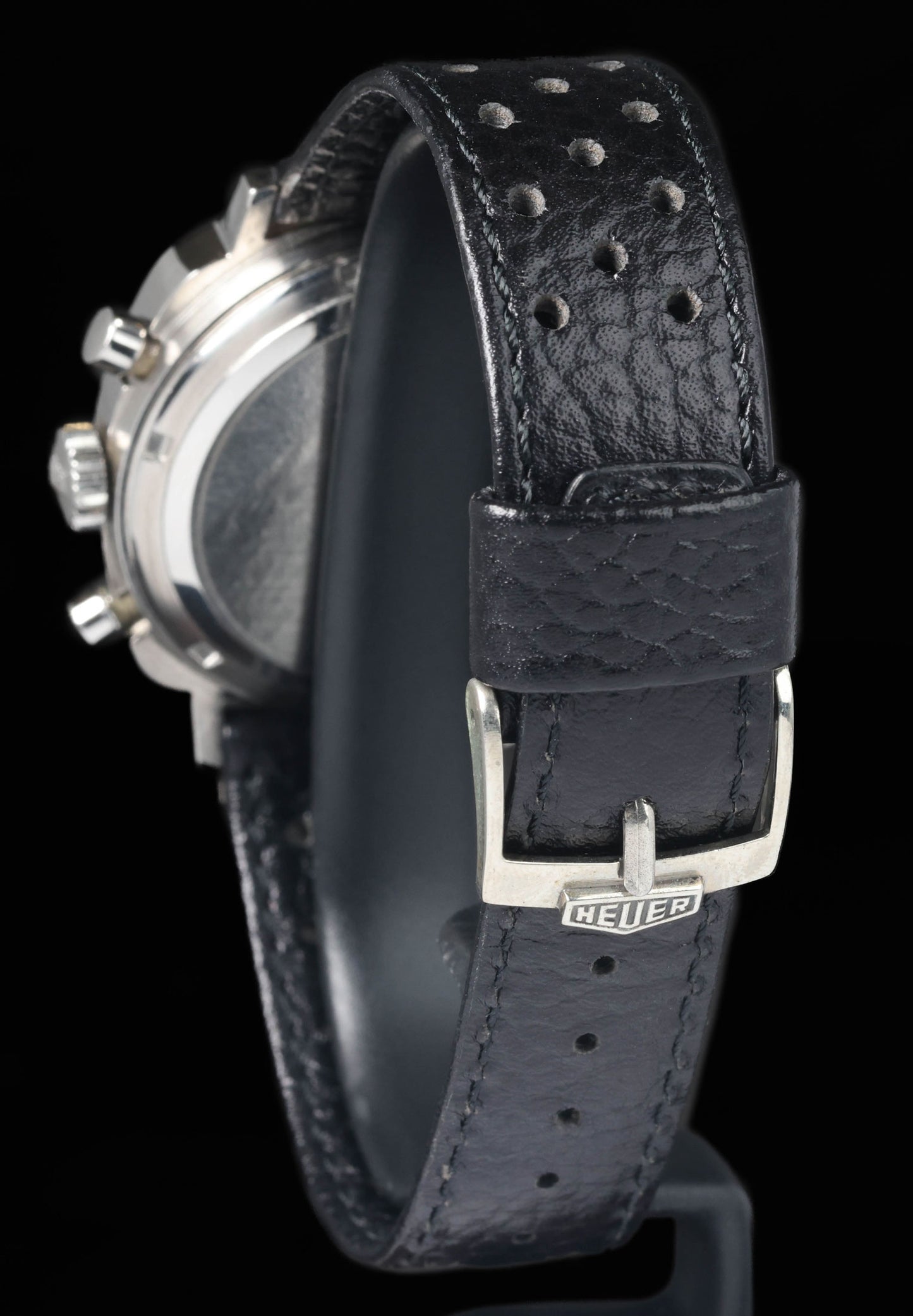
The strap is in great condition and is fitted with a correct Heuer signed buckle, complementing the watch’s period character while remaining fully wearable.
The dial and hands are in good overall condition, with clear printing, stable luminous material, and honest ageing consistent with the watch’s age. Legibility remains strong, and the presentation is cohesive across all components.
As with all watches of this era, this Camaro should be treated as a vintage timepiece and is not recommended for swimming or water exposure, regardless of original specifications.
Share
Why we love this watch
Why we love this watch
Heuer Camaro 7220NT
Introduction
Produced between the late 1960s and early 1970s, the Heuer Camaro reference 7220NT was developed as a manually wound chronograph positioned between Heuer’s established Carrera line and its larger, more overtly sporting models such as the Autavia. The Camaro range was conceived to offer a compact, modern chronograph with strong legibility and contemporary case design, aimed at professional and everyday use rather than specialised competition timing alone. The 7220NT variant is defined by its cushion shaped stainless steel case, Valjoux 72 movement, and high contrast dial configuration that reflects Heuer’s design priorities of the period.
Heuer in the Late 1960s
During this period, Heuer was refining its chronograph portfolio in response to changing tastes and increasing demand for more wearable, versatile designs. The brand had already established its reputation through models such as the Carrera and Autavia, both closely associated with motorsport and professional timing. By the mid to late 1960s, however, there was growing interest in chronographs that balanced sporting functionality with everyday practicality. Case sizes were increasing modestly, dial designs were becoming cleaner, and there was a clear move toward modern, geometric case shapes. The Camaro was introduced within this context as a contemporary alternative to Heuer’s more traditional round case chronographs.
Origins of the Camaro Line
The Camaro line was introduced as a distinct model family rather than a variation of an existing reference. Its name aligned with Heuer’s broader practice of adopting automotive inspired naming conventions, reinforcing the brand’s ongoing association with motorsport culture. While the Camaro did not replace the Carrera or Autavia, it complemented them by offering a different design language. The cushion case provided a modern aesthetic while maintaining compact dimensions, allowing the watch to sit comfortably on the wrist without the visual bulk associated with larger tool chronographs of the era.
Case Design and Dimensions
The Heuer Camaro 7220NT is housed in a stainless steel cushion shaped case measuring approximately 37mm in diameter. This size reflects period norms while offering a slightly broader wrist presence than earlier slim chronographs. The case features softly rounded edges, short integrated lugs, and a relatively thin mid case profile. These proportions contribute to a balanced wearing experience and distinguish the Camaro from the sharper, more angular case designs that would emerge later in the 1970s. The case finish combines brushed and polished surfaces, applied selectively to emphasise the geometry of the cushion form without excessive ornamentation.
Bezel and Crystal
The 7220NT is fitted with a fixed stainless steel bezel that frames the dial cleanly, without tachymeter or telemeter scales engraved externally. This decision places visual emphasis on the dial itself and reinforces the Camaro’s understated, modern character. A domed acrylic crystal is used, consistent with Heuer’s production practices of the time. The crystal contributes to the watch’s overall profile and enhances dial legibility by softening reflections and providing subtle distortion at extreme viewing angles.
Dial Configuration and Aesthetic
The dial of the Heuer Camaro 7220NT is central to its identity. The “NT” designation refers to a noir style dial with contrasting subdials, creating a high contrast layout optimised for legibility. The main dial surface is typically finished in matte black, reducing glare and ensuring clear visibility under varied lighting conditions. Subdials are rendered in a contrasting tone, providing immediate visual separation between chronograph functions and standard timekeeping information. This approach aligns with Heuer’s long standing emphasis on functional clarity.
Subdial Layout and Chronograph Display
The 7220NT uses a classic three register chronograph layout dictated by the Valjoux 72 movement. Running seconds are positioned at 9 o’clock, with the 30 minute and 12 hour chronograph counters placed symmetrically at 3 and 6 o’clock respectively. This balanced arrangement provides intuitive readability and reflects a design language that had become a standard for professional chronographs by the late 1960s. The central chronograph seconds hand is clearly distinguished from the timekeeping hands, ensuring elapsed time can be read without confusion.
Hands, Markers, and Luminous Material
The hands used on the Camaro 7220NT are straight baton style, finished to contrast clearly against the dial. Hour markers are applied or printed depending on production batch, with a focus on legibility rather than decorative detail. Luminous material is applied to the hour markers and hands to support low light visibility. The application is restrained and consistent with Heuer’s functional design ethos, avoiding oversized lume plots or unnecessary visual complexity.
Valjoux 72 Movement
Powering the Heuer Camaro 7220NT is the Valjoux 72, a manually wound chronograph movement that was widely regarded as a benchmark for reliability and precision during the era. Produced by Valjoux, the calibre features a column wheel controlled chronograph mechanism and a three register layout. Its architecture allowed for smooth chronograph operation and precise engagement, characteristics that made it a preferred choice for professional grade chronographs across multiple brands.
Technical Characteristics of the Valjoux 72
The Valjoux 72 operates at 18,000 vibrations per hour and provides a power reserve suitable for daily wear when manually wound. The column wheel design ensures positive pusher feel and consistent chronograph function. The movement’s layout dictates the balanced subdial arrangement seen on the Camaro 7220NT and contributes directly to the watch’s overall proportions. The calibre’s relatively slim profile allows the Camaro to maintain a moderate case thickness, enhancing wearability.
Integration of Movement and Case
The Camaro case was engineered to accommodate the Valjoux 72 without excessive bulk. The cushion profile distributes the movement evenly across the wrist, while the short lug design ensures stability during wear. This integration reflects Heuer’s attention to ergonomics and practical use, ensuring that the chronograph could be worn comfortably over extended periods without compromising functionality.
Position Within the Heuer Catalogue
Within Heuer’s late 1960s catalogue, the Camaro occupied a distinct position. It offered the technical credibility of a Valjoux powered chronograph in a case design that was more contemporary and compact than the Autavia, yet less minimalist than the Carrera. This positioning made the Camaro suitable for a wide range of use cases, bridging the gap between overtly sporting chronographs and more restrained designs intended for everyday wear.
Production Period and Reference Context
The Camaro line had a relatively short production life compared to other Heuer models. The 7220NT was produced during this limited window, resulting in a consistent specification across examples rather than a long sequence of incremental revisions. This consistency reflects the Camaro’s role as a defined design concept rather than a continuously evolving platform.
Design Trends and Industry Context
The late 1960s were a period of experimentation in chronograph design. Cushion cases, high contrast dials, and improved legibility were increasingly common as brands responded to both aesthetic trends and functional demands. The Camaro 7220NT reflects these influences clearly, combining traditional movement architecture with modern case design. At the same time, the watch remained rooted in established chronograph conventions, avoiding radical departures in layout or operation.
Wearability and Practical Use
On the wrist, the Camaro 7220NT offers a compact and balanced experience. Its 37mm case size sits comfortably on a wide range of wrists, while the cushion shape provides visual presence without excessive mass. The dial layout ensures that both timekeeping and chronograph functions are easily readable, supporting the watch’s role as a practical instrument rather than a purely stylistic object.
Historical Significance of the Camaro
The Heuer Camaro 7220NT provides insight into how Heuer approached chronograph design during a period of transition. It demonstrates the brand’s willingness to explore new case shapes and design languages while retaining proven movement technology. The Camaro stands as a documented example of Heuer’s efforts to modernise its offerings without abandoning the functional principles that defined its earlier success.
Relationship to Other Heuer Chronographs
While the Camaro did not achieve the same longevity as the Carrera or Autavia, it played an important role within Heuer’s broader portfolio. Its design elements influenced subsequent models and reflected broader shifts in the industry toward more contemporary aesthetics. The use of the Valjoux 72 aligns the Camaro with some of Heuer’s most respected chronographs of the era, reinforcing its technical credibility.
Final Thoughts
The Heuer Camaro 7220NT was developed as a compact, manually wound chronograph that combined modern case design with established chronograph mechanics. Its cushion shaped case, high contrast dial, and Valjoux 72 movement reflect Heuer’s priorities during the late 1960s, balancing legibility, wearability, and functional clarity. Viewed within its historical and industrial context, the Camaro 7220NT represents a clear and factual example of Heuer’s approach to chronograph design during a period of stylistic and technical evolution.
Case & Bracelet
Case & Bracelet
- Case in excellent unpolished condition.
- Strap in great condition with heuer Buckle
Dial & Hands
Dial & Hands
Dial & hands good condition.
Warranty & Condition
Warranty & Condition
Crown Vintage Watches provides a minimum 6-month mechanical warranty on pre-owned watches, from the date of purchase.
The warranty covers mechanical defects only.
The warranty does not cover damages such as scratches, finish, crystals, glass, straps (leather, fabric or rubber damage due to wear and tear), damage resulting from wear under conditions exceeding the watch manufacturer’s water resistance limitations, and damage due to physical and or accidental abuse.
Please note, water resistance is neither tested nor guaranteed.
Shipping and insurance costs for warranty returns to us must be covered by the customer. Returns must be shipped via traceable courier. Return shipment must be pre-paid and fully insured. Collect shipping will be refused. In case of loss or damages, the customer is liable.
Our Pledge
At Crown Vintage Watches, we stand by the authenticity of every product we sell. For added peace of mind, customers are welcome to have items independently authenticated at their own expense.
Condition
Due to the nature of vintage timepieces, all watches are sold as is. We will accurately describe the current condition and working order of all watches we sell to the best of our ability.
Shipping & Refund
Shipping & Refund