

Crown Vintage
Heuer Carrera CS3110 Reissue 36mm 1964
Heuer Carrera CS3110 Reissue 36mm 1964
Couldn't load pickup availability
TAG Heuer Carrera CS3110
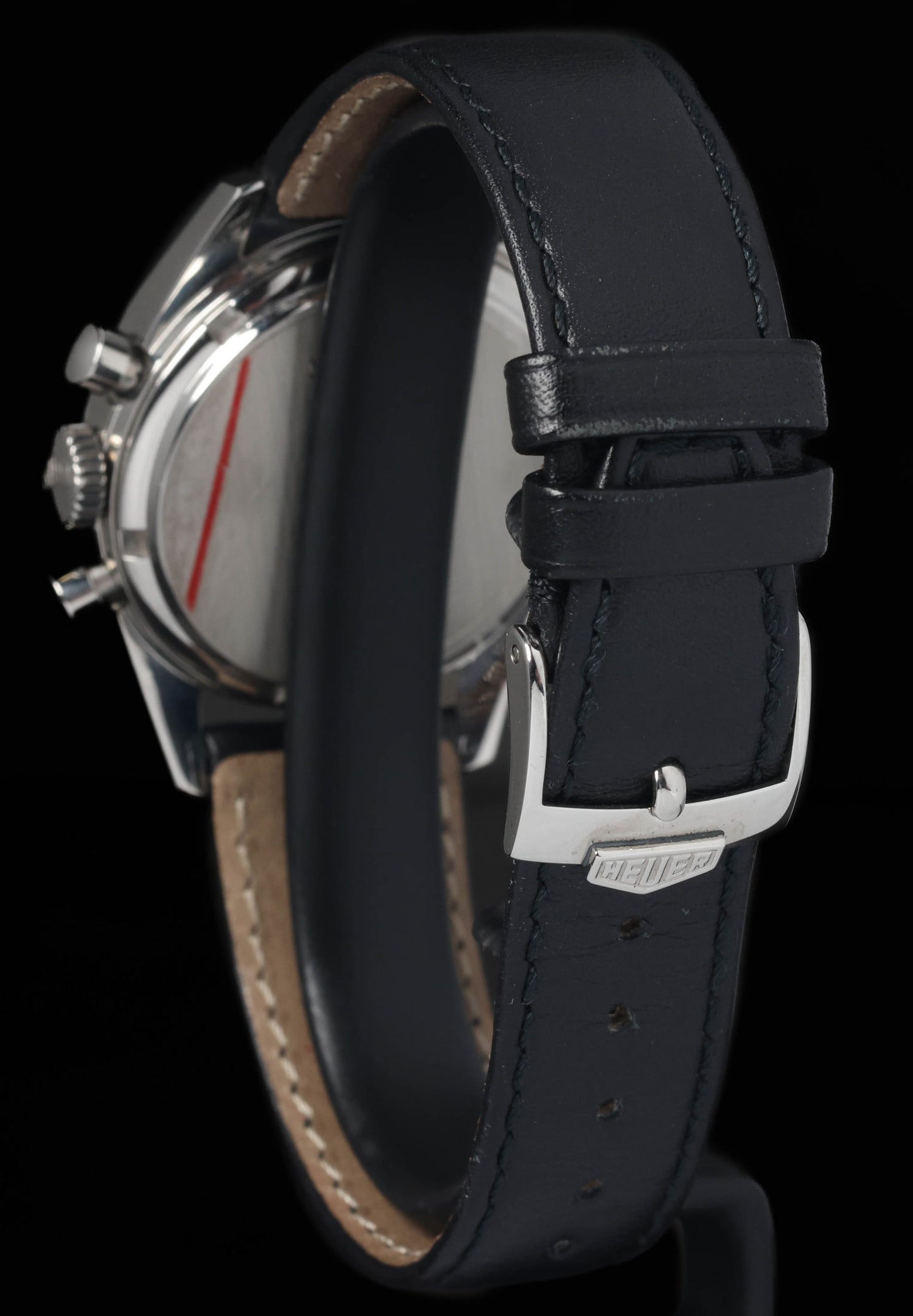
This Heuer Carrera CS3110 presents in excellent overall condition, reflecting careful ownership and sympathetic handling. The stainless steel case remains sharp with well-defined edges and clean surfaces, showing only minimal signs of wear consistent with light, considered use. Original case geometry is fully intact, with no distracting marks or softening evident.
The stainless steel bracelet is also in excellent condition, retaining tight links and a clean finish throughout, with only minor hairlines visible under close inspection. It sits correctly with the case and contributes to the watch’s balanced, period-correct appearance.
The dial is in excellent condition, with crisp printing, even colour, and no visible blemishes, staining, or discolouration. The hands are equally well preserved, matching the dial in both tone and condition, with no corrosion or deterioration observed.
Witschi WAIO Test Results
This watch has passed a 5.0 Bar water pressure test on our Witschi WAIO machine, has been de-magnetised and passed chronometry test. The watch is running at an average of roughly +12 seconds per day, which is very acceptable, with a modest positional spread indicating consistent behaviour across positions. Beat error sits comfortably below 0.5 ms, pointing to good balance alignment, while amplitude averages around 300°, remaining strong even in vertical positions. Overall, the test confirms stable performance with no mechanical warning signs, consistent with a well-kept vintage timepiece.
Overall, this is a very strong example of the Carrera CS3110, displaying consistent condition across all key components and is running well.
Vintage Use Note
Given this watch is over 30 years old, it should be treated as a vintage timepiece and we recommend avoiding swimming or water exposure, even though it has passed water resistance testing at the time of assessment.
Share
Why we love this watch
Why we love this watch
Heuer Carrera CS3110 Review and History
Produced between 1996 and 2002, the Heuer Carrera CS3110 is the reference that brought the Carrera back as a near one to one revival of the original 1960s formula: compact 36mm case, hand wound chronograph, high legibility dial, and the Heuer shield on the dial instead of TAG Heuer. It arrived at a moment when TAG Heuer was reshaping its identity after a long gap in Carrera production, and it did so by leaning into the clearest through-line of the model: purposeful design for timing under pressure.
What the CS3110 Is
The CS3110 is the white or silver dial steel variant from the first Carrera re-editions introduced in 1996. In the same initial trio you also had the black dial steel CS3111 and the yellow gold CS3140, all built around the same essential idea: reintroduce the Carrera with the same proportions and dial logic that defined the earliest references.
What makes the CS3110 especially distinctive in period is the decision to keep it visually “Heuer”. TAG Heuer was the company name, but the watch wears a Heuer signed dial, echoing the pre-TAG era that originally established the Carrera name. TAG Heuer itself notes that the 1996 re-edition was created as an almost one-to-one copy of the first Carrera from 1963, including the 36mm case and the core dial architecture.
The Reference Name and the Carrera Thread
“Carrera” was never just a decorative word on a dial. The name was taken from the Carrera Panamericana road race in Mexico, run in the early 1950s, and TAG Heuer’s own history pages explicitly tie Jack Heuer’s naming choice to that border-to-border event. The significance is practical as much as romantic: the Carrera concept was aimed at timing and readability in racing conditions, which is why early Carreras prioritised clear markers, clean printing, and a dial that can be read instantly.
Case and Wearing Experience
The CS3110 sits in a 36.00mm stainless steel case with a closed caseback, plexi crystal, and 30m water resistance. The profile is around 13.00mm thick, which is typical for a manually wound cam operated chronograph of this layout, and it helps the watch feel properly “of its era” rather than artificially slimmed down.
36mm Done Properly
A key part of the CS3110’s appeal is that it does not try to modernise the Carrera by scaling it up. TAG Heuer’s own vintage write-up frames the 1996 re-editions as faithful to the original 36mm case size and the geometry of the pushers and crown. In practical terms, that means short, crisp lugs and a compact footprint that wears neatly on a wide range of wrists, with the dial doing most of the visual work rather than the case trying to dominate.
Pushers, Crown, and The “Tool” Feel
The original Carrera design language was built around function first ergonomics: straightforward pushers, a crown that is easy to grasp, and a layout that assumes you might be operating it quickly. The CS3110 follows that template closely, and TAG Heuer highlights the fidelity not just in size, but in the crown and pusher geometry as well.
Plexi Crystal and Why It Matters Here
Plexi on a 1990s watch might sound like an anachronism, but on the CS3110 it is a deliberate choice to keep the look and light behaviour consistent with 1960s Carreras. WatchBase lists the CS3110 with a plexi crystal, and that choice supports the warm, slightly softened reflections that suit the vintage dial design.
Dial Design and Legibility
The dial is where the CS3110 earns its “Carrera” status. The layout follows the classic tri-compax pattern with sub-dials at 3, 6, and 9, and a restrained set of applied markers that keep the watch readable without becoming sterile. WatchBase lists the dial colour as silver with stick and dot indexing, consistent with the clean re-edition intent.
The Decimal Minutes Scale
One of the most important dial details on the CS3110 is the decimal minutes scale, a period correct motorsport timing feature where minutes are expressed in tenths for quick calculations. TAG Heuer specifically calls out that all three models of the 1996 Carrera re-edition feature the decimal minutes scale, matching one of the options offered in the earliest generation. It is an unusually functional design choice for a revival piece, because it preserves an authentic racing oriented timing system rather than adding a generic tachymetre purely for appearance.
The Telltale Detail That Separates It From the 1960s Watch
If you put a CS3110 next to an early 1960s Carrera, the similarities are intentional. TAG Heuer also provides a clear visual tell for separating the re-edition from the early originals: the original models had “Carrera” on the dial above the Heuer shield, while the re-edition does not. This is a small change, but it matters historically because it shows how closely TAG Heuer was willing to go while still leaving a discreet signature of the later era.
Movement: Lemania Calibre 1873
Inside the CS3110 is the Lemania calibre 1873, a hand wound chronograph movement that has a long and respected technical lineage. WatchBase identifies the CS3110 as housing the Lemania 1873 and lists the functional layout as hours, minutes, small seconds, plus chronograph.
Why TAG Heuer Chose Lemania
When TAG Heuer brought the Carrera back in 1996, it needed a movement that could deliver the correct architecture and tactile experience: manual winding, tri-compax registers, and robust chronograph operation. TAG Heuer’s own magazine write-up on the Carrera re-edition notes that the watches used a hand wound chronograph movement supplied by Lemania, aligning with the original spirit even though the historical 1960s references often used different families of chronograph movements.
The Lemania 1873 is widely known as a cam actuated design rather than a column wheel. That matters in use because the pusher feel is typically firm, consistent, and engineered for durability. A Chrono24 listing that quotes official TAG Heuer text describes the Lemania 1873 approach as using a cam in place of the column wheel used in some older chronograph designs. The result suits the CS3110’s core idea: a functional chronograph in classic form, not a decorative complication.
Historical Significance: Why the CS3110 Matters in the Carrera Story
The CS3110 is historically significant because it is not simply “a Carrera from the 1990s”. It is the first decisive move to re-establish the Carrera as a central idea after a long production break. TAG Heuer’s Carrera vintage history notes that earlier generations ran from the first introduction in 1963 through to the last appearances in 1985, followed by the sixth generation reintroduction in 1996.
The Original Carrera Context
To understand why the CS3110 was such a careful reintroduction, it helps to understand what the Carrera was at launch. The first Carrera, the reference 2447, debuted in 1963 at the Basel Fair, designed as a new style of chronograph aimed at professional drivers and the demands of racing timing. The design discipline of those early watches is widely documented: a 36mm case, faceted lugs, and dial layouts that strip away anything non-essential so that elapsed time can be read instantly.
The name itself links directly to motorsport history. TAG Heuer’s official historical timeline states that Jack Heuer took the name from the Carrera Panamericana race, staged in Mexico from 1950 to 1954, and that early Carreras were available with functional scales including tachymetre, decimal minutes, or pulsometer. That last point is critical, because it connects directly to the CS3110’s decimal minutes scale and explains why it is more than a styling flourish.
Why The 1996 Re-Edition Approach Was So Conservative
By the mid 1990s, watch design trends were not pointing toward a 36mm manual wind chronograph with plexi. That is precisely why the CS3110 stands out as a historically meaningful product decision. TAG Heuer describes the 1996 re-edition as a cautious approach, creating an almost one-to-one copy of the first Carrera from 1963. The brand essentially used the Carrera’s original principles as a reset button: clean dial, strong lugs, straightforward chronograph controls.
The result was a reference that validated the Carrera name again, then allowed TAG Heuer to expand the range later. On the same TAG Heuer history page, the narrative progresses from the re-editions through to early 2000s “classic” Carreras that shifted toward automatic movements, and then into larger case sizes as tastes changed. Even if you ignore everything that came later, the CS3110 remains the hinge point: it is where the Carrera returns by reaffirming what the Carrera was meant to be in the first place.
The Heuer Shield on a TAG Heuer Era Watch
There is also a branding significance that is easy to miss. The CS3110 is firmly a TAG Heuer era product, yet it is one of the best examples of a deliberate “Heuer forward” presentation. This was not a generic retro release. TAG Heuer itself calls out an exact visual tell between original 1960s Carreras and the re-edition, implying the brand expected people to compare them closely. That level of transparency is part of what makes the CS3110 important historically: it was presented as a revival in dialogue with a known design, not as a loosely inspired modern Carrera.
Variants and The CS3110’s Place Within Them
The CS3110 sits within a small, tightly related family. TAG Heuer documents the initial 1996 trio as CS3110 (white dial steel), CS3111 (black dial steel), and CS3140 (white dial gold). Over the late 1990s the range expanded with additional dial treatments, signalling a gradual shift away from strict one-to-one replication and toward variations that still preserved the core Carrera case and dial logic.
When people refer to “Carrera re-editions” from this era, they are often talking about this precise grouping. WatchBase even frames the CS3110.BC0725 as part of the first series of re-editions, produced from 1996 to 2002.
How to Read the CS3110 on the Wrist
The CS3110 is at its best when you treat it as a simple, readable chronograph with a very deliberate design hierarchy. The applied markers and clean hands do the heavy lifting. The sub dials are recessed enough to separate information without shouting for attention. The decimal minutes track gives the dial a purposeful outer structure, and because TAG Heuer explicitly ties that track to original era options, it reads as historically coherent rather than decorative.
The end result is a watch that makes sense in close up inspection and also at a glance. That combination is the Carrera’s original brief, and it is why this reference continues to read as a proper continuation of the line rather than a costume version of it.
Final Thoughts
The Heuer Carrera CS3110 is one of the clearest examples of a brand reviving an iconic model by returning to first principles rather than chasing contemporary fashion. Its 36mm case, plexi crystal, and Lemania 1873 manual wind movement were deliberate decisions that anchored the watch to the practical, legible chronograph design language established in the early 1960s. Just as importantly, the CS3110 sits at a real turning point in Carrera history: it marks the reintroduction of the Carrera after the long break, and it does so by directly referencing the model’s racing origin story, from the Carrera Panamericana inspired name through to functional dial scales like the decimal minutes track.
Case & Bracelet
Case & Bracelet
Case and bracelet are in excellent condition.
Dial & Hands
Dial & Hands
Dial and hands are in excellent condition.
Warranty & Condition
Warranty & Condition
Crown Vintage Watches provides a minimum 6-month mechanical warranty on pre-owned watches, from the date of purchase.
The warranty covers mechanical defects only.
The warranty does not cover damages such as scratches, finish, crystals, glass, straps (leather, fabric or rubber damage due to wear and tear), damage resulting from wear under conditions exceeding the watch manufacturer’s water resistance limitations, and damage due to physical and or accidental abuse.
Please note, water resistance is neither tested nor guaranteed.
Shipping and insurance costs for warranty returns to us must be covered by the customer. Returns must be shipped via traceable courier. Return shipment must be pre-paid and fully insured. Collect shipping will be refused. In case of loss or damages, the customer is liable.
Our Pledge
At Crown Vintage Watches, we stand by the authenticity of every product we sell. For added peace of mind, customers are welcome to have items independently authenticated at their own expense.
Condition
Due to the nature of vintage timepieces, all watches are sold as is. We will accurately describe the current condition and working order of all watches we sell to the best of our ability.
Shipping & Refund
Shipping & Refund