

Crown Vintage
Heuer Skipper Reference 15640 40mm 1978
Heuer Skipper Reference 15640 40mm 1978
Couldn't load pickup availability
Heuer Skipper Reference 15640 40mm 1978
Case and Exterior Condition
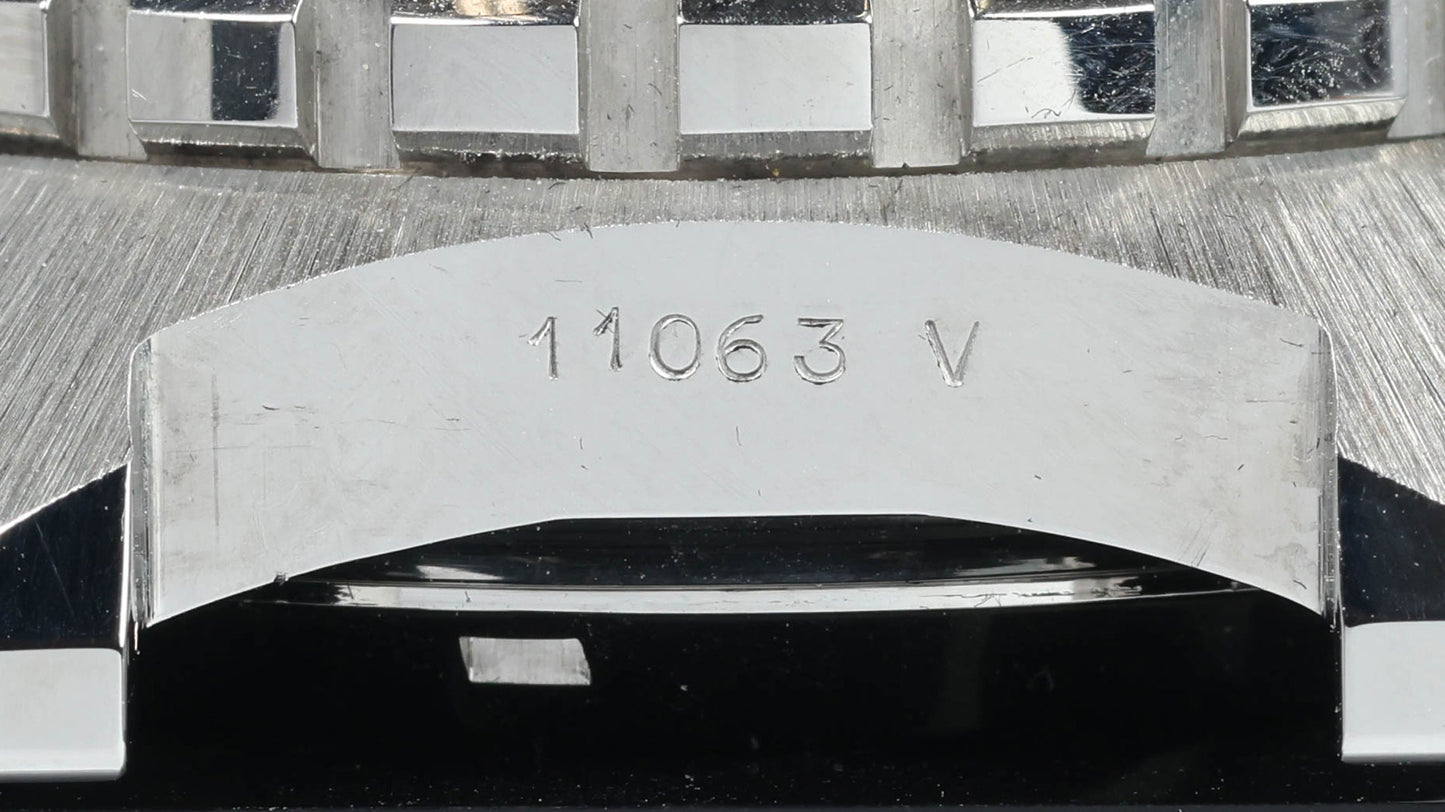
The stainless steel 11063V case is presented in excellent condition, retaining sharp, well defined lugs with original geometry clearly intact. No noticeable hairline scratches are visible even on close inspection. Overall case condition indicates minimal intervention, with edges remaining crisp and surfaces clean. The watch presents exceptionally well on the wrist and will satisfy even the most detail focused buyers. Caseback retains original
Dial, Hands and Crystal
The dial is in excellent vintage condition with strong colour, clean printing and no visible damage. Warm patina on hour markers. The regatta countdown register remains clear and well defined. Hands are also in excellent condition, matching the dial correctly and showing matching patina to hour markers. The mineral crystal is clear, allowing unobstructed visibility of the dial.
Strap
The watch is fitted to a rubber Tropic strap that complements the nautical purpose of the Skipper perfectly. The strap is in excellent condition and suits the overall character of the watch well.
Important Note
As this watch is over 30 years old, it should be treated as a vintage timepiece. Water resistance cannot be guaranteed and it is not recommended for swimming or water exposure, even though it was originally designed for use in a marine environment.
Share
Why we love this watch
Why we love this watch
Heuer Skipper Reference 15640
Introduction
Produced in the late 1970s, the Heuer Skipper reference 15640 was developed as a dedicated regatta chronograph at a time when Heuer was still designing watches around specific timing problems rather than lifestyle positioning. This reference sits within the final generation of Heuer Skipper wristwatches and reflects the brand’s long standing involvement with yachting and professional timing. Built using an Autavia derived case, a modified automatic movement and a simplified regatta focused display, the 15640 was never intended to be a general purpose chronograph. Its design, layout and production volumes were dictated by function, aligning closely with Heuer’s broader approach to specialist sports timing during this period.
Heuer and Regatta Timing Before the Skipper
Heuer’s involvement in regatta timing predates the Skipper wristwatch by several decades. From the early twentieth century, the company produced stopwatches and dashboard timers used in yacht racing, reflecting an understanding of the unique timing demands of the sport. Regattas differ from circuit racing in that the critical timing phase occurs before the race begins. Boats must position themselves accurately at the starting line during a fixed countdown period, most commonly fifteen minutes. This required timing instruments that prioritised clarity and interval awareness rather than elapsed time over long durations.
By the 1960s, Heuer had already established itself as a leader in specialist sports timing, supplying equipment for motorsport, aviation and sailing. The decision to translate regatta timing into a wrist worn chronograph followed naturally from this background. Rather than adapting an existing chronograph without modification, Heuer chose to redesign the display to suit the requirements of yacht racing.
The First Skipper Chronographs
The earliest Heuer Skipper wristwatch appeared in the late 1960s in the form of the Carrera based reference 7754, often referred to as the Skipperera. This watch incorporated a fifteen minute regatta countdown subdial, visually segmented to indicate key phases of the pre race sequence. Production numbers were extremely low, reflecting the specialised nature of the watch and the limited audience for such a function.
Although the Skipperera established the concept, it also highlighted the limitations of adapting a traditional chronograph platform. The manual wind Carrera case was compact and elegant, but not ideally suited to the increasing complexity of automatic chronograph movements that were about to enter the market. As Heuer moved into the 1970s, the Skipper concept migrated toward larger, more robust case designs.
The Skipper and the Autavia Platform
The Autavia line provided a more suitable foundation for a regatta chronograph. Originally developed as a robust sports chronograph with motorsport and aviation applications, the Autavia offered greater case volume, improved legibility and compatibility with automatic movements. During the 1970s, Heuer produced several Skipper references using Autavia cases, both manual and automatic.
The Skipper reference 15640 belongs to this later phase of development. It was conceived after the introduction of Heuer’s automatic chronograph movements and reflects the brand’s efforts to consolidate its specialist watches around fewer, more adaptable platforms. By this stage, Heuer was refining rather than expanding its catalogue, focusing on watches with clearly defined purposes.
Historical Context of the Late 1970s
The period in which the Skipper 15640 was produced was marked by significant change within the Swiss watch industry. Automatic chronographs had become well established, but electronic and quartz technology was beginning to disrupt traditional mechanical watchmaking. Brands were under pressure to rationalise production and reduce complexity while still serving professional users.
Heuer’s response during this period was pragmatic. Rather than abandoning specialist watches immediately, the company continued to produce niche models where there was a clear functional justification. The Skipper 15640 fits squarely within this approach. It was not designed to appeal broadly, but to serve a specific timing role that Heuer had long supported.
Case Architecture and the 11063V
The Skipper 15640 uses the 11063V case, a cushion shaped stainless steel case derived from the Autavia family. This case design emerged in the mid to late 1970s and represented a departure from the earlier round and compressor style Autavias. The cushion form provided increased internal volume for automatic movements and improved wrist stability.
The choice of this case was driven by practicality rather than aesthetics. Automatic chronograph movements required additional space, and the cushion profile allowed Heuer to maintain reasonable proportions while accommodating the necessary components. The case construction prioritised durability and legibility, consistent with the Skipper’s intended use in active environments.
Crystal Choice and Period Specification
Unlike earlier Autavia and Carrera models that used acrylic crystals, the Skipper 15640 was fitted with a mineral crystal. This choice reflected broader industry trends in the late 1970s, as manufacturers sought improved scratch resistance without the cost and production challenges associated with early sapphire crystals.
Mineral crystal offered a balance between clarity and durability, making it suitable for a sports oriented chronograph. For a regatta watch that might be exposed to saltwater spray and frequent handling, this specification aligned well with the Skipper’s functional brief.
Dial Design and Regatta Function
The defining feature of the Skipper dial is its fifteen minute regatta countdown register. Unlike standard chronograph totalisers that record thirty or forty five minutes, the Skipper’s subdial is limited to the pre race interval. This simplification reflects a clear design decision to remove unnecessary information and focus solely on the timing task at hand.
The use of colour segmentation within the register was not decorative. It allowed sailors to assess remaining time at a glance, even under pressure. This approach mirrored Heuer’s earlier regatta timers and reinforced continuity between the company’s wristwatches and professional timing equipment.
The remainder of the dial was arranged for clarity, with minimal complication beyond the regatta function. This restraint is characteristic of Heuer’s specialist watches from this era, where visual balance was subordinate to legibility.
Movement Architecture and the Buren 15
Powering the Skipper 15640 is a modified Buren 15 automatic movement. The Buren 15 belongs to the family of micro rotor based movements that Heuer adopted following its involvement in the automatic chronograph development consortium of the late 1960s. While the Calibre 11 received greater attention, the Buren 15 and its derivatives powered a wide range of Heuer chronographs throughout the 1970s.
For the Skipper, the movement was adapted to drive a fifteen minute chronograph register rather than a conventional thirty minute counter. This modification underscores the extent to which the Skipper was engineered around its intended use. The micro rotor architecture allowed automatic winding without excessive thickness, contributing to a balanced overall case profile.
Contemporary technical commentary has described the Buren based Heuer movements as robust and practical, prioritising reliability over novelty. This assessment aligns closely with the Skipper’s role within the catalogue.
Production Period and Dating
The Skipper reference 15640 is generally dated to the late 1970s, with production extending into the early 1980s. This timing places it among the final Skipper references produced before significant structural changes within Heuer. Archival material and comparative analysis of known examples support this dating, situating the 15640 alongside late Autavia references that share similar case and movement characteristics.
Production volumes were modest, reflecting both the specialised function of the watch and the broader contraction of mechanical chronograph offerings during this period. Unlike mainstream Autavia or Carrera models, the Skipper was never produced in large numbers.
Position Within the Heuer Catalogue
Within Heuer’s catalogue, the Skipper occupied a narrow but clearly defined role. It was not marketed alongside general purpose chronographs, nor was it positioned as a luxury object. Instead, it was presented as a functional instrument for a specific sport.
This positioning is consistent with Heuer’s historical approach to specialist watches. Models such as the Bundeswehr chronographs and certain Autavia variants were developed for defined professional uses rather than broad consumer appeal. The Skipper belongs firmly within this tradition.
Rarity and Survival
Skipper references are encountered far less frequently than other Heuer chronographs of the same era. Several factors contribute to this scarcity, including limited production, niche demand and real world use. Watches that were genuinely used in regatta environments were often subjected to challenging conditions, reducing survival rates over time.
As a result, well preserved examples of the Skipper 15640 are uncommon. This scarcity is not the result of intentional limitation but rather a consequence of purpose driven production and use.
Contemporary Commentary and Sources
Modern scholarship on Heuer has increasingly acknowledged the importance of the Skipper within the brand’s history. Specialist publications have described the Skipper as a clear example of Heuer’s functional design ethos. One detailed analysis notes that the reference 15640 represents the final evolution of the Skipper concept, combining automatic winding with a simplified regatta display.
Other sources have highlighted the continuity between Heuer’s early regatta timers and the Skipper wristwatches, emphasising the company’s long term commitment to sailing as a timed sport.
The End of the Skipper Line
By the early 1980s, the conditions that supported niche mechanical chronographs had largely disappeared. Heuer’s focus shifted as the company adapted to new ownership structures and changing market realities. The Skipper line was quietly discontinued, marking the end of Heuer’s dedicated regatta chronographs.
This transition was not abrupt but reflected a gradual withdrawal from highly specialised mechanical instruments. In this sense, the Skipper 15640 can be viewed as one of the last expressions of a particular approach to watchmaking.
Historical Significance
From a historical perspective, the Heuer Skipper reference 15640 illustrates how a major Swiss manufacturer addressed a specific sporting requirement through thoughtful design and engineering. Its existence is tied directly to Heuer’s identity as a producer of professional timing instruments rather than decorative accessories.
The watch also serves as a record of late 1970s watchmaking priorities, where practicality, clarity and mechanical reliability were still central considerations despite growing external pressures.
Final Thoughts
The Heuer Skipper reference 15640 is best understood through its purpose. It was created to measure a defined interval for a specific sport, using a case, movement and display chosen to support that role. Produced in limited numbers during a period of industry contraction, it represents the final stage of Heuer’s regatta chronograph development. As such, it remains an instructive example of how function shaped design in Heuer’s late independent era.
Case & Bracelet
Case & Bracelet
The 11063V case is in excellent condition. Sharp lugs and no noticeable scratches even on close inspection. Will suit the fussiest of collectors. The rubber tropic strap not only suits the nautical nature of the watch but is in excellent condition.
Dial & Hands
Dial & Hands
Dial and hands are in excellent vintage condition.
Warranty & Condition
Warranty & Condition
Crown Vintage Watches provides a minimum 6-month mechanical warranty on pre-owned watches, from the date of purchase.
The warranty covers mechanical defects only.
The warranty does not cover damages such as scratches, finish, crystals, glass, straps (leather, fabric or rubber damage due to wear and tear), damage resulting from wear under conditions exceeding the watch manufacturer’s water resistance limitations, and damage due to physical and or accidental abuse.
Please note, water resistance is neither tested nor guaranteed.
Shipping and insurance costs for warranty returns to us must be covered by the customer. Returns must be shipped via traceable courier. Return shipment must be pre-paid and fully insured. Collect shipping will be refused. In case of loss or damages, the customer is liable.
Our Pledge
At Crown Vintage Watches, we stand by the authenticity of every product we sell. For added peace of mind, customers are welcome to have items independently authenticated at their own expense.
Condition
Due to the nature of vintage timepieces, all watches are sold as is. We will accurately describe the current condition and working order of all watches we sell to the best of our ability.
Shipping & Refund
Shipping & Refund