

Crown Vintage
Omega Flightmaster 'Tropical Dial' 145.013 44mm 1969
Omega Flightmaster 'Tropical Dial' 145.013 44mm 1969
Couldn't load pickup availability
Omega Flightmaster 'Tropical Dial' 145.013 44mm 1969
This Omega Flightmaster 145.013 presents in great vintage condition, with the case retaining its strong, purposeful shape. Light hairline marks are visible around the case surfaces, consistent with careful wear over time and entirely in keeping with the age of the watch. The overall appearance remains clean and well balanced, with no distractions from the original design.
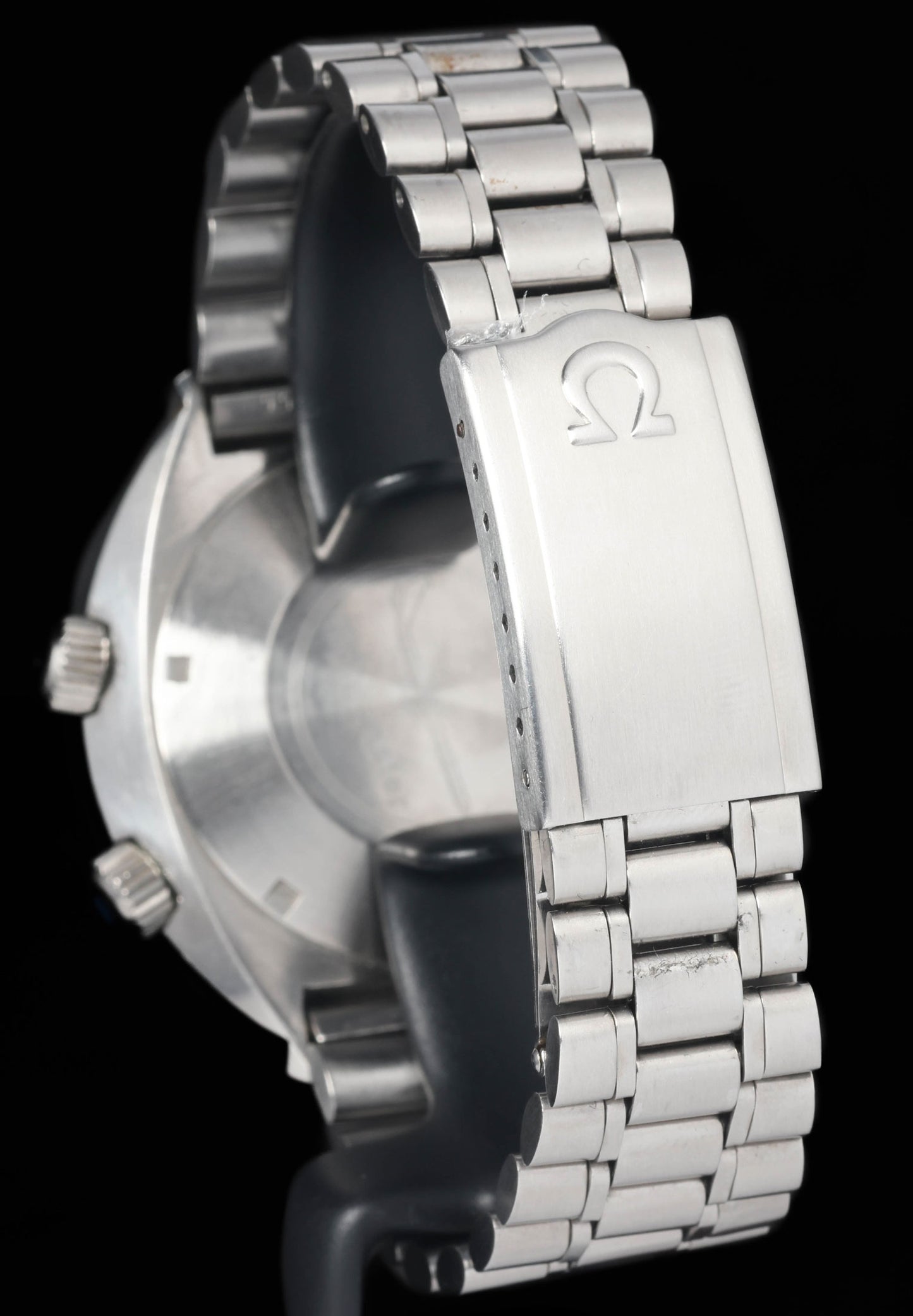
The stainless steel bracelet is in good condition and shows some stretch, as expected with age. It remains structurally sound and sits comfortably on the wrist, matching the tool focused character of the Flightmaster.
The dial is the defining feature of this Flightmaster 145.013. Originally black, it has developed a rich, even tropical patina that has softened into a warm charcoal brown tone. The fading is uniform across the dial, creating depth and warmth without patchiness or inconsistency. This sun aged transformation enhances legibility while giving the watch a distinctive, cohesive vintage presence that strongly complements the Flightmaster’s bold case and functional layout.
Share
Why we love this watch
Why we love this watch
The Story of the Omega Flightmaster 145.013
Introduction
Produced from 1969 into the early 1970s, the Omega Flightmaster 145.013 represents Omega’s first complete attempt at a purpose built aviation chronograph. Unlike many pilot watches of the era, which adapted existing chronograph designs with aviation themed scales, the Flightmaster was conceived from the outset as a cockpit instrument. Omega approached aviation as its own technical and ergonomic problem, resulting in a watch that integrated time zone management, elapsed time measurement, and operational clarity into a single, highly structured design. The 145.013 established the Flightmaster architecture in its original form, powered by the calibre 910 and distinguished by its 24 hour day and night display.
Aviation Context and Omega’s Intent
By the end of the 1960s, commercial aviation had entered a mature jet age. Long haul routes were no longer exceptional, flight crews regularly crossed multiple time zones, and cockpit workloads had increased. Although avionics were advancing, mechanical instruments remained essential, particularly for redundancy and quick reference. Pilots relied on clear, legible tools that could be read instantly and operated without hesitation.
Omega was already recognised for professional timing instruments. The Speedmaster had proven itself in motorsport and spaceflight, but Omega understood that aviation required a different approach. Pilots needed to manage time rather than calculate speed through tachymeters, and they needed clarity rather than decorative complication. Instead of modifying the Speedmaster, Omega chose to develop a separate aviation platform. The Flightmaster project reflected this decision, focusing on time zones, segment timing, and human factors rather than visual continuity with existing models.
The Birth of the Flightmaster and Reference 145.013
The first Flightmaster to reach production was the 145.013. It introduced all the defining elements of the line: a large tonneau shaped case, an internal rotating bezel protected beneath mineral glass, colour coded controls, and an independently adjustable second time zone. At its core was the calibre 910, a manual wind chronograph movement developed specifically for this reference.
The calibre 910’s most distinctive feature is the 24 hour indicator at nine o’clock. Divided into day and night segments, this display was designed to give pilots immediate contextual awareness of their reference time zone. Rather than simply showing another hour hand, the watch provided visual confirmation of whether that time zone was in daylight or darkness. In long haul operations, where crews might be awake while their home base slept, this information had practical relevance.
At the same time, the calibre 910 retained full chronograph functionality, with a 30 minute counter at three o’clock and a 12 hour counter at six. The movement operates at 21,600 vibrations per hour and uses cam and lever chronograph switching, chosen for reliability under vibration and pressure changes. While later Flightmasters would replace the day and night display with running seconds, the 145.013 reflects Omega’s original interpretation of what pilots needed most.
Case Architecture and How It Wears
The Flightmaster case measures approximately 43 mm across, making it one of the largest chronographs of its era. This size was dictated by function rather than style. The dial needed space to remain legible, and the internal bezel required protection beneath the crystal. Omega shaped the case as a tonneau, with broad shoulders and hooded lugs that draw the strap or bracelet close to the body of the watch.
This architecture spreads weight evenly and keeps the watch sitting low on the wrist. Despite its dimensions, the Flightmaster does not feel top heavy. Radial brushing across the upper surfaces reduces glare, an important consideration in cockpit environments where reflections can interfere with quick readings. Polished transitions along the flanks soften the profile without diluting its tool oriented character.
A hardened mineral glass crystal covers both the dial and the internal 60 minute bezel. Omega’s choice of mineral glass over acrylic reflects a focus on optical clarity and resistance to distortion at oblique angles. Beneath the watch, the case back is engraved with the Flightmaster aircraft emblem and model designation, clearly identifying its purpose and separating it from Omega’s other professional families.
Controls, Colour Coding, and Human Factors
One of the most striking aspects of the Flightmaster 145.013 is its control layout. Omega assigned each function a colour and position, reducing cognitive load and the chance of error. The crown at ten o’clock, marked with a blue ring, adjusts the independent hour hand for the second time zone. This hand moves in one hour steps, allowing straightforward adjustment when crossing time zones.
A second crown, positioned around eight thirty and marked in black, controls the internal 60 minute bezel. This bezel allows pilots to mark short operational segments such as taxi times or holding patterns without engaging the chronograph. Because it sits beneath the crystal, it cannot be accidentally moved.
The main crown at three o’clock winds and sets local time, while pushers at two and four operate the chronograph. This clear separation of functions, reinforced by colour and placement, reflects Omega’s attention to human factors. In practice, it allows the watch to be operated confidently under fatigue or while wearing gloves.
Dial Structure and Legibility in Use
The Flightmaster dial is information rich but carefully organised. Local time is given priority through bold hands and clear hour markers. The blue second time zone hand is visually distinct without dominating the display. Chronograph hands are finished in high contrast colours, typically orange or yellow, ensuring immediate differentiation from timekeeping hands.
The day and night indicator at nine o’clock adds contextual information rather than precise time, reinforcing its role as a reference rather than a primary display. Dial finishes range from matte grey to black, chosen to minimise reflections and provide neutral backgrounds for coloured accents. Printing is fine and precise, and the minute track remains legible even when viewed from an angle.
Luminous material on hands and markers supports low light use, while the mineral crystal avoids the distortion associated with acrylic. Combined with the brushed case surfaces, this ensures the watch remains readable in varied lighting conditions.
The Flightmaster in Professional Context
The Flightmaster was worn by professional aircrew and appeared in aviation and spaceflight related training environments. It is documented on the wrist of cosmonaut Alexei Leonov during preparations linked to the Apollo Soyuz Test Project. While the Speedmaster remained NASA’s official chronograph, the Flightmaster developed its own identity rooted firmly in aviation rather than exploration beyond the atmosphere.
Importantly, the Flightmaster was not issued as standard equipment. It was chosen by individuals who valued its functionality. This speaks to its role as a personal instrument rather than a symbolic one.
Evolution Beyond the 145.013
Feedback from use informed later Flightmaster references. Pilots expressed a preference for a running seconds display to confirm operation at a glance, leading Omega to replace the day and night indicator with constant seconds in subsequent models. These changes were refinements rather than corrections, reflecting evolving interpretations of pilot needs rather than flaws in the original concept.
The 145.013 remains the most context driven expression of the Flightmaster idea. It prioritises understanding of time rather than simply displaying it, a distinction that sets it apart within the line.
Design Significance and Perspective
The Flightmaster 145.013 demonstrates Omega’s willingness to invest in specialised solutions. Rather than applying aviation branding to an existing watch, Omega engineered a new platform around a clear brief. The result is coherent, purposeful, and grounded in real operational requirements.
Seen today, the Flightmaster is a reminder of a period when pilots interacted directly with their instruments and when mechanical design responded to professional workflows. Its case, controls, and displays reflect careful thought rather than ornament.
Final Thoughts
The Omega Flightmaster 145.013 is the foundation of Omega’s aviation chronograph programme. With its independently adjustable second time zone, day and night indicator, protected internal bezel, and ergonomically considered case, it captures a moment when mechanical watches were designed as working tools first. It is not a watch that explains itself instantly, but one that reveals its logic through use. That quality, grounded in function and shaped by real need, defines the Flightmaster’s place in aviation watch history.
Case & Bracelet
Case & Bracelet
Case in great vintage condition. Light hairlines visible around case. Bracelet in good condition with some stretch expected with age.
Dial & Hands
Dial & Hands
Dial has formed even tropical patina.
Warranty & Condition
Warranty & Condition
Crown Vintage Watches provides a minimum 6-month mechanical warranty on pre-owned watches, from the date of purchase.
The warranty covers mechanical defects only.
The warranty does not cover damages such as scratches, finish, crystals, glass, straps (leather, fabric or rubber damage due to wear and tear), damage resulting from wear under conditions exceeding the watch manufacturer’s water resistance limitations, and damage due to physical and or accidental abuse.
Please note, water resistance is neither tested nor guaranteed.
Shipping and insurance costs for warranty returns to us must be covered by the customer. Returns must be shipped via traceable courier. Return shipment must be pre-paid and fully insured. Collect shipping will be refused. In case of loss or damages, the customer is liable.
Our Pledge
At Crown Vintage Watches, we stand by the authenticity of every product we sell. For added peace of mind, customers are welcome to have items independently authenticated at their own expense.
Condition
Due to the nature of vintage timepieces, all watches are sold as is. We will accurately describe the current condition and working order of all watches we sell to the best of our ability.
Shipping & Refund
Shipping & Refund