

Crown Vintage
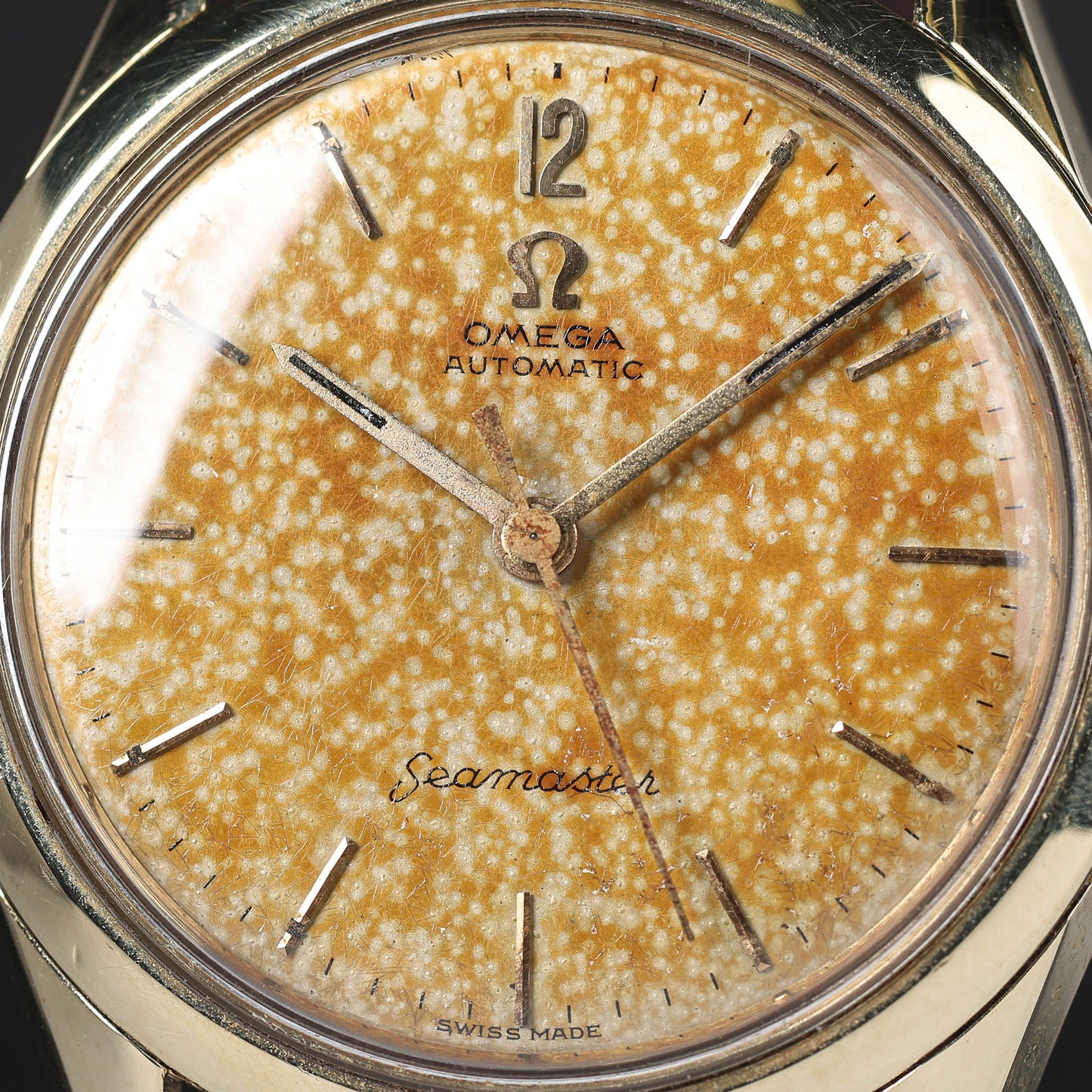
Omega Seamaster 'Tropical' 2802-7SC 34mm circa 1950s
Omega Seamaster 'Tropical' 2802-7SC 34mm circa 1950s
Couldn't load pickup availability
Omega Seamaster 'Tropical' 2802-7SC 34mm circa 1950s
Case & Bracelet
The stainless steel case of this Seamaster 2802-7SC presents in very good vintage condition, with the faceted lugs that define the reference retaining their original edges and light-catching geometry. Hairline scratches are visible across the case surfaces under close inspection, entirely consistent with a watch approaching seventy years of careful use, and preferable to the softened profile that heavy refinishing would have left behind. The snap caseback sits flush and the crown operates as it should. The watch is fitted with a leather strap in good condition, showing light wear commensurate with use and ready for daily wearing.
Dial & Hands
The dial is the standout feature of this example. It has developed a tropical patina, the gradual mellowing of the lacquer that only time and light can produce. The change is uniform across the dial rather than blotchy, which is the distinction between attractive ageing and damage. The applied markers remain sharp, the Omega and Seamaster printing is crisp, and the radium plots have settled into a warm tone that matches the overall character of the dial. The dauphine hands are in good condition, with their facets intact and no lifting or corrosion to the finish.
Share
Why we love this watch
Why we love this watch
Why We Love the Omega Seamaster 2802-7SC 34mm, Circa 1950s
Turn over an Omega Seamaster 2802-7SC and the reference stamped inside the snap caseback tells you exactly where you are in history: the moment Omega retired its bumper automatics and let a full rotor spin freely for the first time. This 34mm stainless steel Seamaster, produced in the mid to late 1950s, sits at one of the great hinge points in twentieth century watchmaking. It carries the calibre 471, Omega's first generation of full rotor, bi-directionally winding automatic movements, inside a waterproof case whose sealing technology was borrowed from wartime submarine engineering. It is a watch that looks like a gentleman's dress piece and behaves like a tool watch, which is precisely what Omega intended when it coined the Seamaster's famous promise of a watch for town, sea and country.
The House That Louis Brandt Built
To understand why the 2802-7SC matters, it helps to understand the company that made it. Omega's story begins in 1848, when Louis Brandt set up a small assembly workshop in La Chaux-de-Fonds, in the Swiss Jura. Brandt built pocket watches from parts supplied by local craftsmen and sold them across Europe, earning a reputation for precision that his sons Louis-Paul and Cesar would carry forward when they moved the business to Biel/Bienne in the 1880s.
The company's defining moment arrived in 1894 with the launch of the 19-ligne Omega calibre, a movement so significant that it gave the firm its name. The Omega calibre was revolutionary because it was built from standardised, interchangeable components. Any watchmaker anywhere could repair it without hand-fitting new parts, an idea that transformed watch production and service in one stroke. Naming the company after the last letter of the Greek alphabet was a statement of intent: this was to be the final word in watchmaking.
By the 1930s Omega had the accuracy records to back up the ambition. In 1932 the brand became the first single official timekeeper of an Olympic Games, at Los Angeles, supplying every chronograph used at the event. That same year Omega launched the Marine, widely recognised as one of the first commercially produced divers' watches, with a patented double case designed to keep water out at depth. The Marine was worn and endorsed by pioneers such as William Beebe, and it established a principle that would define the Seamaster sixteen years later: water resistance was not a gimmick, it was a guarantee.
The Birth of the Seamaster
From wartime waterproofing to civilian wrists
During the Second World War, Omega supplied more than 100,000 watches to Britain's Ministry of Defence, many of them built to withstand damp cockpits, salt spray and rough handling. When peace came, Omega faced the same question as every Swiss manufacturer: how do you translate military robustness into something a civilian actually wants to wear?
The answer arrived in 1948, the year of Omega's own centenary. The Seamaster was launched as a celebration watch, but beneath its polished exterior it was a direct descendant of those wartime pieces. Its crucial innovation was the rubber O-ring gasket sealing the caseback, a technology adapted from submarine hatch seals developed during the war. Where competitors relied on lead or shellac gaskets that hardened, cracked and failed as temperatures shifted, the Seamaster's O-ring stayed elastic and effective from minus 40 to plus 50 degrees Celsius. Omega tested early Seamasters by strapping them to airliners flying polar routes and submerging them at depth, and the watches kept running.
Just as important was the positioning. The Seamaster was never marketed as a pure divers' instrument in these early years. Omega's advertising promised a watch equally at home in town, sea and country, a phrase that captured exactly what the post-war customer wanted: one good watch that could do everything. The Seamaster looked correct under a suit cuff on Monday and shrugged off a weekend of sailing, swimming or gardening. It is not a coincidence that this formula, the elegant everyday sports watch, is the one the entire industry still chases today.
Decoding the Reference 2802-7SC
The reference 2802 family was produced from around 1954 to 1957, with examples reaching the market into the late 1950s, and it represents the Seamaster line at a moment of real confidence. Omega's vintage reference system rewards a little decoding. The core number, 2802, identifies the case design. The SC suffix stands for Seconde Centrale, French for central seconds, confirming the sweep seconds hand driven directly from the movement. The numeral 7 denotes a specific production iteration of the case within the reference's lifespan, one of several evolutionary batches Omega produced as it refined details of case construction and dial execution.
In Omega's period nomenclature, stainless steel versions carried the CK prefix while solid 18k gold examples were marked OT, and the 2802 was offered in steel, solid gold and gold-capped variants. The steel 2802-7SC is arguably the purest expression of the original Seamaster idea: robust, understated and honest. Inside the caseback you find the full reference number alongside Omega Watch Co. markings and the material designation, a reassuring level of documentation that Omega applied consistently throughout the decade.
The case itself measures approximately 34mm across, excluding the crown, with an 18mm lug width and a lug-to-lug span of roughly 40 to 41mm. Those are quintessential 1950s proportions. The lugs are the visual signature of the reference: faceted and slightly pointed, they catch light along their edges and give a compact watch surprising wrist presence. The caseback is a press-fit design sealed with that all-important gasket, and original examples were rated water resistant to 30 metres, a genuinely useful figure for a dress watch of the era. The dial side is protected by a domed acrylic crystal, often carrying a tiny Omega symbol etched at its centre.
Dials across the 2802 series ranged from silvered and cream finishes to the celebrated honeycomb textures associated with the De Luxe versions. Applied metal hour markers in dart, arrowhead or baton form were standard, typically paired with dauphine or pencil hands, with small dots of radium luminous material marking the hours. Nearly seventy years on, that lume has mellowed to warm shades of caramel and honey, one of the most attractive forms of patina in vintage watch collecting.
Details that date the watch
Part of the charm of a 1950s Omega is how precisely the company documented its own work, and the 2802-7SC rewards close inspection. The movement serial number places production within a narrow window: serials in the 14 million range correspond to around 1955, while those in the 16 million range indicate 1956 and 1957. Later examples in the series may carry the Omega hippocampus, the mythological seahorse emblem that began appearing on Seamaster casebacks in the second half of the decade and remains the collection's symbol today. The winding crown should carry the Omega symbol, and many original acrylic crystals do the same at their centre, a detail best seen by catching the light at an angle.
These small marks matter because they show a manufacturer taking its everyday production seriously. Nothing about the 2802-7SC was an afterthought. The case, movement, dial and even the crystal were signed, numbered and recorded, the working habits of a company that had been standardising and documenting its watchmaking since the first Omega calibre of 1894. Holding one today is a little like reading a well kept logbook from 1957: every entry is where it should be.
The Calibre 471: Omega Learns to Spin
If the case tells half the story of the 2802-7SC, the movement tells the other half, and it is arguably the more important one. Through the late 1940s and early 1950s, Omega's automatic watches used bumper movements, in which a weighted segment swings through a limited arc and bounces off buffer springs at each end. Bumper calibres such as the 342 to 354 family were reliable and well loved, and owners still describe the gentle knock of the weight with affection, but the design had clear limits. Winding efficiency was modest, and the constant impact against the buffer springs added wear over time.
Omega's answer was the 470 series, launched in 1954, with the calibre 471 following in 1955. This was the movement family that carried Omega into the modern automatic era, and the 2802-7SC was among the references chosen to showcase it. The 471 uses a full rotor that rotates through a complete 360 degrees on its bearing and winds the mainspring in both directions of travel. Every movement of the wrist contributes energy. The calibre runs at 19,800 vibrations per hour, carries 19 or 20 jewels depending on market, delivers around 46 hours of power reserve and is protected by Incabloc shock absorption. The plates and bridges wear Omega's characteristic rose-copper finish, a detail invisible in daily wear but quietly beautiful whenever the caseback comes off for service.
The quality of this calibre family was no secret at the time. Omega selected the calibre 471 to power the Seamaster XVI, the commemorative watch issued for the 1956 Melbourne Olympic Games, at a time when Omega's name was synonymous with Olympic timekeeping. The 470 series and its successors were produced in enormous numbers through the second half of the 1950s, and the reason so many still run strongly today is simple: the engineering was fundamentally right. Watchmakers continue to praise these movements for their serviceability, the same virtue Omega had been building its reputation on since 1894.
Why We Love Wearing It
There is a particular pleasure in a 34mm watch from this period that modern sizing conventions have almost erased. The 2802-7SC does not announce itself across a room. It sits flat and light on the wrist, slides under any cuff, and reveals its quality only at conversational distance: the play of light on those faceted lugs, the sharp geometry of the applied markers, the slow amber glow of aged radium dots. This is a watch designed for the owner's satisfaction rather than an audience's approval, and in an era of ever-larger watches that restraint feels quietly radical.
It is also a remarkably complete historical document. In a single reference you get Omega's centenary-era waterproofing breakthrough, the company's first great full rotor automatic, the styling language of the high 1950s and the town, sea and country philosophy that invented the everyday sports watch as a category. Few watches of any era compress so much genuine horological history into so modest a footprint.
And then there is the simple fact of survival. A 2802-7SC that reaches us today has been keeping time for the better part of seven decades on a movement architecture so sound that Omega built the rest of its automatic dynasty upon it. Wearing one is not an exercise in nostalgia. It is a daily demonstration that the watch worked exactly as its makers promised, through every year between their world and ours.
Final Thoughts
The Omega Seamaster 2802-7SC captures Omega at full stride: a company one century old, freshly crowned as Olympic timekeeper, armed with wartime sealing technology and a brand new full rotor automatic calibre, distilling all of it into 34 millimetres of stainless steel. The reference asks nothing of its owner except winding by wear and the occasional service, and in return it offers a direct, mechanical connection to the decade in which the modern wristwatch was defined. Some vintage watches are loved for rarity and others for spectacle. The 2802-7SC is loved for something better: it is the honest, beautifully engineered heart of the Seamaster story, from the years when Omega set out to build one watch that could go anywhere, and succeeded.
References
- Omega Vintage Watches Database, Seamaster De Luxe CK 2802 and OT 2802, omegawatches.com
- OTTUHR, Omega Seamaster 2802 Reference Report, ottuhr.com
- Wikipedia, Omega Seamaster and Omega SA
- Teddy Baldassarre, Omega Seamaster: The Comprehensive Guide
- Exclusive Vintage Swiss Watches, The Automatic Omega Calibers 470, 490 and 500
- OTTUHR, Omega 471 Caliber
- Bob's Watches, The History of Omega Watches
Case & Bracelet
Case & Bracelet
- Case in very good vintage condition
- hairlines visible
- Strap in good condition
Dial & Hands
Dial & Hands
- Dial has formed tropical patina
- Hands good condition
Warranty & Condition
Warranty & Condition
Crown Vintage Watches provides a minimum 6-month mechanical warranty on pre-owned watches, from the date of purchase.
The warranty covers mechanical defects only.
The warranty does not cover damages such as scratches, finish, crystals, glass, straps (leather, fabric or rubber damage due to wear and tear), damage resulting from wear under conditions exceeding the watch manufacturer’s water resistance limitations, and damage due to physical and or accidental abuse.
Please note, water resistance is neither tested nor guaranteed.
Shipping and insurance costs for warranty returns to us must be covered by the customer. Returns must be shipped via traceable courier. Return shipment must be pre-paid and fully insured. Collect shipping will be refused. In case of loss or damages, the customer is liable.
Our Pledge
At Crown Vintage Watches, we stand by the authenticity of every product we sell. For added peace of mind, customers are welcome to have items independently authenticated at their own expense.
Condition
Due to the nature of vintage timepieces, all watches are sold as is. We will accurately describe the current condition and working order of all watches we sell to the best of our ability.
Shipping & Refund
Shipping & Refund