

Crown Vintage
Patek Philippe Annual Calendar 5035R-001 37mm 1990s
Patek Philippe Annual Calendar 5035R-001 37mm 1990s
Couldn't load pickup availability
Patek Philippe Annual Calendar 5035R-001 37mm 1990s
Case and Bracelet
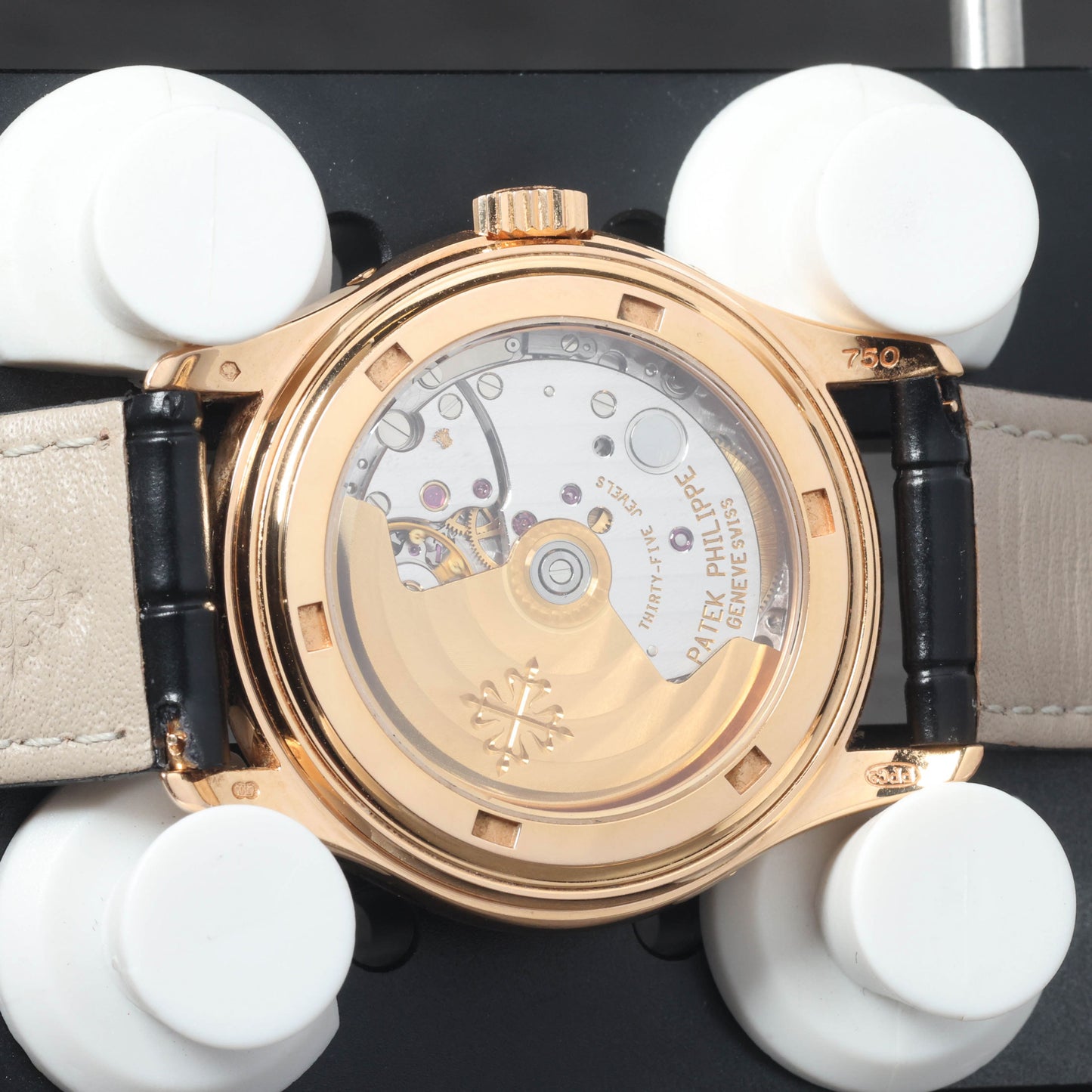
The 18k rose gold case of this Annual Calendar 5035R presents in very good condition. The 37mm case is among the more architecturally detailed of Patek Philippe's dress watches from this era, with its stepped bezel, recessed calendar correctors in the case band and screw-down sapphire display back, and the example here presents accordingly well across these elements. The watch is fitted with a strap in great condition, secured by its rose gold pin buckle, completing the piece in the configuration in which the reference was originally delivered.
Dial and Hands
The dial and hands are in very good condition. The silvered dial of the 5035R carries a considerable amount of information for a Patek Philippe of its size, with the day register at 9 o'clock, the month at 3 o'clock, the 24-hour indication and date aperture at 6 o'clock and applied rose gold Roman numerals framed by a railway minute track, so its presentation is central to the watch's overall impression. On this example the dial surface, applied furniture and leaf-shaped handset all present at a level consistent with careful ownership, preserving the legibility that Patek Philippe made a defining priority of the first annual calendar wristwatch.
Share
Why we love this watch
Why we love this watch
Patek Philippe Annual Calendar 5035R-001: The Watch That Invented a Complication
Every annual calendar wristwatch in existence, whether it comes from Geneva, Glashutte or Le Brassus, descends from a single 37mm design that Patek Philippe unveiled at the Basel fair in 1996, and the reference 5035R-001 is that design rendered in 18k rose gold. This is not a watch that interprets a complication. It is the watch that created one. When Patek Philippe filed Swiss patent CH 685585 G for a calendar mechanism built from rotating wheels rather than sprung levers, it gave the industry an entirely new category of timepiece, one that automatically distinguishes 30-day months from 31-day months and asks for the wearer's attention just once a year, at the end of February. Thirty years on, virtually every serious manufacture offers an annual calendar. In 1996, only one did.
The 5035R-001 pairs that landmark mechanism with a silvered white dial, applied rose gold Roman numerals and a warm 18k rose gold case measuring 37mm across. It is the softest and, to many eyes, the most classically dressed expression of the first-generation Annual Calendar, a reference produced from 1996 until 2005 and powered throughout by the self-winding calibre 315 S QA. What follows is the story of how it came to be, why the movement inside it was genuinely radical, and what makes the rose gold version such a complete object.
The Watch That Created Its Own Category
By the mid 1990s, the Swiss industry had survived the quartz crisis and mechanical watchmaking was enjoying a full renaissance, yet Patek Philippe's catalogue contained a conspicuous gap. At one end sat time-only Calatravas and simple calendar watches that needed correcting five times a year, after February and after each 30-day month. At the other sat the perpetual calendar, a complication Patek had patented for pocket watches in 1889 and had been the first to fit into a wristwatch in 1925. Between the two lay a wide gulf in both mechanical sophistication and price. Philippe Stern, who had become president of the manufacture in 1993, described the company's need for what he called serviceable complications: watches that offered genuine everyday utility and mechanical interest without the cost and delicacy of a grand complication.
The answer arrived at Basel in the spring of 1996 as the reference 5035, the world's first annual calendar wristwatch. The reception was immediate. That autumn the Swiss magazine Montres Passion crowned it Watch of the Year, with the jury noting that beyond the expected Patek Philippe standards of finishing and aesthetics, the 5035 delivered a complication that was useful, simple to live with and entirely new. In an era before the modern proliferation of watch awards, the accolade carried real weight, and the watch it honoured went on to found one of the most successful complication families in modern Patek Philippe history.
A Graduate Project Becomes a Patent
The origin of the mechanism is one of the better stories in modern horology. Rather than instructing his engineers to strip down a perpetual calendar, Philippe Stern set the problem from the opposite direction: begin with a simple calendar watch and find an original, robust and economically rational way to make it track the lengths of the months. The brief explicitly ruled out the levers, rockers and heavy return springs that drive classical perpetual calendars, calling instead for a solution based on rotating components. The concept took shape through an academic engineering project, and the young graduate behind it, Cedric Fague, was hired by Patek Philippe, where he remained active in product development for decades afterwards. The resulting mechanism was refined in-house and protected by Swiss patent CH 685585 G, a document specific enough that competitors could not simply copy the approach. Patek Philippe enjoyed an effective monopoly on the annual calendar for roughly fourteen years before A. Lange und Soehne, Omega and others engineered their own solutions.
Patek Philippe Before the Annual Calendar
The 5035 makes more sense when set against the depth of the company that built it. Patek Philippe traces its origins to 1839, when the Polish watchmaker Antoni Patek founded Patek, Czapek et Cie in Geneva with Franciszek Czapek. After the partners separated, Patek joined forces in 1845 with the French watchmaker Adrien Philippe, inventor of the patented keyless winding and hand-setting system that freed pocket watches from their winding keys. The firm took the name Patek, Philippe et Cie in 1851, the same year Queen Victoria acquired one of its keyless pendant watches at the Great Exhibition in London.
From there the manufacture assembled a record of calendar firsts that no rival can match. It patented a perpetual calendar mechanism for pocket watches in 1889, and in 1925 it created the world's first perpetual calendar wristwatch, building it around a compact movement originally made for a ladies' pendant watch in 1898. In 1932 the company passed into the hands of the Stern family, who had supplied its dials since 1907 through Stern Freres, and who own it still. That dialmaking heritage matters to this story, because when Philippe Stern commissioned the annual calendar six decades later, he insisted that the new complication announce itself through a dial of exceptional clarity, deliberately distinct from the pointer-date layouts of Patek's perpetual calendars. The 5035 was therefore not a departure from tradition but the next entry in a hundred-year lineage of calendar innovation, arriving from the one manufacture with the history to justify it.
Calibre 315 S QA: Wheels Where Levers Used to Be
Through the screw-down sapphire display back of the 5035R-001 sits the calibre 315 S QA, an automatic movement of 35 jewels built on Patek Philippe's 315 base with a dedicated annual calendar module roughly 2mm thick. A 21k gold central rotor winds the mainspring to a power reserve of around 48 hours, the balance is Patek's free-sprung Gyromax beating at 21,600 vibrations per hour, and the whole carries the Geneva Seal, the hallmark of finishing and construction that governed the manufacture's movements in this era. Some later production and auction documentation records the calibre as 315/198, denoting the base and module pairing, though the movement is one and the same.
There is a pleasing irony buried in the architecture. The annual calendar was conceived as the accessible alternative to the perpetual calendar, yet the 315 S QA actually contains more components than the celebrated calibre 240 Q inside the reference 3940 perpetual calendar. The saving came not from parts count but from construction. Because the mechanism is built almost entirely from wheels and pinions connected by pins and screws, rather than the stacked cams, racks and jumper springs of a perpetual, it is simpler to assemble, more robust in daily use and considerably more economical to produce and to service. Complexity was traded for a different kind of intelligence.
How the Annual Calendar Actually Works
The heart of the system is a 24-hour driving wheel fitted with two finger pieces set at an angle to one another. The first finger advances the date wheel once every day, exactly as in a simple calendar. In the four 30-day months of April, June, September and November, the second finger comes into play, driving the date from the 30th directly to the 1st in a process completed over roughly four hours around midnight. Day and month indications follow automatically. Only February falls outside the mechanism's logic, so once a year the wearer advances the date from the 28th, or the 29th in a leap year, to the 1st of March using the recessed correctors set into the case band. One correction annually instead of five is the entire proposition, and it is precisely the sort of quietly transformative convenience that explains why the complication spread across the whole industry.
The 5035R-001 in the Metal
The first Annual Calendar was offered across the gold spectrum, as the 5035J in yellow gold, the 5035G in white gold and the 5035R in rose gold, with a platinum sibling arriving in 1998 as the reference 5056. The rose gold 5035R-001 has a strong claim to being the most harmonious of the group. The warm case metal is repeated in the applied Roman numerals, the leaf-shaped hands and the pin buckle, and set against the silvered white dial it produces a watch that reads as one continuous design rather than a case housing a dial. The 37mm case itself is classic Patek Philippe of the period, with a stepped bezel, elegantly drawn lugs and a screw-down sapphire exhibition back, its proportions echoing the restrained Calatrava language the manufacture had refined over decades.
A Dial Built for Legibility
Philippe Stern's insistence on clarity shaped every element of the dial. The day of the week occupies a subdial at 9 o'clock and the month sits opposite at 3 o'clock, giving the watch the balanced twin-register look that has been synonymous with the complication ever since. A 24-hour indication fills the register at 6 o'clock, and directly within its arc sits the date, displayed not by a pointer hand as on most perpetual calendars of the day but through a generous aperture, a deliberate choice made so that the most frequently consulted piece of calendar information could be read at a glance. A railway minute track frames the whole arrangement, and a slender centre seconds hand sweeps over it. It is a busier dial than any Calatrava, certainly, and the layout retains a charming, slightly experimental quality that later references would smooth away, but nothing on it is decorative for its own sake. Every register earns its place.
Wearing the First of Its Kind
At 37mm and a little over 10mm thick, the 5035R-001 sits squarely in classical dress watch territory, slipping under a shirt cuff in a way its 39mm successor never quite managed. The brown alligator strap and 18k rose gold buckle complete a piece that was conceived as a daily companion rather than a safe queen, which was always the point. Stern's serviceable complication was meant to be worn, wound by the motion of the wrist, corrected once a year and otherwise left alone to do its quietly clever work.
The Reference That Built a Family
The 5035 remained in production until 2005, a nine-year run during which it proved the commercial case for the entire concept. Patek Philippe wasted little time building on it. The reference 5036 added a moon phase to the annual calendar, and in 2005 the 5146 succeeded the 5035 directly, enlarging the case to 39mm and resolving the dial architecture with baton indices and a rebalanced layout. From there the complication migrated across the catalogue into the 5396, the 5205, the Nautilus and the Aquanaut lines, and today Patek Philippe describes the annual calendar as the most celebrated of its useful complications. Rival manufactures followed once the patent's protection faded, and the annual calendar is now a fixture of fine watchmaking from Saxony to the Vallee de Joux. All of it flows from the 5035. The rose gold 5035R-001 is therefore something genuinely uncommon in modern horology: a first-generation example of a complication's founding reference, made by the company that invented it, in the most romantic of the metals it was offered in.
Final Thoughts
Watch history hands out very few genuine firsts, and fewer still that remain this wearable. The Patek Philippe Annual Calendar 5035R-001 is the origin point of an entire complication, carrying the patented wheel-driven mechanism of the calibre 315 S QA inside a 37mm rose gold case whose proportions have aged with unusual grace. It won Watch of the Year in its debut season, established a family that now spans the whole Patek Philippe catalogue, and did it all while asking nothing of its owner beyond a single unhurried adjustment each March. The later references may be larger and their dials more resolved, but none of them can be the first. This one is.
References
1. Swisswatches Magazine, Patek Philippe Annual Calendar: The Ultimate Collector's Guide. swisswatches-magazine.com
2. Collectability, Collectability In Depth: Patek Philippe Annual Calendar. collectability.com
3. Monochrome Watches, In-Depth: A Comprehensive Overview of Patek Philippe's Annual Calendar. monochrome-watches.com
4. Oracle of Time, A Forgotten Icon: The Patek Philippe 5035. oracleoftime.com
5. European Watch Company, A Buyer's Guide to the Patek Philippe Annual Calendar Complication. europeanwatch.com
6. WatchTime, A Closer Look at Patek Philippe's Annual Calendar. watchtime.com
7. Worldtempus, Patek Philippe and the Art of the Annual Calendar. worldtempus.com
8. Teddy Baldassarre, Annual Calendar Watches Guide. teddybaldassarre.com
9. Watch-Wiki, Patek Philippe Annual Calendar 5035. watch-wiki.net
10. Wikipedia, Patek Philippe: history and key patents. en.wikipedia.org
Case & Bracelet
Case & Bracelet
- Case is in very good condition.
- Strap in great condition
Dial & Hands
Dial & Hands
- Dial & hands very good condition
Warranty & Condition
Warranty & Condition
Crown Vintage Watches provides a minimum 6-month mechanical warranty on pre-owned watches, from the date of purchase.
The warranty covers mechanical defects only.
The warranty does not cover damages such as scratches, finish, crystals, glass, straps (leather, fabric or rubber damage due to wear and tear), damage resulting from wear under conditions exceeding the watch manufacturer’s water resistance limitations, and damage due to physical and or accidental abuse.
Please note, water resistance is neither tested nor guaranteed.
Shipping and insurance costs for warranty returns to us must be covered by the customer. Returns must be shipped via traceable courier. Return shipment must be pre-paid and fully insured. Collect shipping will be refused. In case of loss or damages, the customer is liable.
Our Pledge
At Crown Vintage Watches, we stand by the authenticity of every product we sell. For added peace of mind, customers are welcome to have items independently authenticated at their own expense.
Condition
Due to the nature of vintage timepieces, all watches are sold as is. We will accurately describe the current condition and working order of all watches we sell to the best of our ability.
Shipping & Refund
Shipping & Refund