

Crown Vintage
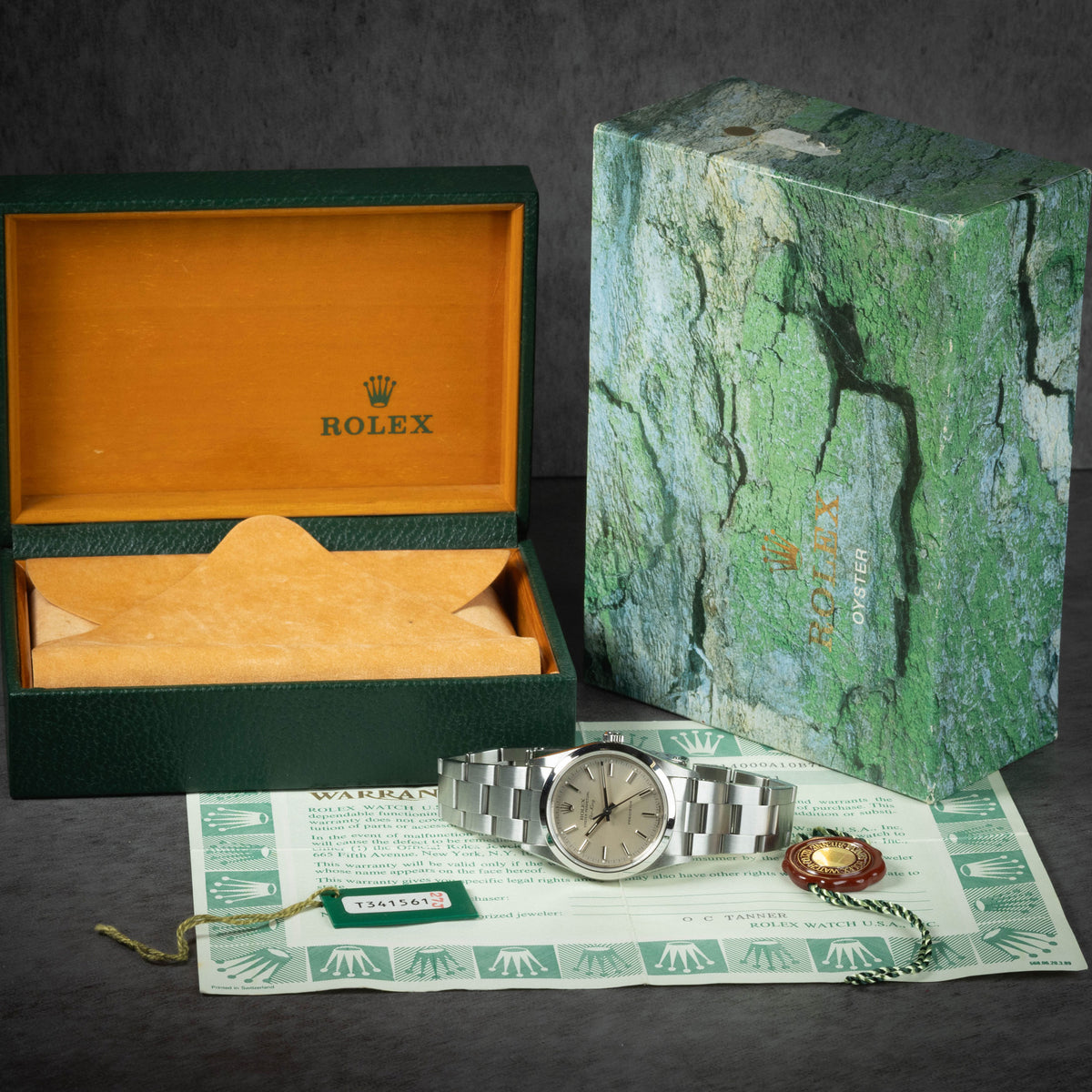
Rolex Air-King 14000 'Tropical' Dial 34mm 1996 Box & Papers
Rolex Air-King 14000 'Tropical' Dial 34mm 1996 Box & Papers
Couldn't load pickup availability
Rolex Air-King 14000 'Tropical' Dial 34mm 1996 Box & Papers
Case and Bracelet
The 34mm Oyster case is in excellent condition, and on this reference that grade carries more weight than it would on a sports model. The Air-King has a smooth bezel, which is the least forgiving surface Rolex fits. There are no graduations, no insert and no engraved scale to break up the light, just a plain polished ring where every contact mark sits in the open. A 14000 that still reads as excellent has avoided the knocks this reference records most visibly, and the case retains its profile with the lug edges defined rather than softened.
The bracelet is the Oyster with solid links, in very good condition with little to no stretch. Stretch is not the metal lengthening. The links pivot on pins, the pins and their seats wear fractionally with every movement of the wrist, and across three decades that accumulated clearance becomes the sag you feel when a bracelet is held at one end. Solid links resist that better than the folded construction of earlier eras, but thirty years is thirty years, so little to no stretch reflects careful ownership as much as it does construction. The bracelet tapers from 19mm at the lugs to 14mm at the clasp, which is why the watch wears lighter than its weight suggests.
Dial and Hands
The dial and hands are in excellent condition. The dial is free of marks, blemishes and lacquer damage across its full surface, the applied baton markers are secure and evenly set, and the printing is crisp and intact. As a 1996 watch the luminous material is tritium, which has long since ceased to perform, and it should be read as a visual element rather than a working one.
Chronometry
The watch was demagnetised and tested on a Witschi WAIO, passing the chronometry stage.
Across four positions it ran -10.2 seconds per day dial up, -6.5 dial down, -6.0 at six up and -7.4 at twelve up, a mean of -7.5 with a positional delta of 4.1. Amplitude averaged 249.9 degrees with a spread of 36.4, and beat error held between 0.3 and 0.4 milliseconds. A spread of 4.1 seconds per day from this calibre is a better result than its specification would predict. It is a thirty year old watch and should be kept dry.
Share
Why we love this watch
Why we love this watch
The 1996 Rolex Air-King 14000
The Watch Named for the Battle of Britain
The Air-King is the last survivor of a set of watches named after an air force.
1945 and the Air series
Rolex released the Air-King in 1945 as one of four models built around the same theme, alongside the Air-Lion, the Air-Giant and the Air-Tiger. The series was created to honour the RAF pilots of the Battle of Britain, and the reason Rolex had any standing to do so was practical rather than sentimental. British service watches of the period were poor, pilots bought Oysters privately to replace them, and the connection between the company and the men flying was established on the ground before it was ever printed on a dial.
Of those four names only one survived. The Air-Lion, the Air-Giant and the Air-Tiger disappeared, and the Air-King became a permanent fixture of the catalogue, which makes it one of the longest running model names Rolex has.
More than thirty years of not changing
The reference 5500 arrived in the late 1950s and stayed in production until 1989, better than three decades on a single reference number. Nothing else in the Rolex range held still for that long. It established what the Air-King was for: a 34mm Oyster Perpetual with a smooth bezel, no date, no complication and no chronometer certification, which made it the least expensive route into an Oyster Perpetual and the most self-effacing watch the company made.
That is the inheritance the 14000 received in 1989. Not a tool watch with a job to do, but a watch defined by everything it had decided to leave out.
1989: The Air-King Becomes Modern
The reference 14000 replaced the 5500 in 1989 and ran until 1999, when it gave way to the 14000M. It is the point at which the Air-King stopped being a vintage watch still in production and became a modern one.
What the 14000 brought
The headline change was the crystal. The 14000 was the first Air-King fitted with sapphire in place of acrylic, which is a larger shift than it sounds, because acrylic domes and warms and scratches and sapphire does none of those things. The case stayed at 34mm and 11.2mm thick, and BeckerTime gives its construction as 316L steel, which fits the wider timeline: Rolex phased 904L in from 1985 and did not move its entire steel range across until 2003.
Dials were offered in black, white, silver, blue and a salmon pink that has become the best known of them, with markers available as plain batons, Roman numerals or the 3, 6 and 9 layout borrowed from the Explorer. The engine-turned bezel version carried its own reference, 14010. Everything else about the watch was left alone.
Precision, not Superlative Chronometer
Here is the detail that explains the dial text, and it is more interesting than it first appears. The calibre 3000 inside the 14000 was the last movement Rolex designed without a Breguet overcoil on the hairspring, using a flat hairspring instead. The Air-King was not submitted for chronometer certification, so its dial reads Precision.
The movement itself was perfectly capable of passing. The same calibre 3000 sits inside the Explorer 14270 and the Submariner 14060, and in those watches it is marked Superlative Chronometer Officially Certified, because certification is applied for movement by movement rather than granted to a design. Sources disagree about whether the calibre 3000 was a chronometer, and the reason they disagree is that both answers are correct depending on which watch the movement went into. In the Air-King it was not, and Rolex printed exactly what it had earned.
Calibre 3000
The calibre 3000 is a self-winding movement of 27 jewels running at 28,800 vibrations per hour, which gives the seconds hand eight beats per second and the smooth sweep associated with the modern Rolex sports references. It measures 28.5mm across and 5.8mm deep, and it winds bidirectionally.
Its one point of difference from what came after is the balance. The calibre 3130 that replaced it in 2000 restored the Breguet overcoil and moved the hairspring onto a full balance bridge rather than the balance cock the 3000 uses. A cock is supported at one end and a bridge at two, which is the more rigid arrangement, and that change is the technical dividing line between the 14000 and the 14000M.
Soleil, and what it does to light
The silver dial on a 14000 is a soleil finish, brushed in fine lines radiating out from the centre so the surface behaves like a record groove under light. Turn the watch and the brightness sweeps around the dial rather than sitting still. Applied stick markers stand above that surface and catch light independently of it, which is why a plain silver dial with no date and no text beyond the essentials is still legible from an angle in poor light.
Case, Bracelet and Proportion
The case is a 34mm Oyster, 43mm from lug to lug, with a smooth bezel, a screw-down crown and a screw-down caseback. Thirty four millimetres is the number most people react to, and it is worth being straightforward about it. This was a full size men's watch in 1996 and reads as a small one now, and the Air-King has never pretended otherwise.
Thirty four millimetres was not a compromise when this case was designed. It was the standard size for a man's wristwatch through most of the twentieth century, the same diameter as the Datejust that Rolex sold in enormous numbers for decades, and the Air-King held it while the rest of the professional range grew past forty. The consequence is a watch that sits inside a shirt cuff rather than on top of one, and that gets its presence from proportion rather than from mass.
The dial layout follows the same discipline. No date means no Cyclops and no asymmetry, so the markers sit at even intervals with nothing interrupting the three o'clock position, and the smooth bezel gives the case an unbroken polished ring rather than a graduated scale demanding to be read. Very little on this watch is asking for anything.
The bracelet is the Oyster reference 78350 with 557B end links, 19mm at the lugs tapering to 14mm at the clasp. That taper is the reason the watch wears lighter than its steel weight suggests. Rolex stamped a date code inside the clasp of bracelets in this era, so a correctly period bracelet on a 1996 watch carries a code from the same window, and documented 1996 examples show V9 and V10 stamps sitting alongside T series cases.
What 1996 Means Here
A 1996 case puts this watch three years from the end of its reference and inside the final years of tritium.
The serial carries a T prefix, engraved between the lugs at the six o'clock side, in the position Rolex used before the serial moved to the rehaut in 2005. Our Rolex serial numbers guide sets out the letter prefixes for this period, and T covers 1996 into 1998.
The timing matters for the dial. Rolex moved to Luminova around 1998, so a 14000 made in the last year or two of the reference has no tritium at all, and the two-part ageing described above simply does not happen on those watches. A 1996 example still sits on the tritium side of that line, which is the side where the dial and the lume age together.
The Papers
The watch is accompanied by its box and its guarantee. Through the 1970s, 1980s and 1990s Rolex issued large paper guarantee certificates rather than the small plastic cards introduced in the mid 2000s, with the watch's details recorded by a pattern of punched holes, alongside the retailer's stamp and the date of sale.
The value of that document to the watch is specific and limited, and worth stating accurately. The case tells you when the watch was made. The guarantee tells you when and where it was sold, and by whom. That is a piece of a watch's history the steel has no way of recording, and on a reference where the dial has spent thirty years responding to wherever it happened to live, knowing where it started is not a trivial addition.
Final Thoughts
The Air-King spent its entire life being the Rolex that asked for the least attention. No date, no rotating bezel, no complication, no chronometer certification, 34mm of steel and a movement that did its job without a certificate saying so. The reference 14000 is that idea at its most refined, with a sapphire crystal and a high beat movement wrapped around a design that had not meaningfully changed since the 1950s.
References
1. Monochrome Watches, In-Depth: The History of the Rolex Air-King: https://monochrome-watches.com/history-of-the-rolex-air-king-the-underrated-pilots-watch/
2. Bob's Watches, Rolex Air-King History: https://www.bobswatches.com/watch-resources/rolex-air-king-history
3. Bob's Watches, The Appealing Simplicity of the Rolex Air-King 14000: https://www.bobswatches.com/rolex-blog/watch-review/simplicity-rolex-air-king-14000.html
4. BeckerTime, Review of the Rolex Air-King Ref. 14000: https://beckertime.com/blog/review-of-the-rolex-air-king-ref-14000/
5. BeckerTime, Rolex Caliber 3000: https://beckertime.com/blog/rolex-caliber-3000/
6. Bob's Watches, Aged to Perfection: All About Rolex Tropical Dials: https://www.bobswatches.com/rolex-blog/resources/aged-perfection-rolex-tropical-dials.html
7. Bulang and Sons, Rolex Air-King Tropical Champagne Dial Ref. 14000: https://bulangandsons.com/products/rolex-air-king-tropical-champagne-dial-ref-14000-w3058
8. Wind Vintage, Rolex Air-King Reference 14000: https://www.windvintage.com/rolex-air-king-reference-14000
9. WatchProZine, The Rolex Paperwork Through the Ages: https://www.watchprozine.com/rolex/the-rolex-paperwork-through-the-ages/
10. Bob's Watches, Rolex Serial Numbers and Production Dates Lookup Chart: https://www.bobswatches.com/rolex-serial-numbers
Case & Bracelet
Case & Bracelet
- Case & bracelet in excellent condition
- Bracelet in very good condition, little to no stretch.
Dial & Hands
Dial & Hands
- Dial & hands excellent condition.
Warranty & Condition
Warranty & Condition
Crown Vintage Watches provides a minimum 6-month mechanical warranty on pre-owned watches, from the date of purchase.
The warranty covers mechanical defects only.
The warranty does not cover damages such as scratches, finish, crystals, glass, straps (leather, fabric or rubber damage due to wear and tear), damage resulting from wear under conditions exceeding the watch manufacturer’s water resistance limitations, and damage due to physical and or accidental abuse.
Please note, water resistance is neither tested nor guaranteed.
Shipping and insurance costs for warranty returns to us must be covered by the customer. Returns must be shipped via traceable courier. Return shipment must be pre-paid and fully insured. Collect shipping will be refused. In case of loss or damages, the customer is liable.
Our Pledge
At Crown Vintage Watches, we stand by the authenticity of every product we sell. For added peace of mind, customers are welcome to have items independently authenticated at their own expense.
Condition
Due to the nature of vintage timepieces, all watches are sold as is. We will accurately describe the current condition and working order of all watches we sell to the best of our ability.
Shipping & Refund
Shipping & Refund