

Crown Vintage
Rolex Datejust 1601 'Buckley Dial' 36mm 1976
Rolex Datejust 1601 'Buckley Dial' 36mm 1976
Couldn't load pickup availability
Rolex Datejust 1601 'Buckley Dial' 36mm 1976
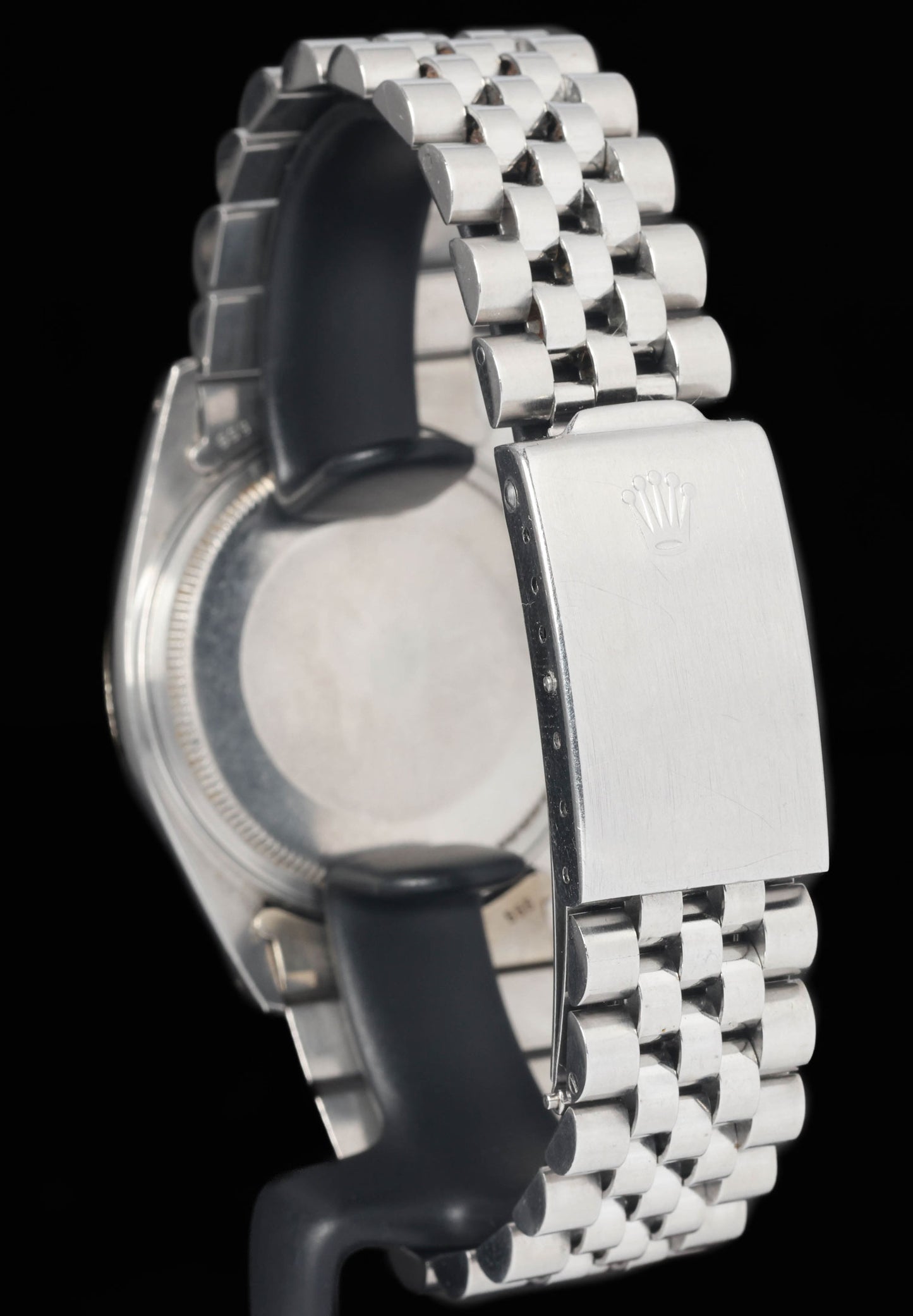
Presented in good condition, this 1976 Rolex Datejust 1601 with Buckley dial retains sharp case geometry with light hairlines visible in normal light. The lugs are extremely crisp with factory brushing, and there are no dents or deep marks noted. The fluted bezel presents cleanly with a minor dent upon close inspection. Acrylic crystal is clear and free of distracting scratches. The Jubilee bracelet is great with only some stretch; light hairlines are present on links and clasp, and it secures firmly. The blue Buckley dial shows light, even oxidation with a pleasing patina; printing is crisp, applied markers and coronet present neatly, and the T flanking SWISS at six is intact. Hands are oxidised with tidy luminous fill and correct alignment. Crown action is positive, and time and date setting operate as expected during handling. Given its age, treat this as a vintage timepiece and avoid water exposure or wearing whilst swimming.
Share
Why we love this watch
Why we love this watch
Why We Love: Rolex Datejust Reference 1601, Blue Buckley Dial, 1976
A Datejust That Refused to Be Ordinary
There is a version of the Rolex Datejust that never tried to compete with diamond-set dials or hard stone exotica. It did not rely on gem-set bezels or sunburst lacquer to announce itself. It simply offered something that, at the time of its production, almost nobody wanted: printed Roman numerals on a matte blue dial, finished with matching painted hands and not a scrap of applied metal in sight. That watch is the Datejust reference 1601 with a blue Buckley dial, and it is one of the most compelling four-digit Datejusts in existence. The 1976 example we have here represents a very specific intersection of reference, configuration, and colour that the vintage Rolex community has spent the better part of two decades learning to appreciate properly. The story of how it got its name is as entertaining as the watch itself is beautiful. Both are worth understanding in full.
Reference 1601: The Datejust That Defined the Blueprint
The Rolex Datejust reference 1601 is, in the estimation of many collectors and historians, the archetypal expression of the model. Rolex produced it from approximately 1960 through to 1981, giving it one of the longest production runs of any four-digit Datejust reference and allowing it to outlast its siblings, the smooth-bezelled reference 1600 and the engine-turned reference 1603, by several years.¹ What distinguishes the 1601 within that family is its bezel: a fluted design executed in white or yellow gold, depending on the configuration, that frames the dial with the kind of restrained luxury Rolex had spent the postwar decades perfecting.
The case measures 36 millimetres in diameter, with a lug-to-lug distance of 44 millimetres and a case thickness of 11.7 millimetres.² These dimensions, which modern collectors now refer to with something approaching reverence, were the result of Rolex's conviction that the Datejust should be a watch capable of moving from the boardroom to the weekend without any adjustment in posture or attitude. The Oyster case, with its screw-down caseback and crown, provided water resistance that lent the watch a robustness its dress watch competitors could not match.³ The front of the case is finished matte, while the flanks receive a fine polish, a detail that rewards closer inspection and speaks to the craftsmanship Rolex applied even to what was considered a production volume reference.
The reference 1601 was the model that, in the words of one horological writer, became the blueprint for the modern Datejust. Place a contemporary steel and white gold Datejust 36 alongside a well-preserved 1601 and the lineage is unambiguous.⁴ The proportions, the bezel architecture, the Jubilee bracelet: all of it flows directly from decisions Rolex made in the late 1950s and codified across two decades of 1601 production.
The Caliber 1575 and What It Represents
Beneath the caseback of this 1976 example beats the Rolex caliber 1575, a movement that represents the matured form of the engine family Rolex introduced with the 1601 at launch. The original 1565 ran at 18,000 vibrations per hour with a 42-hour power reserve.⁵ When the 1575 arrived in 1965, it brought a higher beat rate of 19,800 vibrations per hour, improved shock protection for the balance wheel, and an instant date change function that snaps the date disc cleanly over at midnight.⁶ By 1972, Rolex had added a hacking seconds mechanism to the caliber, allowing the seconds hand to be stopped when the crown is pulled, which made precise time setting significantly easier.⁷
Collectors occasionally open a 1601 and find the movement bridge engraved with the number 1570 rather than 1575. This is not a cause for concern. The 1570 designation refers to the non-date base version of the movement, but because Rolex designed the 15xx family as a modular architecture and used the same engraved plates across the entire range, date-equipped movements frequently carry the non-date designation on their bridges.⁸ It is a small piece of Rolex industrial logic that continues to create unnecessary alarm among new collectors and knowing satisfaction among experienced ones.
The 1575 is a movement with a well-earned reputation for longevity. It is straightforward to service, tolerant of irregular winding, and built to standards that were considered excessive for a dress watch at the time of its introduction. A properly maintained example from 1976 will keep time today with minimal deviation.
The Pie-Pan Dial: Depth Before Flatness Was Fashionable
One of the visual signatures of the four-digit Datejust family, and the 1601 in particular, is the pie-pan dial configuration. On this dial design, the outer ring containing the minute track and lume plots sits lower than the central chapter, creating a subtle stepped profile that gives the dial genuine three-dimensionality.⁹ The effect is amplified by the acrylic crystal, which rises noticeably above the bezel in a high domed profile that reads as unmistakably vintage today. Running your thumb from the case flank up across the bezel and then up the side of that crystal reveals a series of distinct material and textural transitions that no sapphire-crystal Datejust can replicate.
The Cyclops lens, positioned over the date window at three o'clock, was a feature Rolex introduced to the Datejust line in 1953.¹⁰ On an acrylic crystal from this era, the lens has a warmth and slight distortion at its edges that the later sapphire versions never quite captured. When the date disc beneath it has aged to a slightly creamy or ivory tone, as is common on well-preserved examples of this period, the effect is one of complete visual coherence across every component of the dial side.
What Is a Buckley Dial?
The Buckley dial is defined by a single, significant departure from Rolex convention: its hour markers are not applied to the dial surface but printed onto it. Where the standard Datejust dial of this era carries polished metal baton or Roman numeral indices physically attached to the dial from behind, the Buckley dial carries painted Roman numerals, rendered in a distinctive elongated font, directly onto the surface. The result is a dial without raised edges, without reflected glint from applied metal, and without the layered visual depth that applied markers create.¹¹
What the Buckley dial offers instead is legibility and an unusual graphic clarity. The numerals are large and unambiguous. The matte surface absorbs rather than reflects light. The hands, which on a correct Buckley example are painted to match the colour of the Roman numerals rather than polished to a mirror finish, reinforce the typographic logic of the dial rather than interrupting it.¹² The overall effect is something closer to a fine printed document than to the conventional Rolex aesthetic, which made it an outlier in the brand's catalogue and ensured it was largely ignored by buyers at the time of its production.
Authentic Buckley dials are typically stamped on their reverse side with the name Singer, identifying the manufacturer responsible for producing the dial.¹³ This detail has become one of the reference points that experienced collectors use when verifying whether a dial is a genuine period original or a later reproduction, of which increasing numbers have entered the market as the desirability of the configuration has grown.
Blue: The Rarest Configuration
White and champagne are the most commonly encountered Buckley dial colours. Gold examples appear with some regularity. The blue variant, however, is a different matter. It is, by consistent collector consensus and the evidence of market scarcity, the rarest Buckley dial colour in regular production.¹⁴ John Buckley himself, in the formal criteria he set out for what constitutes a true Buckley dial, listed blue as one of the valid backgrounds while describing the grey as the very rare variant, placing blue in a position of meaningful scarcity within the configuration.¹⁵
On the reference 1601, the blue Buckley typically presents with white Roman numerals printed on a matte blue ground, the contrast between the two providing a legibility that the white-on-white or gold-on-champagne versions achieve through tonal subtlety rather than outright contrast. The lume plots on examples of this generation are tritium, which ages to a warm creamy patina over decades. When that patina is present and evenly developed, as it tends to be on unworn or lightly worn examples, it introduces a third tone into the dial that sits between the blue ground and the white printing in a way that no new watch can manufacture.
One characteristic of the blue Buckley that collectors learn to watch for is the condition of the lacquer. These dials are prone to chipping around the lume plots, and finding a blue example with its lacquer fully intact is, as one specialist dealer has noted, close to impossible in exceptional condition.¹⁶ A well-preserved blue Buckley is therefore not merely a question of colour preference but of genuine scarcity in the specific condition required for a serious collection.
The Origin of a Name: A Forum Joke That Became Horological Legend
The Buckley dial was not named by Rolex. The company has never used the term in any official documentation, and it appears on no swing tag, guarantee card, or catalogue from the era of production.¹⁷ The name came from a conversation on the Vintage Rolex Forum in 2008, and the full story of how it emerged is one of the more entertaining in modern watch collecting.
The background involves John Mayer, the musician, who in the mid-2000s developed a visible enthusiasm for vintage Rolex on the forum and became particularly associated with acquiring Datejusts fitted with printed dials. When the community debated naming a specific dial configuration after him, following the established tradition of naming coveted variants after notable collectors (the Paul Newman dial being the obvious precedent), forum moderator Ed Delgado put the idea forward formally.¹⁸
John Buckley, a New York-based vintage watch dealer and the proprietor of Tuscany Rose, was having none of it. In his own words, posted to the forum, he was unimpressed by the prospect of a dial being named after a musician who had arrived to the hobby recently and with considerable financial resources. In a move he described as more joking than serious, he proposed instead that a dial he had long personally championed, the printed Roman numeral Datejust dial that virtually nobody else wanted, be named after himself.¹⁹ He had been quietly buying and selling these dials for years, at a time when collectors routinely passed them over in favour of applied markers and more visually assertive configurations.
The joke landed. The name spread rapidly beyond the forum, appearing in listings and dealer descriptions within months, and has since become one of the most recognised pieces of Rolex collecting vocabulary in the world. Buckley later reflected that he had begun the exercise to bring attention to dials that were always among his favourites but had never been popular, and that he was genuinely proud to have his name attached to them.²⁰
The irony that the Buckley dial owes its name partly to an attempt to prevent John Mayer from having a dial named after him has not been lost on the community. Nor has the more interesting irony that Buckley chose the most unassuming dial in the Datejust catalogue for his self-nomination, which has since become a meaningful premium configuration, precisely because he understood something about it that the broader market had not yet worked out.
What a Correct Example Looks Like
On a genuine, all-original Buckley dial Datejust, every component of the dial side speaks the same design language. The printed Romans must be paired with painted hands in the corresponding colour: white Romans with white hands, blue background with matching printed handset, the logic consistent throughout. When a watch has been serviced and the hands replaced with a polished period-correct set rather than the original painted equivalents, the dial loses a fundamental element of its visual coherence and, for collectors who understand the configuration, a significant proportion of its interest.²¹
The Singer stamp on the reverse of the dial, the intact lacquer surface, the unpolished case retaining its original geometry, and a handset that has been with the watch from the factory rather than introduced at some point during its service history: these are the markers of an example that has arrived to the present day intact.
The Watch That Waited for Its Moment
The reference 1601 with a blue Buckley dial from 1976 is a watch that spent years being overlooked. It arrived in a market that preferred gold applied markers and glamorous dials, and it offered instead something more considered and, ultimately, more durable: a dial concept built entirely around legibility and graphic coherence, executed on the most finely resolved version of the four-digit Datejust case, powered by a movement that was already decades into proving its reliability. The blue background placed it at the rarest end of the Buckley colour range. The fluted white gold bezel of the reference 1601 gave it a formal elegance that the engine-turned 1603, where Buckley dials also appear, does not quite match in the same way.
It took a community of dedicated collectors, and one particularly outspoken New York dealer with a good sense of humour, to bring this watch to the attention it deserved. The rest, as forum archives from 2008 onwards confirm, is well-documented history.
Case & Bracelet
Case & Bracelet
- Case is in good vintage condition. Light hairlines visible around the case.
- Sharp lugs with factory brushing still visible.
- Bracelet in good condition, only some stretch visible.
- The bracelet has light hairlines.
Dial & Hands
Dial & Hands
- Dial & hands good vintage condition.
Warranty & Condition
Warranty & Condition
Crown Vintage Watches provides a minimum 6-month mechanical warranty on pre-owned watches, from the date of purchase.
The warranty covers mechanical defects only.
The warranty does not cover damages such as scratches, finish, crystals, glass, straps (leather, fabric or rubber damage due to wear and tear), damage resulting from wear under conditions exceeding the watch manufacturer’s water resistance limitations, and damage due to physical and or accidental abuse.
Please note, water resistance is neither tested nor guaranteed.
Shipping and insurance costs for warranty returns to us must be covered by the customer. Returns must be shipped via traceable courier. Return shipment must be pre-paid and fully insured. Collect shipping will be refused. In case of loss or damages, the customer is liable.
Our Pledge
At Crown Vintage Watches, we stand by the authenticity of every product we sell. For added peace of mind, customers are welcome to have items independently authenticated at their own expense.
Condition
Due to the nature of vintage timepieces, all watches are sold as is. We will accurately describe the current condition and working order of all watches we sell to the best of our ability.
Shipping & Refund
Shipping & Refund