

Crown Vintage
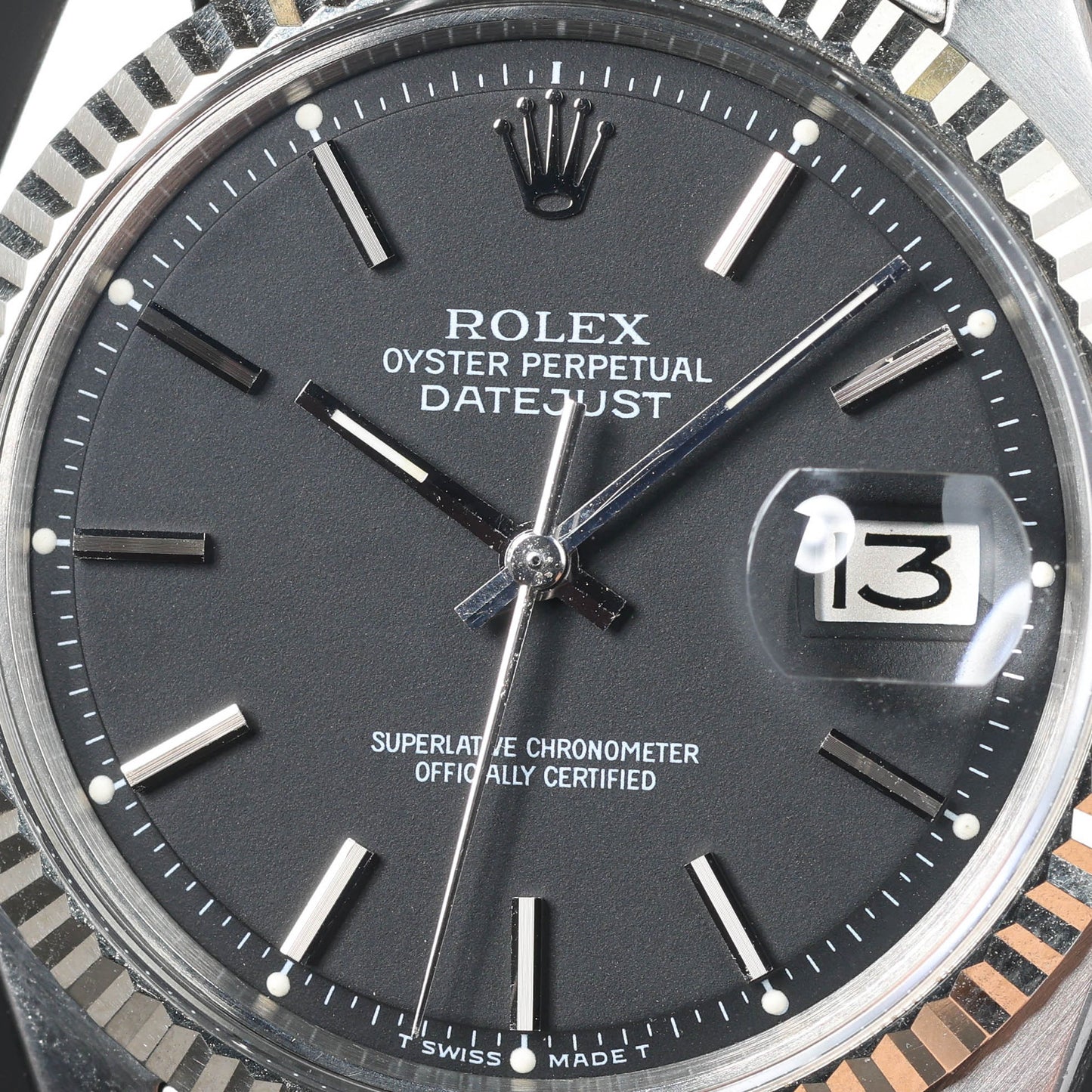
Rolex Datejust 1601 'Matte Black dial' 36mm 1971
Rolex Datejust 1601 'Matte Black dial' 36mm 1971
Couldn't load pickup availability
Rolex Datejust 1601 'Matte Black dial' 36mm 1971
Case and Bracelet
The 36mm Oyster case presents in very good condition, carrying only very light hairlines across its surfaces and holding good definition for a piece now more than fifty years old. The fluted bezel and acrylic crystal are consistent with the reference. The serial number engraving between the lugs shows some scratching. The bracelet remains sound and wears comfortably, with light stretch through the links of the kind to be expected from decades of regular use.
Dial and Hands
The matte black dial is in very good condition, its surface clean and even with no notable marks or deterioration, and the hands are similarly very good and correctly seated. The tritium luminous material and T SWISS T designation are period-correct for a 1971 example, and the date display at three o'clock reads cleanly. Overall the dial and handset are honest and well preserved, presenting as a coherent original pairing.
Chronometry
Timing has not yet been carried out. Once run on the Witschi WAIO, the rate, beat error and amplitude for this calibre 1575 will be recorded across the standard positions and assessed against the COSC tolerance of minus four to plus six seconds per day, as the movement is chronometer-certified. Those figures will follow on completion of testing.
Use Advisory
As a vintage watch of more than fifty years, this Datejust should be treated accordingly. Gentle handling and regular servicing appropriate to a watch of this age are advised.
Share
Why we love this watch
Why we love this watch
Matte Black Under a Fluted Bezel: The 1971 Rolex Datejust 1601
The only gold on this 1971 Datejust rings the dial rather than fills it, a white gold fluted bezel set around a matte black face of the kind Rolex usually kept for its tool watches, which gives the reference 1601 a quieter and slightly sterner look than the silver and champagne sunbursts most people picture on a Datejust. It is the most familiar Datejust of all, the fluted-bezel 1601, wearing one of its least expected dials.
To see why that combination works, and why a matte black dial sits so naturally under a fluted bezel, it helps to go back to what the Datejust was meant to be from the start, and to the bezel that has signalled it since 1945.
The Datejust and Its Fluted Bezel
Rolex created the Datejust in 1945 to mark the company's fortieth anniversary, and it was a genuine first. The Datejust was the first self-winding waterproof chronometer wristwatch to display the date in a window at three o'clock on the dial, which is exactly where the name comes from. It brought together three things Rolex had already pioneered, the waterproof Oyster case of 1926, the self-winding Perpetual rotor of 1931, and chronometer-rated accuracy, and then added the date on top. The result set a template that the rest of the watch industry has been following ever since, to the point that the window at three o'clock is now simply how most people expect a watch to show the date.
From that very first model, the Datejust wore a fluted bezel. The original came in eighteen-carat gold and was fitted with a new five-link bracelet made specially for it and named the Jubilee, in honour of the anniversary the watch celebrated. The fluting is now purely decorative, though on the earliest Oyster watches a bezel of this kind was screwed down onto the case to help seal it, the grooves giving Rolex's tools something to grip. That detail eventually became pure signature, and the fluted bezel is today one of the features that makes a Datejust recognisable at a glance.
Why the Bezel Is Always Gold
One quirk of the Datejust's fluted bezel is that Rolex has always made it in gold, never in steel. A fluted bezel is a gold bezel by definition, so a Datejust in stainless steel does not receive a steel fluted bezel but a gold one fitted to the steel case. On the reference 1601 that usually means an eighteen-carat white gold fluted bezel, which reads as bright and crisp as polished steel to the casual eye while in fact being a precious metal. Yellow gold fluted bezels were fitted too, giving a two-tone look, but the white gold version keeps the watch looking like an all-steel piece while quietly adding a band of gold around the dial.
That is the bezel on this watch. The matte black dial sits inside a ring of white gold, the single concession to preciousness on an otherwise restrained steel watch, and the contrast between the two is a good part of what gives the piece its character.
The Reference 1601 in the Datejust Family
By the early 1960s the Datejust had settled into the four-digit reference series to which the 1601 belongs. These sixteen-hundred references shared a common construction, a thirty-six-millimetre Oyster case, a 1500-series automatic movement, an acrylic crystal with the Cyclops lens over the date, and a choice of the Jubilee or Oyster bracelet. What set the individual references apart was mainly the bezel, and the small differences in finish that the bezel brought with it.
The 1601 carried the fluted bezel in gold, the look most strongly associated with the Datejust. Its siblings offered alternatives, the 1600 with a plain smooth steel bezel and the 1603 with a textured engine-turned steel bezel, but it was the 1601 with its fluted bezel that became the definitive version, and it enjoyed the longest production run of the three, lasting into the early 1980s. When someone pictures a classic vintage Datejust, more often than not it is a 1601 they are picturing, and the Cyclops, the fluted bezel and the Jubilee bracelet have all become archetypes in their own right.
The bracelet plays its own part in how the watch wears. The 1601 was offered on the five-link Jubilee, the supple bracelet designed for the original Datejust in 1945, or the broader three-link Oyster, and the choice shifts the watch's character noticeably. The Jubilee leans dressier and dresses the watch up to match its fluted bezel, while the Oyster gives it a flatter, more sporting stance. On a matte black dial either reads well, and the bracelet becomes one more way the same reference can be tilted toward formality or toward ease.
A Matte Black Dial on a Dress Watch
The Datejust is so closely tied to silver and champagne sunburst dials that a matte black dial comes as a small surprise. Where a sunburst dial throws light around and leans into the watch's dressier side, a matte finish absorbs light and does the opposite. The black sits flat and deep, and the printing on it, rendered in crisp white, stands out cleanly against the dark ground. The effect is more restrained and a little more serious than the usual Datejust face, closer in spirit to the matte dials Rolex was fitting to its sports watches in the very same years.
Black dials on the 1601 of this era were frequently made without luminous plots on the dial itself, with any luminous material confined to the hands. That leaves the dial very clean, just applied metal hour markers and white text on a matte black field, with nothing to interrupt it. This example also predates the sigma dials, marked with small Greek letters either side of the word Swiss to show that the markers are white gold, which Rolex introduced across the Datejust range in the years just after this watch was made. Paired with the white gold fluted bezel, the result is a watch that manages to look both dressed up and stripped down at once, formal in its frame and quietly understated in its face.
The Pie-Pan Profile
The four-digit Datejusts are known for a dial detail that the later references lost, the pie-pan profile. Rather than lying perfectly flat, the dial slopes gently downward at its outer edge where the minute track sits, so that the centre of the dial rests on a slightly raised plane. Seen from the side or under raking light, the dial takes on the shape of an upturned pie pan, which is where the nickname comes from.
That sloped edge gives the dial a quiet three-dimensionality, a sense of depth that a flat dial does not have. It is a subtle thing, easy to miss head-on and obvious once the watch is tilted, and it is one of the details that gives the early Datejusts their particular character. On a matte black dial the effect is more discreet still, since there is no sunburst to catch the change in angle, but the depth is there in the way the printing and the markers sit on the stepped surface.
The Calibre 1575 in 1971
Inside this 1971 Datejust is the calibre 1575, the chronometer-rated automatic that Rolex used across the Datejust and several of its other models in this period. It runs at nineteen thousand eight hundred vibrations per hour, uses the Microstella regulating system and a free-sprung balance for stability, and holds a power reserve of around forty-eight hours. It had taken over from the earlier calibre 1565 in the mid-1960s, raising the beat rate for smoother running and steadier timekeeping. If the case back is opened, the movement bridge may be found engraved 1570, the no-date base calibre on which the dated 1575 was built, which is correct factory practice and not a sign of anything being wrong.
There are two things about a 1971 example worth knowing, and both have to do with what the movement does not do.
Setting the Date Without a Shortcut
The first is that the 1601 was never a quickset watch. The date cannot be advanced on its own through the crown. To move it forward you set the time forward, running the hands around the dial and through midnight until the date clicks over, then returning the hands to the correct time. It is the way every Datejust worked before the quickset mechanism arrived with the five-digit references at the end of the 1970s, a small ritual that ties the watch firmly to its era.
The second is that a watch from 1971 predates the hacking seconds function, which Rolex added to the calibre 1575 around 1972. On this example the seconds hand keeps sweeping while the time is set, rather than stopping when the crown is pulled. The case around the movement is the familiar thirty-six-millimetre Oyster in steel, with a Twinlock screw-down crown and an acrylic crystal, water resistant and sensibly proportioned in the way the reference always was.
The Everyday Rolex
Unlike most of the Rolex models that became famous, the Datejust was never built for a sport or a setting. It was not made to dive, fly, race or climb. It was made to tell the time and the date accurately and to keep doing so, on the wrist of someone going about an ordinary day, and that lack of a specific job is precisely the point. It is what has allowed the Datejust to pass through eight decades without ever looking dated or out of place.
A matte black 1601 takes that everyday brief and tilts it very slightly. The white gold fluted bezel keeps it formal enough for any occasion that calls for a dress watch, while the matte black dial gives it a cooler, more understated face that sits just as easily with a casual outfit. It is the most classic of Datejusts wearing its least expected dial, and the two pull gently against each other in a way that keeps the watch quietly interesting on the wrist.
Final Thoughts
A 1971 Datejust 1601 with a matte black dial is the familiar made slightly unfamiliar. Everything that signals a Datejust is present, the fluted bezel, the Cyclops over the date, the Jubilee or Oyster bracelet, and the chronometer movement inside the thirty-six-millimetre Oyster case. What changes the character is the dial, a matte black field that swaps the usual brightness of a Datejust for something quieter and more serious, set off by the white gold ring around it.
Caught in 1971, the watch sits at a specific point in its own history, running the calibre 1575 without a hacking seconds and still asking to have its date set the patient way. That is part of what makes it worth dwelling on. It is the everyday Rolex at its most enduring, presented in a combination that shows how much character the Datejust can hold while changing almost nothing at all. The fluted bezel says dress watch, the matte black dial says otherwise, and the watch is the better for the conversation between them.
References
1. Rolex, Oyster Perpetual Datejust, model history and newsroom, rolex.com.
2. Monochrome, The Evergreens: The History of the Rolex Datejust, monochrome-watches.com.
3. SwissWatchExpo, Ultimate Guide to the Rolex Datejust, swisswatchexpo.com.
4. Fratello, Exploring Evergreens: Rolex Datejust 36mm Ref. 1601, fratellowatches.com.
5. Chrono24, Rolex Datejust 36 Ref. 1601 Reference Guide, chrono24.com.
6. Bob's Watches, Rolex Datejust 1601, bobswatches.com.
7. Bulang and Sons, Rolex Datejust 1601 Matte Black Dial listings, bulangandsons.com.
Case & Bracelet
Case & Bracelet
- Case and bracelet in very good condition, very light hairlines visible.
- Bracelet has light stretch.
- Serial scratched
Dial & Hands
Dial & Hands
- Dial & hands very good condition
Warranty & Condition
Warranty & Condition
Crown Vintage Watches provides a minimum 6-month mechanical warranty on pre-owned watches, from the date of purchase.
The warranty covers mechanical defects only.
The warranty does not cover damages such as scratches, finish, crystals, glass, straps (leather, fabric or rubber damage due to wear and tear), damage resulting from wear under conditions exceeding the watch manufacturer’s water resistance limitations, and damage due to physical and or accidental abuse.
Please note, water resistance is neither tested nor guaranteed.
Shipping and insurance costs for warranty returns to us must be covered by the customer. Returns must be shipped via traceable courier. Return shipment must be pre-paid and fully insured. Collect shipping will be refused. In case of loss or damages, the customer is liable.
Our Pledge
At Crown Vintage Watches, we stand by the authenticity of every product we sell. For added peace of mind, customers are welcome to have items independently authenticated at their own expense.
Condition
Due to the nature of vintage timepieces, all watches are sold as is. We will accurately describe the current condition and working order of all watches we sell to the best of our ability.
Shipping & Refund
Shipping & Refund