

Crown Vintage
Rolex Datejust 1601 'Tropical Orange' 36mm 1970s
Rolex Datejust 1601 'Tropical Orange' 36mm 1970s
Couldn't load pickup availability
Rolex Datejust 1601 'Tropical Orange' 36mm 1970s
Case and Bracelet
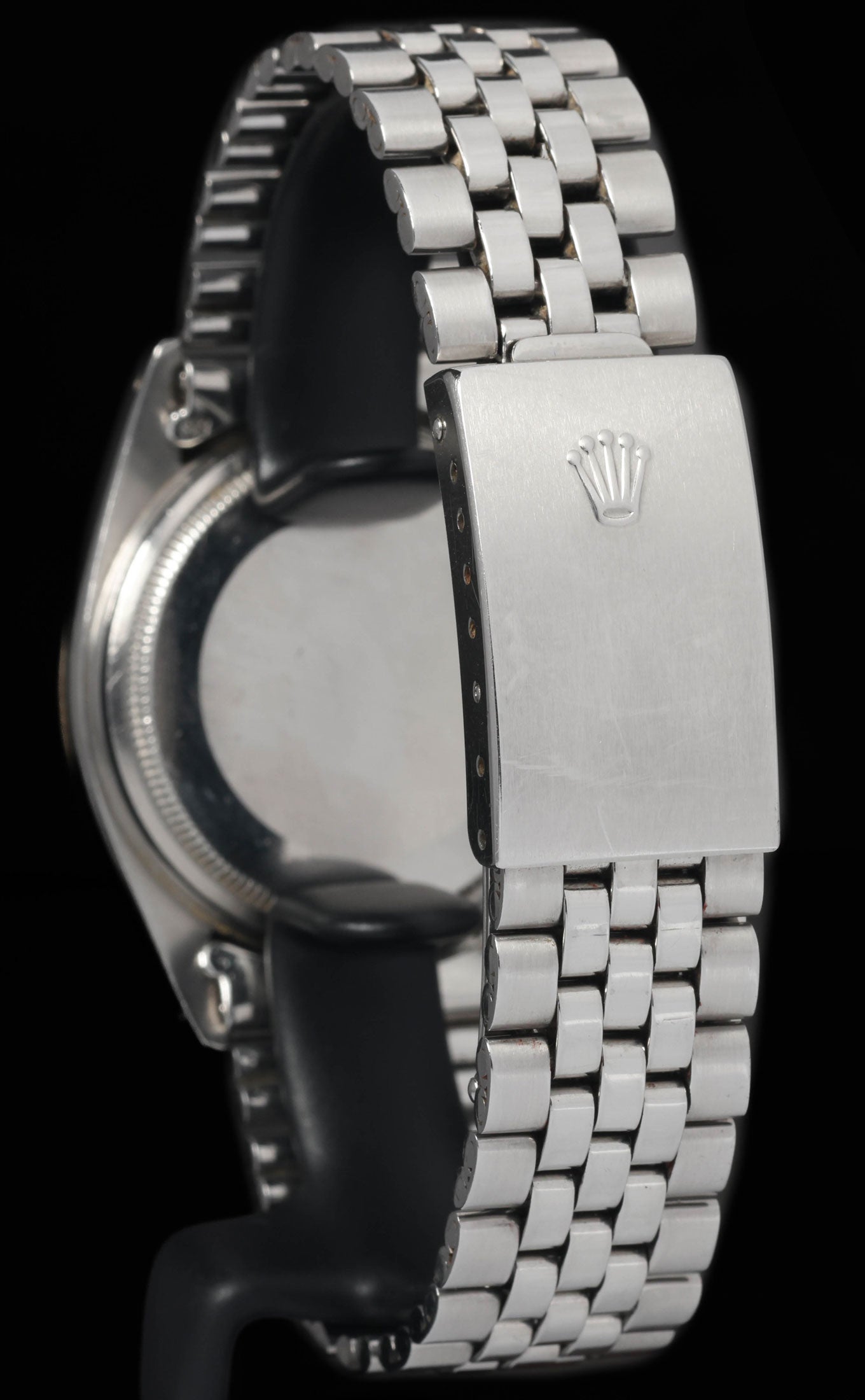
The 36mm Oyster case presents in good vintage condition, with light hairlines visible across the surfaces consistent with decades of honest wear. The case retains strong definition and good overall form, and the fluted white gold bezel, always the softer and more vulnerable element on a steel 1601, holds its shape well. The folded-link Jubilee bracelet shows the stretch typical of the period, entirely expected on a bracelet of this age and construction.
Dial and Hands
The dial and hands are in good condition. The original silver dial has developed a warm orange tropical patina, the slow result of decades of light and air acting on the dial's vintage coating, and it gives the watch a character no factory dial could replicate. The tritium luminous plots on the applied markers and the hands have aged to a consistent, matching tone, an indicator that the luminous material is original and unmodified.
Use Advisory
This is a vintage timepiece, now around fifty years old, and should be treated accordingly. The watch should be kept away from water and moisture and given gentler handling than a modern Oyster would ask for.
Share
Why we love this watch
Why we love this watch
From Silver to Orange: A 1970s Rolex Datejust 1601
The silver dial Rolex fitted to this Datejust 1601 in the 1970s is no longer silver. Five decades of light and air have turned it a soft, uneven orange, a warm amber tone that no factory could have specified and no two examples will ever share exactly. Everything around it still reads instantly as a Datejust: the fluted white gold bezel, the Cyclops bubble sitting over the date, the Jubilee bracelet tapering into the case. The dial, though, tells a slower story, one written not in Geneva but across the years the watch spent on a wrist, in a drawer, and in the sun. It arrived plain and became singular.
The Watch That Put the Date in a Window
Rolex launched the Datejust in 1945, the year the company turned forty, and built the watch to mark the occasion. The first reference, the 4467, came only in 18 carat yellow gold and carried a claim no other wristwatch could make at the time. It was the first self-winding chronometer to show the date in a window on the dial, the disc advancing on its own as the hours passed. That achievement rested on two earlier Rolex inventions. The waterproof Oyster case had arrived in 1926, and the self-winding Perpetual rotor followed in 1931. The Datejust drew them together, added a date complication, and wrapped the whole thing in a freshly designed bracelet.
That bracelet was the Jubilee, a supple five-piece-link design created specifically for the 1945 launch and named, like the anniversary itself, for the jubilee it celebrated. For a time Rolex even weighed calling the watch the Jubilee before settling the name on the bracelet alone. The earliest 4467 dials did not even carry the Datejust signature; the name only began appearing on the dial in the 1950s, once steel and two-tone versions joined the line. Two further details that now feel inseparable from the Datejust came slightly later. The instantaneous date change, where the disc flips precisely at midnight rather than drifting over an hour or two, arrived around 1955. The Cyclops lens, the small magnifying bubble moulded into the crystal above the date, was a Rolex invention of 1953.
What matters about all of this is that the Datejust was never built for a single purpose. The Submariner was made for divers and the Daytona for the track, but the Datejust was designed simply to be a complete, everyday watch, accurate without fuss and equally at home under a shirt cuff or out in the open. That breadth is exactly why the line has run, almost uninterrupted, for eighty years, and why the reference in front of us still feels so natural to wear. The watch inherits every part of that founding idea.
The Reference 1601
The 1601 belongs to the four-digit generation of Datejusts that Rolex introduced around 1959 and produced into the late 1970s, with unsold stock trickling out of dealers' cases into the early 1980s. It sat in the middle of a closely related trio. The reference 1600 wore a smooth steel bezel, the 1603 an engine-turned steel bezel, and the 1601 the fluted bezel that has become the visual signature of the entire line. On a steel-cased Datejust that fluted bezel is always made of gold, either white or yellow, because Rolex reserves the fluting for precious metal. This example pairs a steel case with a white gold bezel, the cool-toned combination that gives the watch its glint without the warmth of a two-tone.
For many people the 1601 is simply what a Datejust looks like. The proportions, the bezel, the bracelet, and the Cyclops together form a template that Rolex has revisited for more than half a century and that countless other brands have borrowed. Over its long run the reference appeared with an enormous range of dials, from silver and champagne to blue, grey, and black, which is part of why a 1601 rarely feels generic even though so many were made. The dial colour, more than anything else, sets one apart from the next, and on this watch the dial has taken that idea further than Rolex ever intended.
The Movement Inside
Early 1601s ran the calibre 1565, beating at 18,000 vibrations per hour. From around 1965 Rolex fitted the calibre 1575, which raised the rate to 19,800 vibrations per hour for a smoother sweep of the seconds hand and steadier timekeeping. Both were chronometer-certified, which is why the dial carries the line Superlative Chronometer Officially Certified beneath the Datejust name. A small quirk of these movements is that the bridges are often stamped 1560 or 1570, the designations of the otherwise identical no-date versions, because Rolex used a common bridge across the family.
The 1575 gained a hacking, or stop-seconds, function in 1972, allowing the seconds hand to be halted for precise setting. What it did not yet have was a quickset date. On this generation the date can only be advanced by turning the hands back and forth through midnight, a small ritual that the later five-digit references and their calibre 3035 would eventually do away with. None of this counts against the movement. The 1500-series calibres are among the most durable automatics Rolex ever built, and a well-kept example keeps good time decades after it left the factory.
Case, Bezel and Bracelet
The 1601 uses the classic 36mm Oyster case, roughly 11.7mm thick and 44mm from lug to lug, a size that has aged into something close to universal. A screw-down Twinlock crown and a screw-down caseback gave it 100 metres of water resistance when new, though any vintage Oyster should be treated as far less watertight today. Over the dial sits acrylic rather than sapphire, domed and slightly soft to the touch, with the Cyclops moulded in above the date. Acrylic scratches easily but polishes out just as readily, and it lends vintage Rolex dials a warmth that flat sapphire never quite matches.
The fluted white gold bezel is the watch's defining feature and also its most delicate. Gold is softer than steel, so a fluted bezel that has been polished carelessly loses its crisp edges and turns soft and rounded. A sharp, well-defined fluting is part of how one of these holds its character. Below it, the Jubilee bracelet carries the five-link construction designed back in 1945, in this era built with folded links and hollow end pieces that give it a light, fluid feel on the wrist. The lugs are drilled through, a practical touch from the period that makes the bracelet straightforward to remove.
How a Silver Dial Becomes Orange
The orange of this dial is not paint, and it is not damage in the ordinary sense. It is the slow result of a chemistry that Rolex did not intend and only understood long after it had begun. Through the middle of the twentieth century, dial makers sealed their work under a varnish based on nitrocellulose, a coating often referred to as Zapon. It was meant to protect the dial surface, light included. The trouble is that nitrocellulose is porous. Unlike the polyurethane-based varnishes used today, which form a nearly sealed barrier, the older coating let oxygen and moisture seep slowly through to the metal beneath.
Given enough years, and enough ultraviolet light and humidity, that slow exchange changes the chemistry of both the varnish and the pigment it was protecting. Black dials drift toward chocolate and brown. Silver dials, like this one, warm through cream and champagne toward caramel and orange. The effect took so long to appear that Rolex did not register the flaw until dials in the field had already begun to turn, at which point the company moved to more stable coatings and, during servicing, often simply replaced the affected dials with fresh ones. A dial that escaped that fate and turned instead is a genuine record of the decades it lived through.
The name tropical comes from the conditions that accelerate the change. Watches that spent their years in warm, sunlit, humid parts of the world tended to turn faster and more dramatically, so the discoloured dials became associated with the tropics. In truth the process can happen anywhere a watch sees enough light over enough time, which is why the term now covers far more than its geography suggests. It is also why modern Datejusts will almost never do this. The sealed varnishes Rolex and others adopted in the decades since simply do not let the dial breathe in the way the old nitrocellulose did, so the slow oxidation that produced a face like this one is, in effect, a closed chapter. A tropical silver dial is something that could only have been made by a watch of roughly this age, left to the right mix of light and time.
Why No Two Are Alike
Because the change depends on how a particular watch was worn, stored, and exposed, every tropical dial ages on its own terms. The colour is rarely even. It pools and mottles, deeper in some areas and lighter in others, tracing the uneven path that light and air took across the surface over the years. On this 1601 the original silver has shifted into a warm, patchy orange that catches differently depending on the angle, a finish that reads almost like weathered stone rather than a flat printed dial. It is the kind of surface that only time produces, and that no two Datejusts will produce in quite the same way.
That individuality is the quiet appeal of a dial like this. A factory-fresh silver Datejust is a clean, formal, slightly anonymous thing, and there is nothing wrong with that. A tropical one carries the marks of its own particular history, a single object that has become unrepeatable. The watch's bones are exactly as Rolex made them. Only the face has wandered off-script.
The 1601 on the Wrist
Stripped of its history, the 1601 is still a deeply easy watch to live with. The 36mm case sits flat and unobtrusive, dressy enough for a cuff and relaxed enough for a weekend, which is precisely the versatility Rolex chased when it built the Datejust to belong to no single sport or setting. The white gold bezel adds a cool flash of brightness against the steel without announcing itself, and the domed acrylic softens the whole picture in a way that suits a watch of this age.
What the tropical dial does is reframe all of that. The familiar Datejust silhouette becomes a setting for something unexpected, a warm orange face where a cool silver one used to be. The contrast between the formality of the design and the wildness of the dial is the charm of the thing. It looks like exactly what it is: a classic, conservative watch that has spent fifty years quietly turning into something with a great deal more character.
Final Thoughts
The Datejust 1601 is the most archetypal version of one of the most recognisable watches ever made, a design so settled that it has barely needed to change in sixty years. This particular 1601 takes that familiar form and adds something the factory never planned. Its silver dial, sealed under a varnish that could not quite hold back the years, has become a soft, uneven orange, a small chemical accident turned into a face that belongs to no other watch. The history of the brand and the reference explains the Datejust you can describe on paper. The dial explains the one you actually see, a record of light, air, and time that belongs to this example alone.
References
1. Rolex, “Datejust.” rolex.com.
2. Wikipedia, “Rolex Datejust.” en.wikipedia.org/wiki/Rolex_Datejust.
3. Monochrome Watches, “The Evergreens: The History of the Rolex Datejust.” monochrome-watches.com.
4. WatchGuys, “Rolex Datejust 4467.” watchguys.com.
5. Chrono24, “Rolex Datejust 36 Ref. 1601.” chrono24.com.
6. Fratello Watches, “Exploring Evergreens: Rolex Datejust 36mm Ref. 1601.” fratellowatches.com.
7. Bob’s Watches, “Aged to Perfection: All About Rolex Tropical Dials.” bobswatches.com.
8. aBlogtoWatch, “Tropical Dials Explained By A Vintage Watch Restoration Expert.” ablogtowatch.com.
9. LeWatchBuyers, “Rolex Tropical Dials.” lewatchbuyers.com.
10. Collectability, “The Beauty of Imperfection.” collectability.com.
Case & Bracelet
Case & Bracelet
- Case and bracelet in good vintage condition, light hairlines visible.
- Case condition remains strong.
- Bracelet has stretch, as to be expected with age.
Dial & Hands
Dial & Hands
- Dial & hands good condition
- Nice orange tropical patina
Warranty & Condition
Warranty & Condition
Crown Vintage Watches provides a minimum 6-month mechanical warranty on pre-owned watches, from the date of purchase.
The warranty covers mechanical defects only.
The warranty does not cover damages such as scratches, finish, crystals, glass, straps (leather, fabric or rubber damage due to wear and tear), damage resulting from wear under conditions exceeding the watch manufacturer’s water resistance limitations, and damage due to physical and or accidental abuse.
Please note, water resistance is neither tested nor guaranteed.
Shipping and insurance costs for warranty returns to us must be covered by the customer. Returns must be shipped via traceable courier. Return shipment must be pre-paid and fully insured. Collect shipping will be refused. In case of loss or damages, the customer is liable.
Our Pledge
At Crown Vintage Watches, we stand by the authenticity of every product we sell. For added peace of mind, customers are welcome to have items independently authenticated at their own expense.
Condition
Due to the nature of vintage timepieces, all watches are sold as is. We will accurately describe the current condition and working order of all watches we sell to the best of our ability.
Shipping & Refund
Shipping & Refund