

Crown Vintage
Rolex Datejust 1603 'Blue Dial' 36mm 1970
Rolex Datejust 1603 'Blue Dial' 36mm 1970
Couldn't load pickup availability
Rolex Datejust 1603 'Blue Dial' 36mm 1970
Case and Bracelet
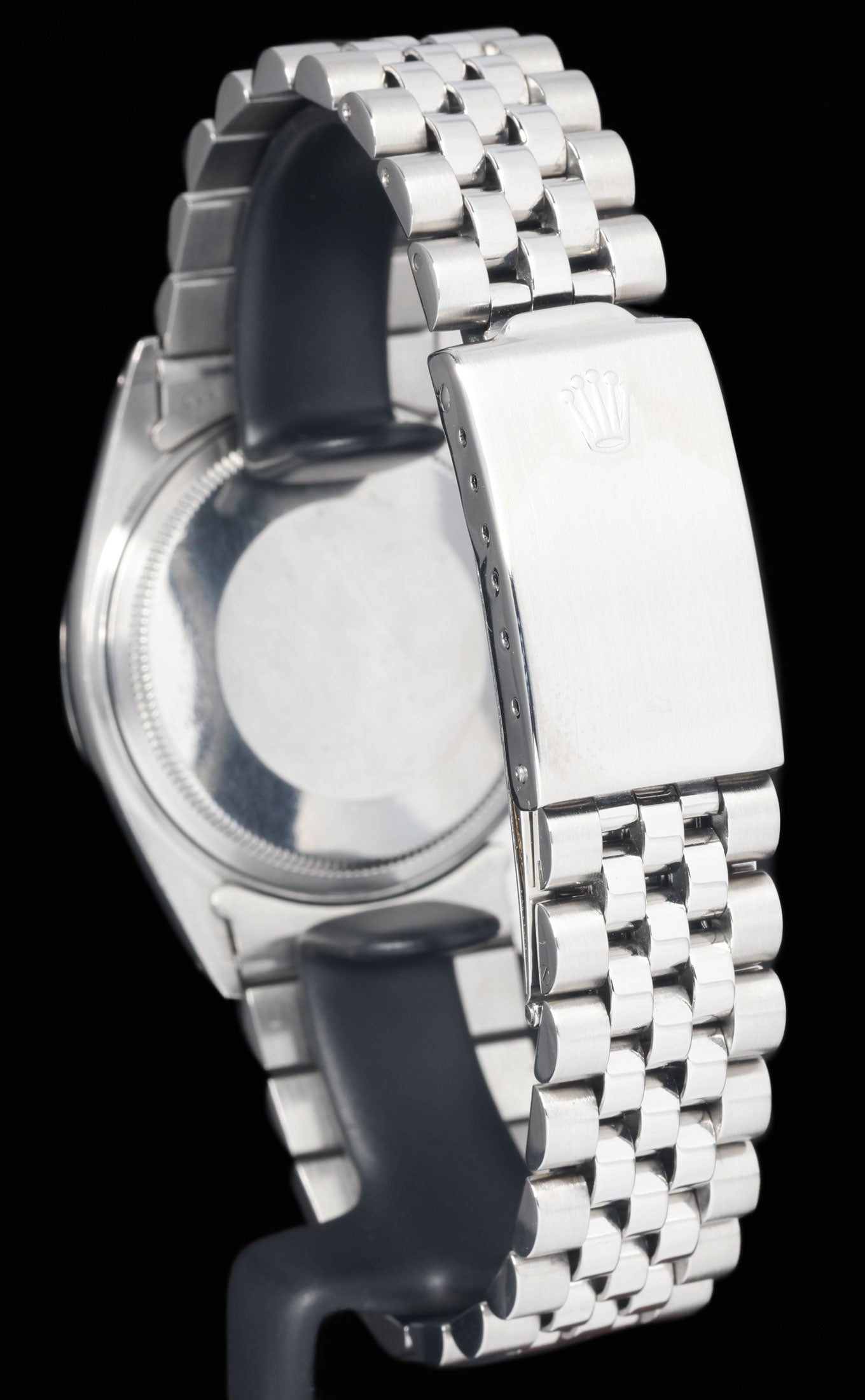
The 36mm Oyster case presents in very good condition, with light hairlines visible across the surfaces and case definition that remains very strong for a piece of this age. The engine-turned steel bezel and acrylic crystal are consistent with the reference. The bracelet is likewise in very good condition and wears well.
Dial and Hands
The blue dial is in very good condition, clean and even across the surface, with the hands similarly very good and correctly seated. The luminous material on the dial and hands has aged to an even, matching patina, the kind of consistent tone that points to original and untouched tritium. The tritium dial markings and the date display at three o'clock are consistent with a 1971 example. Overall the dial and handset present as a coherent and well-preserved original pairing.
Use Advisory
As a vintage watch of more than fifty years, this Datejust should be treated accordingly. Gentle handling and regular servicing appropriate to a watch of this age are advised.
Share
Why we love this watch
Why we love this watch
Milled, Not Fluted: A 1970 Rolex Datejust 1603 in Blue
Setting the date on this 1970 Datejust means walking the hands all the way around the dial and past midnight, because the reference 1603 never carried a quickset mechanism, and the blue dial you nudge toward the new day sits beneath a bezel milled straight into the steel rather than fluted in gold. It is a Datejust stripped of its most famous flourish, the gold fluted bezel, and given a quieter, more mechanical kind of character in its place.
Everything about a steel, engine-turned 1603 in blue points back to what the Datejust was when Rolex created it in 1945, a watch built around one good idea executed properly. To see why this particular combination works, it helps to start with that idea.
The Watch That Put the Date in a Window
Rolex created the Datejust in 1945 to mark the company's fortieth anniversary, and it gave the model a genuine first. The Datejust was the first self-winding waterproof chronometer wristwatch to show the date in a window at three o'clock on the dial, and that single function is where the name comes from. Before it, a wristwatch wearer who wanted the date had to read it from a sub-dial or a pointer, or do without. The Datejust put the date where it has lived on millions of watches ever since, in a small aperture that the rest of the industry would spend the following decades imitating.
The first Datejust appeared in eighteen-carat gold, fitted with a fluted bezel and a new five-link bracelet designed specifically for it. That bracelet was named the Jubilee, in honour of the anniversary the watch celebrated, and the name was briefly considered for the watch itself before settling on the bracelet alone. In the earliest examples the date did not snap over at midnight but drifted across in the hour or two beforehand. The instantaneous change that defines the modern Datejust came later, as did the small lens that would become the model's signature.
Three Innovations in One Case
What made the 1945 Datejust possible was the combination of three things Rolex had already developed separately. The waterproof Oyster case had arrived in 1926, giving the brand a sealed, screw-down case that kept moisture out. The self-winding Perpetual rotor followed in 1931, doing away with the need to hand-wind a watch each day. To these Rolex added chronometer-certified accuracy, a standard the company had been pursuing since the earliest years of the century. The Datejust brought all three together in one watch and added the date complication on top, which is why it is often described as the model where the modern Rolex formula came fully together.
The Cyclops lens, the small magnifier that sits over the date on the crystal, was added in 1953. It enlarges the date for easier reading and has remained a fixture of the Datejust ever since, one of the few details that makes a Rolex recognisable even at a glance and even from across a table.
Where the Reference 1603 Fits
By the start of the 1960s the Datejust had moved into the four-digit reference series that the 1603 belongs to. This generation, the sixteen-hundreds, ran from around 1960 into the late 1970s and shared a common recipe, a thirty-six-millimetre Oyster case, a 1500-series automatic movement, an acrylic crystal with a Cyclops lens, and a choice of the Jubilee or the Oyster bracelet. What separated one reference from another within the series was, above all, the bezel.
The reference 1601 wore the fluted bezel in gold that most people picture when they think of a Datejust. The reference 1600 had a smooth, polished steel bezel for the plainest possible look. The 1603 sat between them with something different again, a bezel finished in steel but textured rather than flat. This is the engine-turned bezel, and it is the feature that defines the reference.
The sixteen-hundreds replaced the earlier six-thousand series that had carried the Datejust through the 1950s, and the change was driven by what was inside rather than by how the watch looked. Where the previous generation had used older movements, the new references were built around the 1500-series calibres, a more modern family that would power the Datejust for the best part of two decades. Outwardly the watch barely changed, which is the point. By this stage the Datejust had arrived at a shape and a set of details that Rolex saw little reason to disturb, and the reference numbers in the series largely track the movement and the bezel rather than any dramatic shift in design.
The Engine-Turned Bezel
An engine-turned bezel is decorated with a fine, repeating pattern of lines machined directly into the metal, a technique borrowed from the older craft of engine-turning that watchmakers had long used to bring life to plain surfaces. On the 1603 the result is a bezel that catches the light in a way a smooth steel bezel cannot, without reaching for the formality or the shine of gold. It gives the watch texture and a little quiet decoration while keeping it entirely in steel.
Rolex carried the engine-turned bezel through to the middle of the 2000s before retiring it, and no Datejust in the current range uses one. That makes it a detail particular to a specific era of the model, the period when a steel Datejust could be dressed up slightly without changing metals, and the 1603 is the reference that wore it through the 1960s and 1970s.
A Blue Dial in a Field of Silver and Grey
For most of its run the steel 1603 was offered in a fairly restrained set of dial colours. Silver, grey and white were the everyday choices, the shades that suited the watch's role as something to be worn with anything and noticed by no one in particular. Against that backdrop a blue dial is a quieter departure than it might first appear, a small note of colour on a watch otherwise built around understatement.
The blue on a dial of this period has a depth that changes with the light, reading as near-black in shadow and opening up to a clear blue in the sun. The applied hour markers and the hands carry tritium luminous material, which on a watch of this age has usually warmed from white to a soft cream, and the date sits in its window at three o'clock beneath the Cyclops. It is the same layout the Datejust has always used, given a different temperature by the colour beneath it. On a steel case with an engine-turned bezel, a blue dial pulls the whole watch a half step away from the boardroom and toward something with a little more personality.
It is worth remembering how a dial like this was made and how it has aged. The colour was applied to a brass base and finished under lacquer, and more than half a century of light and wear leaves its own mark, so no two surviving blue dials look quite alike. That individuality is part of what gives a watch of this age its character, the sense that the dial in front of you has spent fifty years becoming exactly the shade it now is rather than arriving that way from the factory.
The Calibre 1575 in 1970
Inside this 1970 Datejust is the calibre 1575, the automatic movement Rolex used across the Datejust and its sports models through this era. It is a chronometer-certified movement running at nineteen thousand eight hundred vibrations per hour, with the Microstella regulating system and a free-sprung balance that Rolex favoured for stability, and a power reserve in the region of forty-eight hours. It had replaced the earlier calibre 1565 around 1965, raising the beat rate for smoother running and better timekeeping.
A detail of the date worth knowing is that the 1603 was never a quickset watch. There is no way to advance the date on its own through the crown. Looking at the open case back can also be slightly confusing, since the movement bridge is often engraved 1570, the no-date base calibre on which the dated 1575 was built. That marking is correct factory practice rather than a sign of anything being amiss.
Setting the Date the Old Way
To move the date on this watch forward you set the time forward, running the hands twice around the dial and through midnight until the date clicks over, then bringing the hands back to the correct time. It is the way every Datejust worked before the quickset mechanism arrived with the five-digit references at the end of the 1970s, and it is a small ritual that ties the watch to its period.
A 1970 example also sits at a particular point in the calibre's development. The hacking function, which stops the seconds hand when the crown is pulled so the watch can be set to the exact second, was not added to the 1575 until around 1972. A watch from 1970 therefore predates it, so the seconds hand sweeps on while the time is set. The case around the movement is the standard thirty-six-millimetre Oyster in steel, with a Twinlock screw-down crown and an acrylic crystal, robust and sensibly sized in the way the reference always was.
A Watch Built for No Particular Purpose
Unlike most of the Rolex models that have become famous, the Datejust was never designed for a sport or an environment. It was not made to dive, to fly, to race or to climb. It was made to tell the time and the date accurately and to keep doing so, on the wrist of someone going about an ordinary day. That absence of a specific job is the whole point of the Datejust, and it is what has let the model move through eight decades without ever looking out of place.
The steel, engine-turned 1603 is arguably the most complete expression of that idea. It carries none of the gold that marks the dressier Datejusts and none of the tool-watch hardware of the sports references. It is simply a well-made automatic chronometer that shows the date, in a size that suits almost any wrist, finished with just enough texture in the bezel to keep it from being plain. A blue dial adds a note of character without disturbing any of that, which is exactly the kind of small, considered choice the reference invites.
Final Thoughts
A 1970 Datejust 1603 with a blue dial is a watch that rewards understanding what it is not as much as what it is. It is not the gold fluted Datejust of the advertisements, not a quickset watch, and not a tool built for any particular adventure. It is the steel, engine-turned version of Rolex's most enduring everyday design, caught at a specific moment in 1970 when the calibre 1575 was running without a hacking seconds and the date still had to be set the patient way.
What it offers instead is the Datejust idea in one of its purest forms, the date in a window, the chronometer movement, the Oyster case and the Cyclops lens, all wrapped in steel and given a quiet lift by a textured bezel and a dial in blue. It is a reminder that the Datejust earned its place not by doing one thing dramatically but by doing the ordinary things faultlessly, year after year, on the wrist of anyone who valued knowing the time and the date and trusting both.
References
1. Rolex, Oyster Perpetual Datejust, model history and newsroom, rolex.com.
2. Monochrome, The Evergreens: The History of the Rolex Datejust, monochrome-watches.com.
3. SwissWatchExpo, Ultimate Guide to the Rolex Datejust, swisswatchexpo.com.
4. Bob's Watches, Rolex Datejust History and Rolex 1603 Review, bobswatches.com.
5. BeckerTime, Review of the Rolex Datejust Ref. 1603, beckertime.com.
6. WatchGuys, Rolex Datejust 1603 and Datejust 1601 reference guides, watchguys.com.
7. Wristler, Rolex Datejust 1600 vs 1601 vs 1603: Vintage Icons Compared, wristler.eu.
Case & Bracelet
Case & Bracelet
- Case and bracelet in very good condition, light hairlines visible.
- Case condition remains very strong.
Dial & Hands
Dial & Hands
- Dial & hands very good condition
- Nice matching patina
Warranty & Condition
Warranty & Condition
Crown Vintage Watches provides a minimum 6-month mechanical warranty on pre-owned watches, from the date of purchase.
The warranty covers mechanical defects only.
The warranty does not cover damages such as scratches, finish, crystals, glass, straps (leather, fabric or rubber damage due to wear and tear), damage resulting from wear under conditions exceeding the watch manufacturer’s water resistance limitations, and damage due to physical and or accidental abuse.
Please note, water resistance is neither tested nor guaranteed.
Shipping and insurance costs for warranty returns to us must be covered by the customer. Returns must be shipped via traceable courier. Return shipment must be pre-paid and fully insured. Collect shipping will be refused. In case of loss or damages, the customer is liable.
Our Pledge
At Crown Vintage Watches, we stand by the authenticity of every product we sell. For added peace of mind, customers are welcome to have items independently authenticated at their own expense.
Condition
Due to the nature of vintage timepieces, all watches are sold as is. We will accurately describe the current condition and working order of all watches we sell to the best of our ability.
Shipping & Refund
Shipping & Refund