

Crown Vintage
Rolex Datejust 16234 'Linen Dial' 36mm Circa 1990
Rolex Datejust 16234 'Linen Dial' 36mm Circa 1990
Couldn't load pickup availability
Rolex Datejust 16234 'Linen Dial' 36mm Circa 1990
Case & Bracelet
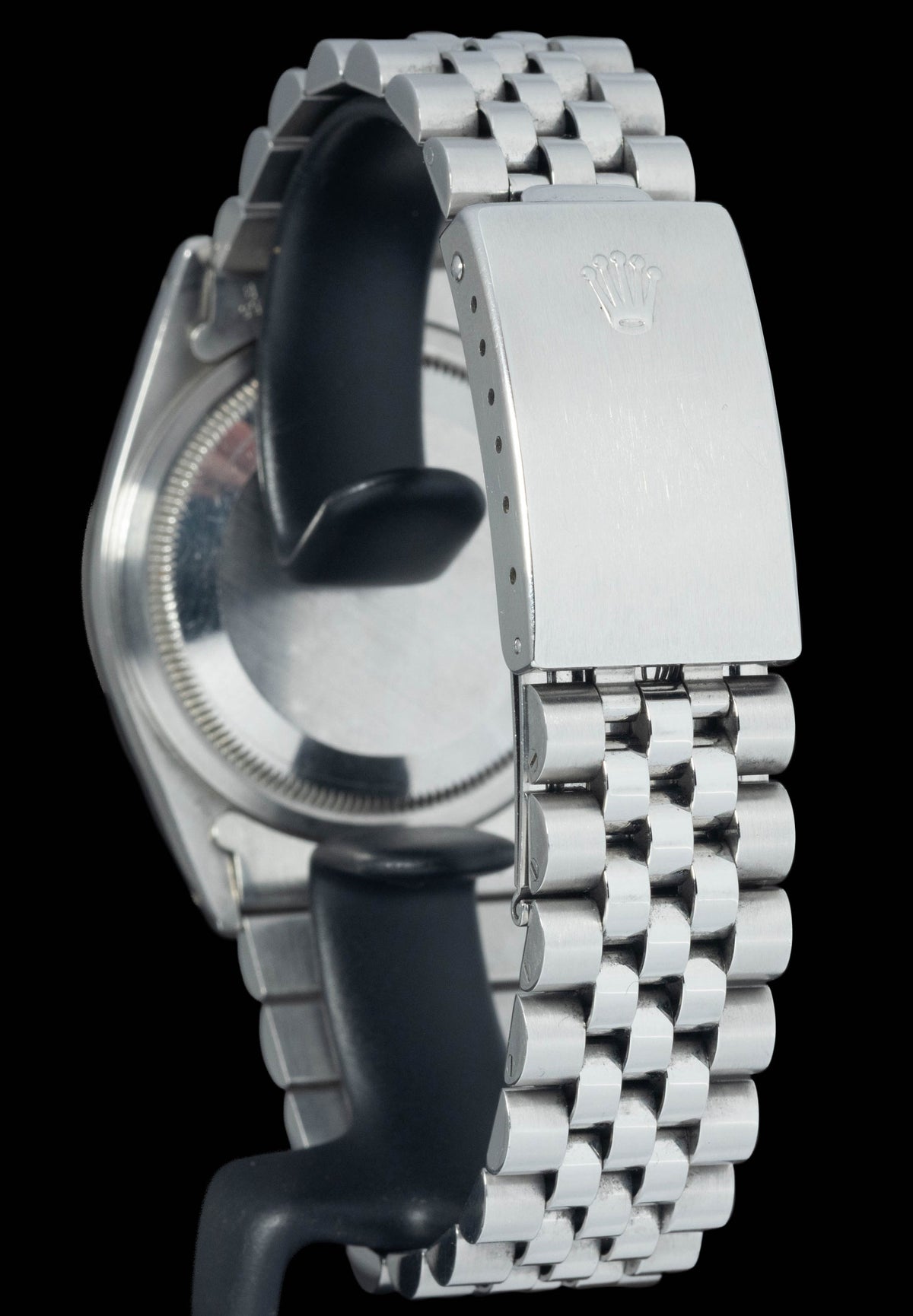
The 36mm Oyster case is in great condition and remains very sharp, with only a little wear visible along the case sides. On a 16234 the sharpness of the lugs and the crisp step up to the white gold fluted bezel are what polishing takes away first, so a case that still reads this cleanly has been looked after.
The bracelet is in very good condition with light stretch visible. Bracelets of this generation use hollow centre links on pins, and a little stretch is the normal result of more than thirty years of wear rather than a fault.
Dial & Hands
The linen dial and hands are in great condition. On a textured linen dial any marks would break up the fine woven pattern, so a dial in this condition shows the texture as intended beneath the sapphire crystal the 16234 brought to the steel Datejust.
Share
Why we love this watch
Why we love this watch
The Datejust Gets Its Sapphire: Rolex 16234, 36mm, Circa 1990
Tap the crystal of a Rolex Datejust 16234 with a fingernail and it answers with a hard, glassy click, where the 16014 before it gave back the softer knock of acrylic. That sound marks the point in 1988 when the Datejust stopped being a vintage watch and became a modern one. The 16234 took the fluted white gold bezel, the Jubilee bracelet and the date under a Cyclops lens that Rolex had been refining for more than forty years, fitted them with a sapphire crystal and the new calibre 3135, and set the template every steel Datejust has followed since. This example dates from around 1990, the first years of that generation.
Rolex Before the Datejust
Every element of the 16234 rests on three ideas Rolex had already proved by the time the Datejust was born: that a wristwatch could be sealed, that it could wind itself, and that it could be certified as accurate.
Wilsdorf, London and Geneva
Hans Wilsdorf founded Wilsdorf and Davis in London in 1905 and registered the name Rolex in 1908, choosing a word short enough to fit on a dial and easy to pronounce in any language. After the First World War, with conditions in Britain working against the business, the company moved to Geneva in 1919. When his wife died in 1944, Wilsdorf placed his holdings in the Hans Wilsdorf Foundation, the private trust that has owned Rolex since his death in 1960.
The Oyster and the Perpetual
In 1926 Rolex introduced the Oyster, a case sealed with a screw down caseback, bezel and crown to keep out water and dust, and proved it the following year when Mercedes Gleitze wore one during her swim across the English Channel. In 1931 came the Perpetual rotor, a weighted half disc that wound the mainspring from the movement of the wrist. The words Oyster Perpetual printed on the dial of every 16234 are those two inventions, and the fluted bezel on its case is the same part that once screwed the first Oysters shut.
A Date in a Window: The Datejust Since 1945
The 16234 makes sense only as the latest chapter in a story Rolex had been telling since the end of the Second World War.
The anniversary watch
Rolex marked its fortieth anniversary in 1945 with the reference 4467, the first self-winding chronometer wristwatch to show the date in a window on the dial and change it automatically, as Rolex's own account and Monochrome's history of the model both record. It brought together the Oyster case, the Perpetual rotor and chronometer certification in one watch, and it came in 18 carat yellow gold on a new five piece link bracelet named the Jubilee for the anniversary it celebrated. The case measured 36mm, a size the Datejust has kept ever since, and one the 16234 still wears.
The bezel and the lens
Two more details arrived before the Datejust settled into its classic form. The fluted bezel was older than the model itself, a survivor of the 1926 Oyster, where the milled edges gave a tool something to grip as the bezel was screwed down to seal the case. By the time it reached the Datejust it had become decorative, but it kept its ability to catch light from dozens of angles at once. In the early 1950s Rolex added the Cyclops, a magnifying lens over the date window, with references 6304 and 6305, as Monochrome notes. With those two elements in place, the Datejust looked much as it does on the 16234.
The Long Middle: Reference 1601
For most of the 1960s and 1970s, the steel Datejust with a white gold fluted bezel was the reference 1601. Monochrome dates it from around 1959 to 1981, overlapping with its successor at the end, which makes it one of the longest running Rolex references of the period.
Acrylic and a slower beat
The 1601 was a watch of its time. It wore a domed acrylic crystal, and its movements ran at the slower beats of the era. Monochrome records the calibre 1565 in early examples and the calibre 1575 from 1965, with hacking seconds added in 1972 so the watch could be set precisely against a time signal. Bob's Watches notes that the 1601 generation beat at 18,000 to 19,800 vibrations per hour, giving the seconds hand a visibly gentler sweep than later Rolex movements.
The limitation owners noticed most was the date. The 1601 had no quickset, so moving the date forward meant winding the hands through twenty four hours for every day that needed changing. For a watch named after its date, that was an irony Rolex would soon fix.
1977: The Transitional 16014
In 1977 Rolex introduced the first five digit Datejusts, and with them the calibre 3035. Monochrome is clear that the big change was the quickset date, finally letting the owner jump the date forward from the crown without touching the hands.
Calibre 3035
The 3035 also raised the beat rate to 28,800 vibrations per hour, the frequency Rolex still uses today. Bob's Watches records 27 jewels and a power reserve of around 42 hours, with chronometer certification. The steel and white gold fluted version was the 16014, made from 1977 to around 1988.
Half vintage, half modern
The 16014 is best understood as a transitional watch. Inside, it had a modern high beat movement with a quickset date. Outside, most examples kept the domed acrylic crystal of the 1601, with the Cyclops formed as part of it, which Bob's Watches describes as the reference's link to the vintage era. Late transitional 16014s are documented with sapphire crystals, as dealer records such as Bernard Watch show, but acrylic was the norm. The final step to a fully modern Datejust was still to come.
1988: The 16234 Arrives
In 1988 Rolex introduced the 162 series, and the steel Datejust with a white gold fluted bezel became the reference 16234. BeckerTime explains the numbering: 162 identifies a Datejust of the generation fitted with the new calibre 3135, the 3 denotes the fluted bezel, and the 4 marks stainless steel paired with white gold. Monochrome places production from 1988 to around 2004.
The 16234 was one member of a wider family built on the same case and movement, and the numbering tells you which. Change the fourth digit and the bezel changes; change the fifth and the metal changes. BeckerTime points to the 16263, a two tone Rolesor model from the same series, as an example of how far the 162 platform could be stretched. Within that family, the 16234 is the steel and white gold fluted watch that follows most directly from the 1601 and the 16014, which is why its arrival reads as a continuation rather than a new start. Anyone who knew a Datejust in 1960 would have recognised a 16234 in 1990 immediately, and would only have noticed the difference when they reset the date or ran a thumb across the crystal.
Sapphire as standard
The change that defines the 16234, according to Monochrome, is the move from acrylic to sapphire. Synthetic sapphire rates 9 on the Mohs hardness scale, just below diamond, so the crystal resists the scratches and scuffs an acrylic crystal collects in daily wear. The switch also changed the profile of the watch. A sapphire crystal is flatter than the domed acrylic of the 1601 and most 16014s, and the Cyclops became a separate lens fixed to its surface. Bob's Watches notes the Cyclops magnifies the date two and a half times. The result is a crisper, more modern face that reads cleanly at every angle.
Calibre 3135
Inside is the calibre 3135, which Caliber Corner dates to 1988. It runs at 28,800 vibrations per hour on 31 jewels, with a Glucydur balance regulated by Microstella nuts rather than a traditional regulator, hacking seconds and the quickset date the 3035 had introduced. BeckerTime highlights its full balance bridge, which supports the balance wheel at both ends rather than from one side, improving shock resistance and long term stability. Power reserve is given as around 48 hours by Caliber Corner and Bob's Watches, and around 50 hours by BeckerTime.
The 3135 went on to a long career across the Rolex range. Caliber Corner records it staying in production until around 2015, when the Submariner Date became the last model to use it before the calibre 3235 took over. A Datejust from 1990 therefore carries a movement at the start of a run lasting more than a quarter of a century.
What Stayed the Same
The 16234 changed the crystal and the movement, and very little else. That restraint is the point.
White gold on steel
The fluted bezel is 18 carat white gold, set on a stainless steel case, a combination Rolex calls White Rolesor. White gold keeps the cool tone of the steel beneath it, so the polished flutes add brightness without introducing a second colour. BeckerTime notes that the 16234 was offered on either the three link Oyster bracelet or the five link Jubilee, both with folding clasps and hollow centre links, and the case is water resistant to 100 metres.
Thirty six millimetres
The case kept the 36mm diameter of the 1945 original. That continuity is why a 16234 sits so comfortably between the vintage and modern eras: it wears exactly like a Datejust from the 1950s, while offering a sapphire crystal and a movement that remained current into the 2010s. BeckerTime and Bob's Watches both describe the 16234 as a bridge between those two worlds.
What Circa 1990 Means on This Watch
Rolex adopted letter prefix serials in 1987. Our Rolex serial numbers guide places the L prefix around 1988 to 1990 and the E prefix around 1990 to 1991, engraved between the lugs at six o'clock. A watch from around 1990 comes from the first years of the 16234's sixteen year production, when the 3135 was brand new and sapphire had only just become standard on the steel Datejust.
This example has a linen dial, where a fine crosshatched texture is worked into the dial surface, giving it the look of woven cloth. On a Datejust the texture softens the light across the dial and works quietly with the facets of the fluted bezel. It is a detail worth noticing, but the story of this watch is the reference itself.
Final Thoughts
What we love about this 16234 is where it sits in the Datejust story. Everything that makes a Datejust recognisable had been settled for decades by 1988: the 36mm Oyster case, the fluted bezel from 1926, the Jubilee from 1945 and the Cyclops from the early 1950s. The 1601 carried that design through the 1960s and 1970s, and the 16014 gave it a quickset date and a modern beat. The 16234 finished the job with a sapphire crystal and the calibre 3135, then held its ground for sixteen years. A watch from around 1990 is the modern Datejust at the very start, with the design unchanged and everything underneath it brought up to date.
References
1. Monochrome Watches, The History of the Rolex Datejust: https://monochrome-watches.com/rolex-datejust-complete-history/
2. Rolex, Datejust collection and history: https://www.rolex.com/watches/datejust
3. BeckerTime, Review of the Rolex Datejust ref. 16234: https://beckertime.com/blog/review-of-the-rolex-datejust-ref-16234/
4. Bob's Watches, Rolex 16234 Review: https://www.bobswatches.com/rolex-blog/editorial/rolex-16234-review.html
5. Bob's Watches, Rolex 16014 Review: https://www.bobswatches.com/rolex-blog/buying-guides/rolex-datejust-16014-reviewed-ultimate-buying-guide.html
6. Caliber Corner, Rolex Caliber 3135: https://calibercorner.com/rolex-caliber-3135/
7. Bernard Watch, Rolex Datejust 16014 Sapphire: https://www.bernardwatch.com/Rolex/Datejust-36/RLX8016
8. Rubber B, History of the Rolex Datejust: https://rubberb.com/blog/history-of-the-rolex-datejust/
9. Wikipedia, Rolex: https://en.wikipedia.org/wiki/Rolex
10. Crown Vintage, Rolex Serial Numbers Guide: https://crownvintage.com.au/blogs/vintage-stories/rolex-serial-numbers
Case & Bracelet
Case & Bracelet
- Case in great condition, very sharp.
- Little wear is visible around the case sides.
- Bracelet in very good condition, light stretch visible.
Dial & Hands
Dial & Hands
Dial & hands in great condition.
Warranty & Condition
Warranty & Condition
Crown Vintage Watches provides a minimum 6-month mechanical warranty on pre-owned watches, from the date of purchase.
The warranty covers mechanical defects only.
The warranty does not cover damages such as scratches, finish, crystals, glass, straps (leather, fabric or rubber damage due to wear and tear), damage resulting from wear under conditions exceeding the watch manufacturer’s water resistance limitations, and damage due to physical and or accidental abuse.
Please note, water resistance is neither tested nor guaranteed.
Shipping and insurance costs for warranty returns to us must be covered by the customer. Returns must be shipped via traceable courier. Return shipment must be pre-paid and fully insured. Collect shipping will be refused. In case of loss or damages, the customer is liable.
Our Pledge
At Crown Vintage Watches, we stand by the authenticity of every product we sell. For added peace of mind, customers are welcome to have items independently authenticated at their own expense.
Condition
Due to the nature of vintage timepieces, all watches are sold as is. We will accurately describe the current condition and working order of all watches we sell to the best of our ability.
Shipping & Refund
Shipping & Refund